Within Nunavut UFOs
Did an Inuit Settlement Vanish at Angikuni Lake?
The famous vanished-settlement story grew through retelling and misrepresented both the historical record and Inuit movement across the land.
On this page
- How the original camp story began
- What the RCMP inquiry found
- How later UFO retellings distorted Inuit life
Page outline Jump by section
Introduction
The claim that an entire Inuit settlement vanished from Angikuni Lake in 1930 is best understood as a modern legend, not an unresolved mass-disappearance case. The earliest located newspaper version described a trapper finding six empty tents and about 25 missing people, but no dependable witness statement, named missing-person list, police case file or contemporary community record supports the event. The Royal Canadian Mounted Police says its patrols recorded no unusual incident, while a January 1931 police inquiry reportedly found “no foundation” for the story.[rcmp.ca]rcmp.caFun facts and urban legends | Royal Canadian Mounted PoliceFun facts and urban legends | Royal Canadian Mounted Police…
The case nevertheless became attached to Nunavut’s UFO folklore because later writers added luminous objects, disturbed graves, abandoned weapons and an apparently instantaneous evacuation. Those additions made the story more dramatic while moving it further from the already weak original account. Its real importance lies in showing how an unverified southern newspaper story could turn ordinary Inuit movement across the land into an exotic mystery.
How the original camp story began
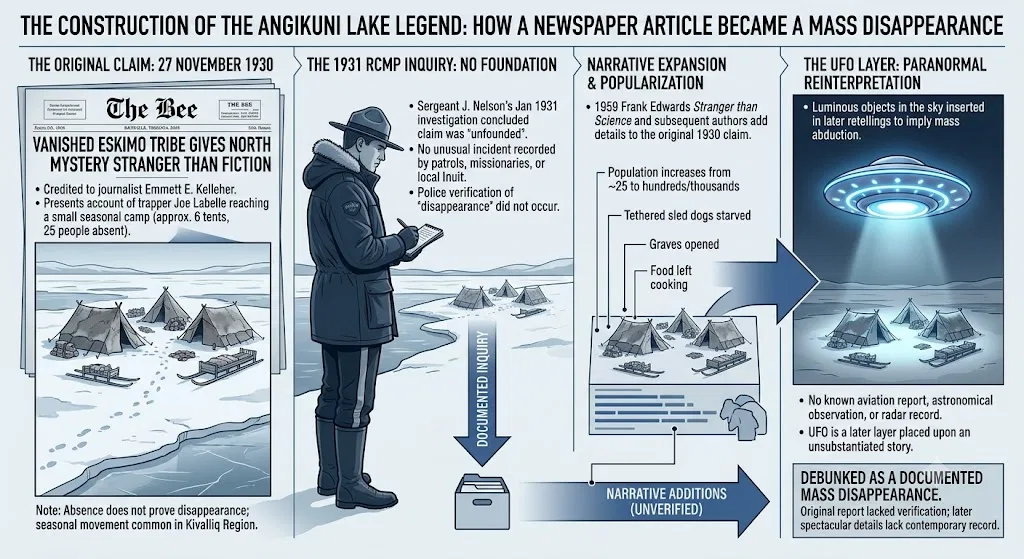
The earliest traceable version appeared on 27 November 1930 in The Bee of Danville, Virginia, under the headline “Vanished Eskimo Tribe Gives North Mystery Stranger Than Fiction”. The article was credited to Emmett E. Kelleher and presented the account of Joe Labelle, described as a trapper who supposedly knew an Inuit camp near Angikuni Lake. Labelle was said to have reached the site in search of shelter and found six tents deserted, with roughly 25 men, women and children absent.[newspapers.com]newspapers.comAngikuniVANISHED ESKIMO TRIBE GIVES NORTH MYSTERY STRANGER THAN FICTION D' that Joe Labelle, trapper, found low, a typical Eski…
Even this first version was a reported story rather than a documented investigation. No interview transcript, signed statement from Labelle, precise camp location or names of the allegedly missing residents accompanied it. The account reached readers through a journalist writing far from the lake, rather than through a local police notice, trading-post record, missionary report or appeal from relatives.
That absence matters. A disappearance involving several families should normally leave more than an atmospheric newspaper article: there would be identifiable people, relatives asking questions, trading relationships, travel knowledge from neighbouring camps and some record of the search. In the Angikuni story, the supposed victims remain an anonymous group whose number changes from one retelling to another.
The setting was also repeatedly misdescribed. Angikuni Lake is in today’s Kivalliq Region of Nunavut, along the Kazan River system. Nunavut did not become a separate territory until 1999; in 1930 the area formed part of the Northwest Territories. The original claim therefore belongs geographically to present-day Nunavut, but it should not be treated as a documented event in Nunavut’s later territorial records.

What the RCMP inquiry found
The strongest direct institutional judgement is the RCMP’s rejection of the story. Its historical material states that no evidence supports the disappearance and that Mounted Police patrols, local trappers and missionaries recorded no unusual event in the area. It also argues that the enormous permanent settlement described in some later versions could not have existed unnoticed in such a remote district.[RCMP]rcmp.caFun facts and urban legends | Royal Canadian Mounted PoliceFun facts and urban legends | Royal Canadian Mounted Police…
The RCMP’s current webpage attributes the legend to Frank Edwards’s 1959 book Stranger than Science. That detail is incomplete because the Kelleher newspaper article appeared nearly three decades earlier. The earlier article does not rescue the disappearance claim, however. It merely shows that the legend began in print in 1930 rather than in Edwards’s book. Edwards helped revive and popularise a story that had already circulated.[rcmp.ca]rcmp.caFun facts and urban legends | Royal Canadian Mounted PoliceFun facts and urban legends | Royal Canadian Mounted Police…
A more detailed historical account describes Sergeant J. Nelson of The Pas examining the story in January 1931. Nelson reportedly concluded that he could find no foundation for it. He also questioned the portrayal of Labelle as an experienced local traveller, noting that Labelle had apparently obtained his first trapping licence that season. A photograph used in connection with the tale was reportedly an older image dating from 1909 rather than evidence of the supposed missing camp.[Wikipedia]WikipediaAngikuni LakeAngikuni Lake
The available record does not resemble an inconclusive police search in which investigators confirmed that named people had vanished but failed to locate them. It resembles an inquiry into a sensational press claim that could not be substantiated. There is no verified RCMP account of officers reaching a mysteriously abandoned settlement, finding bodies of sled dogs, opening graves or pursuing unexplained lights.
This distinction is often blurred online. A statement that “the RCMP investigated the story” is repeatedly transformed into “the RCMP investigated the disappearance”. The first can mean that police checked whether the newspaper report had any basis. The second wrongly suggests that officers verified the camp, its population and the missing families before encountering an insoluble mystery.
How the story became more frightening
The 1930 newspaper version already depended on a powerful narrative device: a place that appeared recently occupied but had suddenly become silent. Later versions sharpened that device by adding signs of interrupted daily life—food left cooking, needles remaining in unfinished clothing and rifles abandoned in tents.
Other details accumulated more gradually:
- seven sled dogs were said to have starved while still tethered;
- one grave, and later an entire burial ground, was said to have been opened;
- the missing population rose from about 25 to several hundred or even thousands;
- searchers supposedly found no footprints leading away;
- police officers or other witnesses were said to have seen a strange blue or pulsing object in the sky.
These claims do not form a stable body of independent testimony. They are symptoms of narrative expansion. Each addition makes the scene appear more instantaneous, inexplicable and threatening, but the additions are not matched by stronger documentation. Comparisons of the early article with later books and mystery accounts show the population and physical details changing substantially over time.[wikipedia.org]WikipediaAngikuni LakeAngikuni Lake
The UFO connection is especially revealing. The earliest located article was framed as a northern disappearance mystery, not a documented extraterrestrial encounter. Strange lights and mass-abduction theories became prominent in later paranormal retellings. Once those lights were inserted, the story could be marketed as evidence that a craft had removed an entire community.
There is no known aviation report, astronomical observation, radar record, military document or contemporary police statement tying an unidentified aerial phenomenon to Angikuni Lake in 1930. The UFO element is therefore not independent evidence explaining an established disappearance. It is a later layer placed upon an unsubstantiated disappearance story.

Why an empty camp was not a vanished village
The legend treats an unoccupied camp as though it were an abandoned permanent town. That assumption poorly reflects historical Inuit land use in the interior Kivalliq region. Research combining archaeology with oral history from Baker Lake elders records a landscape of camps, caribou crossings, caches and places used at particular times of year along the Kazan River. Occupation varied with season, resources and travel rather than following the fixed pattern of a southern village.[University of Calgary Journal Hosting]journalhosting.ucalgary.caArchaeology and Oral History of Inuit Land Use on the Kazan River, Nunavut: A Feature-based Approach | ARCTIC…
Archaeological features in the Kazan region are distributed across the land, and researchers have identified distinct seasonal patterns rather than one simple division between “inhabited” and “deserted”. Tent rings, storage features and hunting places record repeated use of a broad cultural landscape. A camp could be important and well known without being occupied continuously.[University of Calgary Journal Hosting]journalhosting.ucalgary.caArchaeology and Oral History of Inuit Land Use on the Kazan River, Nunavut: A Feature-based Approach | ARCTIC…
This does not prove that Joe Labelle reached a real empty camp; the underlying report remains unverified. It does show why the tale’s reasoning is defective. Even had a traveller found tents without occupants, absence alone would not establish that anyone had disappeared. People could have moved to another hunting place, followed caribou, visited relatives, sought supplies or occupied a more suitable seasonal camp.
The story also assumes that no one would leave possessions behind unless forced to vanish instantly. In a land-use system involving repeated travel between camps, objects, caches and structures could remain in place for later use. Their presence would require careful dating and local interpretation before conclusions could be drawn. The legend instead converts every alleged object into a frozen clue from the supposed final minutes of a community.
Most importantly, it removes Inuit knowledge from the account. The anonymous residents are not presented as people with relatives, destinations, decisions or expertise in travelling across their homeland. They exist only as mysterious absences observed by an outsider. That narrative structure made the tale easy to sensationalise but makes it poor history.
What would be needed to treat it as a real case
A credible mass-disappearance claim would require evidence considerably stronger than a repeatedly copied newspaper story. Useful confirmation might include:
- the names or family identities of the missing people;
- a contemporary report from relatives or neighbouring Inuit;
- an original statement from Labelle that could be authenticated;
- patrol diaries, occurrence reports or correspondence identifying the camp;
- trading-post or missionary records showing that a known group ceased contact;
- archaeological evidence of a camp abandoned under unusual circumstances;
- independent witnesses whose accounts were recorded before the story became folklore.
No comparable evidence has emerged publicly. Instead, the documentary trail leads back to one sensational article, an early police rejection and increasingly ornate later retellings. The fact that the 1930 article genuinely existed is sometimes presented as proof that the event happened. It proves only that the claim was printed.
The RCMP’s modern explanation should itself be read carefully: its suggestion that Frank Edwards originated the story overlooks the earlier newspaper report. That error is a reason to refine the chronology, not to revive the disappearance. Correcting one part of a debunking does not validate the much larger unsupported claim.
Why the myth matters in Nunavut’s UFO history
Angikuni is not one of Nunavut’s strongest UFO cases because there is no reliable original UFO observation at its centre. Its place in the territory’s paranormal history comes from later reinterpretation. Writers took a supposedly unexplained absence and supplied an aerial cause after the event, creating the impression of an early mass-abduction case.
That process is useful to recognise when assessing other northern stories. A report can change category as it travels: an uncertain newspaper anecdote becomes a missing-person mystery, then a police case, then a UFO incident. Repetition hides the transitions, so later readers may assume that all the elements—missing villagers, starved dogs, opened graves, police searches and strange lights—came from the same contemporary record.
The story also demonstrates the risks of treating remoteness as evidence. Nunavut’s distance, weather and sparse written archives can make verification difficult, but difficulty is not confirmation. A dramatic claim does not become more credible merely because the place is unfamiliar to most readers or expensive to investigate.
There is a further cultural risk. Presenting mobile Inuit families as a static “lost tribe” misrepresents how people lived and travelled across the Kivalliq landscape. It replaces documented patterns of seasonal land use with an outsider’s image of an isolated settlement waiting passively to be discovered. The result is less an account of Inuit history than a southern mystery narrative using Inuit people as unnamed characters.
The most defensible verdict
The Angikuni Lake disappearance should be classified as debunked as a documented mass disappearance, although the exact origin and construction of every detail in the legend remain subjects for media-history research. A 1930 newspaper article existed, but publication is not corroboration. Police inquiries found no evidential foundation, and no dependable record identifies a missing community.
Seasonal movement is sometimes offered as a complete solution—perhaps Labelle simply encountered an empty camp—but even that grants more credibility to the encounter than the sources justify. The safest conclusion is not that a known community moved away and was misunderstood. It is that there is inadequate evidence that Labelle found the scene described at all.
Later UFO explanations weakened rather than strengthened the case. They added spectacular claims without producing contemporary records, named witnesses or physical evidence. Angikuni Lake therefore matters less as an unsolved encounter than as a warning about how quickly a weakly sourced northern tale can acquire police authority, extraterrestrial machinery and a false picture of Inuit life through repetition.
Amazon book picks
Further Reading
Books and field guides related to Did an Inuit Settlement Vanish at Angikuni Lake?. Use these as the next step if you want deeper reading beyond the article.
Arctic Dreams
To write this book, the author travelled widely in the Arctic, with Eskimos, biologists, archaeologists and landscape painters, among oth...
The Truth About the UFO Crash at Roswell
The true story of the crash of an alien spacecraft--with a crew of five--near Roswell, New Mexico, and the great lengths federal agencies...

The Vanishing Hitchhiker
First published 1981. Subjects: History and criticism, Legends, Urban folklore, Légendes, Folklore urbain.
eBay marketplace picks
Marketplace Samples
Live-tested eBay searches with available results related to this page.
Selected fromUFO poster oneBay.co.uk.


Current eBay listing
I Want To Believe UFO Poster Giclée Fine Art Heavyweight Print


Current eBay listing
VINTAGE UFO FLYING SAUCERS COMIC ADVERTISING A2 POSTER PRINT
Endnotes
1.
Source: rcmp.ca
Title: Fun facts and urban legends | Royal Canadian Mounted Police
Link:https://rcmp.ca/en/history-rcmp/fun-facts-and-urban-legends
Source snippet
Fun facts and urban legends | Royal Canadian Mounted Police...
2.
Source: Wikipedia
Title: Angikuni Lake
Link:https://en.wikipedia.org/wiki/Angikuni_Lake
3.
Source: newspapers.com
Link:https://www.newspapers.com/article/the-bee-angikuni/136850600/?locale=en-GB
Source snippet
AngikuniVANISHED ESKIMO TRIBE GIVES NORTH MYSTERY STRANGER THAN FICTION D' that Joe Labelle, trapper, found low, a typical Eski...
4.
Source: skeptoid.com
Link:https://skeptoid.com/episodes/371
Source snippet
The Vanishing Village of Angikuni Lake16 Jul 2013 — Vanished Eskimo Tribe Gives North Mystery Stranger Than Fiction. The Bee, New...
5.
Source: journalhosting.ucalgary.ca
Title: University of Calgary Journal Hosting
Link:https://journalhosting.ucalgary.ca/index.php/arctic/article/view/63914
Source snippet
Archaeology and Oral History of Inuit Land Use on the Kazan River, Nunavut: A Feature-based Approach | ARCTIC...
6.
Source: anomalyinfo.com
Title: Anomaly Info Lake Anjikuni Disappearances (sources) | Anomalies: the Strange
Link:https://anomalyinfo.com/Library/lake-anjikuni-disappearances-sources
Source snippet
Vanished Eskimo Tribe Gives North Mystery Stranger Than Fiction," by Emmett E. Kelleher, article in the Danville Bee, newspaper of Danvil...
7.
Source: anomalyinfo.com
Link:https://anomalyinfo.com/Stories/1930-november-lake-anjikuni-disappearances
Source snippet
Anomaly Info1930, November: Lake Anjikuni Disappearances - AnomaliesThe legend of the Lake Angikuni disappearances, as given above, comes...
8.
Source: kids.kiddle.co
Title: Angikuni Lake
Link:https://kids.kiddle.co/Angikuni_Lake
Additional References
9.
Source: thecanadianencyclopedia.ca
Title: aboriginal cultural landscape
Link:https://thecanadianencyclopedia.ca/en/article/aboriginal-cultural-landscape
Source snippet
The Canadian EncyclopediaIndigenous Cultural Landscape6 Nov 2008 — Harvaqtuurmiut (see Caribou Inuit) identified the Fall Caribou Crossin...
10.
Source: youtube.com
Title: The Unexplained Disappearance Of An Entire Inuit Village
Link:https://www.youtube.com/watch?v=79fzm5gIO5w
Source snippet
The Angikuni Incident: A Whole Village Vanishes in Canada...
11.
Source: researchgate.net
Link:https://www.researchgate.net/publication/256439475_Archaeology_and_Oral_History_of_Inuit_Land_Use_on_the_Kazan_River_Nunavut_A_Feature-based_Approach
12.
Source: facebook.com
Link:https://www.facebook.com/100024628161975/posts/an-entire-village-disappeared-overnight-disappearance-unsolvedmysteries-ancientm/2218451218985795/
13.
Source: instagram.com
Link:https://www.instagram.com/popular/anjikuni-lake-incident/
14.
Source: academia.edu
Link:https://www.academia.edu/4309629/Archaeology_and_Oral_History_of_Inuit_Land_Use_on_the_Kazan_River_Nunavut_a_Feature_based_Approach
15.
Source: weeklyspooky.com
Link:https://www.weeklyspooky.com/angikuni-lake-mystery/
16.
Source: instagram.com
Link:https://www.instagram.com/reel/DRbn17Kk9G9/?hl=en
17.
Source: vocal.media
Link:https://vocal.media/horror/the-mysterious-anjikuni-lake-village-disappearance-fact-or-creepy-folklore
18.
Source: reddit.com
Link:https://www.reddit.com/r/mystery/comments/1kboz1l/the_vanishing_village_of_lake_anjikuni_a_mystery/