Within Northwest UFO Files
How Police Recorded Northern UFO Sightings
Reports from Inuvik, Fort Simpson, Fort Smith and Fort Resolution reveal how police recorded unusual lights despite limited tools.
On this page
- Reports from Inuvik and Fort Simpson
- Witness sketches and standard forms
- Why official records often stayed unresolved
Page outline Jump by section
Introduction
Federal archives preserve a scattered but revealing trail of Royal Canadian Mounted Police reports about unusual lights seen from Northwest Territories communities during the 1960s. Records from Inuvik, Fort Resolution, Fort Smith, Fort Simpson, Fort Norman and nearby northern locations do not establish that extraordinary craft were present. They show something more historically useful: how local police converted brief, uncertain observations into official evidence when radar data, photographs and specialist investigators were usually unavailable.
The RCMP’s contribution was chiefly administrative and testimonial. Officers interviewed witnesses, recorded direction, colour, movement and duration, requested sketches, checked personal credibility and forwarded paperwork through federal channels. In many cases, that process confirmed that a sincere person had seen something puzzling without supplying enough information to identify it. The resulting files therefore matter less as proof of exotic objects than as a record of the limits of Canadian northern surveillance and investigation.[Canada]canada.cas UFOs: The search for the unknownCanada's UFOs: The search for the unknown - Canada.ca…
Reports from Inuvik and Fort Simpson
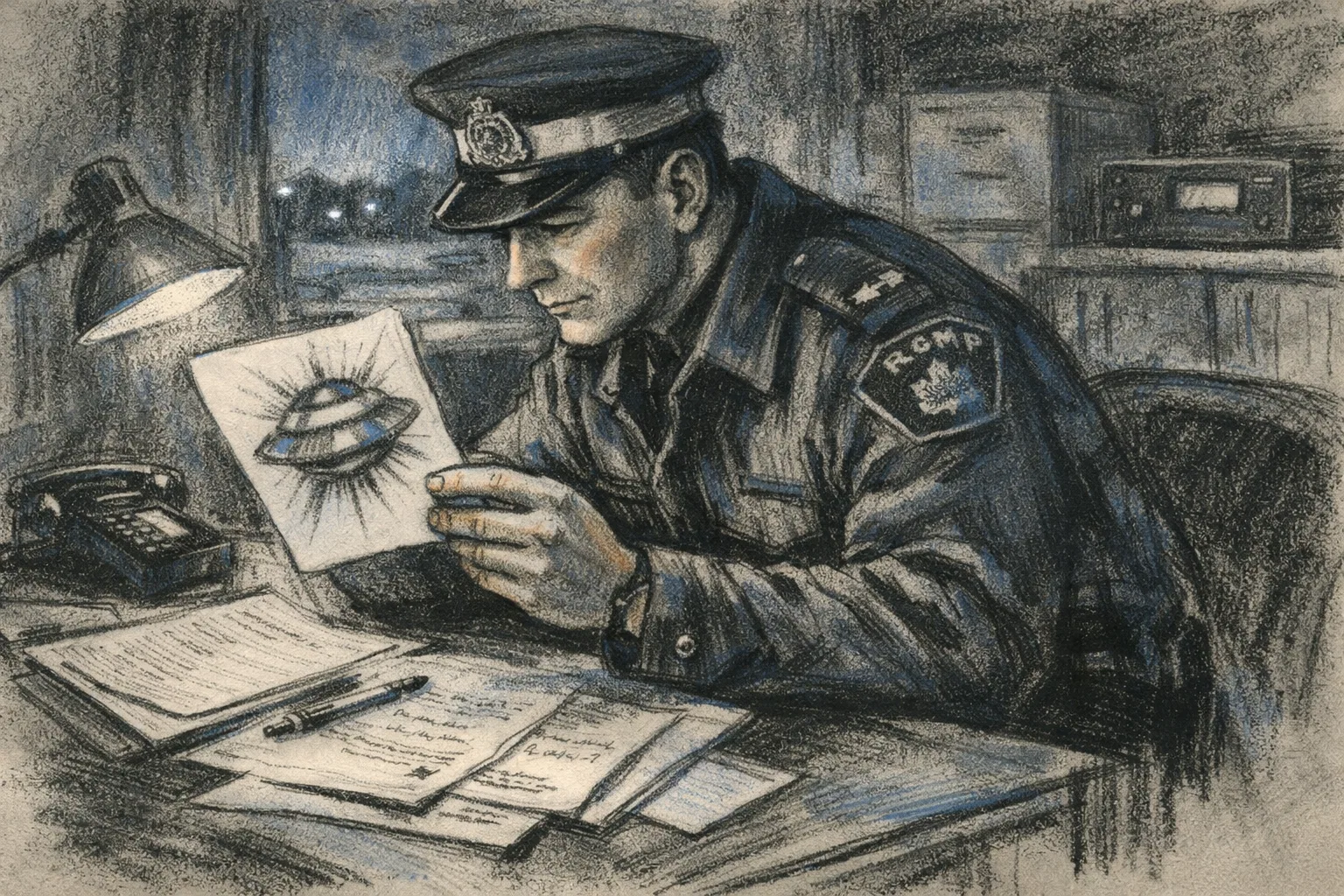
The Inuvik case of January 1967 is particularly instructive because the principal observer was an RCMP constable. Constable Ford reported seeing an unidentified object in the Inuvik area. His superior, Inspector K. D. Smith, stated that he had no doubt Ford had seen what he described. That judgement did not mean Smith accepted an extraordinary explanation; it meant he regarded Ford as an honest observer reporting a genuine visual experience.[Digital Collections]digitalcollections.trentu.caDigital Collections
The episode also exposed scepticism inside the detachment. Two other constables reportedly made little effort to verify Ford’s observation, looking only from a window in the general direction he indicated before attributing it to a star. Inspector Smith criticised their indifference and instructed them to be more receptive to reports from fellow members. His concern was procedural rather than paranormal: unusual observations were still supposed to receive a fair hearing, even when the subject invited jokes or embarrassment.[Digital Collections]digitalcollections.trentu.caDigital Collections
No surviving evidence cited in the archival history shows that the Inuvik object was tracked independently, photographed or correlated with aviation records. A bright star remains a plausible explanation, particularly because stars low on the horizon can appear to change colour, move or pulse in unstable air. Yet the contemporaneous memorandum does not provide enough positional, timing or astronomical detail to test that suggestion properly. The case is therefore unresolved only in the limited documentary sense: the report survives, but the data needed for a firm identification do not.
Fort Simpson produced a different kind of record. An RCMP sighting report dated 8 February 1969 included a hand-drawn object resembling a layered star, with a circular centre and different colours marked across its sections. The sketch was filed in the RCMP’s “Flying Objects (Sighting Of)” records and later preserved at Library and Archives Canada.[Digital Collections]digitalcollections.trentu.caDigital Collections
The drawing is memorable, but it cannot by itself establish shape, distance or physical structure. A point-like light distorted by atmospheric turbulence can appear to flash in several colours, while glare around a bright star or planet may create apparent rays or layers. Without a measured bearing, angular size, comparison observations or an exact account of movement, the sketch records the witness’s visual impression rather than an objectively defined craft. Its value is historical: it shows that northern police reports were not always confined to a few typed sentences, and that witnesses were encouraged to translate difficult visual experiences into a form officials could file and compare.
Fort Resolution and Fort Smith: credibility without identification
Reports from July 1968 demonstrate how much weight RCMP officers placed on personal reputation. A Fort Resolution report dated 19 July described its witness as a steady, truthful and reliable individual. A Fort Smith report dated 26 July similarly judged that its observer was not someone likely to imagine or invent the sighting. These assessments became part of the official paperwork alongside the description of the event.[Digital Collections]digitalcollections.trentu.caDigital Collections
That practice was especially significant in small northern communities, where an investigating officer might know the witness personally or could make discreet enquiries among employers, neighbours and colleagues. Across the wider RCMP files, officers routinely commented on sobriety, sincerity and local standing. The surviving history finds that police reports from the mid-1960s onward generally treated witnesses as reliable people, even where their observations remained uncertain.[Digital Collections]digitalcollections.trentu.caDigital Collections
This distinction is central to reading the Northwest Territories cases fairly. A credible witness can still misjudge an unfamiliar light. Human vision is poor at estimating the distance, speed and size of an isolated object against a dark sky. A stationary astronomical object may seem to move when viewed without stable foreground references; an aircraft seen head-on may appear motionless before changing direction abruptly; meteors, reflections and illuminated vapour trails can look unlike familiar aircraft. RCMP officers could reasonably conclude that a person was truthful without concluding that the person’s interpretation was correct.[Digital Collections]digitalcollections.trentu.caDigital Collections
The Fort Resolution and Fort Smith records are therefore not strong evidence for unconventional vehicles. The published archival study identifies the reports and their credibility judgements but does not provide sufficient surviving observational detail to reconstruct either event rigorously. Their importance lies in showing how police testimony worked: character assessment could strengthen confidence that an incident had been reported honestly, but it could not supply missing measurements.
Witness sketches and standard forms
Canadian authorities attempted to impose a common structure on UFO reporting. Forms and police narratives sought details such as the time and location of the observation, weather, number of objects, apparent form, luminosity, colour, direction, duration and behaviour. Standard reporting procedures also encouraged investigators to obtain a drawing. Library and Archives Canada now holds approximately 9,500 digitised UFO-related documents from the RCMP, Department of National Defence, Department of Transport and National Research Council, including reports, correspondence, procedures and forms.[Canada]canada.cas UFOs: The search for the unknownCanada's UFOs: The search for the unknown - Canada.ca…
The forms helped prevent every report from becoming an unstructured story. A sketch could indicate whether several lights were aligned, whether an object changed appearance, or which direction it travelled. The Fort Simpson drawing and another January 1969 report from Willow Lake, Northwest Territories, belong to a national collection containing more than 200 witness drawings.[Digital Collections]digitalcollections.trentu.caDigital Collections
Yet standardisation did not turn eyewitness impressions into instrument readings. Witnesses usually did not know the object’s actual distance, making estimates of size and speed highly uncertain. Colours could be affected by haze, ice crystals, window glass, eye adaptation or atmospheric refraction. A drawing made after the event could preserve the main remembered pattern while unintentionally sharpening vague edges or converting changing light into a fixed geometric form.
RCMP officers themselves recognised this limitation. In forwarding drawings attached to the July 1968 Fort Resolution report, the investigating officer remarked that they were plain and unlikely to provide much information. That sceptical note is important: the police preserved the visual material without treating it as decisive evidence.[Digital Collections]digitalcollections.trentu.caDigital Collections
Why official records often stayed unresolved
Northern UFO reports frequently stopped at the paperwork stage because the organisations receiving them did not operate as a single, well-funded investigative programme. Canada’s federal effort was spread among several departments whose responsibilities changed over time and whose officials communicated inconsistently. A major archival study describes the national investigation as largely passive and disconnected, with agencies repeatedly uncertain about who should take responsibility.[Batadora]batadora.trentu.caetd 776A History of Canada's UFO Investigation, 1950-1995 | Digital Collections…
By the late 1960s, the RCMP was systematically gathering witness statements, but it did not possess a dedicated network of scientific field teams for every distant-light report. Defence officials argued that large-scale investigation was impractical when an object had disappeared and left no tangible evidence. The National Research Council, which received some material, reportedly considered many police reports of little scientific value and did not plan to investigate most of them directly.[Digital Collections]digitalcollections.trentu.caDigital Collections
The archive itself was fragmented. Air Defence Command, working within the North American air-defence system, had previously handled security-related reports, but internal correspondence later indicated that some earlier files had been destroyed under routine disposal procedures rather than transferred. The RCMP retained its own reports instead of handing the complete collection to the National Research Council. As a result, apparently related records could remain in separate departmental files, and the absence of a conclusion does not necessarily indicate that an exhaustive investigation failed. Often, no exhaustive investigation occurred.[Digital Collections]digitalcollections.trentu.caDigital Collections
Remoteness magnified these weaknesses. A report made after a light had vanished might require checks with an airport, weather station, military unit or astronomical specialist hundreds or thousands of kilometres away. Precise timekeeping and bearings were essential for comparing a sighting with an aircraft, meteor or celestial object, but many reports began with rough estimates. Even when officers acted promptly, they normally had testimony rather than radar plots, calibrated photographs or recoverable material.
“Unresolved” in these files should therefore be read cautiously. It may mean that officials considered several ordinary possibilities but lacked enough data to choose between them. It may mean that the record was filed without specialist analysis. It rarely means that investigators eliminated aircraft, stars, planets, meteors and atmospheric effects before confronting an inexplicable remainder.
What the northern RCMP files actually demonstrate
Taken together, the community reports reveal a policing system that was more open to documenting strange observations than popular accounts sometimes suggest. Officers did not automatically accuse witnesses of lying, and in Inuvik an inspector actively rebuked colleagues for dismissing another constable too casually. In Fort Resolution, Fort Smith and Fort Norman, police evaluations explicitly defended witnesses’ honesty and reliability.[Digital Collections]digitalcollections.trentu.caDigital CollectionsDigital Collections
At the same time, the records do not support a conclusion that police confirmed unknown machines crossing the Northwest Territories. The most common evidence was a sincere statement, sometimes accompanied by an approximate sketch. Independent tracking, physical traces and photographs were absent from the community cases discussed here. Later archival preservation strengthened confidence that these reports were genuinely made and officially handled, but it did not strengthen the underlying identification claims.
Their lasting importance is governmental rather than sensational. The reports show local RCMP detachments acting as the practical front door for unexplained-sighting reports in northern Canada. Police could establish who reported an event, whether the account appeared honest and roughly what was observed. They could not reliably determine what a distant transient light was once it had disappeared. That gap between careful recording and limited explanatory power is the defining feature of the Northwest Territories’ scattered RCMP UFO record.
Amazon book picks
Further Reading
Books and field guides related to How Police Recorded Northern UFO Sightings. Use these as the next step if you want deeper reading beyond the article.
The UFO Experience: A Scientific Inquiry
Cited by the New York Review of Books as "the best brief for visitation," this classic study presents an analysis of UFO reports and conc...
UFOs: Generals, Pilots, and Government Officials Go on the Re...
NEW YORK TIMES BESTSELLER • Impeccably researched, this riveting journalistic investigation separates fact from fiction, and documents th...
The Report on Unidentified Flying Objects
Book Excerpt: ing can never be positively identified. It might have been a hallucination or it might have been some vehicle from outer sp...
The Demon-Haunted World
NEW YORK TIMES BESTSELLER • From the renowned astronomer and author of Cosmos comes a “powerful [and] stirring defense of informed ration...
eBay marketplace picks
Marketplace Samples
Live-tested eBay searches with available results related to this page.
Selected fromUFO poster oneBay.co.uk.
Current eBay listing
I Want To Believe UFO Poster Giclée Fine Art Heavyweight Print
Current eBay listing
VINTAGE UFO FLYING SAUCERS COMIC ADVERTISING A2 POSTER PRINT


Endnotes
1.
Source: canada.ca
Title: ‘s UFOs: The search for the unknown
Link:https://www.canada.ca/en/library-archives/collection/research-help/science-technology/ufos.html
Source snippet
Canada's UFOs: The search for the unknown - Canada.ca...
2.
Source: digitalcollections.trentu.ca
Title: Digital Collections
Link:https://digitalcollections.trentu.ca/_flysystem/fedora/2022-04/A_History_of_Canada_s_UFO_Investigation_1950_1995.pdf
3.
Source: rcmp.ca
Link:https://rcmp.ca/en/nwt/news
4.
Source: batadora.trentu.ca
Title: etd 776
Link:https://batadora.trentu.ca/objects/etd-776
Source snippet
A History of Canada's UFO Investigation, 1950-1995 | Digital Collections...
5.
Source: scribd.com
Title: A History of Canada s UFO Investigation 1950 1995
Link:https://www.scribd.com/document/817127658/A-History-of-Canada-s-UFO-Investigation
6.
Source: ro.scribd.com
Title: A History of Canada s UFO Investigation 1950 1995
Link:https://ro.scribd.com/document/817127658/A-History-of-Canada-s-UFO-Investigation
7.
Source: revenantjournal.com
Link:https://www.revenantjournal.com/contents/search-for-the-unknown-canadas-ufo-files-and-the-rise-of-conspiracy-theory-by-matthew-hayes-montreal-quebec-mcgill-queens-university-press-2022-isbn-978-0228010746-210pp-34/
Additional References
8.
Source: grc.ca
Link:https://grc.ca/en/gazette/one-mans-passion-classic-cars-recreated-icon-rcmp-history
Source snippet
October 11, 2025 — HOW ONE MAN’S PASSION FOR CLASSIC CARS RECREATED AN ICON OF RCMP HISTORY By Patricia Vasylchuk Image Piccott purchased...
Published: October 11, 2025
9.
Source: 8ch.net
Title: Why do people from around the world visit, hoping to catch a glimpse of somethin
Link:https://www.8ch.net/qnotables25/res/40878.html
Source snippet
/qnotables25/ -/qresearch/ Re-Posts #50March 28, 2025 — For decades, unexplained aircraft and eerie encounters have been reported here, b...
Published: March 28, 2025
10.
Source: transmissionstoearth.wordpress.com
Title: physical encounters with mantis aliens part i wilderness encounters
Link:https://transmissionstoearth.wordpress.com/2024/02/01/physical-encounters-with-mantis-aliens-part-i-wilderness-encounters/
Source snippet
Transmissions to EarthFebruary 1, 2024 — In the first case, this seemed to occur in tandem with eye contact, and it may be the case wit...
Published: February 1, 2024
11.
Source: youtube.com
Title: Thirty Witnesses Encounter The Biggest UFO Sighting Ever Reported
Link:https://www.youtube.com/watch?v=iDgDxav3d0E
Source snippet
Chris Rutkowski launch of Canada's UFOs: Declassified This video is directly relevant because it details historical Canadian government a...
12.
Source: uploads.isaackoi.com
Link:https://uploads.isaackoi.com/2024/06/steven-greer-ufo-archive-list-of.html?m=0
Source snippet
Koi - New Uploads: Steven Greer UFO archive - list of Disclosure Project files and getting them organised / assimilatedJune 25, 2024 — Ru...
Published: June 25, 2024
13.
Source: metabunk.org
Link:https://www.metabunk.org/threads/war-gov-ufo-department-of-war-releases-uap-files-2026-release-3.14949/
Source snippet
Department of War Releases UAP Files - 2026 Release 3 | MetabunkJune 12, 2026 — * CIA-UAP-017, Placement on High Alert Due to Perceived A...
Published: June 12, 2026
14.
Source: youtube.com
Title: Chris Rutkowski Launch of Canada’s UFOs: Declassified
Link:https://www.youtube.com/watch?v=bcSI4rw0M4Q
Source snippet
Falcon Lake Incident: The Most Credible UFO Case in History...
15.
Source: slideshare.net
Link:https://www.slideshare.net/slideshow/free-uk-ufo-national-archives-documents-29194034/29194034
16.
Source: publications.gc.ca
Link:https://publications.gc.ca/collections/collection_2017/aanc-inac/R42-4-1971-4-eng.pdf
17.
Source: cinemaretro.com
Link:https://www.cinemaretro.com/index.php?%2Fauthors%2F2-cinema-retro%2Fp19%2F%2F%2FP67.html=