Within PEI UFOs
What Does the Kensington UFO Video Prove?
The Kensington recording is valuable as a witness document, but its missing horizon and distance data prevent a confident identification.
On this page
- How the lights were filmed over the Gulf
- What the mobile footage can and cannot show
- Aircraft, drones and other proposed explanations
Page outline Jump by section
Introduction
The Kensington video proves that a witness recorded unidentified lights over the Gulf of St Lawrence on the night of 4 June 2014. It does not prove their size, distance, speed, altitude or physical shape, and therefore cannot establish that they were an extraordinary aircraft. The recording remains valuable because it preserves part of the event rather than relying entirely on memory, but its black background, lack of a visible horizon and limited mobile-phone detail remove most of the reference points needed for a confident identification.
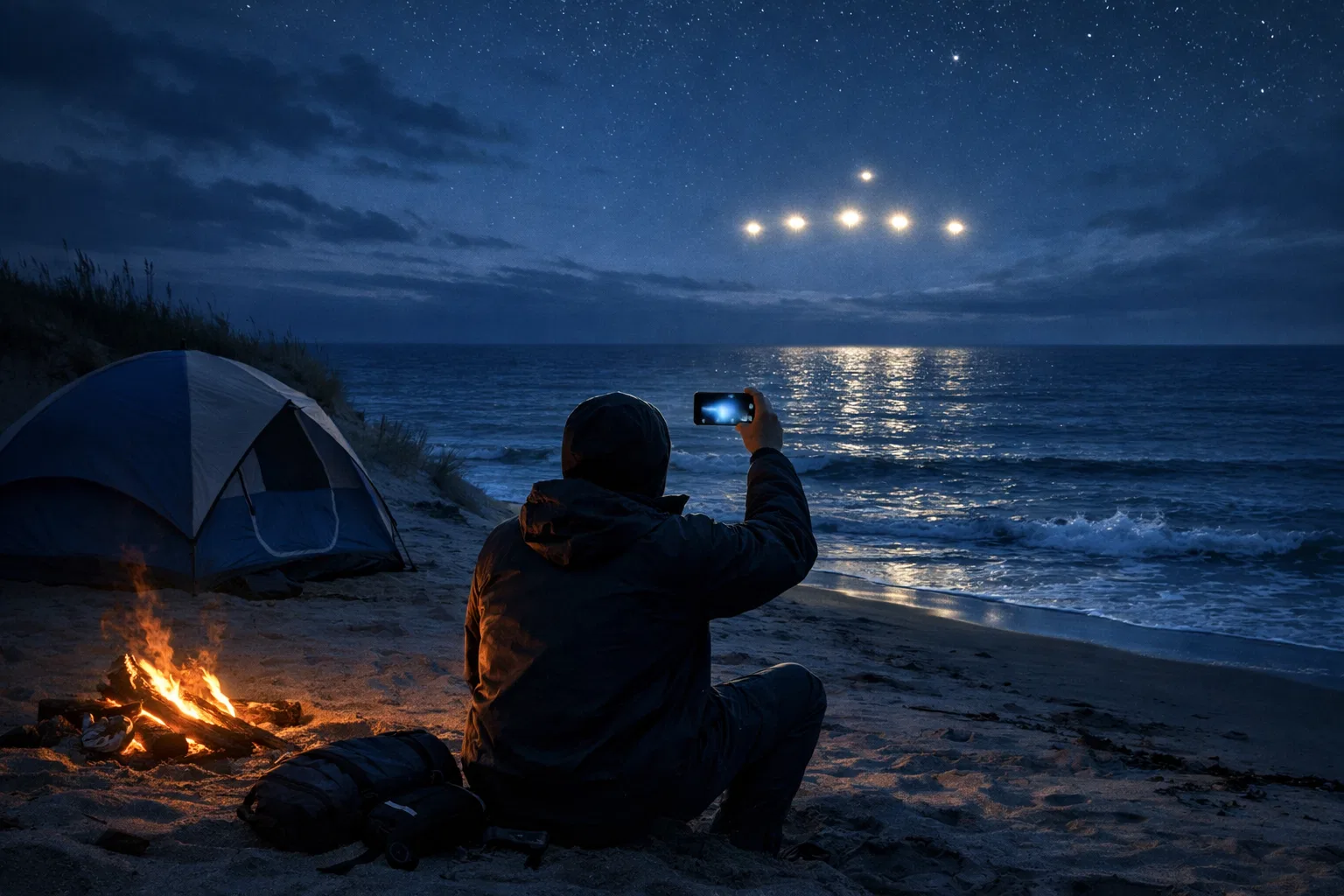
John Sheppard, visiting Prince Edward Island from Moncton, reportedly filmed the lights for about 22 minutes from Twin Shores Camping Area on the Island’s north shore. The case later received national publicity after the Mutual UFO Network, or MUFON, treated it as a notable unresolved sighting. Public descriptions such as “confirmed” caused confusion: they meant that investigators accepted that something had been observed and recorded, not that they had confirmed an alien craft or even an unusually capable vehicle.[VICE]vice.comDid the CBC Just Confirm the Existence of Aliens?Did the CBC Just Confirm the Existence of Aliens?…
How the lights were filmed over the Gulf
Sheppard said he noticed the display while extinguishing a bonfire late in the evening at Twin Shores, an oceanfront campground near Kensington in the Darnley area. From there, he was looking out from Prince Edward Island’s north coast towards the Gulf of St Lawrence. The location matters because an observer facing open water can see distant aircraft, vessels and lights across a long line of sight, but may have few nearby objects against which to judge their position.[Audioboom]audioboom.com4670465 the 2014 kensington pei ufo sightingNighttime / The 2014 Kensington PEI UFO Sighting…
Accounts of the footage describe one or more bright points that changed appearance, flashed and seemed to move or separate. Sheppard compared part of the display to a spinning top or dreidel and became concerned enough to move close to a bush while continuing to film. At one point he switched on a torch, apparently testing whether it affected what he was seeing. The published extract examined by VICE showed small lights surrounded almost entirely by black sky, while the complete recording was reported to run for approximately 22 minutes.[VICE]vice.comDid the CBC Just Confirm the Existence of Aliens?Did the CBC Just Confirm the Existence of Aliens?…
The duration is one reason the report attracted attention. A 22-minute observation is not readily dismissed as a momentary reflection, camera flash or brief meteor. It also gave Sheppard time to watch the lights directly as well as through his phone. Nevertheless, duration alone does not reveal what produced the lights. An approaching aircraft, a distant hovering drone, a lantern moving slowly with the wind or several unrelated lights can remain visible for many minutes.
There is also an important difference between the witness’s full experience and the material available to later viewers. Sheppard could look around, use his peripheral vision and compare the display with the wider landscape. Anyone assessing a tightly framed recording sees only what the phone captured. When the shoreline, sea and nearby objects disappear into darkness, much of the original visual context disappears with them.

What the mobile footage can and cannot show
The video’s strongest contribution is straightforward: it records luminous objects or sources behaving in a way that Sheppard found unusual. It supports the existence of a real observation and allows viewers to examine its duration, changes in brightness and apparent movement. That is better evidence than a retrospective description made without photographs or film.
Its identification value is much weaker. A light occupying only a few pixels contains little information about the object producing it. The visible blob may be the true outline of a source, but it may instead be glare, defocus, camera movement, digital enlargement or the spreading of intense light across neighbouring pixels. Smartphone cameras are constrained by compact lenses and small sensors, and low-light recording is particularly vulnerable to noise, blur and loss of fine detail. Digital zoom can make an image larger without recovering information that the lens never resolved.[nih.gov]pmc.ncbi.nlm.nih.govHence, most cameras for mobile devicesImage and video processing on mobile devices: a survey - PMCby C Morikawa · 2021 · Cited by 114 — The form factors of mobile devices d…
That means descriptions such as “diamond-shaped”, “bottom-heavy” or “spinning” must be treated cautiously. A point source can change apparent shape as the phone searches for focus, adjusts exposure or moves slightly in the operator’s hands. Atmospheric turbulence can also make a distant light fluctuate in brightness and colour. The recording may accurately show that the light’s image changed, but it cannot by itself demonstrate that a solid object was physically changing shape or rotating.
The missing horizon problem
The most serious limitation is the absence of a stable horizon or recognisable foreground. Without one, analysts cannot reliably measure the light’s elevation above the sea, compare its motion with fixed landmarks or determine whether the camera itself moved. A light that appears to sweep rapidly across an empty frame may be moving quickly, but the same effect can be produced by a small hand movement while filming at high magnification.
Distance is equally important. The footage does not provide a range measurement. A small light nearby and a powerful light many kilometres away can have the same angular size — the amount of the viewer’s field of vision that they occupy. Until distance is known, physical size cannot be calculated. Until both distance and a reliable track are known, apparent movement cannot be converted into speed.
This is why serious aerial-phenomena research emphasises triangulation, synchronised cameras, wide-field imagery, radar-derived range and environmental measurements. Multiple viewpoints can reveal a source’s position in three dimensions; a single phone recording of points against a black sky generally cannot.[arXiv]arxiv.orgOpen source on arxiv.org.
The lack of contextual data also makes retrospective checking difficult. Ideally, investigators would need the precise viewing position, compass bearing, elevation angle, camera model, original uncompressed file, exact start and finish times, local weather, witness sketches made before publicity, and contemporary aircraft and vessel information. Public reporting does not show that a complete, independently reproducible package of that kind was assembled.
Why “confirmed sighting” was misleading
MUFON reportedly investigated the case, placed it among its leading reports from 2014 and described it as one of relatively few “confirmed” cases. Its representatives said efforts had been made to test ordinary possibilities and that a drone specialist did not consider a drone a persuasive explanation. CBC coverage in January 2016 helped turn what had been a regional report into one of Prince Edward Island’s best-known modern UFO stories.[VICE]vice.comDid the CBC Just Confirm the Existence of Aliens?Did the CBC Just Confirm the Existence of Aliens?…
The word “confirmed”, however, carried more weight in headlines than the evidence justified. In this setting, it indicated that MUFON believed the witness had recorded something it could not identify. It did not mean that an independent scientific body had established the object’s dimensions, performance or origin. Nor did it mean that aircraft, drones and other conventional explanations had been disproved.
Contemporary criticism focused partly on the investigation’s presentation. VICE noted that the initial CBC report relied heavily on the witness and MUFON, offered little detail about the methods used to eliminate alternatives and initially lacked a substantial dissenting assessment. CBC subsequently published a follow-up discussing disputed interpretations, including aircraft, drones and lanterns.[VICE]vice.comDid the CBC Just Confirm the Existence of Aliens?Did the CBC Just Confirm the Existence of Aliens?…
This distinction is central to understanding the Kensington case. An event can be sincerely reported, genuinely recorded and still remain unidentified because the evidence is insufficient. “Unidentified” is a description of the state of the investigation, not a category of vehicle.

Aircraft, drones and other explanations
No conventional explanation has been demonstrated beyond reasonable doubt. The principal alternatives remain plausible classes of explanation rather than solved identifications.
Aircraft: A plane viewed almost head-on can seem nearly stationary because most of its motion is towards the observer rather than across the sky. Landing lights can dominate the view and obscure navigation lights until the aircraft turns. Changes in heading, cloud cover or atmospheric conditions can make the source brighten, dim, split into several points or appear to move sideways. Without a known bearing and reliable historical flight track, however, no particular aircraft can be matched securely to the recording.
Drones: Consumer multirotor aircraft were already available in 2014 and could hover, change direction and carry bright or coloured lights. A drone therefore fits some reported aspects of the display. Against that, the observation reportedly lasted for roughly 22 minutes and appeared to occur out over the Gulf, which would have required a capable aircraft, a suitable launch point and an operator willing to fly at night or over water. Those objections reduce the attractiveness of a casual drone explanation but do not eliminate it. The absence of an identified operator is not evidence that no drone was present.
Lanterns or balloons: A lantern can drift, brighten, fade and apparently alter course as winds change at different heights. Several lanterns can produce a sequence of lights that seems coordinated. Yet a lantern explanation must account for the reported duration, brightness and apparent patterns. With no distance or wind reconstruction, the video cannot firmly confirm or reject it.
Ships and coastal lights: The north-shore setting opens the possibility of vessel lights, fishing activity or distant shore-based sources. Atmospheric refraction over water can alter the apparent height and appearance of lights near the horizon. The difficulty is that the recording does not clearly preserve the horizon, so investigators cannot establish whether the sources were low over the Gulf, high in the sky or merely framed that way by the camera.
Astronomical sources: Bright stars and planets commonly produce UFO reports because they scintillate, change colour and appear to move when watched without reference points. The Kensington sequence, as described, seems more complex than a single stationary star. Even so, astronomical objects cannot be tested properly without an exact viewing direction and elevation. It is also possible for a witness to observe more than one kind of source during a lengthy event.
These explanations need not be mutually exclusive. A long recording could contain an aircraft at one stage and a distant fixed or drifting light at another. Treating every visible point as part of one coordinated object may impose a pattern that the footage itself cannot establish.
What would have made identification possible?
A second recording from another part of the campground or coastline would have transformed the case. By comparing the lights’ positions against stars or landmarks from two known locations, investigators could have estimated distance and altitude. A wide shot preserving the beach and horizon would also have allowed camera motion to be separated from object motion.
Other decisive evidence might have included:
- original video metadata establishing exact times and camera settings;
- compass bearings and measured angles above the horizon;
- contemporary aircraft radar or flight-plan records;
- vessel-position information from the Gulf;
- weather observations at several altitudes;
- photographs or video from independent witnesses;
- a known drone operator, lantern release or other source matching the timing.
None of these requirements assumes that Sheppard’s account was mistaken. They are simply the measurements needed to progress from “a light was recorded” to “the source was located and identified”. Modern proposals for scientifically studying unusual aerial events similarly rely on wide- and narrow-field cameras, triangulation, radar, environmental instruments and other independent sensors rather than isolated imagery alone.[arXiv]arxiv.orgOpen source on arxiv.org.
What the Kensington video ultimately proves
The Kensington recording is best classified as a credible witness document with low identification power. It establishes that Sheppard devoted considerable time to filming lights he could not recognise and that the event was substantial enough to merit examination. There is no clear indication that the footage was fabricated, and its duration makes some fleeting explanations less likely.
At the same time, the video does not provide the measurements required to support claims of extraordinary speed, enormous size, structured shape or unconventional technology. The apparent strangeness lies mainly in how the lights look in an information-poor night scene. Their true distance and movement remain unknown, and ordinary explanations were debated rather than conclusively excluded.
Within Prince Edward Island’s UFO history, the case matters less as proof of an exotic craft than as an example of the limits of mobile-phone evidence. A recording can preserve an experience and make a sighting memorable without resolving it. Kensington therefore remains unexplained in the narrow sense: no source has been securely identified. That unresolved status should not be inflated into confirmation of anything beyond unusual lights seen and filmed over, or in the direction of, the Gulf of St Lawrence.
Amazon book picks
Further Reading
Books and field guides related to What Does the Kensington UFO Video Prove?. Use these as the next step if you want deeper reading beyond the article.
The UFO Experience: A Scientific Inquiry
Cited by the New York Review of Books as "the best brief for visitation," this classic study presents an analysis of UFO reports and conc...
UFOs: Generals, Pilots, and Government Officials Go on the Re...
NEW YORK TIMES BESTSELLER • Impeccably researched, this riveting journalistic investigation separates fact from fiction, and documents th...
The Report on Unidentified Flying Objects
Book Excerpt: ing can never be positively identified. It might have been a hallucination or it might have been some vehicle from outer sp...
The Demon-Haunted World: Science as a Candle in the Dark
NEW YORK TIMES BESTSELLER • From the renowned astronomer and author of Cosmos comes a “powerful [and] stirring defense of informed ration...
eBay marketplace picks
Marketplace Samples
Live-tested eBay searches with available results related to this page.
Selected fromUFO lights poster oneBay.co.uk.


Endnotes
1.
Source: vice.com
Title: Did the CBC Just Confirm the Existence of Aliens?
Link:https://www.vice.com/en/article/does-the-cbc-think-that-aliens-exist/
Source snippet
Did the CBC Just Confirm the Existence of Aliens?...
2.
Source: audioboom.com
Title: 4670465 the 2014 kensington pei ufo sighting
Link:https://audioboom.com/posts/4670465-the-2014-kensington-pei-ufo-sighting
Source snippet
Nighttime / The 2014 Kensington PEI UFO Sighting...
3.
Source: pmc.ncbi.nlm.nih.gov
Title: Hence, most cameras for mobile devices
Link:https://pmc.ncbi.nlm.nih.gov/articles/PMC8215099/
Source snippet
Image and video processing on mobile devices: a survey - PMCby C Morikawa · 2021 · Cited by 114 — The form factors of mobile devices d...
4.
Source: ar5iv.labs.arxiv.org
Title: Modern smartphone sensors are roughly 5 × \times
Link:https://ar5iv.labs.arxiv.org/html/2102.09000
Source snippet
ar5iv[2102.09000] Mobile Computational Photography: A Tour - ar5ivThe most obvious limitations of a smartphone camera are the size of its...
5.
Source: arxiv.org
Title: arXiv Handheld Mobile Photography in Very Low Light
Link:https://arxiv.org/abs/1910.11336
6.
Source: arxiv.org
Link:https://arxiv.org/abs/2305.18566
7.
Source: twinshores.com
Title: Twin Shores | Darnley, Prince Edward Island
Link:https://www.twinshores.com/
Source snippet
Twin Shores | Darnley, Prince Edward Island...
8.
Source: youtube.com
Link:https://www.youtube.com/watch?v=RG-4vfX3aAY
9.
Source: facebook.com
Link:https://www.facebook.com/heritagePEI/photos/did-you-know-pei-is-home-to-one-of-the-top-10-ufo-sightings-in-canada-for-worldu/3239106256120369/
10.
Source: facebook.com
Link:https://www.facebook.com/twinshores/
11.
Source: rvparky.com
Title: Twin Shores Camping Area
Link:https://www.rvparky.com/location/twin-shores-camping-area
12.
Source: ufo-canada.branchoria.com
Link:https://ufo-canada.branchoria.com/alternatives/
13.
Source: ufo-canada.branchoria.com
Title: prince edward island
Link:https://ufo-canada.branchoria.com/prince-edward-island/
14.
Source: tourismpei.com
Link:https://www.tourismpei.com/where-to-stay/twin-shores-camping-area
15.
Source: camp.zone
Title: Twin Shores Camping Area
Link:https://camp.zone/campground-page/Twin-Shores-Camping-Area
16.
Source: parkadvisor.com
Title: Twin Shores Camping Area
Link:https://www.parkadvisor.com/ca/prince%2Bedward%2Bisland/kensington/1006597/Twin%2BShores%2BCamping%2BArea
17.
Source: pmc.ncbi.nlm.nih.gov
Link:https://pmc.ncbi.nlm.nih.gov/articles/PMC12707383/
Additional References
18.
Source: reddit.com
Title: the 2014 kensington ufo sighting pei canada
Link:https://www.reddit.com/r/UnresolvedMysteries/comments/6651xy/the_2014_kensington_ufo_sighting_pei_canada/
Source snippet
The 2014 Kensington UFO Sighting (PEI, Canada)The 2014 Kensington UFO Sighting (PEI, Canada)... 10y ago. Chilean Navy declassifies video...
19.
Source: instagram.com
Link:https://www.instagram.com/p/DZseKTIGjLT/?hl=en
20.
Source: navcanada.ca
Link:https://www.navcanada.ca/en/flight-planning/drone-flight-planning.aspx
21.
Source: uavcoach.com
Link:https://uavcoach.com/drone-laws-in-canada/
22.
Source: osler.com
Link:https://www.osler.com/osler/media/Osler/infographics/CG5049_Drone-Law-Canada.pdf
23.
Source: facebook.com
Link:https://www.facebook.com/DisneyPlusCA/posts/seen-anything-let-us-know-what-and-where-in-the-comments-belowfxs-alien-earth-co/1225397866269412/
24.
Source: centralcoastalpei.com
Link:https://centralcoastalpei.com/members/twin-shores-camping-area/
25.
Source: touristplaces.ca
Link:https://www.touristplaces.ca/kensington-pe/twin-shores-camping-area/
26.
Source: facebook.com
Link:https://www.facebook.com/groups/266900051167619/posts/1759850625205880/
27.
Source: tapesearch.com
Link:https://www.tapesearch.com/episode/case-file-199-the-prince-edward-island-ufo-sighting/DQxFMdGBonrBNZ4xRCC2zY