Within Aviation
Why airport lights can mimic impossible flight
Head-on approaches, turning aircraft and directional landing lights can create convincing impressions of hovering, sudden acceleration and disappearance.
On this page
- Why an approaching aircraft can look stationary
- How a turn creates apparent sideways acceleration
- Why landing lights can vanish without switching off
Page outline Jump by section
Introduction
One of the most common reasons that people report a light apparently hovering, then shooting sideways or disappearing without warning, is not an exotic aircraft but the geometry of a normal landing approach. This effect is especially relevant in Quebec, where busy approach corridors around Montréal–Trudeau, Mirabel, Saint-Hubert and Québec City place many aircraft on long, straight final approaches that can be viewed from considerable distances.
The illusion is convincing because the observer sees an intensely bright landing light but receives very little information about the aircraft’s true distance, speed or direction. As a result, an ordinary airliner flying directly towards the observer can appear almost motionless for several minutes before apparently accelerating, turning or vanishing. Understanding this mechanism helps explain why a number of lights reported near airports have later proved consistent with routine aircraft movements rather than unexplained aerial phenomena.[Federal Aviation Administration]faa.govFederal Aviation AdministrationChapter 2. Aeronautical Lighting and Other Airport Visual AidsJanuary 8, 2015…
Why an approaching aircraft can look stationary
Human vision judges movement mainly through changes in an object’s position against the background. An aircraft flying almost directly towards an observer produces very little sideways, or angular, motion even though it may be travelling at 250 km/h or more on approach.
Instead of crossing the sky, the aircraft grows gradually brighter while remaining in nearly the same apparent position. At night, the landing lights dominate the view and the airframe itself is usually invisible, removing many of the visual clues that normally reveal speed and distance.
This creates a striking contradiction between perception and reality:
- The aircraft is moving rapidly through three-dimensional space.
- Its apparent position against the sky changes only slowly.
- The observer therefore interprets it as hovering.
The effect is strongest several kilometres from the runway, when the aircraft is aligned closely with the observer’s line of sight. Around major Quebec airports, arrivals can remain on this alignment for many minutes before reaching the airport environment.[Federal Aviation Administration]faa.govFederal Aviation AdministrationChapter 2. Aeronautical Lighting and Other Airport Visual AidsJanuary 8, 2015…
For someone unfamiliar with local arrival routes, this apparent lack of motion can seem inconsistent with any conventional aircraft. Yet it is an expected consequence of perspective rather than unusual flight performance.
How a turn creates apparent sideways acceleration
The illusion changes dramatically when the aircraft begins turning onto another heading or passes slightly to one side of the observer.
While flying directly towards the observer, almost all of its motion is along the line of sight. As soon as the aircraft banks or its track shifts, much more of its true speed becomes visible across the observer’s field of view.
To the eye, this can resemble a sudden burst of acceleration even though the aircraft has not significantly changed speed.
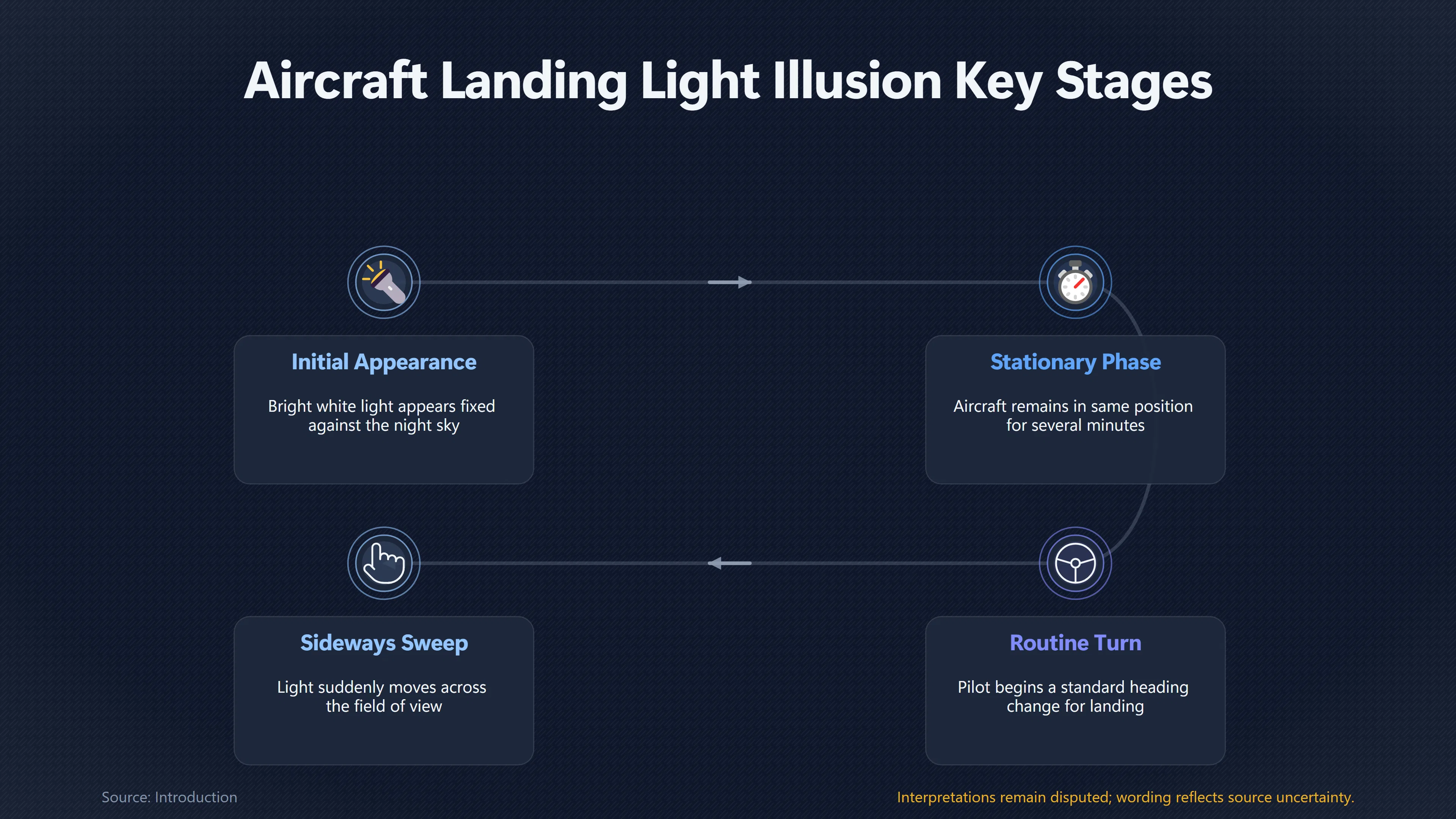
The sequence often follows a recognisable pattern:
- A bright white light appears almost fixed.
- The light remains apparently stationary for several minutes.
- The aircraft begins a routine turn.
- The light suddenly sweeps sideways across the sky.
- The observer concludes that the object accelerated impossibly fast.
In reality, the aircraft’s speed may have changed very little. What changed was the viewing angle. The observer was no longer looking almost exactly along the aircraft’s flight path, so its sideways motion suddenly became visible.
This mechanism is particularly relevant around complex terminal airspace such as greater Montréal, where arriving and departing aircraft routinely alter heading as instructed by air traffic control.

Why landing lights can vanish without switching off
Another feature frequently reported in Quebec sighting accounts is a brilliant white light that disappears instantly, as though it has been extinguished.
Landing lights are highly directional. They are designed to project intense beams forwards so that pilots can see the runway environment and so that approaching aircraft are conspicuous to others. They are not intended to illuminate equally in every direction.
When an aircraft turns even by a modest angle, the observer may move outside the strongest part of the beam.
Several things happen almost simultaneously:
- the intense forward-facing landing lights fade rapidly;
- the aircraft’s much dimmer navigation and anti-collision lights become the dominant visible lights;
- if haze or cloud had been reflecting the beam towards the observer, that reflection also disappears.
To someone who had been seeing only the bright landing lights, the aircraft can appear to have vanished altogether, even though it remains plainly visible from another direction.[Federal Aviation Administration]faa.govFederal Aviation AdministrationChapter 2. Aeronautical Lighting and Other Airport Visual AidsJanuary 8, 2015…
The reverse also occurs. A previously invisible aircraft can seem to appear suddenly when its landing lights rotate into the observer’s line of sight during a turn onto final approach.
Weather and darkness make the illusion stronger
Several common atmospheric conditions increase the likelihood of misidentification.
Haze, thin cloud, mist and moisture scatter bright landing lights, making them appear larger than the aircraft producing them. This reduces the observer’s ability to judge distance accurately.
Dark surroundings create an additional problem because there are few visual references against which motion can be estimated. A bright point of light suspended above an unlit landscape is much harder to place in three-dimensional space than an aircraft seen in daylight.
Pilot training material has long recognised that haze, featureless terrain and ground-lighting conditions can distort perception of distance and movement. These visual effects are significant enough to feature in aviation safety guidance because they can mislead pilots as well as observers on the ground.[Federal Aviation Administration]faa.govFederal Aviation Administration Fitness for FlightFederal Aviation Administration Fitness for Flight
Why this matters when assessing Quebec UFO reports
Landing-light illusions do not explain every unidentified aerial sighting in Quebec, nor should they be used to dismiss reports automatically. Some cases involve multiple witnesses, radar information or circumstances that require separate analysis.
However, where reports describe a single brilliant white light near an airport or established flight corridor that:
- appears to hover,
- suddenly accelerates sideways,
- or disappears without any obvious descent,
a conventional aircraft on approach is one of the first explanations investigators should examine.
The mechanism matches a recurring pattern found near busy airports worldwide and fits the geometry of many observations around Montréal’s complex airspace. Because the effect depends on perspective rather than unusual aircraft behaviour, sincere witnesses can accurately describe what they saw while still reaching an incorrect conclusion about what produced it.
Within Quebec’s UFO history, this makes landing-light illusions an important interpretive tool rather than a blanket debunking device. Careful reconstruction of flight paths, viewing direction, weather conditions and airport operations often determines whether a seemingly extraordinary hovering light was actually an ordinary aircraft seen from an uncommon angle.

Amazon book picks
Further Reading
Books and field guides related to Why airport lights can mimic impossible flight. Use these as the next step if you want deeper reading beyond the article.
Stick and Rudder: An Explanation of the Art of Flying
In the early 1940's, Wolfgang Langewiesche wrote a series of articles in Air Facts analyzing the various aspects of piloting techniques....
Human Factors in Flight
The late Captain Frank H Hawkins FRAes, M Phil, was Human Factors Consultant to KLM, for whom he had flown for over 30 years as line capt...
The Invisible Gorilla: How Our Intuitions Deceive Us
NEW YORK TIMES BESTSELLER • Our minds don’t work the way we think they do. Two renowned psychologists explain how and why our intuitions...
The Killing Zone: How and Why Pilots Die
This is not AI-generated content. The contents were written and verified by subject matter experts from Aviation Supplies & Academics, an...
eBay marketplace picks
Marketplace Samples
Live-tested eBay searches with available results related to this page.
Selected fromairport sign oneBay.co.uk.

Endnotes
1.
Source: faa.gov
Link:https://www.faa.gov/air_traffic/publications/atpubs/AIM/aim0201.html
Source snippet
Federal Aviation AdministrationChapter 2. Aeronautical Lighting and Other Airport Visual AidsJanuary 8, 2015...
Published: January 8, 2015
2.
Source: faa.gov
Title: Federal Aviation Administration Chapter 8. Medical Facts for Pilots
Link:https://www.faa.gov/air_traffic/publications/atpubs/aim/aim0801.html
Source snippet
Medical Facts for PilotsJanuary 8, 2015 — 1. Various complex motions and forces and certain visual scenes encountered in flight can creat...
Published: January 8, 2015
3.
Source: faa.gov
Title: Federal Aviation Administration Fitness for Flight
Link:https://www.faa.gov/air_traffic/publications/atpubs/aip_html/chap8_section_1.html
4.
Source: faa.gov
Title: Chapter 2
Link:https://www.faa.gov/Air_traffic/publications/atpubs/aim_html/chap2_section_1.html
Source snippet
Aeronautical Lighting and Other Airport Visual Aids(See TBL 2-1-1 and TBL 2-1-2.) FIG 2-1-8 Runway Entrance Lights Image: Runway Entrance...
5.
Source: faa.gov
Title: Airport Lighting Aids SECTION 1
Link:https://www.faa.gov/air_traffic/publications/atpubs/aip_html/chap2_section_1.html
Source snippet
AIRPORT LIGHTING AIDS 1. Approach Light Systems (ALS) 1. ALS provide the basic means to transition from instrument flight to visual fligh...
6.
Source: faa.gov
Link:https://www.faa.gov/data_research/research/med_humanfacs/oamtechreports/1970s/1978/197815
Source snippet
Office of Aerospace Medicine Technical Reports | Federal Aviation AdministrationOFFICE OF AEROSPACE MEDICINE TECHNICAL REPORTS FAA Office...
7.
Source: faa.gov
Link:https://www.faa.gov/data_research/research/med_humanfacs/oamtechreports/1980s/1982/198206
Source snippet
Office of Aerospace Medicine Technical Reports | Federal Aviation AdministrationOFFICE OF AEROSPACE MEDICINE TECHNICAL REPORTS FAA Office...
Additional References
8.
Source: faraim.org
Link:https://faraim.org/faa/aim/chapter-2/section-2-1-1.html
Source snippet
APPROACH LIGHT SYSTEMS (ALS) a. ALS provide the basic means to transition from instrument flight to visual flight for landing. Operationa...
9.
Source: faraim.org
Link:https://www.faraim.org/faa/aim/chapter-8/section-8-1-5.html
Source snippet
ILLUSIONS IN FLIGHT a. Introduction. Many different illusions can be experienced in flight. Some can lead to spatial disorientation. Othe...
10.
Source: faraim.org
Link:https://faraim.org/faa/aim/chapter-7/section-7-6-14.html
Source snippet
FLYING IN FLAT LIGHT, BROWN OUT CONDITIONS, AND WHITE OUT CONDITIONS a. Flat Light. Flat light is an optical...
11.
Source: angleofattack.com
Title: Approach Light Systems (ALS) — AIM 2-1-1 Explained | Angle of Attack
Link:https://www.angleofattack.com/aim/chapter-2/2-1-1/
Source snippet
APPROACH LIGHT SYSTEMS (ALS) By Chris Palmer, 2x Master Aviation Educator · Gold Seal CFI · Updated May 21, 2026 AIM 2-1-1 All of Chapter...
Published: May 21, 2026
12.
Source: ufouap.net
Title: Aircraft Lights Mistaken for UFOs: Night Guide | Global UFO Archive
Link:https://www.ufouap.net/en/explainers/aircraft-lights-mistaken-for-ufos
Source snippet
July 16, 2026 — Skywatching / Updated 2026-07-16 / 7 min read AIRCRAFT LIGHTS MISTAKEN FOR UFOS: A NIGHT IDENTIFICATION GUIDE An aircraft...
Published: July 16, 2026
13.
Source: youtube.com
Title: Spatial Disorientation Explained: Deadly Flight Illusions Every Pilot Must Know
Link:https://www.youtube.com/watch?v=6BD9fyyIJzY
Source snippet
Why aircraft landing lights appear to hover UFO illusion Mind-Blowing UFO Sighting at SFO: Plane Hovering in Mid-Air no! Matrix Glitch or...
14.
Source: pubmed.ncbi.nlm.nih.gov
Link:https://pubmed.ncbi.nlm.nih.gov/17760289/
Source snippet
2007 Aug;78(8):801-8. VISUAL SPATIAL DISORIENTATION: REVISITING THE BLACK HOLE ILLUSION Randall W Gibb^{ 1 } Affiliations Expand AFFILIAT...
15.
Source: ntrs.nasa.gov
Link:https://ntrs.nasa.gov/citations/19940008840
Source snippet
cueing aids for rotorcraft landings - NASA Technical Reports Server (NTRS)July 1, 1993 — Visual cueing aids for rotorcraft landings The p...
Published: July 1, 1993
16.
Source: ntrs.nasa.gov
Link:https://ntrs.nasa.gov/citations/19720007349
Source snippet
effects on an IFR hovering task: Analytical predictions and experimental results - NASA Technical Reports Server (NTRS)November 1, 1971 —...
Published: November 1, 1971
17.
Source: ntrs.nasa.gov
Link:https://ntrs.nasa.gov/citations/19830013921
Source snippet
nasa.govMotion/visual cueing requirements for vortex encounters during simulated transport visual approach and landing - NASA Technical R...