Within Pilot Sightings
Why No Radar Return Did Not Settle the Case
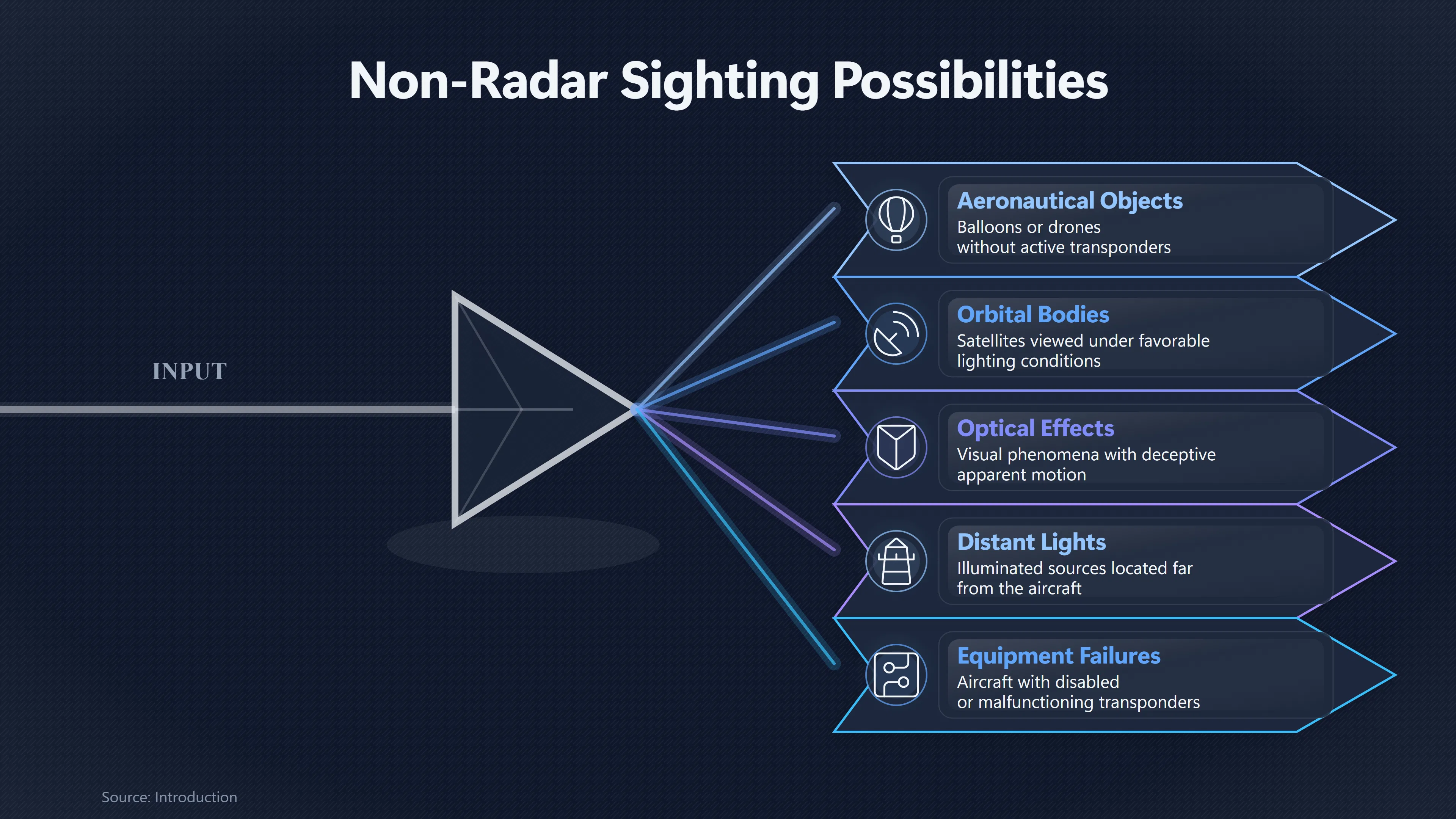
No radar or traffic-alert match weakens the ordinary-aircraft explanation, but it cannot exclude balloons, drones, distant lights or optical effects.
On this page
- What aircraft traffic alert systems can and cannot detect
- Why surveillance coverage may miss real objects
- How uncertain location estimates affect radar searches
Page outline Jump by section
Introduction
One of the most discussed features of the January 2023 Canadian North sighting near Yellowknife is that neither the flight crew’s onboard traffic system nor air traffic controllers reported matching aircraft. At first glance, that may appear to rule out an ordinary aviation explanation. In practice, however, the absence of a radar or traffic-system contact is informative without being decisive. It weakens the idea that the lights were another conventionally tracked aircraft operating normally in controlled airspace, but it does not eliminate other possibilities such as poorly located distant lights, balloons, drones, satellites, optical effects or aircraft that were not generating the particular surveillance data available to the crew and controllers.[cabinradio.ca]cabinradio.caCabin Radio Canadian North crew reports ‘lights in sky’ over YellowknifeCabin RadioCanadian North crew reports ‘lights in sky’ over YellowknifeFebruary 11, 2023…

The Yellowknife case therefore illustrates an important principle in aviation investigations: a “no radar return” finding is evidence that must be interpreted alongside the limitations of the surveillance systems involved, not treated as proof that an object was physically absent or extraordinary.
Why No Radar Return Did Not Settle the Case
During the radio exchange, the Canadian North crew told Yellowknife controllers that they could see two bright lights but were not receiving corresponding targets on the aircraft’s Traffic Collision Avoidance System (TCAS). Controllers replied that they likewise had no obvious matching surveillance contact and confirmed that area controllers had no reported traffic carrying out manoeuvres nearby. The crew stressed that the lights posed no immediate collision hazard but wanted to know whether any known aircraft matched what they were observing.[Cabin Radio]cabinradio.caCabin Radio Canadian North crew reports ‘lights in sky’ over YellowknifeCabin RadioCanadian North crew reports ‘lights in sky’ over YellowknifeFebruary 11, 2023…
That combination makes the sighting more interesting than an ordinary visual misidentification. If another airliner had been operating in the reported location using a functioning transponder, both TCAS and modern air traffic surveillance would normally be expected to provide some indication of its presence. The absence of such indications therefore weighs against the simplest explanation of “another scheduled aircraft.”
However, it is only one piece of evidence. Surveillance systems are designed around known aircraft broadcasting recognised signals or reflecting radar energy under particular conditions. They are not universal detectors of every illuminated object visible in the night sky.[Transport Canada]tc.canada.caTransport Canada Advisory Circular (AC) No.Transport Canada Advisory Circular (AC) No.
What Aircraft Traffic-Alert Systems Can and Cannot Detect
TCAS is a collision-avoidance system rather than a general object detector. It interrogates compatible aircraft transponders and warns crews about aircraft that meet specific equipment and operational conditions. It does not detect every airborne object simply because it is visible from the cockpit.[Transport Canada]tc.canada.caTransport Canada Advisory Circular (AC) No.Transport Canada Advisory Circular (AC) No.
In the context of the Yellowknife sighting, several important limitations matter:
- No compatible transponder, no TCAS target. Objects without an operating aviation transponder—including balloons, many drones and satellites—will not appear.
- Not every aircraft necessarily appears. Equipment failures, disabled transponders or aircraft operating outside required surveillance standards can reduce or eliminate TCAS detection.
- TCAS is built for collision avoidance. Its purpose is identifying aircraft that could present a traffic conflict, not cataloguing every light visible from the cockpit.
Consequently, the crew’s statement that nothing appeared on TCAS is significant because it argues against a normally equipped nearby aircraft, but it cannot identify what the lights actually were.
Why Surveillance Coverage May Miss Real Objects
Ground surveillance is also more complicated than the phrase “nothing on radar” sometimes suggests.
Modern Canadian air traffic surveillance increasingly combines conventional radar with Automatic Dependent Surveillance–Broadcast (ADS-B), in which equipped aircraft broadcast their own position. Space-based ADS-B has greatly expanded surveillance across Canada’s northern airspace, but the capabilities available to controllers depend on aircraft equipage, system architecture and the operational environment.[navcanada.ca]navcanada.ca2023 08 10 national.aspxNAV CANADANAV CANADA 2023-08-10 NationalAugust 10, 2023…
Several factors can therefore prevent a visible object from producing an identifiable surveillance track:
- the object may not transmit ADS-B or a compatible transponder signal;
- it may have too little radar cross-section for reliable conventional detection;
- it may be outside the geometry needed for dependable surveillance identification;
- it may not be an aircraft at all.
These limitations explain why investigators generally avoid treating the absence of surveillance data as proof that no object existed. Instead, they ask a narrower question: would a conventional aircraft operating as expected have been detected? In the Yellowknife case, the answer appears closer to “probably yes” than “certainly yes”, leaving room for both conventional and unresolved interpretations.[canada.ca]tc.canada.caTransport Canada Advisory Circular (AC) No.Transport Canada Advisory Circular (AC) No.
How Uncertain Location Estimates Affect Radar Searches
Another difficulty comes from the crew’s own changing estimates of where the lights were located.
During the approach, the reported position shifted from east of Yellowknife to above the aircraft and later to roughly 10–20 nautical miles north-west of the airport, with an estimated altitude around Flight Level 270. Such changes are not unusual during night observations. Without knowing the true distance to a light, even experienced pilots can misjudge its altitude and horizontal position while both observer and possible source continue moving.[Cabin Radio]cabinradio.caCabin Radio Canadian North crew reports ‘lights in sky’ over YellowknifeCabin RadioCanadian North crew reports ‘lights in sky’ over YellowknifeFebruary 11, 2023…
This uncertainty affects radar interpretation in several ways.
If investigators search the wrong volume of airspace because the estimated position is inaccurate, an otherwise relevant radar contact may appear unrelated. Conversely, if the lights were actually much farther away than believed, they may never have occupied the region being checked by controllers in the first place.
The uncertainty therefore works in two directions: it reduces confidence in any specific altitude or distance estimate, while also making it harder to conclude that surveillance systems definitely searched the correct location.
What the Missing Radar Contact Actually Tells Us
Taken on its own, the lack of a matching TCAS target and the absence of an obvious surveillance contact make the ordinary-airliner explanation less persuasive. They indicate that controllers and the flight crew were not overlooking a routine, identified aircraft conducting normal operations near Yellowknife.[Cabin Radio]cabinradio.caCabin Radio Canadian North crew reports ‘lights in sky’ over YellowknifeCabin RadioCanadian North crew reports ‘lights in sky’ over YellowknifeFebruary 11, 2023…
They do not, however, demonstrate that the lights represented an unknown aircraft or an extraordinary phenomenon. The evidence remains compatible with several possibilities that would not necessarily produce a radar or traffic-system return, including balloons, some drones, distant illuminated objects, satellites seen under favourable lighting conditions, or optical effects whose apparent motion differed from their true motion.
Within the broader history of aviation-related UFO reports in the Northwest Territories, this is why the Yellowknife incident remains noteworthy but unresolved. The absence of matching surveillance data strengthens the case for taking the crew’s observation seriously, yet it falls short of identifying what they saw. The radar evidence narrows the range of conventional explanations without eliminating them altogether.
Amazon book picks
Further Reading
Books and field guides related to Why No Radar Return Did Not Settle the Case. Use these as the next step if you want deeper reading beyond the article.
UFOs: Generals, Pilots, and Government Officials Go on the Re...
NEW YORK TIMES BESTSELLER • Impeccably researched, this riveting journalistic investigation separates fact from fiction, and documents th...
The UFO Experience: A Scientific Inquiry
Cited by the New York Review of Books as "the best brief for visitation," this classic study presents an analysis of UFO reports and conc...
Understanding Radar Systems
What is radar? What systems are currently in use? How do they work? Understanding Radar Systems provides engineers and scientists with an...
Skunk Works
This classic history of America's high-stakes quest to dominate the skies is "a gripping technothriller in which the technology is real"...
eBay marketplace picks
Marketplace Samples
Live-tested eBay searches with available results related to this page.
Selected fromairplane model oneBay.co.uk.
Endnotes
1.
Source: tc.canada.ca
Title: Transport Canada Advisory Circular (AC) No. 500-029
Link:https://tc.canada.ca/en/aviation/reference-centre/advisory-circulars/advisory-circular-ac-no
2.
Source: tc.canada.ca
Title: ca Flying to Canada: what you need to know
Link:https://tc.canada.ca/en/aviation/general-operating-flight-rules/flying-canada-what-you-need-know-tp-15048
Source snippet
to Canada: what you need to know - TP 15048February 12, 2025 — If you want to operate with a PLB instead of an ELT, the PLB must: * trans...
Published: February 12, 2025
3.
Source: tc.canada.ca
Title: advisory circular ac no 700 009
Link:https://tc.canada.ca/en/aviation/reference-centre/advisory-circulars/advisory-circular-ac-no
4.
Source: tc.canada.ca
Link:https://tc.canada.ca/en/aviation/reference-centre/exemptions-canadian-aviation-regulations-cars/exemption-paragraphs-801012a-80108b-canadian-aviation-regulations-specifically-subparagraph-944bii-paragraphs-1052b-1151b-chapter-2-paragraphs-21a-22c-24a-sections
5.
Source: youtube.com
Title: Transponder Modes Explained (Mode A, Mode C, Mode S, Ident)
Link:https://www.youtube.com/watch?v=uYKZLigpjZ8
Source snippet
TCAS | Traffic alert and collision avoidance System | How it works?...
6.
Source: youtube.com
Title: TCAS | Traffic alert and collision avoidance System | How it works?
Link:https://www.youtube.com/watch?v=Cjrl0bp4FFw
7.
Source: cabinradio.ca
Title: Cabin Radio Canadian North crew reports ‘lights in sky’ over Yellowknife
Link:https://cabinradio.ca/120760/news/yellowknife/canadian-north-crew-reports-lights-in-sky-over-yellowknife/
Source snippet
Cabin RadioCanadian North crew reports ‘lights in sky’ over YellowknifeFebruary 11, 2023...
Published: February 11, 2023
8.
Source: navcanada.ca
Title: NAV CANADANAV CANADA ADS-B Performance Requirements
Link:https://www.navcanada.ca/en/air-traffic/space-based-ads-b/ads-b-performance-requirements.aspx
9.
Source: navcanada.ca
Title: 2023 08 10 national.aspx
Link:https://www.navcanada.ca/en/flight-planning/service-notices/2023-08-10-national-.aspx
Source snippet
NAV CANADANAV CANADA 2023-08-10 NationalAugust 10, 2023...
Published: August 10, 2023
10.
Source: crtc.gc.ca
Title: Cabin Radio does not operate any licensed radio stations in Canada. 4
Link:https://crtc.gc.ca/eng/archive/2025/2025-188.htm
Source snippet
Broadcasting Decision CRTC 2025-188 | CRTCJuly 30, 2025 — Cabin Radio’s service produces online programming and serves more than 8,000 un...
Published: July 30, 2025
11.
Source: navcanada.ca
Link:https://www.navcanada.ca/en/news/news-releases/ads-b-mandate-comes-into-effect-in-canadian-domestic-class-a-airspace.aspx
Source snippet
NAV CANADA ADS-B mandate comes into effect in Canadian Domestic Class A AirspaceAugust 10, 2023 — August 10, 2023 ADS-B MANDATE COMES INT...
Published: August 10, 2023
12.
Source: cabinradio.ca
Title: CRT C decides YK cannot sustain new FM station, barring Cabin Radio
Link:https://cabinradio.ca/121231/news/arts/crtc-decides-yk-cannot-sustain-new-fm-station-barring-cabin-radio/
Additional References
13.
Source: youtube.com
Link:https://www.youtube.com/watch?v=Q6JgyhoCyi8
Source snippet
Primary vs Secondary Radar | Radar Basics...
14.
Source: youtube.com
Title: A320 Surveillance, TCAS, EGPWS
Link:https://www.youtube.com/watch?v=K_RNHKbHOO4
Source snippet
Transponder Modes Explained (Mode A, Mode C, Mode S, Ident)...
15.
Source: crtc.gc.ca
Link:https://crtc.gc.ca/eng/archive/2023/2023-33.htm
Source snippet
Broadcasting Decision CRTC 2023-33 | CRTCFebruary 15, 2023 — BROADCASTING DECISION CRTC 2023-33 PDF version Reference: 2021-374 Ottawa, 1...
Published: February 15, 2023
17.
Source: youtube.com
Title: Primary vs Secondary Radar | Radar Basics
Link:https://www.youtube.com/watch?v=q2Gt7EhiyTg
Source snippet
A320 Surveillance, TCAS, EGPWS - Traffic Collision Aviodance System (TCAS)...