Within UFO Archives
Does Government Paperwork Verify an Ontario UFO?
Official files usually prove that a report was received and circulated, not that the claimed object was independently confirmed.
On this page
- What official records genuinely establish
- Received testimony versus confirmed evidence
- How to recognise stronger corroboration
Page outline Jump by section
Introduction
Government UFO paperwork is often misunderstood as proof that officials confirmed an extraordinary event. In reality, Canadian government records—particularly those relating to Ontario—usually establish something much narrower but historically significant: that a report was received, logged, circulated, assessed or archived by public authorities. They demonstrate that officials considered a sighting worthy of administrative attention because it might relate to aviation safety, national defence, policing, astronomy or public correspondence. They do not normally certify that witnesses accurately described an objectively observed craft, nor do they amount to official confirmation of extraterrestrial visitation.[Canada]canada.cas UFOs: The search for the unknownCanada's UFOs: The search for the unknown - Canada.caMarch 2, 2026…
This distinction matters because Ontario occupies a central place in Canada’s archival history of unidentified aerial phenomena (UAP), formerly more commonly called UFOs. Ottawa hosted many of the federal departments that received reports, while Ontario itself generated numerous civilian, police and aviation sightings. Consequently, the province appears frequently within Library and Archives Canada (LAC) collections. The existence of extensive paperwork has sometimes encouraged claims that “the government verified UFOs.” A careful reading of the records shows something more nuanced: the archives verify reporting and government response, not necessarily the reported phenomenon itself.[Canada]canada.cas UFOs: The search for the unknownCanada's UFOs: The search for the unknown - Canada.caMarch 2, 2026…
What Official Records Actually Verify
When historians discover an Ontario UFO file in the federal archives, the documents can establish several kinds of verified facts.
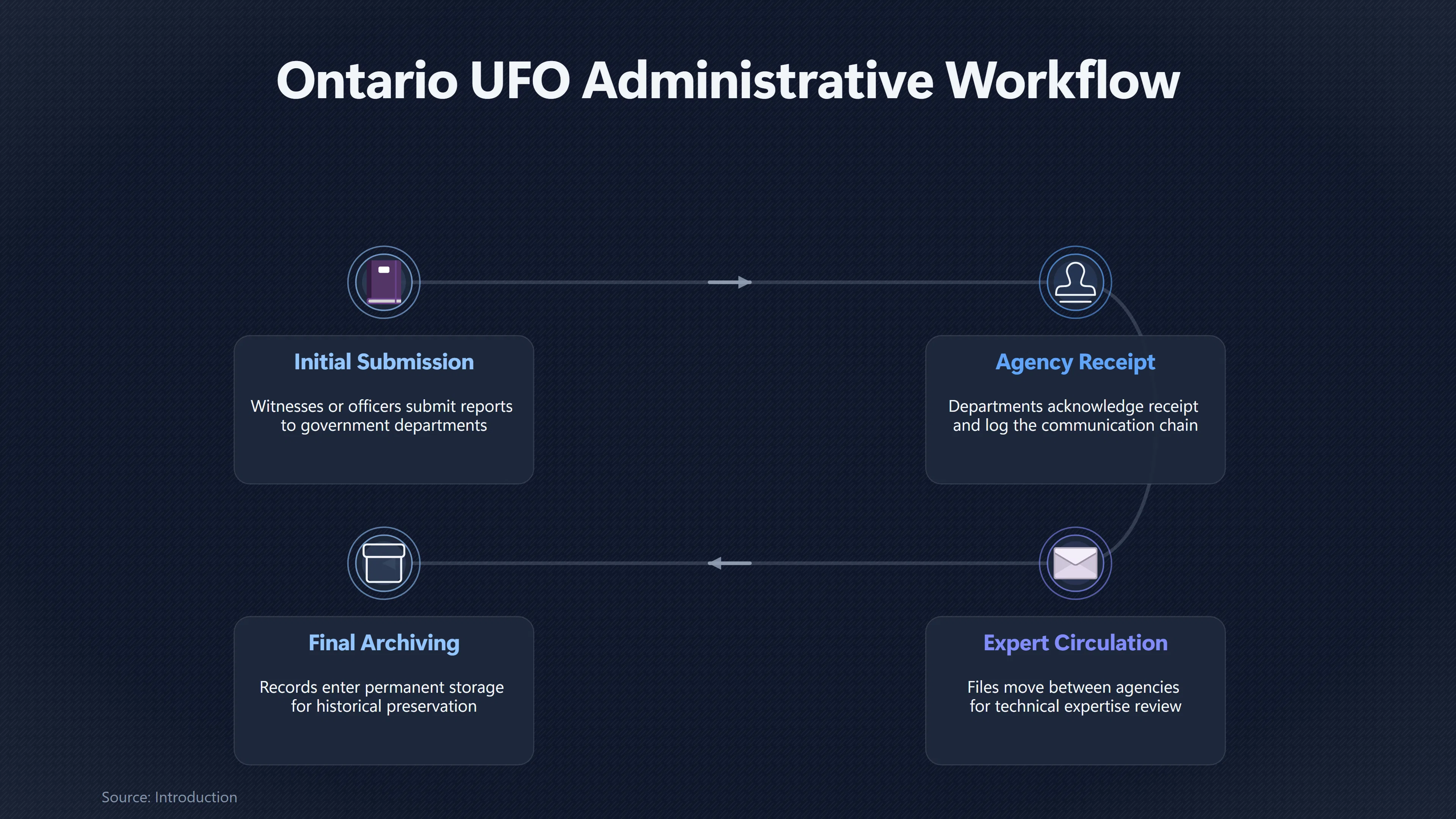
First, they verify that a report entered the Canadian government’s administrative system. A witness wrote to a department, a police officer submitted a report, an air traffic official filed an occurrence, or another agency forwarded correspondence. The paperwork itself confirms this chain of communication.
Second, official files verify that public servants undertook specific administrative actions. They may acknowledge receipt, request further information, circulate reports between agencies, compare accounts with astronomical data or refer a matter to another department with relevant expertise.
Third, they preserve contemporaneous evidence that would otherwise have been lost. Dates, locations, weather conditions, witness descriptions and official comments become part of the historical record, allowing later researchers to reconstruct how a particular incident unfolded.
Library and Archives Canada explains that its collection consists primarily of correspondence, reports, memoranda and procedural documents accumulated by four federal organisations—the Department of National Defence (DND), Department of Transport, National Research Council (NRC) and Royal Canadian Mounted Police (RCMP). The collection contains roughly 9,500 digitised documents from a larger archive exceeding 15,000 pages covering reports from 1947 through 1995.[Canada]canada.cas UFOs: The search for the unknownCanada's UFOs: The search for the unknown - Canada.caMarch 2, 2026…
These verified administrative facts should not be confused with verification of the reported object.
Why Government Interest Does Not Mean Government Confirmation
Government agencies investigate many reports that ultimately prove mistaken, incomplete or unresolved. Aviation authorities examine reports of possible aircraft incidents. Police investigate complaints that later prove unfounded. Meteorological agencies examine unusual weather observations. The act of investigation demonstrates institutional responsibility rather than prior belief.
Canadian UFO paperwork followed the same principle.
A report reaching DND did not mean military officials believed Canadian airspace had been penetrated by an unknown craft. A report reaching the NRC did not imply astronomers accepted an extraordinary explanation. Rather, departments examined reports because they fell within their statutory responsibilities.
The 2025 Sky Canada Project emphasises this historical pattern. Reviewing decades of federal practice, it concludes that departments received UFO reports for multiple purposes, including responding to public enquiries, attempting to explain unusual observations and investigating selected incidents where appropriate. The report also notes that responsibility shifted repeatedly between departments and lacked a permanent, unified investigative programme.[Innovation Canada]ised-isde.canada.caOpen source on canada.ca.
This fragmented administrative history explains why Ontario sightings may appear simultaneously in defence, transport, police and scientific files without representing multiple independent confirmations of the underlying event.
Received Testimony Versus Confirmed Evidence
Perhaps the most important distinction in Ontario’s archival record is between testimony and corroborated evidence.
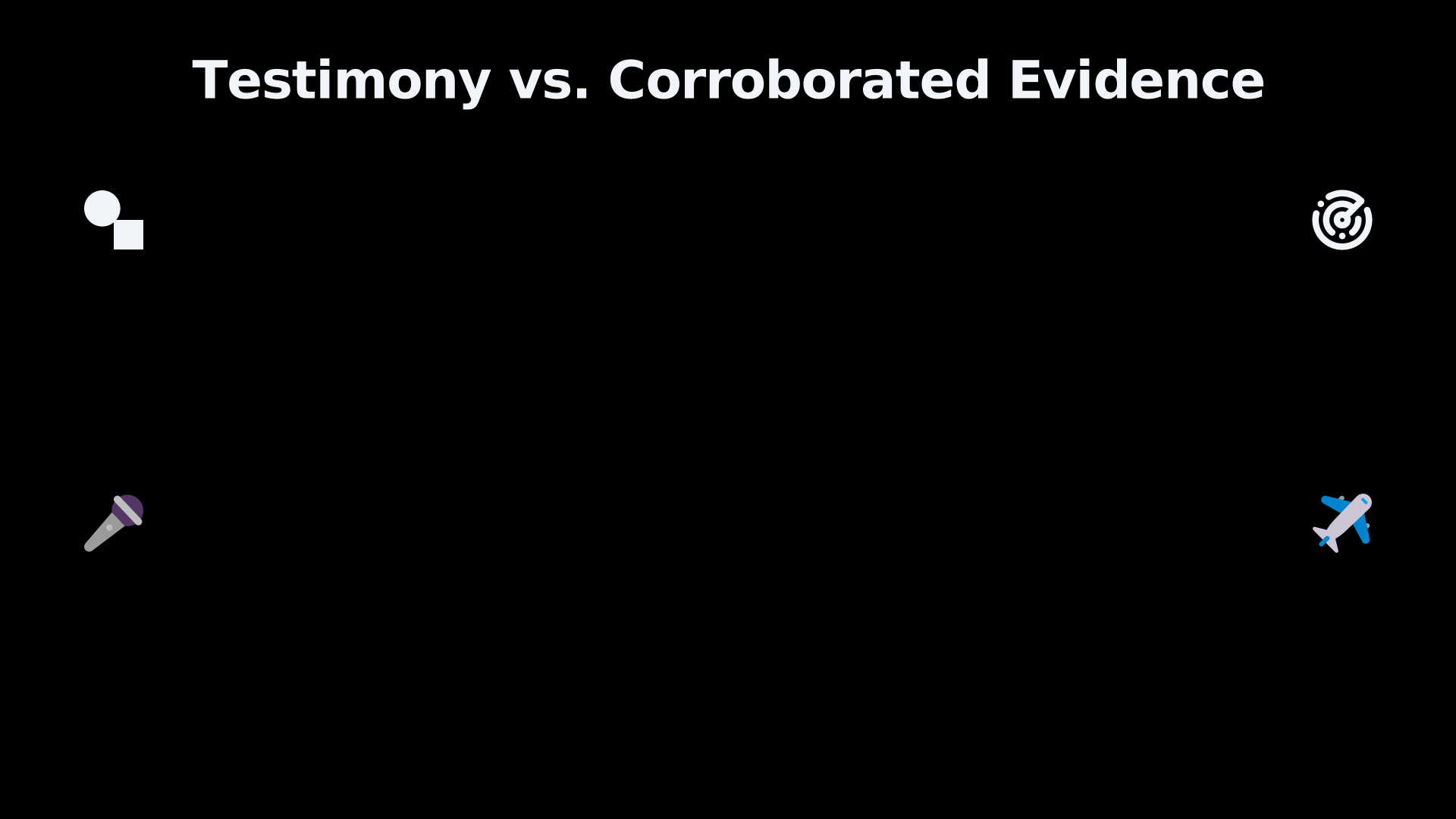
A witness statement records what somebody sincerely believed they observed. Even where investigators regarded witnesses as honest, that assessment does not automatically establish that the observation occurred exactly as described.
Government files frequently preserve:
- witness letters;
- interview summaries;
- police occurrence reports;
- departmental correspondence;
- sketches;
- newspaper clippings enclosed with official memoranda.
These documents provide valuable historical evidence regarding what people reported.
Independent confirmation requires something more.
Examples of genuinely corroborating evidence include:
- multiple independent witnesses interviewed separately;
- contemporaneous radar observations;
- air traffic control records;
- military tracking information;
- authenticated photographs whose provenance can be established;
- astronomical calculations excluding bright planets, meteors or satellite passes;
- physical evidence capable of forensic examination.
Most Ontario archival files contain only some of these elements. Many consist primarily of witness testimony accompanied by administrative correspondence explaining how departments handled the report. The paperwork therefore verifies that testimony existed—not necessarily that the reported object was independently confirmed.[Canada]canada.cas UFOs: The search for the unknownCanada's UFOs: The search for the unknown - Canada.caMarch 2, 2026…
What an “Unidentified” Classification Really Means
Readers often misunderstand official terminology.
When Canadian records describe a case as “unidentified” or retain it within files dealing with unidentified phenomena, this does not mean investigators concluded an extraordinary craft had been observed.
Instead, “unidentified” usually indicates that available evidence proved insufficient for a confident conventional explanation.
There are many reasons this can happen:
- observation lasted only seconds;
- witness estimates conflicted;
- no photographs existed;
- weather information was incomplete;
- aviation records could not eliminate every possibility;
- investigators lacked sufficient detail to reach a definitive conclusion.
The National Research Council’s “Non-Meteoritic Sightings” files illustrate this point particularly well. The category primarily distinguished reports that could not readily be classified as meteors. It was an administrative filing category rather than an endorsement of extraordinary explanations. Astronomer Dr Peter Millman and colleagues routinely examined conventional possibilities including meteors, planets and other astronomical phenomena before deciding whether enough information existed to classify an event.[Innovation Canada]ised-isde.canada.caOpen source on canada.ca.
Consequently, unresolved does not mean verified.
Ontario Examples of Administrative Verification
Ontario illustrates these distinctions because many reports entered federal systems through aviation or government channels headquartered in Ottawa.
A report from Toronto, Kingston, Ottawa or northern Ontario might move through several departments if witnesses believed aviation safety or defence issues could be involved.
For example, one department might:
- receive the initial report;
- forward it to another agency possessing technical expertise;
- receive an explanatory reply;
- archive the correspondence.
The resulting paperwork documents the government’s workflow.
Researchers occasionally point to multi-agency correspondence as evidence that “multiple government departments verified the UFO.” In practice, the documents often show only that several departments discussed the same witness report.
Likewise, an RCMP occurrence report confirms that police documented an incident. It does not necessarily indicate officers witnessed the event themselves or concluded that the reported object objectively existed.
Understanding these distinctions prevents readers from assigning greater evidential weight to bureaucratic circulation than the documents support.
How Stronger Verification Can Occur
Although government paperwork alone rarely verifies an unusual aerial object, some historical cases provide stronger corroboration than others.
Researchers generally regard a case as more evidentially persuasive when several independent strands of evidence converge.
Characteristics that strengthen verification include:
Independent witnesses. Separate observers describing similar events without influencing one another increase confidence that something unusual occurred, even if its nature remains uncertain.
Objective measurements. Radar returns, instrument readings or aviation records provide evidence independent of human perception.
Prompt investigation. Interviews conducted immediately after an event generally preserve more reliable details than recollections recorded months later.
Cross-checking by specialists. Files showing investigators compared astronomical conditions, weather, aircraft movements and satellite information demonstrate a more rigorous investigative process.
Consistent documentation. Agreement between police records, aviation reports and witness statements strengthens confidence in factual details such as time and location.
Importantly, even several of these factors together may verify only that an unusual aerial event occurred—not what caused it.

Common Misreadings of Government Files
Several recurring misconceptions appear in discussions of Ontario UFO archives.
“It’s in government files, so it must be true.”
Archiving preserves information. It does not certify accuracy. Governments archive mistaken reports, rumours, complaints and unresolved investigations across many subjects.
“Multiple departments handled it, therefore they confirmed it.”
Departments often exchanged files simply because responsibilities overlapped. Administrative circulation should not be mistaken for multiple independent investigations reaching identical conclusions.
“Officials could not explain it, therefore they knew it was extraordinary.”
Failure to identify an object is not evidence for any particular explanation. It may instead reflect insufficient data, missing records or limitations in available technology.
“The government investigated, therefore it believed witnesses.”
Governments routinely investigate reports without assuming their correctness. Investigation reflects institutional responsibility, not prior acceptance.
These distinctions are reinforced by the Sky Canada Project, which explicitly states that its own purpose is not to prove or disprove extraterrestrial visitation but to improve reporting systems, transparency and scientific treatment of unidentified aerial phenomena.[Science.gc.ca]science.gc.caSky Canada ProjectDecember 3, 2025…
Reading Ontario UFO Archives Critically
For readers exploring Ontario’s historical UFO record, the most productive approach is to ask what each document actually demonstrates.
A witness letter establishes that someone reported an event.
A police memorandum establishes that officers documented a complaint or observation.
A Department of National Defence file establishes that defence officials considered whether the report had security implications.
A National Research Council assessment establishes that scientists attempted to compare the observation with known natural phenomena.
Only where independent evidence accompanies these records—such as multiple corroborating witnesses, aviation data or instrument observations—does the evidential weight increase beyond simple administrative documentation.
This approach neither dismisses official files nor exaggerates their significance. Instead, it treats government paperwork for what it genuinely is: reliable evidence about reporting, investigation and institutional response.
Why the Distinction Matters
Ontario’s federal archives remain one of Canada’s richest historical resources for studying unidentified aerial reports. They demonstrate that Canadian institutions did not simply ignore public sightings. Officials received reports, preserved correspondence, consulted experts and occasionally conducted substantive investigations. Those administrative actions are themselves historically important because they document how Canadian governments responded to public uncertainty over unusual aerial observations across several decades.[Canada]canada.cas UFOs: The search for the unknownCanada's UFOs: The search for the unknown - Canada.caMarch 2, 2026…
However, the archives also show the limits of official verification. Government paperwork confirms that reports existed and that departments acted upon them according to their responsibilities. It does not automatically confirm that witnesses observed exactly what they believed they saw, nor does it establish that unexplained reports represent extraordinary technology. For anyone interpreting Ontario’s UFO history, recognising this distinction is the single most important principle for reading the archival record accurately.
Amazon book picks
Further Reading
Books and field guides related to Does Government Paperwork Verify an Ontario UFO?. Use these as the next step if you want deeper reading beyond the article.
The UFO Experience: A Scientific Inquiry
Cited by the New York Review of Books as "the best brief for visitation," this classic study presents an analysis of UFO reports and conc...
UFOs: Generals, Pilots, and Government Officials Go on the Re...
NEW YORK TIMES BESTSELLER • Impeccably researched, this riveting journalistic investigation separates fact from fiction, and documents th...
The Report on Unidentified Flying Objects
Book Excerpt: ing can never be positively identified. It might have been a hallucination or it might have been some vehicle from outer sp...
The Demon-Haunted World: Science as a Candle in the Dark
NEW YORK TIMES BESTSELLER • From the renowned astronomer and author of Cosmos comes a “powerful [and] stirring defense of informed ration...
Endnotes
1.
Source: canada.ca
Title: ‘s UFOs: The search for the unknown
Link:https://www.canada.ca/en/library-archives/collection/research-help/science-technology/ufos.html
Source snippet
Canada's UFOs: The search for the unknown - Canada.caMarch 2, 2026...
Published: March 2, 2026
2.
Source: ised-isde.canada.ca
Link:https://ised-isde.canada.ca/site/science/en/office-chief-science-advisor/sky-canada-project/management-public-reporting-unidentified-aerial-phenomena-canada
3.
Source: ised-isde.canada.ca
Title: Innovation Canada
Link:https://ised-isde.canada.ca/site/science/sites/default/files/documents/sky-canada-report.pdf
4.
Source: science.gc.ca
Title: Sky Canada Project
Link:https://science.gc.ca/site/science/en/office-chief-science-advisor/sky-canada-project
Source snippet
December 3, 2025...
Published: December 3, 2025
5.
Source: science.gc.ca
Title: annual report chief science advisor 2024 2025
Link:https://science.gc.ca/site/science/en/office-chief-science-advisor/annual-reports/annual-report-chief-science-advisor
Source snippet
Annual Report of the Chief Science Advisor 2024-2025December 17, 2025 — Canada’s Sovereign Airspace: The Sky Canada Project Canada exerci...
Published: December 17, 2025
6.
Source: archives.gov.on.ca
Title: archival collection
Link:https://www.archives.gov.on.ca/archival-collection/
Source snippet
collectionSeptember 1, 2025 — Archival Collection | Archives of Ontario Records, Photographs, Maps, and Digital Archives ABOUT OUR COLLEC...
Published: September 1, 2025
7.
Source: publications.aws.tpsgc-pwgsc.cloud-nuage.canada.ca
Link:https://publications.aws.tpsgc-pwgsc.cloud-nuage.canada.ca/site/fra/9.954480/publication.html
Source snippet
Iu37-59/2025E-PDF - Publications du gouvernement du Canada - Canada.caJune 1, 2025 — MANAGEMENT OF PUBLIC REPORTING OF UNIDENTIFIED AERIA...
Published: June 1, 2025
8.
Source: science.gc.ca
Link:https://science.gc.ca/site/science/en/office-chief-science-advisor/sky-canada-project/preview-sky-canada-report-ocsa
9.
Source: ontario.ca
Title: Directory of Records | ontario.ca
Link:https://www.ontario.ca/page/directory-records
Additional References
10.
Source: youtube.com
Title: Chris Rutkowski launch of Canada’s UFOs: Declassified (August Night Press)
Link:https://www.youtube.com/watch?v=bcSI4rw0M4Q
Source snippet
Chris Rutkowski Canada UFO declassified history 07-05-22 Chris Rutkowski, Canada's UFOs: Declassified Podcast UFO Live Shows...
11.
Source: youtube.com
Title: Sky Canada Project, UFOs, UAPs and FOIA | UAP Files Podcast S3E7 | Daniel Otis
Link:https://www.youtube.com/watch?v=BPBzvNkDOTk
Source snippet
Somewhere in the Skies | Canada's UFO Files Declassified with Chris Rutkowski...
12.
Source: youtube.com
Title: Somewhere in the Skies | Canada’s UFO Files Declassified with Chris Rutkowski
Link:https://www.youtube.com/watch?v=VNTh1JMO8bc
Source snippet
Chris Rutkowski launch of Canada's UFOs: Declassified (August Night Press)...
13.
Source: publications.gc.ca
Link:https://publications.gc.ca/site/eng/9.954480/publication.html
Source snippet
Management of public reporting of unidentified aerial phenomena in Canada: report of the Sky Canada Project.: Iu37-59/2025E-PDF - Govern...
14.
Source: youtube.com
Title: Daniel Otis on Canada’s UFO Connection
Link:https://www.youtube.com/watch?v=HgXcV9XZunw
Source snippet
Sky Canada Project, UFOs, UAPs and FOIA | UAP Files Podcast S3E7 | Daniel Otis...
15.
Source: youtube.com
Link:https://www.youtube.com/watch?v=psGxOznGuiM
Source snippet
Daniel Otis on Canada's UFO Connection...
16.
Source: ipc.on.ca
Link:https://www.ipc.on.ca/en/access-organizations
17.
Source: nationalarchives.gov.uk
Title: UF O reports
Link:https://www.nationalarchives.gov.uk/explore-the-collection/explore-by-time-period/postwar/ufo-reports/
18.
Source: publications.gc.ca
Link:https://publications.gc.ca/site/eng/9.954481/publication.html