Within Military Skies
Why Cold War Bases Recorded Every Unknown
At Cold War bases, unidentified lights and radar returns were recorded because they might indicate navigation errors, equipment faults or hostile aircraft.
On this page
- How air defence duties encouraged formal reporting
- What an unidentified return meant operationally
- Why documentation did not imply extraterrestrial belief
Page outline Jump by section
Introduction
Cold War air bases in Newfoundland and Labrador did not record unexplained lights or radar contacts because military personnel believed they had found extraterrestrial craft. They recorded them because any unidentified object in strategically important airspace could represent a navigation error, equipment malfunction, an unidentified aircraft, or—in the worst-case planning of the era—a hostile military threat. At bases such as Goose Bay, and within the wider North American air-defence network that included Gander and NORAD-linked radar sites, reporting the unknown was a routine operational requirement rather than an endorsement of extraordinary explanations. Canadian military policy emphasised identifying, classifying and documenting unusual observations before deciding whether they were harmless or significant.[ised-isde.canada.ca]ised-isde.canada.caManagement of Public Reporting of Unidentified Aerial Phenomena in CanadaJune 1, 2025…
This distinction is essential when reading Cold War-era UFO reports from Newfoundland and Labrador. The existence of a report tells us that something could not be identified immediately—not that officials concluded it was something extraordinary.
How air-defence duties encouraged formal reporting
During the Cold War, Canada’s eastern approaches formed part of North America’s principal defence corridor. Aircraft arriving across the North Atlantic passed through airspace watched by military radar stations, air traffic controllers and interceptor forces. Goose Bay also supported multinational military operations, making accurate air surveillance a daily necessity.
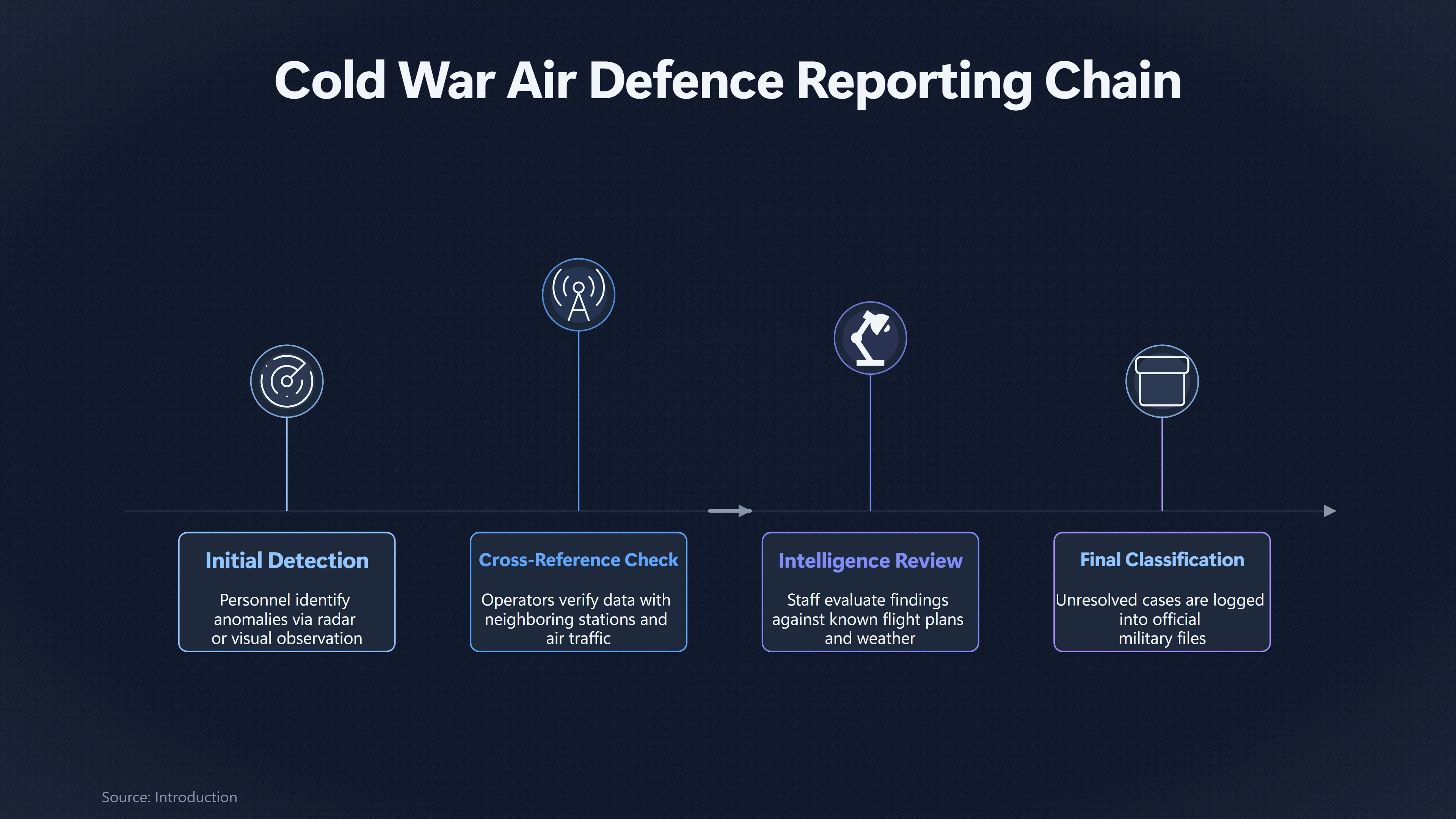
In this environment, personnel were expected to report anything that did not match known flight plans, radar tracks or recognised atmospheric phenomena. The goal was operational awareness rather than curiosity about unexplained phenomena. A report might trigger checks with:
- radar operators at neighbouring stations;
- air traffic control;
- intelligence staff;
- weather services;
- nearby aircraft;
- interceptor units if necessary.
Most reports were resolved during this process, but unresolved cases still remained in official files because documenting uncertainty was preferable to ignoring it.[Canada]canada.caNORAD Authorities and OperationsNORAD Authorities and Operations - Canada.ca…
The same culture explains why Newfoundland and Labrador generated relatively rich documentation compared with many civilian sightings. Bases employed trained observers working around the clock, using radios, radar and visual observation together. If something unusual appeared, there was already a reporting chain in place.
What an unidentified return meant operationally
Modern readers often associate the word “unidentified” with UFO folklore. During the Cold War, military personnel understood it very differently.
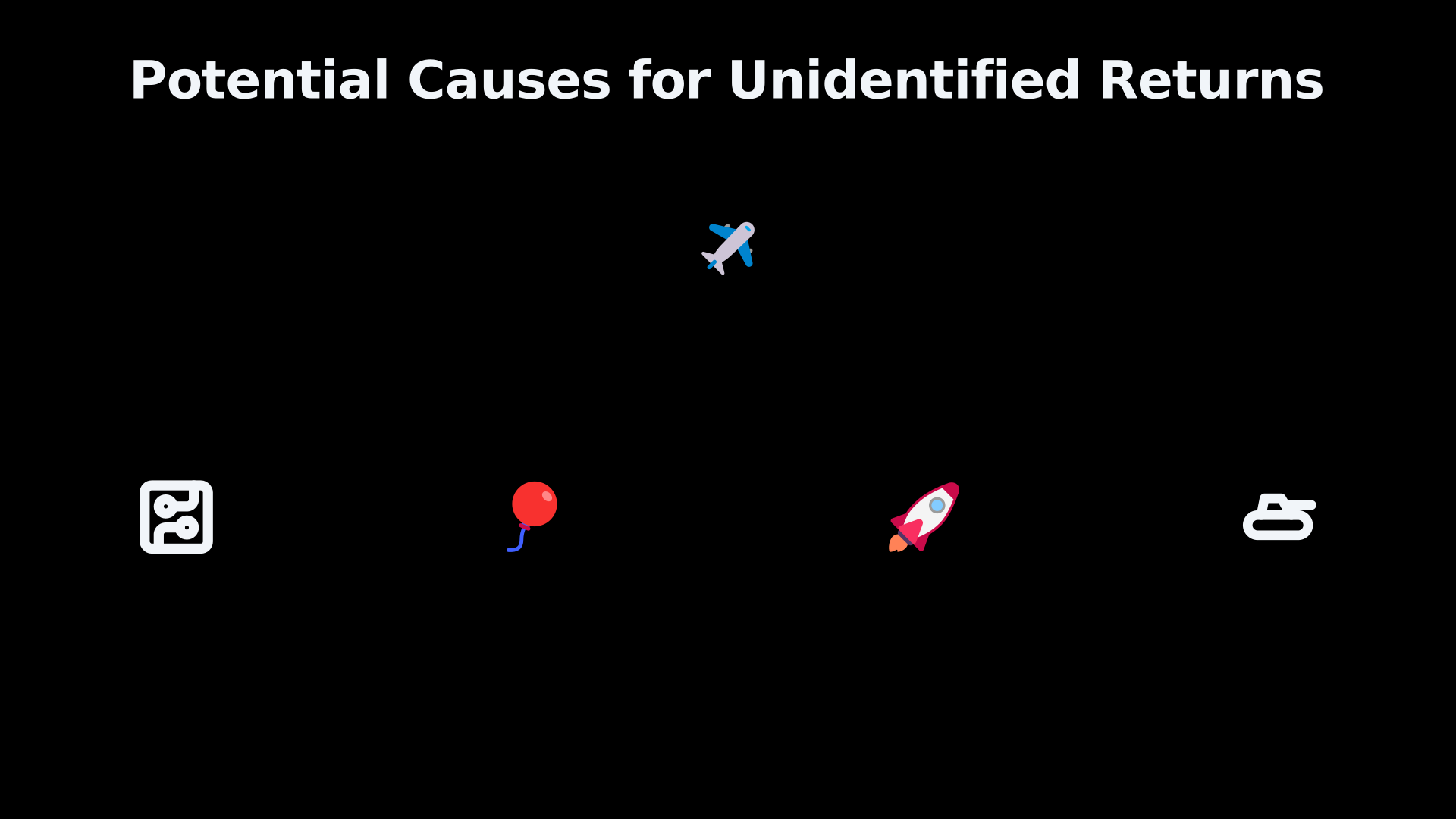
An unidentified radar return or visual sighting usually meant only that the object had not yet been matched with a known explanation. Possible causes included:
- an aircraft flying without an expected flight plan;
- navigation errors;
- radar interference or anomalous propagation;
- weather balloons;
- atmospheric or astronomical effects;
- electronic equipment faults;
- military exercises not yet communicated to every unit;
- in the most serious scenario, a potential hostile aircraft.
The uncertainty itself justified reporting. Air-defence systems were designed around early warning, meaning personnel were expected to investigate first and classify later. Waiting until an object was fully understood before making a report would have defeated the purpose of the warning network.[Canada]canada.caNORAD Authorities and OperationsNORAD Authorities and Operations - Canada.ca…
This operational mindset also explains why both radar contacts and eyewitness accounts could be logged even when later evidence suggested an ordinary explanation.

Canadian policy treated reports as security questions
Canada’s approach differed from popular impressions that governments were primarily hunting for evidence of alien visitors.
In 1952, the Defence Research Board established Project Second Storey, chaired by astronomer Peter Millman, to examine reports of “flying saucers” reaching Canadian government departments. The committee’s purpose was to determine whether such reports represented a defence or scientific problem requiring organised investigation. It even developed a standard reporting form intended to make observations more consistent across departments.[ised-isde.canada.ca]ised-isde.canada.caManagement of Public Reporting of Unidentified Aerial Phenomena in CanadaJune 1, 2025…
The committee met only a handful of times between 1952 and 1954 before concluding that reported unidentified objects did not appear to present a national security threat and offered little scientific value under the evidence then available. Rather than proving extraordinary phenomena, the exercise demonstrated that government agencies wanted a structured process for evaluating unusual reports before reaching conclusions.[ised-isde.canada.ca]ised-isde.canada.caManagement of Public Reporting of Unidentified Aerial Phenomena in CanadaJune 1, 2025…
For Newfoundland and Labrador’s military installations, this meant unusual observations continued to be recorded because documentation served operational accountability, even after enthusiasm for dedicated UFO investigations faded.
Why documentation did not imply extraterrestrial belief
One of the most common misunderstandings is that official paperwork proves officials believed extraordinary explanations.
Military record-keeping worked differently. Cold War organisations documented many uncertain events—including radar anomalies, communications failures and unidentified aircraft—not because they accepted extraordinary interpretations but because uncertainty itself carried operational significance.
A report could remain “unidentified” for several reasons:
- insufficient evidence;
- conflicting witness accounts;
- incomplete radar information;
- inability to reconstruct weather conditions;
- lack of follow-up data.
None of these outcomes automatically implied an unknown technology or extraterrestrial origin. In military terminology, “unidentified” simply described the status of the investigation at that point.
Canada’s recent review of historical UAP reporting similarly notes that the Royal Canadian Air Force investigates unexplained observations only when they relate to potential threats or distress, reflecting continuity with the security-focused approach established during the Cold War rather than an institutional belief in extraordinary explanations.[ised-isde.canada.ca]ised-isde.canada.caManagement of Public Reporting of Unidentified Aerial Phenomena in CanadaJune 1, 2025…
Why this matters for Newfoundland and Labrador’s UFO history
Understanding why Cold War bases recorded unexplained sightings changes how many provincial cases should be interpreted.
The military infrastructure around Goose Bay, Gander and associated radar sites increased both the number of observations and the quality of documentation. Reports were more likely to include multiple witnesses, radar information or communications records than many civilian sightings elsewhere in Canada.
That richer documentary trail can make some Newfoundland and Labrador incidents appear more impressive than isolated reports. However, it primarily reflects the province’s role within North American air defence rather than evidence that unusual phenomena occurred there more frequently than elsewhere.
The surviving records therefore tell two stories at once. They preserve genuine moments when trained observers encountered something they could not immediately identify, while also illustrating the disciplined reporting culture of Cold War air defence—one that required unknown observations to be logged, investigated and circulated because overlooking a real threat was considered a greater risk than documenting a mystery.
Amazon book picks
Further Reading
Books and field guides related to Why Cold War Bases Recorded Every Unknown. Use these as the next step if you want deeper reading beyond the article.
The Report on Unidentified Flying Objects
Book Excerpt: ing can never be positively identified. It might have been a hallucination or it might have been some vehicle from outer sp...
The UFO Experience: A Scientific Inquiry
Cited by the New York Review of Books as "the best brief for visitation," this classic study presents an analysis of UFO reports and conc...
UFOs and Government: A Historical Inquiry
Governments around the world have had to deal with the UFO phenomenon for a good part of a century. How and why they did so is the subjec...
NORAD and the Soviet Nuclear Threat: Canada's Secret Electron...
A fascinating account of the Cold War as it affected the defense of North America.
eBay marketplace picks
Marketplace Samples
Live-tested eBay searches with available results related to this page.
Selected frommilitary aviation poster oneBay.co.uk.

Endnotes
1.
Source: ised-isde.canada.ca
Title: Management of Public Reporting of Unidentified Aerial Phenomena in Canada
Link:https://ised-isde.canada.ca/site/science/en/office-chief-science-advisor/sky-canada-project/management-public-reporting-unidentified-aerial-phenomena-canada
Source snippet
June 1, 2025...
Published: June 1, 2025
2.
Source: canada.ca
Title: NORAD Authorities and Operations
Link:https://www.canada.ca/en/department-national-defence/corporate/reports-publications/proactive-disclosure/secd-april-24-2023/norad-authorities-and-operations.html
Source snippet
NORAD Authorities and Operations - Canada.ca...
3.
Source: canada.ca
Title: Key Issues – High-Altitude Objects
Link:https://www.canada.ca/en/department-national-defence/corporate/reports-publications/proactive-disclosure/nddn-7-march-23/key-issues.html
Source snippet
Key Issues – High-Altitude Objects - Canada.ca...
4.
Source: ised-isde.canada.ca
Title: ca Sky Canada Project
Link:https://ised-isde.canada.ca/site/science/en/office-chief-science-advisor/sky-canada-project
Source snippet
Canada ProjectDecember 3, 2025 — SKY CANADA PROJECT DISCLAIMER It should be noted that the Sky Canada Project is not intended to access a...
Published: December 3, 2025
5.
Source: publications.aws.tpsgc-pwgsc.cloud-nuage.canada.ca
Link:https://publications.aws.tpsgc-pwgsc.cloud-nuage.canada.ca/site/fra/9.954480/publication.html
Source snippet
Iu37-59/2025E-PDF - Publications du gouvernement du Canada - Canada.caJune 1, 2025 — MANAGEMENT OF PUBLIC REPORTING OF UNIDENTIFIED AERIA...
Published: June 1, 2025
6.
Source: canada.ca
Title: Domestic and Continental Defence
Link:https://www.canada.ca/en/department-national-defence/corporate/reports-publications/proactive-disclosure/pacp-march-6-2023-arctic-waters-surveillance-oag-report-6/domestic-continental-defence.html
7.
Source: canada.ca
Link:https://www.canada.ca/en/air-force/corporate/who-we-are/organizational-structure/1-canadian-air-division/5-wing/history.html
8.
Source: canada.ca
Title: Secrets of the BOMARC: Re-examining Canada’s Misunderstood Missile, Part 1
Link:https://www.canada.ca/en/air-force/corporate/reports-publications/royal-canadian-air-force-journal/2014-vol3-iss3-06-secrets-of-the-bomarc.html
9.
Source: declassified.ca
Title: Project Second Storey
Link:https://declassified.ca/project-second-storey/
10.
Source: canadaufohistory.com
Title: Canada UFO History
Link:https://www.canadaufohistory.com/1947-1954/project-second-storey
Additional References
11.
Source: projectparallax.org
Link:https://www.projectparallax.org/release-04/dow-uap-d095-joint-u-s-canadian-aviation-projects-and-ufo-sighting-reports-1954-1955/
Source snippet
DOW-UAP-D095, Joint U.S.-Canadian Aviation Projects and UFO Sighting Reports, 1954-1955 – PROJECT PARALLAXJuly 10, 2026 — Release 04 (Jul...
Published: July 10, 2026
12.
Source: archives.gov
Title: Project BLUE BOOK
Link:https://www.archives.gov/research/military/air-force/ufos
Source snippet
Unidentified Flying Objects | National ArchivesJune 25, 2024 — PROJECT BLUE BOOK - UNIDENTIFIED FLYING OBJECTS GENERAL INFORMATION The Un...
Published: June 25, 2024
13.
Source: publications.gc.ca
Link:https://publications.gc.ca/pub?id=9.954480&sl=0
Source snippet
Management of public reporting of unidentified aerial phenomena in Canada: report of the Sky Canada Project.: Iu37-59/2025E-PDF - Govern...
14.
Source: media.nationalarchives.gov.uk
Title: nationalarchives.gov.uk The Cold War and UFOs | The National Archives
Link:https://media.nationalarchives.gov.uk/index.php/cold-war-ufos/
15.
Source: condon.ncas.org
Title: Condon Report, Sec V, Chap 3 – UFO Study Progs in Foreign Countries
Link:https://condon.ncas.org/text/s5chap03.htm
16.
Source: govweird.com
Title: goose bay labrador october 1948 incident number illegible 28931625
Link:https://www.govweird.com/topics/ufo/project-blue-book/goose-bay-labrador-october-1948-incident-number-illegible-28931625
Published: october 1948
17.
Source: youtube.com
Link:https://www.youtube.com/watch?v=10n29IRC8OU
18.
Source: youtube.com
Link:https://www.youtube.com/watch?v=hSvwIiDqptM
19.
Source: youtube.com
Link:https://www.youtube.com/watch?v=meAZ_NLC7fQ
20.
Source: youtube.com
Link:https://www.youtube.com/watch?v=nv9SN5OPuNY