Within Nova Scotia UFOs
Could Ordinary Events Explain Shag Harbour?
Meteors, aircraft, flares, vessels and atmospheric distortion can explain parts of the report, but none fits every claimed detail.
On this page
- Meteor and astronomical possibilities
- Aircraft, flares and military activity
- Vessels, refraction and horizon effects
Page outline Jump by section
Introduction
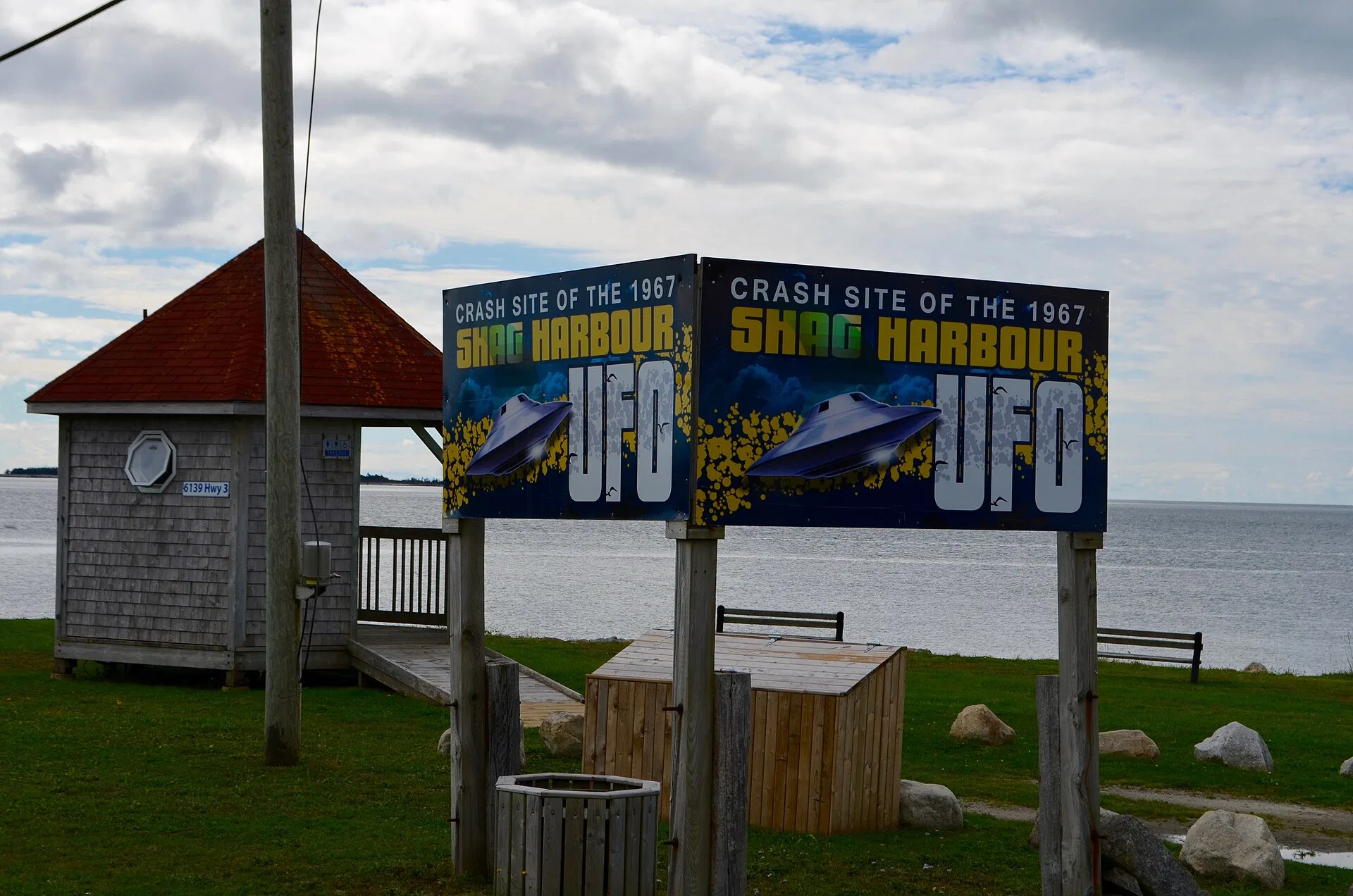
Several ordinary events could explain the lights reported at Shag Harbour on 4 October 1967, but no single explanation has been shown to fit every part of the surviving account. A meteor could resemble a bright object descending towards the sea. Aircraft lights, illumination flares or military activity could produce flashing lights and an apparent controlled approach. Fishing vessels, buoys and atmospheric refraction could account for a light apparently resting or moving on the water. None of these possibilities, however, can now be tested against photographs, radar measurements, recovered debris or precise observations of direction and duration.

That is why the case remains unresolved rather than inexplicable. The official response established that witnesses reported something unusual and that rescuers found no missing aircraft or wreckage. It did not establish that one physical object flew through the air, struck the Atlantic and then travelled beneath it. The central question is therefore not whether an ordinary explanation is imaginable, but how much of the reported sequence each explanation can account for without relying on later embellishment.
Meteor and astronomical possibilities
A bright meteor or fragmenting fireball is one of the simplest explanations for the initial descent. Seen at night over an open horizon, a meteor can appear much lower and closer than it really is. Its path may seem to end at the sea even though it remains tens or hundreds of kilometres away. Fragmentation can create several bright points, changes in colour and flashes that witnesses might interpret as lights attached to a larger object.
This possibility fits several broad elements of the Shag Harbour report: a cluster or row of luminous points, rapid downward movement and the belief that something had crashed beyond the shoreline. It also requires no missing aircraft and would naturally leave no wreckage in the harbour. The lack of reliable range information is important. Witness estimates such as “half a mile away” or descriptions of a particular angle of descent were visual judgements made at night, largely without fixed objects against which distance and altitude could be measured. The surviving public accounts do not provide the triangulated bearings needed to reconstruct a definite flight path. Library and Archives Canada preserves the case among reports classified as non-meteoric or unidentified, but that archival category records the historical assessment rather than proving that modern investigators can exclude every astronomical explanation.[Bac LAC]recherche-research.bac-lac.gc.caBac LAC1967 Shag Harbour UFO Sighting and Related Research…
A meteor becomes less convincing when the entire reported sequence is treated as one continuous event. Local accounts say the lights descended and were then followed by a yellow or pale light apparently moving or bobbing on the water. Some witnesses described four orange lights flashing in sequence before the descent, while police and residents later watched a separate-looking light offshore. A brief meteor does not ordinarily remain visible at sea level for an extended period.[barringtonmunicipality.com]barringtonmunicipality.comShag Harbour UFO Incident | Visiting UsShag Harbour UFO Incident | Visiting Us
That objection is not decisive because the sequence may have combined two unrelated sights. A fireball could have triggered the initial aircraft-crash report, after which witnesses searching a dark harbour noticed a boat, buoy or distant coastal light and assumed it marked the impact point. Once people expected to see a crashed aircraft, an otherwise ordinary light on the water could have become part of the same narrative. This “two-event” explanation is less elegant than identifying one object, but it reflects a common difficulty in night-time incidents: observers may link separate stimuli because they occur close together in time and direction.
Astronomical explanations also suffer from a basic evidential gap. No securely matched contemporary meteor observation, trajectory calculation or astronomical record has been publicly produced that places a suitable fireball over south-west Nova Scotia at approximately 11.20 pm that night. A meteor is therefore plausible as a mechanism, but not demonstrated as the solution.
Aircraft, flares and military activity
The first witnesses themselves reportedly thought that an aeroplane had crashed. That initial interpretation deserves weight because the lights were seen before Shag Harbour became associated with UFO culture. Aircraft carry multiple navigation, anti-collision and landing lights, and their apparent arrangement can change as the aircraft turns. At night, several separate lights can merge into one bright mass or appear to flash in a pattern. Aviation guidance also warns that scarce visual references make height, distance and movement difficult to judge after dark.[Federal Aviation Administration]faa.govFederal Aviation Administration Airplane Flying Handbook (3C) Chapter 11Federal Aviation Administration Airplane Flying Handbook (3C) Chapter 11
An aircraft approaching almost directly towards an observer may appear to hover because its sideways movement is slight. When it turns, descends or switches its brightest lights away from the observer, it can seem to plunge, vanish or change direction abruptly. Haze, low cloud and the lack of a visible horizon can magnify this effect. These mechanisms could reproduce the impression of an organised group of lights rather better than a meteor could.
The problem is that the Rescue Coordination Centre checked for an aviation emergency and found no reported missing aircraft. The surviving official summary, quoted in contemporary-case reporting, stated that the sighting had not been identified as a flare, float, aircraft or other known object. That finding explains why authorities passed the matter onwards as a UFO report and why a naval underwater search followed.[Global News]globalnews.caOpen source on globalnews.ca.
The wording should not be stretched too far. It means that investigators had not matched the report to an identified aircraft during their preliminary enquiries. It does not show that every aircraft visible from Shag Harbour was reconstructed by exact position, heading and lighting configuration. An aircraft need not have crashed or gone missing to generate a misleading sighting. It might have continued normally, remained outside local reporting channels or been seen at a distance much greater than witnesses assumed.
Even so, an aircraft-only explanation has difficulty with the reported light on the water. It must either dismiss that observation as an error or propose that witnesses switched attention from an aircraft to an unrelated marine light. It also lacks a confirmed flight whose position and timing match the descent. The existence of ordinary air traffic over the region is not itself an identification.
Flares
Flares are another strong candidate because they are bright, can descend slowly beneath parachutes, may flicker or change colour and can appear to hang over the sea. Several flares released in sequence could resemble a structured row of lights. Wind may carry them sideways while their gradual descent creates the impression of controlled movement. Over water, their reflections can make the display appear larger or closer to the surface.
A flare explanation becomes especially attractive in a coastal area where vessels, search-and-rescue activity and military operations were possible. It could also account for why witnesses saw light but rescuers recovered no substantial wreckage. A burned-out flare casing might be difficult to find in open water.
Yet no vessel, aircraft or military unit has been reliably identified as the source of flares at the required time and place. Contemporary investigators reportedly considered and rejected flares during their preliminary checks. That was not necessarily an exhaustive forensic exclusion, but it means the hypothesis lacks the most important supporting evidence: a launch record or credible admission from those responsible.[Global News]globalnews.caOpen source on globalnews.ca.
Flares also do not naturally explain every reported feature. A parachute flare normally descends rather than makes a sharp diagonal dive, and several independent flares need not preserve a fixed formation. Reports that the lights appeared connected to a single large object may reflect perception rather than physical structure, but they count against the simplest flare model. Stories that factory workers released flares have circulated in popular retellings, although publicly available evidence for that specific claim is weak.[Podcasts - Your Podcast Transcripts]podcasts.happyscribe.com1November 9, 2020 — On the night of October 4th, 1967, a group of rowdy factory workers lit off flares in an event that was wildly miscon…
Secret military hardware
The Cold War setting has encouraged suggestions involving surveillance equipment, experimental aircraft, missiles, satellites or foreign military hardware. The Nova Scotia coast was strategically important for monitoring North Atlantic shipping and submarines, so an initially secret military event is not inherently absurd. Contemporary officials would also have been cautious about unexplained activity near Canadian waters.[Global News]globalnews.caOpen source on globalnews.ca.
However, “classified technology” often functions as a placeholder rather than an explanation. No authenticated record has surfaced identifying a specific Canadian, American or Soviet vehicle lost at Shag Harbour. The naval search found no trace of machinery, and later claims that an object travelled underwater towards a submarine-detection facility rely mainly on retrospective and reportedly off-the-record testimony rather than the strongest contemporary documents. Reputable reporting has noted that these later stories lack hard supporting evidence.[Global News]globalnews.caOpen source on globalnews.ca.
A separate alleged naval encounter once connected with the Shag Harbour story was eventually dated to 1960, seven years before the 1967 incident. That chronological correction weakens attempts to combine the two episodes into one continuous military or underwater mystery.[Popular Mechanics]popularmechanics.comufo crash defcon mystery underwaterStyles' interviews with aging military personnel revealed stories of active, occupied crafts resting on the seabed, although many witness…

Vessels, refraction and horizon effects
A vessel is one of the most practical explanations for the light reportedly seen after the descent. Fishing boats, small craft and maritime markers can show several lights whose arrangement changes with heading, waves and the observer’s position. At night, the hull may remain invisible while only the lights are seen. A vessel turning away can appear to dim or sink; one moving beyond an island, headland or patch of fog can disappear suddenly.
This hypothesis fits Shag Harbour’s coastal setting and the description of a light moving slowly across or near the water. It also provides a straightforward source for disturbed water, wake or foam. The yellowish foam reported by searchers has sometimes been treated as physical residue from an unknown object, but no sample was preserved and analysed. Without such testing, it cannot distinguish between an impact, a vessel’s wake, naturally accumulated sea foam or material already present on the surface.
The official preliminary account reportedly stated that a “float” had not been identified as the cause. That reduces the likelihood of an obvious buoy or known marker, but it does not establish that every small vessel or distant light had been located and excluded.[Global News]globalnews.caOpen source on globalnews.ca.
Atmospheric conditions can make maritime lights still more deceptive. Mirages occur when strong temperature gradients bend light through layers of air near the surface. At sea, refraction can raise objects that are normally below the horizon, distort their apparent height, stretch or duplicate their lights and make vessels seem suspended above the water. Historical Met Office material describes mirages as products of refraction in near-surface air layers and notes that such effects can alter the apparent position of the sea horizon.[Met Office Digital]digital.nmla.metoffice.gov.ukOpen source on metoffice.gov.uk.
Refraction is therefore a useful mechanism, but not a complete case solution. No detailed meteorological reconstruction has shown that a sufficiently strong temperature inversion existed along the relevant sightline that night. Nor would mirage effects alone readily create a bright object descending rapidly from higher in the sky. Their most plausible role is as an amplifier: a distant vessel, buoy or aircraft light may have appeared displaced, enlarged or unusually mobile.
The dark maritime setting also increases the risk of perceptual error. Without reliable distance cues, the eye can interpret a small nearby light and a powerful distant light in similar ways. Separate lights may seem attached to one dark body, while movement caused by waves, an observer’s vehicle or small involuntary eye movements may be attributed to the source. Aviation training material specifically warns that night lights can blend with stars or other lighting and that groups of lights can merge into a single apparent mass.[Federal Aviation Administration]faa.govFederal Aviation Administration Airplane Flying Handbook (3C) Chapter 11Federal Aviation Administration Airplane Flying Handbook (3C) Chapter 11
Why no explanation closes the case
The most economical conventional reading is not necessarily a single mechanism. The initial descending lights may have been a meteor, aircraft or flares, while the later offshore glow may have come from a vessel, buoy or refracted coastal light. The reported foam may have been ordinary sea foam or wake noticed only because searchers were looking for evidence of a crash. This combined explanation accommodates the absence of wreckage better than a literal impact does.
Its weakness is that it cannot be verified. The surviving information lacks the measurements needed to discriminate among the possibilities:
- no photographs or film of the lights;
- no preserved sample of the foam;
- no confirmed radar track tied to the main sighting;
- no precisely surveyed witness bearings;
- no identified aircraft, vessel or flare launch matching the full report;
- no debris despite surface and underwater searches.
Those gaps work in both directions. They prevent a conventional explanation from being proved, but they also prevent confident claims that the witnesses saw a solid craft enter the sea. Library and Archives Canada describes Shag Harbour as Canada’s most famous UFO incident and confirms that the RCMP and Canadian Forces investigated it. The archive establishes the reality of the reports and official response, not the extraordinary nature of their cause.[Bac LAC]recherche-research.bac-lac.gc.caBac LAC1967 Shag Harbour UFO Sighting and Related Research…
The official statement that investigators had not identified a flare, float, aircraft or known object remains important, but it was a conclusion reached from a rapid search-and-rescue enquiry with limited evidence. “Unidentified” is the correct historical outcome. It is not equivalent to “unexplainable”, and it does not rank extraterrestrial technology above incomplete combinations of familiar events.
What the evidence supports about Explanations
Meteors explain the apparent descent but not the prolonged offshore light. Aircraft can produce organised flashing patterns but no matching flight has been established, and no aircraft was missing. Flares can drift, flicker and descend over water, yet there is no confirmed launch source. Vessels and buoys suit the later surface observation, while refraction and poor night-time depth perception could greatly distort their appearance, but they struggle to account for the initial aerial display by themselves.
The result is a genuinely unresolved Nova Scotia case with several plausible conventional pathways rather than one ordinary explanation that has been conclusively demonstrated. Later retellings have added underwater journeys, secret bases and extraordinary military encounters, but these claims are much less securely documented than the original reports, emergency response and unsuccessful search. The strongest sceptical conclusion is therefore modest: Shag Harbour does not require an exotic explanation, yet the surviving record is too sparse to determine which ordinary events produced the lights.
Amazon book picks
Further Reading
Books and field guides related to Could Ordinary Events Explain Shag Harbour?. Use these as the next step if you want deeper reading beyond the article.
The Demon-Haunted World: Science as a Candle in the Dark
NEW YORK TIMES BESTSELLER • From the renowned astronomer and author of Cosmos comes a “powerful [and] stirring defense of informed ration...

Maritime UFO Files
First published 1998. Subjects: Unidentified flying objects, Sightings and encounters.
Dark Object: The World's Only Government-Documented UFO Crash
The facts confirm the UFO crash happened. Officials deny it. What don’t they want us to know? In 1965 a massive wave of UFO sightings occ...
The Canadian UFO Report: The Best Cases Revealed
First published 2006. Subjects: Unidentified flying objects, Sightings and encounters.
eBay marketplace picks
Marketplace Samples
Live-tested eBay searches with available results related to this page.
Selected fromUFO poster oneBay.co.uk.


Current eBay listing
I Want To Believe UFO Poster Giclée Fine Art Heavyweight Print


Current eBay listing
VINTAGE UFO FLYING SAUCERS COMIC ADVERTISING A2 POSTER PRINT
Endnotes
1.
Source: canada.ca
Link:https://www.canada.ca/en/library-archives/collection/research-help/science-technology/ufos.html
Source snippet
Canada's UFOs: The search for the unknown2 Mar 2026 — The Library and Archives Canada collection of government records on UFOs was...
2.
Source: barringtonmunicipality.com
Title: Shag Harbour UFO Incident | Visiting Us
Link:https://www.barringtonmunicipality.com/Visiting-Us/shag-harbour-ufo-incident
3.
Source: podcasts.happyscribe.com
Link:https://podcasts.happyscribe.com/conspiracy-theories/shag-harbour-incident-pt
Source snippet
1November 9, 2020 — On the night of October 4th, 1967, a group of rowdy factory workers lit off flares in an event that was wildly miscon...
Published: November 9, 2020
4.
Source: recherche-research.bac-lac.gc.ca
Link:https://recherche-research.bac-lac.gc.ca/eng/public/list/43130
Source snippet
Bac LAC1967 Shag Harbour UFO Sighting and Related Research...
5.
Source: faa.gov
Title: Federal Aviation Administration Airplane Flying Handbook (3C) Chapter 11
Link:https://www.faa.gov/sites/faa.gov/files/regulations_policies/handbooks_manuals/aviation/airplane_handbook/12_afh_ch11.pdf
6.
Source: globalnews.ca
Link:https://globalnews.ca/news/3761270/canadas-best-documented-ufo-sighting-still-intrigues-50-years-on/
7.
Source: popularmechanics.com
Title: ufo crash defcon mystery underwater
Link:https://www.popularmechanics.com/science/a68066027/ufo-crash-defcon-mystery-underwater/
Source snippet
Styles' interviews with aging military personnel revealed stories of active, occupied crafts resting on the seabed, although many witness...
8.
Source: digital.nmla.metoffice.gov.uk
Link:https://digital.nmla.metoffice.gov.uk/download/file/IO_31ea0d19-1cd8-4476-abcd-0c53e045f2a6
9.
Source: digital.nmla.metoffice.gov.uk
Link:https://digital.nmla.metoffice.gov.uk/download/file/sdb%3AdigitalFile%7Cf7ccda5e-1442-4252-a6d2-fec511b5cbf4/
10.
Source: Wikipedia
Title: Landing lights
Link:https://en.wikipedia.org/wiki/Landing_lights
11.
Source: recherche-research.bac-lac.gc.ca
Link:https://recherche-research.bac-lac.gc.ca/fra/publique/liste/43130
12.
Source: digital.nmla.metoffice.gov.uk
Link:https://digital.nmla.metoffice.gov.uk/download/file/IO_0386eba2-0388-4fac-b76d-166714a77b4c
13.
Source: skeptoid.com
Link:https://skeptoid.com/episodes/565
14.
Source: groseducationalmedia.ca
Link:https://www.groseducationalmedia.ca/vsc/canada6.html
Additional References
15.
Source: weather.gov
Link:https://www.weather.gov/media/sgx/documents/The_Weather_Guide.pdf
16.
Source: weather.gov
Link:https://www.weather.gov/arx/why_halos_sundogs_pillars
17.
Source: theconspiratory.com
Link:https://theconspiratory.com/theory/shag-harbour-ufo
18.
Source: facebook.com
Link:https://www.facebook.com/CanadianCoastGuard/posts/did-you-know-the-coast-guard-once-searched-for-a-possible-ufo-in-1967-residents-/1138213549994735/
19.
Source: facebook.com
Link:https://www.facebook.com/PrairieHarborYachtClub/posts/have-you-ever-seen-a-ship-on-the-horizon-that-appears-to-be-floating-above-the-w/863412796530439/
20.
Source: facebook.com
Link:https://www.facebook.com/EdPiotrowskiWPDE/posts/kristin-rahn-captured-this-bizarre-image-of-what-looks-like-floating-hotels-beyo/1489123775909485/
21.
Source: facebook.com
Link:https://www.facebook.com/groups/803385438510648/posts/1254524716730049/
22.
Source: reddit.com
Link:https://www.reddit.com/r/UFOs/comments/vda56r/what_is_the_most_genuinely_convincing_ufo_story/
23.
Source: reddit.com
Link:https://www.reddit.com/r/aviation/comments/1iehq93/why_would_pilots_turn_landing_lights_on_and_off/
24.
Source: facebook.com
Link:https://www.facebook.com/groups/AllAboutSeaBright/posts/5157402844398581/