Within Quebec UFOs
What Do Canada's Quebec UFO Files Prove?
Police, military and aviation documents preserve Quebec sightings, but an official record is not the same as official endorsement.
On this page
- Which Canadian agencies recorded unusual sightings
- How police, military and aviation records were created
- Why preliminary reports require cautious interpretation
Page outline Jump by section
Introduction
Canada’s federal UFO files prove that people in Quebec repeatedly reported unusual things in the sky and that police, military, scientific and aviation bodies sometimes recorded or assessed those reports. They do not prove that extraterrestrial craft visited the province. Most surviving documents are administrative records: witness statements, police notes, routing slips, correspondence, reporting forms and preliminary aviation entries. Their existence shows that an observation entered a government system, not that officials endorsed the witness’s interpretation.
Quebec’s paper trail is nevertheless valuable. It reveals who received sightings, what information officials considered important, how responsibility moved between agencies and why apparently impressive files often end without a firm conclusion. It also exposes a lasting weakness: Canada never maintained one continuous, standardised investigation programme capable of giving every Quebec report the same level of scrutiny.[Canada]canada.caCanada's UFOs: The search for the unknown2 Mar 2026 — These documents were accumulated between 1947 and the early 1980s and represe…
Which Canadian agencies recorded Quebec sightings?
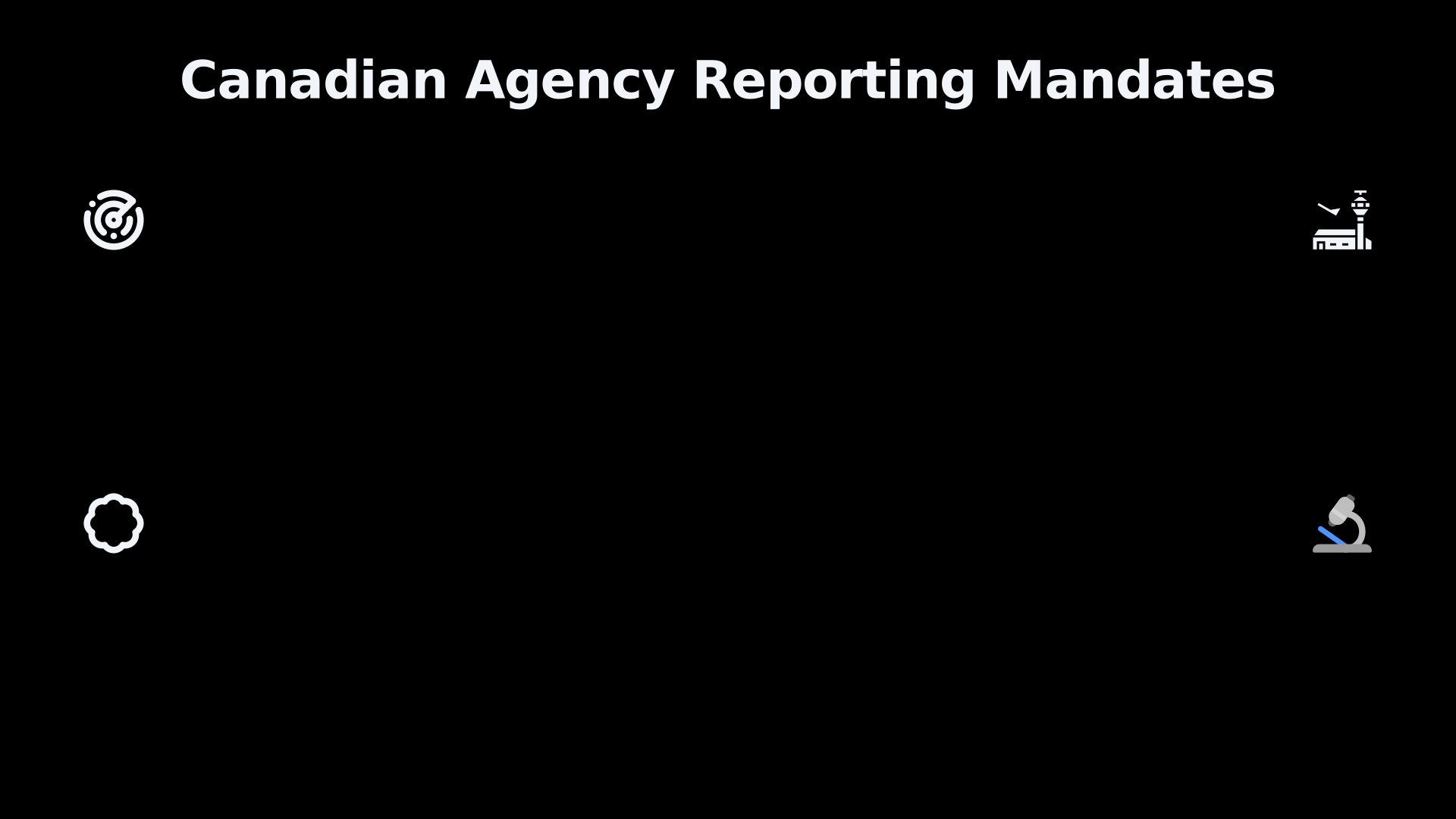
The federal archive is not the product of a single Canadian equivalent of the United States Air Force’s Project Blue Book. Library and Archives Canada says its historical UFO holdings were assembled principally from four organisations: the Department of National Defence, the Department of Transport, the National Research Council of Canada and the Royal Canadian Mounted Police. The material dates mainly from 1947 to the mid-1990s and includes more than 15,000 pages, with roughly 9,500 pages digitised.[Canada]canada.caCanada's UFOs: The search for the unknown2 Mar 2026 — These documents were accumulated between 1947 and the early 1980s and represe…
Each organisation recorded sightings for a different reason.
The Department of National Defence and the Royal Canadian Air Force were chiefly concerned with airspace, military activity and possible security implications. A report near a defence installation, radar site or flight path could therefore attract attention even when nobody believed it involved an exotic vehicle. During the early Cold War, unidentified aircraft, balloons and possible foreign surveillance were practical defence concerns.
The Department of Transport, and later Transport Canada, dealt with reports that touched civil aviation. Pilots, controllers and airport personnel were more likely to generate records because an unidentified light, object or apparent near-miss could affect flight safety. This made aviation files potentially richer than casual public accounts, but they were still normally designed to document an operational occurrence rather than solve a wider mystery.
The RCMP recorded complaints and witness statements, particularly where public safety, possible aircraft distress or suspicious activity was involved. Officers might interview witnesses, contact an airport or forward information to another department. The resulting file could be careful and detailed without containing a technical investigation or an official verdict.
The National Research Council of Canada, or NRC, became the principal federal recipient of public UFO reports in 1967. Reports were handled through the Herzberg Institute of Astrophysics and commonly placed in a “Non-Meteoritic Sightings” file, meaning observations thought not to be ordinary meteor reports. Astronomer Peter Millman and colleagues sometimes proposed explanations involving planets, stars, meteors or optical effects. The NRC stopped collecting UFO reports in 1995, after which its files were transferred to the national archives.[ISED Canada]ised-isde.canada.caISED Canada
Quebec reports could also begin outside the federal system. A witness might contact a municipal police force, the Sûreté du Québec, an airport, a newspaper or an astronomy group. The 2025 Sky Canada report confirmed that the Sûreté du Québec remains one possible contact point where a sighting raises a public-safety concern. Whether such a report later appears in federal holdings depends on whether it was forwarded, copied or connected to an agency’s mandate.[ISED Canada]ised-isde.canada.caISED Canada
That fragmented route matters. The apparent absence of a federal file does not prove that no report was made, while the presence of several documents may represent copies of the same original sighting moving between offices.
How Quebec reports became official documents
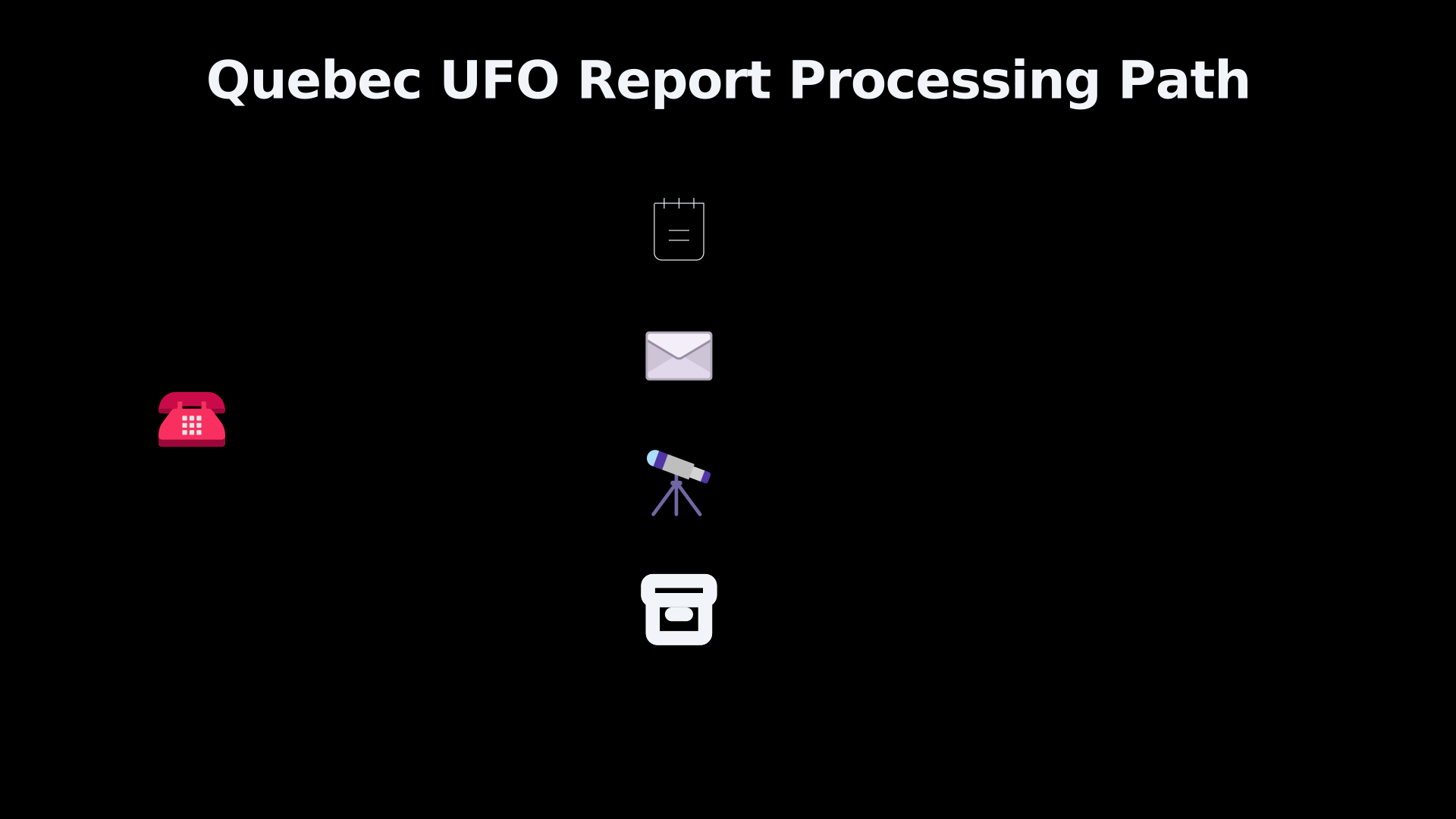
An official-looking UFO file often began with an ordinary telephone call. A resident might tell police that a luminous object was hovering over a road, moving against the wind or changing colour. An officer would note the time, direction, duration, weather, witness details and apparent movement. The report might then be sent to military authorities, Transport officials or the NRC.
This process could produce a substantial bundle of paperwork:
- an initial witness statement;
- notes from a police detachment;
- enquiries to airports, radar units or weather offices;
- a standard sighting questionnaire;
- correspondence between departments;
- an astronomical assessment;
- and a closing memorandum stating that no further action was required.
The number of pages can therefore exaggerate the amount of independent evidence. Five documents may record five stages in the handling of one account, not five corroborating observations.
Canadian officials made attempts to standardise this process. Project Second Storey, an interdepartmental committee active from 1952 to 1954, developed a reporting form intended for use across government. According to the Sky Canada review, it was never adopted widely. The committee itself did not operate as a field-investigation unit and eventually concluded that UFOs presented neither a security threat nor sufficient scientific interest to justify continued military investigation. Reports nevertheless continued to reach Defence, Transport, the RCMP and local authorities.[ISED Canada]ised-isde.canada.caISED Canada
Responsibility changed again in 1967, when the federal government transferred oversight of public UFO reporting to the NRC. This brought together older material associated with Defence’s Project Second Storey and Transport’s Project Magnet, as well as later submissions from police, officials and members of the public. The transfer created an archival centre of gravity, but not a consistently funded national investigation service.[ISED Canada]ised-isde.canada.caISED Canada
Historian Matthew Hayes, who examined Canada’s federal UFO record, found that RCMP officers generally recorded core details diligently but rarely offered a definite opinion about what a witness had seen. That restraint is easy to misread. A file marked “unexplained” may simply mean that the officer lacked enough information, expertise or reason to identify the stimulus; it does not necessarily mean that investigators ruled out aircraft, astronomy, weather or misperception.[digitalcollections.trentu.ca]digitalcollections.trentu.caa history of canada's ufo investigation, 1950-1995July 29, 2019 — 7 Apr 2022 — Thousands of pages of documentation of UFO sightings exist…
What the archive can reveal about Quebec
The strongest use of Quebec’s federal paper trail is historical rather than sensational. It helps researchers reconstruct patterns that memory and later storytelling may distort.
It establishes that reports were made
A dated police statement or departmental memo can confirm that a witness contacted an authority at the time claimed. This is more reliable than a story first published decades later. Contemporary files can also preserve the original language before later articles enlarge the object, extend its duration or add details absent from the first account.
It shows how officials tested ordinary explanations
Some files document checks with airports, meteorological services, radar personnel or astronomers. These enquiries can narrow possibilities. A confirmed meteor, aircraft, balloon or bright planet may weaken the extraordinary interpretation. Conversely, a failed identification can leave a case genuinely unresolved, although usually because evidence was insufficient rather than because every conventional explanation was eliminated.
It exposes differences between witness impressions
One Quebec observer may describe a structured object while another records only lights. An officer may estimate an elevation but not a distance. A civilian may report silence even though ambient noise or range made sound difficult to judge. These differences are not trivial; they determine whether later calculations of speed, altitude or size have any foundation.
It documents government priorities
The file’s routing often says more about governance than about the object. A report sent to Defence may have been screened for airspace risk. A Transport entry may exist because a pilot altered course. An RCMP report may reflect a call for service. An NRC memorandum may be an attempt to identify a celestial object. None of these actions amounts to institutional confirmation of a mysterious craft.
The archive also has important gaps. Library and Archives Canada’s online collection is a large digitised subset, not a perfectly indexed census of every Quebec sighting. Place names may appear in English or French, communities may be misspelt, and a report may be filed under an agency, date, detachment or technical category rather than “UFO”. Researchers looking only for “Quebec” or “Montreal” can therefore miss relevant material.[Canada]canada.caCanada's UFOs: The search for the unknown2 Mar 2026 — These documents were accumulated between 1947 and the early 1980s and represe…
A further complication is the cut-off in formal federal collection. NRC responsibility ended in 1995, so later Quebec incidents are not represented through one comparable archival series. The well-known Hotel Bonaventure sighting of November 1990 falls near the end of that era, but even a major multi-witness event should not be expected to produce one complete, unified federal dossier. Police, airport, media and civilian-investigator records may remain separated.
Why aviation files need special caution
Modern Quebec sightings involving pilots or air-traffic control may appear in Transport Canada’s Civil Aviation Daily Occurrence Reporting System, known as CADORS. The system gathers information about events involving Canadian aircraft, Canadian airspace, airports and international airspace for which Canada has accepted responsibility. Reports may originate with pilots, controllers, NAV CANADA, police, the Transportation Safety Board or other bodies.[ISED Canada]ised-isde.canada.caISED CanadaManagement of Public Reporting of Unidentified Aerial…The Sky Canada Project, led by the Office of the Chief Science Adviso…
A CADORS entry can be especially useful because it may contain a precise time, altitude, route, aircraft type and crew description. Yet it remains an occurrence record, not automatically the result of a completed investigation. Transport Canada analysts create entries from the information available, and unusual objects may be categorised under labels such as weather balloon, meteor, rocket, UFO or other operational incident. Follow-up is generally driven by aviation risk. Events that pose no serious safety concern may receive little further examination.[ISED Canada]ised-isde.canada.caISED Canada
This distinction is crucial when reading a Quebec pilot report. A pilot is usually a strong witness to matters such as relative movement, horizon position and operational effects. Pilots are not infallible judges of distance or the nature of a light lacking a clear reference point. Bright planets, satellites, meteors, balloons, drones, military activity and reflections can all produce misleading impressions, particularly at night.
Negative radar evidence must also be interpreted carefully. Failure to find a matching return may count against a large conventional aircraft in a particular location, but it does not establish that the phenomenon was a solid object. Radar coverage has limits, and some visual phenomena would not be expected to appear at all.
Why preliminary reports require cautious interpretation
The most common mistake is to treat bureaucratic language as a conclusion. In federal files, “unidentified” usually describes the state of the available information. It does not mean “unidentifiable”, and it certainly does not mean “extraterrestrial”.
Three questions help separate a useful Quebec file from a merely intriguing one.
Was the account independently corroborated? Multiple witnesses are valuable only when their observations were genuinely independent. People watching together can influence one another, while later media reports can make accounts converge.
Were objective records preserved? Radar data, air-traffic communications, photographs with reliable metadata, weather observations and contemporary maps are more useful than later estimates. Even then, each source has limitations and must be matched accurately to the time and place.
Was an explanation tested or merely mentioned? A file listing “aircraft?”, “meteor?” or “balloon?” has not necessarily evaluated those possibilities. Equally, a note saying no aircraft was reported does not prove that all aviation activity was excluded.
Canada’s recent Sky Canada review reached a broader conclusion that applies directly to Quebec: federal departments still receive occasional reports, but few investigate unless the matter falls within national security, transport safety or public safety responsibilities. The RCMP could not provide reliable UAP statistics because calls may be recorded under broader operational categories, while Transport Canada’s aviation database captures only a small and highly selective portion of public sightings.[ISED Canada]ised-isde.canada.caISED CanadaManagement of Public Reporting of Unidentified Aerial…The Sky Canada Project, led by the Office of the Chief Science Adviso…
The review also found that Canada lacks a cohesive, standardised public reporting and follow-up system. That finding weakens sweeping claims based on provincial totals. Quebec’s apparent number of official cases reflects reporting habits, population, access to police and aviation channels, archival survival and indexing practices as much as it reflects what was seen in the sky.[ISED Canada]ised-isde.canada.caISED Canada Management of Public Reporting of Unidentified AerialScience Advisor of Canada (OCSA), was initiated to review current practices surrounding public reporting…Read more…
What do Canada’s Quebec UFO files prove?
They prove that unusual aerial observations formed a recurring, legitimate administrative issue for Canadian institutions. Witnesses reported them; police documented some; military and aviation bodies screened some for risk; scientists attempted to explain some; and archivists preserved much of the resulting paperwork.
They also prove that the system was uneven. Responsibilities shifted, standard forms were inconsistently used, investigations depended on departmental mandates and later files were dispersed among aviation, policing and civilian channels. A case could remain unresolved because the observation was genuinely difficult, because evidence was lost, or simply because no agency had a reason to pursue it further.
For Quebec’s UFO history, the federal files are therefore best read as a record of claims, procedures and institutional responses. They can strengthen confidence that an incident was reported promptly and handled by identifiable officials. They can reveal corroboration, eliminate ordinary explanations or expose later embellishment. What they cannot do on their own is transform an unidentified sighting into proof of an extraordinary vehicle. The paper trail is evidence that government recorded a mystery; it is not government certification of the mystery’s most dramatic interpretation.
Amazon book picks
Further Reading
Books and field guides related to What Do Canada's Quebec UFO Files Prove?. Use these as the next step if you want deeper reading beyond the article.
UFOs: Generals, Pilots, and Government Officials Go on the Re...
NEW YORK TIMES BESTSELLER • Impeccably researched, this riveting journalistic investigation separates fact from fiction, and documents th...
UFOs and Government: A Historical Inquiry
Governments around the world have had to deal with the UFO phenomenon for a good part of a century. How and why they did so is the subjec...
The Report on Unidentified Flying Objects
Book Excerpt: ing can never be positively identified. It might have been a hallucination or it might have been some vehicle from outer sp...
The Demon-Haunted World
Rating: 4.5/5 from 43 Google Books ratings
NEW YORK TIMES BESTSELLER • From the renowned astronomer and author of Cosmos comes a “powerful [and] stirring defense of informed ration...
eBay marketplace picks
Marketplace Samples
Live-tested eBay searches with available results related to this page.
Selected fromUFO poster oneBay.co.uk.


Current eBay listing
I Want To Believe UFO Poster Giclée Fine Art Heavyweight Print

Current eBay listing
VINTAGE UFO FLYING SAUCERS COMIC ADVERTISING A2 POSTER PRINT
Endnotes
1.
Source: canada.ca
Link:https://www.canada.ca/en/library-archives/collection/research-help/science-technology/ufos.html
Source snippet
Canada's UFOs: The search for the unknown2 Mar 2026 — These documents were accumulated between 1947 and the early 1980s and represe...
2.
Source: ised-isde.canada.ca
Link:https://ised-isde.canada.ca/site/science/en/office-chief-science-advisor/sky-canada-project/management-public-reporting-unidentified-aerial-phenomena-canada
Source snippet
ISED CanadaManagement of Public Reporting of Unidentified Aerial...The Sky Canada Project, led by the Office of the Chief Science Adviso...
3.
Source: ised-isde.canada.ca
Title: ISED Canada
Link:https://ised-isde.canada.ca/site/science/sites/default/files/documents/report-sky-canada-project.pdf
4.
Source: digitalcollections.trentu.ca
Link:https://digitalcollections.trentu.ca/_flysystem/fedora/2022-04/A_History_of_Canada_s_UFO_Investigation_1950_1995.pdf
Source snippet
a history of canada's ufo investigation, 1950-1995July 29, 2019 — 7 Apr 2022 — Thousands of pages of documentation of UFO sightings exist...
Published: July 29, 2019
5.
Source: ised-isde.canada.ca
Title: ISED Canada Management of Public Reporting of Unidentified Aerial
Link:https://ised-isde.canada.ca/site/science/sites/default/files/documents/Sky-Canada-Preview-January-2025.pdf
Source snippet
Science Advisor of Canada (OCSA), was initiated to review current practices surrounding public reporting...Read more...
6.
Source: canada.ca
Link:https://www.canada.ca/en/department-national-defence/corporate/transparency/access-information-privacy/info-source-sources-of-federal-government-and-employee-information.html
7.
Source: tc.canada.ca
Title: ca4. High Altitude Object Incidents
Link:https://tc.canada.ca/en/binder/4-high-altitude-object-incidents
8.
Source: ised-isde.canada.ca
Title: preview sky canada report ocsa
Link:https://ised-isde.canada.ca/site/science/en/office-chief-science-advisor/sky-canada-project/preview-sky-canada-report-ocsa
9.
Source: canada.ca
Title: episode 053
Link:https://www.canada.ca/en/library-archives/collection/engage-learn/podcasts/discover/episode-053.html
10.
Source: canada.ca
Title: episode 054
Link:https://www.canada.ca/en/library-archives/collection/engage-learn/podcasts/discover/episode-054.html
11.
Source: ised-isde.canada.ca
Title: questions and answers about sky canada project
Link:https://ised-isde.canada.ca/site/science/en/office-chief-science-advisor/sky-canada-project/questions-and-answers-about-sky-canada-project
12.
Source: search.open.canada.ca
Link:https://search.open.canada.ca/qpnotes/record/tc%2CTC-2022-QP-00005
13.
Source: ised-isde.canada.ca
Link:https://ised-isde.canada.ca/site/science/sites/default/files/documents/rapport-sky-canada.pdf
14.
Source: ised-isde.canada.ca
Title: sky canada project
Link:https://ised-isde.canada.ca/site/science/en/office-chief-science-advisor/sky-canada-project
15.
Source: parks.canada.ca
Title: ca First World War Internment Exhibit
Link:https://parks.canada.ca/lhn-nhs/ab/caveandbasin/culture/internement-internment
16.
Source: search.open.canada.ca
Title: ca Notice: Basic HTML
Link:https://search.open.canada.ca/opendata/?page=1554&sort=metadata_modified+desc&subject=Science+and+Technology++Sciences+et+technologie&wbdisable=true
17.
Source: inspection.canada.ca
Link:https://inspection.canada.ca/en/animal-health/terrestrial-animals/diseases/reportable/avian-influenza/latest-bird-flu-situation/status-province
18.
Source: ised-isde.canada.ca
Title: trademark search
Link:https://ised-isde.canada.ca/cipo/trademark-search/1157822
19.
Source: inspection.canada.ca
Link:https://inspection.canada.ca/en/plant-health/invasive-pests-and-plants/directives/invasive-alien-species/95-03
20.
Source: tc.canada.ca
Title: canadian aviation regulation advisory council carac
Link:https://tc.canada.ca/en/corporate-services/acts-regulations/list-regulations/canadian-aviation-regulations-sor-96-433/canadian-aviation-regulation-advisory-council-carac
21.
Source: tc.canada.ca
Title: ca RP A—Remotely Piloted Aircraft
Link:https://tc.canada.ca/sites/default/files/2026-03/aim-2026-1_rpa_en.pdf
22.
Source: archives.gov
Title: presidential libraries
Link:https://www.archives.gov/research/topics/uaps/presidential-libraries
23.
Source: rcmp.ca
Title: genealogy and archival research
Link:https://www.rcmp.ca/en/history-rcmp/genealogy-and-archival-research
24.
Source: youtube.com
Title: Somewhere in the Skies | Canada’s UFO Files Declassified with Chris Rutkowski
Link:https://www.youtube.com/watch?v=VNTh1JMO8bc
Source snippet
Canada government UFO files Library Archives Canada Book explores UFOs in Canada CTV News...
25.
Source: nationalarchives.gov.uk
Title: ufo reports
Link:https://www.nationalarchives.gov.uk/explore-the-collection/explore-by-time-period/postwar/ufo-reports/
26.
Source: vice.com
Title: canada military rcaf ufos sightings
Link:https://www.vice.com/en/article/canada-military-rcaf-ufos-sightings/
Additional References
27.
Source: activehistory.ca
Title: And quite a lot of them too.Read more
Link:https://activehistory.ca/blog/2017/02/10/canada-ufos-and-wishful-thinking-2/
Source snippet
Active HistoryCanada, UFOs, and Wishful Thinking - Active HistoryFeb 10, 2017 — But as interesting as all that is, what excites me more i...
28.
Source: youtube.com
Title: What the Canadian government knows about UFOs
Link:https://www.youtube.com/watch?v=ntyUWhbtcqM
Source snippet
Chris Rutkowski on Canada's UFOs, Government UFO Consultation and Nearly Five Decades of Research...
29.
Source: publicsafety.gc.ca
Link:https://www.publicsafety.gc.ca/lbrr/archives/cnsgc00004071-3-3-eng.pdf
30.
Source: reddit.com
Link:https://www.reddit.com/r/UFOs/comments/198e3pq/canadian_ufo_flight_reports/
31.
Source: science.gc.ca
Link:https://science.gc.ca/site/science/en/office-chief-science-advisor/sky-canada-project/management-public-reporting-unidentified-aerial-phenomena-canada
32.
Source: youtube.com
Link:https://www.youtube.com/watch?v=psGxOznGuiM
Source snippet
Declassified UFO sightings...
33.
Source: youtube.com
Title: Book explores UFOs in Canada
Link:https://www.youtube.com/watch?v=eMUmy3Ubcbw
Source snippet
Somewhere in the Skies | Canada's UFO Files Declassified with Chris Rutkowski...
34.
Source: facebook.com
Title: a major ufo conference is coming to canada for the first time this summer bringi
Link:https://www.facebook.com/604Now/posts/a-major-ufo-conference-is-coming-to-canada-for-the-first-time-this-summer-bringi/1727744582690384/
35.
Source: facebook.com
Title: we may not be area 51 but did you know that we hold a vast collection of ufo fil
Link:https://www.facebook.com/LibraryArchives/posts/we-may-not-be-area-51-but-did-you-know-that-we-hold-a-vast-collection-of-ufo-fil/588151890149717/
36.
Source: dam-oclc.bac-lac.gc.ca
Title: bac-lac.gc.ca DETAINE E RIGHTS AND STATE OBLIGATIONS
Link:https://dam-oclc.bac-lac.gc.ca/download?fileName=Reeves-Darin-LLM-Law-August-2014.pdf&id=a460e332-66c5-4b14-9121-042b5e2adfa3&is_thesis=1&oclc_number=1032924286