Within Saskatchewan
What Do Saskatchewan's Official UFO Records Prove?
RCMP, military and Transport Canada files show that a report was logged, not that authorities verified an exotic craft.
On this page
- RCMP scene checks and witness statements
- Military and air traffic reporting channels
- Why an official file is not official confirmation
Page outline Jump by section
Introduction
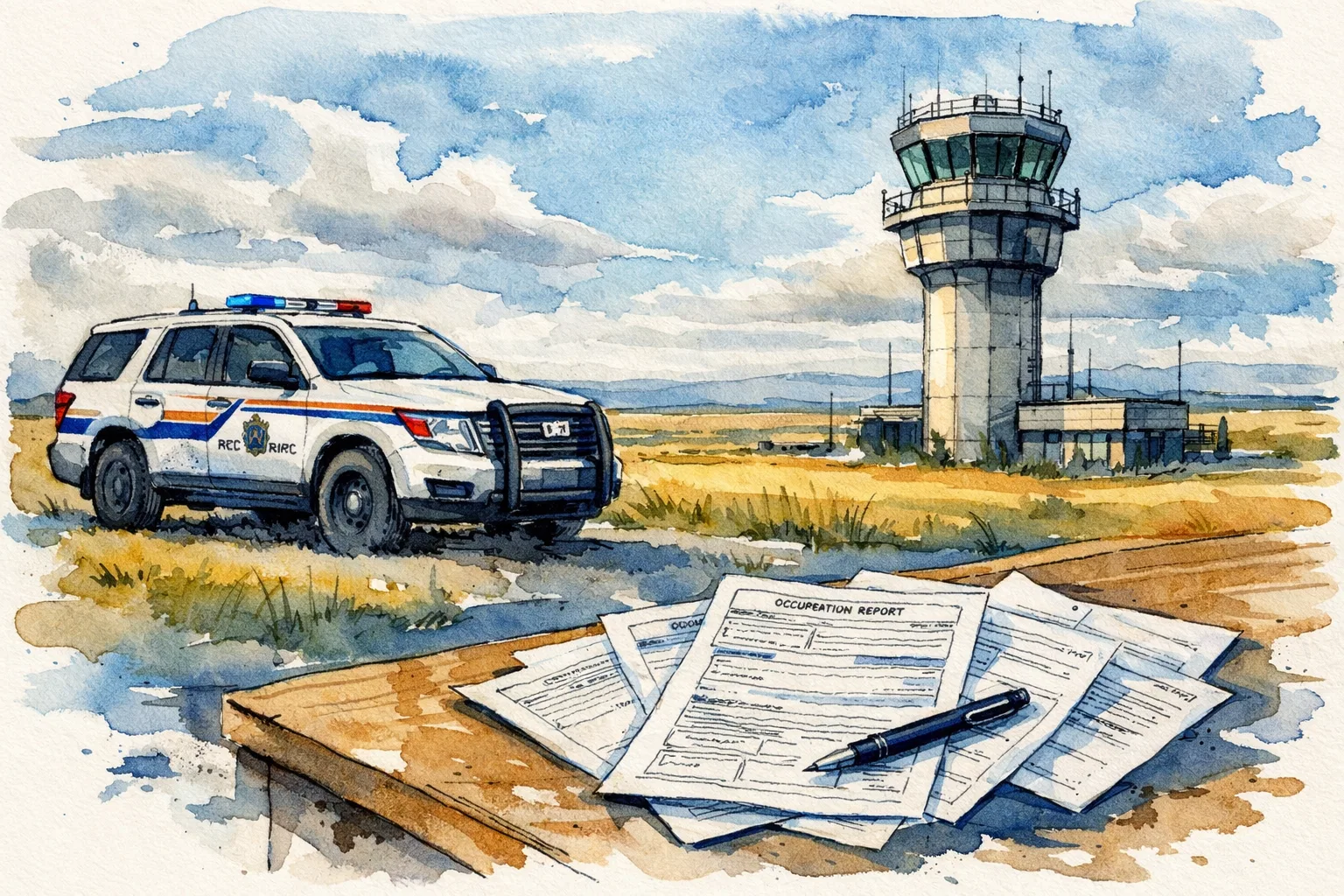
A Saskatchewan UFO report enters an official record when it reaches an agency through an existing policing, aviation-safety or defence channel. That record proves that someone reported an unusual event and that officials logged, assessed or sometimes examined it. It does not prove that the object was an extraordinary craft, still less an extraterrestrial one.
The route depends on the circumstances. A resident may call the Royal Canadian Mounted Police (RCMP), prompting a local incident file and perhaps witness interviews or a scene check. A pilot usually reports through air traffic control, after which information may pass from NAV CANADA to Transport Canada’s Civil Aviation Daily Occurrence Reporting System, known as CADORS. Military authorities may become involved when radar activity, restricted airspace, national security or flight safety is at issue. Canada has no single, comprehensive UFO investigation service connecting all these routes, so Saskatchewan reports can be scattered among differently classified files.[ISED Canada]canada.caISED CanadaISED Canada

RCMP scene checks and witness statements
For a Saskatchewan resident on the ground, the RCMP is often the most obvious official contact. This is particularly true outside larger cities, where the force provides local policing. A caller describing unusual lights, a low-flying object, damaged vegetation or suspected aircraft activity may therefore generate a police occurrence record even though the RCMP has no dedicated UFO-investigation programme.[ISED Canada]canada.caISED Canada
The first decision is not whether the caller has seen an alien spacecraft. Police assess whether the report suggests an immediate public-safety issue, a possible offence or some other matter within their mandate. Relevant questions may include whether an aircraft appears to be in distress, whether an unauthorised drone is present, whether someone has entered private property, whether dangerous debris has fallen, or whether the sighting is connected with suspicious activity.
The federal Sky Canada Project found that the RCMP generally does not investigate unidentified aerial phenomena merely because they are unexplained. The force has no formal national policy specifically governing the collection and circulation of UFO reports. Such calls may be entered as non-criminal incidents under an Aeronautics Act-related category, but they can also be classified more generally—for example, as a suspicious vehicle. That inconsistency makes it difficult to count Saskatchewan UFO calls retrospectively: a search for “UFO” will not necessarily find every relevant file.[ISED Canada]canada.caISED Canada

What a local inquiry can establish
Where circumstances justify attendance, an officer can document useful facts:
- the witness’s account, including time, direction, duration and apparent movement;
- the condition of the witness and whether other people saw the same event;
- photographs, sketches or measurements supplied or made at the scene;
- visible damage, tracks, debris or signs of trespass;
- nearby aircraft, weather or emergency activity known at the time;
- referrals to aviation, military or scientific bodies.
These steps can strengthen the evidence that a report was made promptly and that described physical features really existed. They do not, by themselves, determine what produced those features.
The distinction is central to Saskatchewan’s best-known case. After Edwin Fuhr reported five hovering objects near Langenburg in September 1974, RCMP involvement helped move the story beyond an unrecorded personal recollection. Police saw circular disturbances in the vegetation and gathered information about his account. The surviving narrative therefore contains limited external corroboration for the presence of marks at the reported location. It does not contain independent police observation of the alleged objects or forensic results demonstrating that a flying machine created the circles.[langenburg.ca]langenburg.caufo sightings45 years ago, The Town of Langenburg became an international sensation! On September 1st, 1974 former farmer Edwin Fuhr faced an incredib…
This is how an official file can be both historically important and evidentially modest. It may preserve the witness’s words, establish what an officer observed afterwards and show that no obvious crime was detected. It cannot retrospectively supply radar data, photographs or independent witnesses that were absent from the event.
Military and air-traffic reporting channels
Reports made from aircraft follow a different path. Pilots who see unexplained lights or objects normally tell the nearest air traffic control tower, flight service station or other air-traffic unit. That unit prepares an Aviation Occurrence Report for NAV CANADA. Relevant information is then sent to Transport Canada, whose analysts decide whether to create a CADORS entry. Members of the public can also submit an aviation incident directly to Transport Canada, although publication in CADORS depends on whether the report meets its inclusion criteria.[ISED Canada]canada.caISED Canada
CADORS is an aviation-occurrence system, not a catalogue of verified UFOs. It records initial information about events involving Canadian-registered aircraft, Canadian airports and Canadian-controlled airspace. Its much broader contents include equipment problems, bird strikes, operational mistakes, laser incidents and other events relevant to aviation safety. NAV CANADA supplies about four-fifths of the occurrence information used in its records; other sources can include aircraft operators, police, the Transportation Safety Board and members of the public.[canada.ca]tc.canada.caTransport Canada4. High Altitude Object IncidentsTransports Canada11 Aug 2023 — Transport Canada collects aviation occurrence information through the Civil Aviation Daily Occurrence Repo…
An unexplained Saskatchewan sighting may be placed under a CADORS event category covering “Weather Balloon, Meteor, Rocket, UFO and Intelligence Sighting”, or under another operational category depending on the information available. The grouping itself demonstrates why the word “UFO” in a database field should not be read as a conclusion. The category accommodates multiple possible causes and serves the practical purpose of routing and retrieving reports.[ISED Canada]canada.caISED Canada

From cockpit observation to database entry
A simplified reporting chain looks like this:
- A pilot or crew member observes something unusual. The description may initially be no more than lights, an apparent object, unexpected movement or a perceived conflict with the aircraft’s route.
- The crew reports it to air traffic control. Controllers may ask other aircraft whether they can see the same thing and check known traffic or operational information.
- NAV CANADA creates an aviation occurrence report. This preserves the operational account rather than attempting a complete scientific explanation.
- Transport Canada assesses the report for CADORS. Analysts summarise the event and assign categories based on the available details.
- Further agencies may be alerted when warranted. Transport Canada, the Transportation Safety Board, NAV CANADA or the North American Aerospace Defense Command (NORAD) may become involved if the occurrence suggests an aviation hazard, airspace violation, security concern or possible threat. ISED Canada
A useful Saskatchewan-area example came on 19 January 2024, when several airline crews reported unusual lights above the Canadian Prairies, including observations made while flying over Saskatchewan. The reports were heard by air traffic control and entered into the Canadian aviation-occurrence system; Canadian air-defence authorities were reportedly notified. The strength of the record lies in its multiple professional witnesses and contemporaneous operational reporting. Yet the official entry still did not certify the lights as exotic vehicles. Suggested possibilities included satellites or sunlight effects, while the incomplete positional and sensor evidence prevented a firm public identification. ISED Canada
CADORS records are explicitly preliminary. Their purpose is to distribute timely safety information and support trend analysis, normal operational reporting and any appropriate follow-up. Transport Canada has stated that unidentified-object reports can be difficult to pursue precisely because the object, location or origin may not be sufficiently defined. Unless a case presents a serious safety or regulatory concern, it may be logged without a prolonged attempt to solve it. Open Government Portal+2VICE
When defence authorities become involved
The Royal Canadian Air Force and NORAD do not operate as general public UFO-identification services. Their central concern is whether activity in or approaching Canadian airspace represents an identifiable aircraft, a potential threat, an airspace violation or a distress situation. A report may reach them through military sensors, operational networks, Transport Canada or NAV CANADA, but unexplained civilian sightings are not routinely subjected to a dedicated military UFO investigation. ISED Canada
The Sky Canada review reported that Defence Research and Development Canada had no formal programme or mandate to receive and analyse public UFO sightings. The Royal Canadian Air Force likewise does not typically investigate unexplained phenomena outside threat or distress contexts. Consequently, the phrase “reported to NORAD” means that information reached an aerospace-defence organisation for operational awareness or assessment; it does not mean that NORAD confirmed an anomalous craft. ISED Canada
This distinction matters in Saskatchewan because aircraft cross the province on major east–west and north–south routes, while military and civilian surveillance responsibilities extend far beyond provincial borders. A light observed over Saskatchewan might therefore be described in a record created by a controller elsewhere, attached to a flight originating in another province or assessed as part of a wider Prairie airspace event. “Saskatchewan report” does not always mean that the file was opened by a Saskatchewan office.
How historical files reached the archives
Canada’s historical arrangements were different. From the late 1940s through the early 1980s, federal departments accumulated thousands of pages concerning unusual aerial sightings. The records include correspondence, police reports, memoranda, procedures and standard reporting forms—not merely conclusions about individual cases. Library and Archives Canada describes approximately 9,500 digitised documents from that period, while the wider collection extends to more than 15,000 pages and includes material originating with National Defence, the Department of Transport, the National Research Council and the RCMP. Canada
Responsibility shifted over time. In the early 1950s, the Defence Research Board’s Project Second Storey developed a standard sighting form intended to improve information sharing among government departments, although it was not widely adopted. Between 1954 and 1967, reports continued to arrive through police, defence and transport channels. In 1967, responsibility for receiving many federal UFO reports was transferred to the National Research Council, which collected submissions from the public, municipalities, the RCMP and National Defence until the mid-1990s. ISED Canada
The National Research Council’s role was partly scientific but generally prosaic. Astronomers could compare descriptions with planets, bright stars, meteors, fireballs and atmospheric effects. Reports considered potentially meteoritic were useful because a bright fireball might lead to the recovery of a meteorite. Other cases were filed as non-meteoritic observations. An unresolved designation usually reflected insufficient information or the absence of a persuasive identification; it did not establish that investigators had excluded every conventional cause. ISED Canada
For Saskatchewan history, this archival structure has two consequences. First, a case may appear in more than one institutional trail—for example, a local RCMP report followed by correspondence with the National Research Council. Second, surviving files reflect what happened to be forwarded and retained. They are not a complete census of everything Saskatchewan residents saw. Many people told only relatives, newspapers or private UFO groups, while some police calls were recorded under broad categories that cannot now be reliably isolated.
Why an official file is not official confirmation
Official records are valuable because they can fix a report in time and reveal how authorities responded. Their evidential weight depends on what they actually contain.
An RCMP file may confirm that an officer interviewed a witness and observed circular marks. A CADORS entry may confirm that pilots reported lights to controllers and that aviation officials circulated the information. A military message may confirm that air-defence personnel were notified. None of those facts automatically validates the witness’s interpretation.
The most useful way to read an official Saskatchewan UFO record is to separate four different questions:
Was the report received?
A file number, occurrence summary or dated memorandum usually answers this well.
What was independently observed?
Police photographs, controller recordings, radar data and multiple independent witnesses carry more weight than a summary repeating one person’s claim.
How much investigation occurred?
Logging, referral, a scene visit and a technical investigation are different levels of official activity. A record may close after a basic safety check without any attempt to determine the ultimate cause.
What conclusion did the agency reach?
Terms such as “unidentified”, “unknown” or “UFO” often mean that the available report did not permit identification. They should not be expanded into conclusions that the document itself does not make.
This approach prevents two opposite errors. One is dismissing every official file as meaningless bureaucracy: contemporaneous statements and operational records can preserve information unavailable elsewhere. The other is treating government paperwork as proof that officials endorsed an extraordinary explanation. Saskatchewan’s records support a narrower conclusion: unusual aerial reports have repeatedly entered Canadian systems because police, aviation and defence agencies need to document possible hazards, offences and airspace concerns, even when the object’s identity remains uncertain.
A fragmented record, not a single Saskatchewan UFO archive
Canada’s 2025 Sky Canada report found that public reporting remains fragmented, with no cohesive, standardised national system joining police, aviation, defence, scientific and civilian submissions. Different agencies collect different details for different purposes, and there is little consistent follow-up when a report presents no apparent safety or security risk. A national survey commissioned for the project also found that many witnesses did not know whom to contact, reinforcing the likelihood that official totals substantially understate public experiences. Science.gc.ca+2ISED Canada
For researchers, this means Saskatchewan’s official record must be reconstructed rather than opened as a single collection. Historical cases are most likely to surface through Library and Archives Canada, old RCMP material and National Research Council correspondence. Modern aviation cases appear principally through CADORS and associated air-traffic records. More recent police reports may remain difficult to identify because the RCMP lacks a UFO-specific classification and releases can be limited by privacy, operational and records-management rules.
The result is uneven but still useful. Official records can show who reported what, when, through which channel and what authorities did next. They are strongest when they preserve independent observations, precise timings, sensor information or physical documentation. They are weakest when they merely repeat an uncorroborated description. In Saskatchewan’s UFO history, official status should therefore be understood as evidence of documentation and institutional response—not a government certificate that an extraordinary craft was present.
Amazon book picks
Further Reading
Books and field guides related to What Do Saskatchewan's Official UFO Records Prove?. Use these as the next step if you want deeper reading beyond the article.
The UFO Experience: A Scientific Inquiry
Cited by the New York Review of Books as "the best brief for visitation," this classic study presents an analysis of UFO reports and conc...
UFOs: Generals, Pilots, and Government Officials Go on the Re...
NEW YORK TIMES BESTSELLER • Impeccably researched, this riveting journalistic investigation separates fact from fiction, and documents th...
UFOs and Government: A Historical Inquiry
Governments around the world have had to deal with the UFO phenomenon for a good part of a century. How and why they did so is the subjec...
The Report on Unidentified Flying Objects
Book Excerpt: ing can never be positively identified. It might have been a hallucination or it might have been some vehicle from outer sp...
eBay marketplace picks
Marketplace Samples
Live-tested eBay searches with available results related to this page.
Selected fromUFO poster oneBay.co.uk.

Current eBay listing
VINTAGE UFO FLYING SAUCERS COMIC ADVERTISING A2 POSTER PRINT

Current eBay listing
I Want To Believe UFO Poster Giclée Fine Art Heavyweight Print

Endnotes
2.
Source: science.gc.ca
Link:https://science.gc.ca/site/science/en/office-chief-science-advisor/sky-canada-project/preview-sky-canada-report-ocsa
Source snippet
Preview: Sky Canada Report from the Office of the Chief...15 Jan 2025 — The Sky Canada Project has highlighted several gaps and areas fo...
3.
Source: ised-isde.canada.ca
Link:https://ised-isde.canada.ca/site/science/en/office-chief-science-advisor/sky-canada-project/management-public-reporting-unidentified-aerial-phenomena-canada
Source snippet
ISED CanadaManagement of Public Reporting of Unidentified Aerial...NAV CANADA provides about 80% of the aviation occurrence information...
4.
Source: langenburg.ca
Title: ufo sightings
Link:https://langenburg.ca/p/ufo-sightings
Source snippet
45 years ago, The Town of Langenburg became an international sensation! On September 1st, 1974 former farmer Edwin Fuhr faced an incredib...
5.
Source: canada.ca
Link:https://www.canada.ca/en/library-archives/collection/research-help/science-technology/ufos.html
Source snippet
Canada's UFOs: The search for the unknown2 Mar 2026 — These documents were accumulated between 1947 and the early 1980s and represe...
6.
Source: tc.canada.ca
Title: Transport Canada4. High Altitude Object Incidents
Link:https://tc.canada.ca/en/binder/4-high-altitude-object-incidents
Source snippet
Transports Canada11 Aug 2023 — Transport Canada collects aviation occurrence information through the Civil Aviation Daily Occurrence Repo...
7.
Source: search.open.canada.ca
Link:https://search.open.canada.ca/qpnotes/record/tc%2CTC-2022-QP-00005
8.
Source: vice.com
Title: the truth is out there but this company holding ufo info wont share it
Link:https://www.vice.com/en/article/the-truth-is-out-there-but-this-company-holding-ufo-info-wont-share-it/
9.
Source: science.gc.ca
Link:https://science.gc.ca/site/science/en/office-chief-science-advisor/sky-canada-project/management-public-reporting-unidentified-aerial-phenomena-canada
10.
Source: science.gc.ca
Title: sky canada report
Link:https://science.gc.ca/site/science/sites/default/files/documents/sky-canada-report.pdf
11.
Source: rcmp.ca
Title: Women in the RCMP | Royal Canadian Mounted Police
Link:https://rcmp.ca/en/history-rcmp/women-rcmp
12.
Source: rcmp.ca
Title: Women in the RCMP | Royal Canadian Mounted Police
Link:https://rcmp.ca/en/history-rcmp/women-rcmp?wbdisable=false
13.
Source: rcmp.ca
Link:https://rcmp.ca/en/campaigns-and-promotions/50th-anniversary-women-police-officers-rcmp-celebrating-women
14.
Source: rcmp.ca
Link:https://rcmp.ca/en/gazette/four-members-troop-17-reflect-earning-credibility-and-sticking-together
15.
Source: canada.ca
Title: RCM P commemorates 35-year anniversary of female Mounties
Link:https://www.canada.ca/en/news/archive/2009/09/rcmp-commemorates-35-year-anniversary-female-mounties.html
16.
Source: canada.ca
Title: RCM P to commemorate the 35th anniversary of female Mounties
Link:https://www.canada.ca/en/news/archive/2009/09/rcmp-commemorate-35th-anniversary-female-mounties.html
17.
Source: canada.ca
Title: episode 053
Link:https://www.canada.ca/en/library-archives/collection/engage-learn/podcasts/discover/episode-053.html
18.
Source: parks.canada.ca
Title: ca Join our emailing list
Link:https://parks.canada.ca/pn-np/ab/jasper/gestion-management/courriel-email
19.
Source: tc.canada.ca
Title: ca In This Issue
Link:https://tc.canada.ca/sites/default/files/2023-08/ASL-2-2023.pdf
20.
Source: canada.ca
Title: short billed dowitcher 2024
Link:https://www.canada.ca/en/environment-climate-change/services/species-risk-public-registry/cosewic-assessments-status-reports/short-billed-dowitcher-2024.html
21.
Source: canada.ca
Title: episode 054
Link:https://www.canada.ca/en/library-archives/collection/engage-learn/podcasts/discover/episode-054.html
22.
Source: canada.ca
Title: plains minnow 2025
Link:https://www.canada.ca/en/environment-climate-change/services/species-risk-public-registry/recovery-strategies/plains-minnow-2025.html
23.
Source: canada.ca
Title: minister anandprovides an important national security update
Link:https://www.canada.ca/en/department-national-defence/news/2023/02/minister-anandprovides-an-important-national-security-update.html
24.
Source: canada.ca
Title: macropis cuckoo bee 2025
Link:https://www.canada.ca/en/environment-climate-change/services/species-risk-public-registry/cosewic-assessments-status-reports/macropis-cuckoo-bee-2025.html
25.
Source: inspection.canada.ca
Title: rmd 08 02
Link:https://inspection.canada.ca/en/plant-health/invasive-species/directives/pest-risk-management/rmd
26.
Source: canada.ca
Title: black tailed prairie dog 2024
Link:https://www.canada.ca/en/environment-climate-change/services/species-risk-public-registry/cosewic-assessments-status-reports/black-tailed-prairie-dog-2024.html
27.
Source: canada.ca
Title: least bittern 2024
Link:https://www.canada.ca/en/environment-climate-change/services/species-risk-public-registry/cosewic-assessments-status-reports/least-bittern-2024.html
28.
Source: canada.ca
Link:https://www.canada.ca/en/environment-climate-change/services/species-risk-public-registry/imminent-threat-assessments/caribou-rangifer-tarandus-boreal-population.html
29.
Source: canada.ca
Link:https://www.canada.ca/content/dam/eccc/documents/pdf/corporate-info/transitional-material/ECCC%20-%20Early%20Actions%20and%20Priority%20Files_Redacted.pdf
30.
Source: canadashistory.ca
Title: Women on the Force
Link:https://www.canadashistory.ca/Explore/Women/Women-on-the-Force
31.
Source: Wikipedia
Link:https://es.wikipedia.org/wiki/UFO
32.
Source: facebook.com
Link:https://www.facebook.com/groups/472456403800111/posts/650279862684430/
33.
Source: ufo-canada.branchoria.com
Title: rcmp file
Link:https://ufo-canada.branchoria.com/rcmp-file/
34.
Source: revenantjournal.com
Link:https://www.revenantjournal.com/contents/search-for-the-unknown-canadas-ufo-files-and-the-rise-of-conspiracy-theory-by-matthew-hayes-montreal-quebec-mcgill-queens-university-press-2022-isbn-978-0228010746-210pp-34/
35.
Source: aa.com.tr
Title: canada ufo sightings include reports from airline crews
Link:https://www.aa.com.tr/en/americas/canada-ufo-sightings-include-reports-from-airline-crews/3120051
36.
Source: canadaufohistory.com
Link:https://www.canadaufohistory.com/1954-1966
37.
Source: thecanadareport.ca
Title: canada military ufo uap records
Link:https://www.thecanadareport.ca/canada-military-ufo-uap-records/
Additional References
38.
Source: tsb.gc.ca
Title: Transportation Safety Board of Canada Backgrounder
Link:https://www.tsb.gc.ca/eng/medias-media/fiches-facts/a17o0038/a17o0038-20190131-03.html
Source snippet
Transportation Safety Board of CanadaBackgrounder - Transportation Safety Board of Canada31 Jan 2019 — Transport Canada's Civil Aviation...
39.
Source: youtube.com
Title: Chris Rutkowski launch of Canada’s UFOs: Declassified (August Night Press)
Link:https://www.youtube.com/watch?v=bcSI4rw0M4Q
Source snippet
Unexplained phenomena in small town Saskatchewan 50 years ago: were there UFOs seen in Langenburg?...
40.
Source: youtube.com
Link:https://www.youtube.com/watch?v=qaS94Z2IZG4
Source snippet
The Summer of UFOs: Canada's 1975 Wave (with Chris Rutkowski)...
41.
Source: war.gov
Link:https://www.war.gov/ufo/
42.
Source: youtube.com
Link:https://www.youtube.com/watch?v=4eG7Z5de1D0
Source snippet
Edwin Fuhr and the 1974 Langenburg, Saskatchewan UFO Event...
43.
Source: youtube.com
Link:https://www.youtube.com/watch?v=z08f_5lD8ys
Source snippet
What Do We Know About UFOs? | The Agenda...
44.
Source: albertabicycle.ab.ca
Link:https://www.albertabicycle.ab.ca/uploads/files/Documents/media/2005/_Spin200503_web.pdf
45.
Source: unexplained-mysteries.com
Link:https://www.unexplained-mysteries.com/news/374299/audio-pilots-discuss-sightings-of-triangular-ufo-formation-over-canada
46.
Source: medium.com
Link:https://medium.com/vice/canadian-military-documents-ufo-sightings-intelligence-report-reveals-6ddc25b87706
47.
Source: facebook.com
Link:https://www.facebook.com/PureCountry927/posts/early-on-jan-19-several-pilots-reported-multiple-lights-sometimes-in-a-triangle-/781418787337511/