Within Friedman Archive
Why Friedman's UFO Archive Is So Hard to Process
Five cargo vans of mixed papers, recordings and objects turned Friedman's collection into an unusually demanding archival project.
On this page
- What arrived in the five cargo vans
- How archivists organise mixed and disordered records
- What digitisation does not make instantly accessible
Page outline Jump by section
Introduction
The Stanton T. Friedman fonds at the Provincial Archives of New Brunswick is one of the largest private UFO research collections ever donated to a Canadian public archive. Its preservation is difficult not because of the subject matter alone, but because of the collection’s sheer size, mixed formats and highly disordered state. Archivists have described receiving roughly five cargo vans of material from Friedman’s Fredericton home, containing everything from correspondence and government records to audio tapes, photographs, artefacts and personal memorabilia. Turning that accumulation into a usable archival collection is a long-term process that involves far more than placing boxes on shelves.[activehistory.ca]activehistory.caActive History Archivists in Isolation – Active HistoryActive HistoryArchivists in Isolation – Active HistoryMay 12, 2020…

For New Brunswick, this work has broader significance. The collection documents decades of Canadian and international UFO research carried out from Fredericton, making it both a provincial historical resource and an unusually complex preservation project.
What arrived in the five cargo vans
The biggest challenge began with the condition of the donation itself. According to staff at the Provincial Archives of New Brunswick, the Friedman fonds filled approximately five cargo vans and occupied several rooms during processing. Archivists estimated that what was visible in one processing room represented only a fraction of the total collection.[Active History]activehistory.caActive History Archivists in Isolation – Active HistoryActive HistoryArchivists in Isolation – Active HistoryMay 12, 2020…
Unlike many archival donations that arrive with some existing filing system, Friedman’s working papers reflected decades of active research. Materials included:
- handwritten notes and research files;
- correspondence with witnesses, researchers and journalists;
- lecture notes, travel itineraries and speaking records;
- photographs, negatives and slides;
- audio cassettes and video recordings;
- copies of government records obtained through freedom of information requests;
- manuscripts, draft articles and book material;
- physical objects including promotional items, artwork and unusual artefacts collected during investigations.[Active History]activehistory.caActive History Archivists in Isolation – Active HistoryActive HistoryArchivists in Isolation – Active HistoryMay 12, 2020…
Many of these different media were intermixed within the same boxes. That makes preservation substantially more difficult than processing a collection consisting only of paper records.
How archivists organise mixed and disordered records
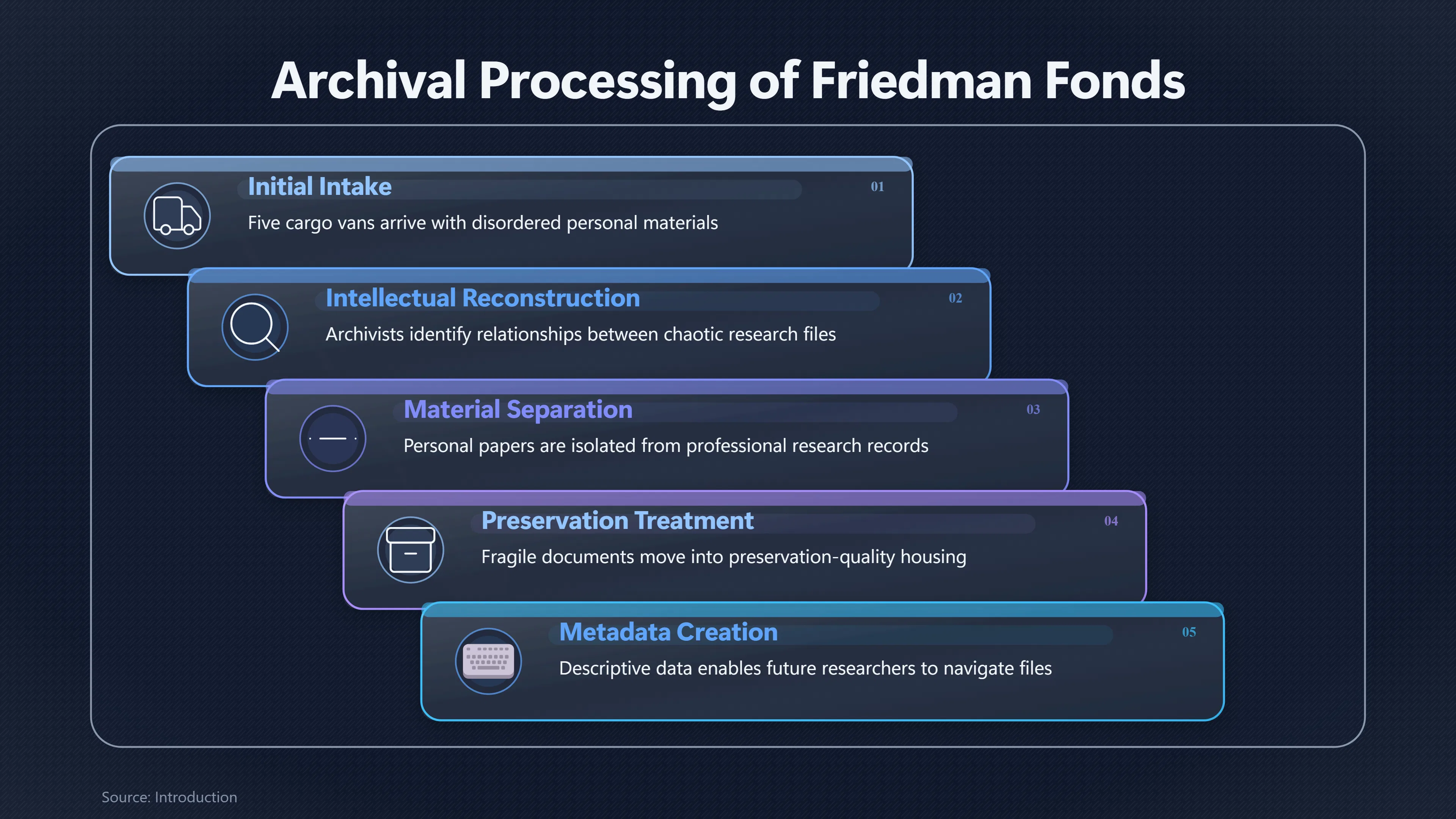
One common misconception is that archives simply catalogue donated material. In reality, large personal collections must first be intellectually reconstructed before researchers can use them.
Archivists processing the Friedman fonds have publicly described it as “chaotic” and the greatest challenge of one archivist’s two-decade career. Their work involves identifying how records relate to one another, separating unrelated material, preserving the original context where possible, and creating descriptions that allow future researchers to understand how Friedman actually worked rather than merely what subjects interested him.[Active History]activehistory.caActive History Archivists in Isolation – Active HistoryActive HistoryArchivists in Isolation – Active HistoryMay 12, 2020…
This arrangement process generally includes several distinct tasks:
- identifying duplicate material without destroying useful research evidence;
- separating personal papers from professional research records;
- grouping correspondence into coherent series;
- rehousing fragile documents in preservation-quality folders and boxes;
- identifying obsolete or deteriorating audiovisual formats that require specialised handling;
- recording enough descriptive metadata to produce reliable finding aids.
These tasks require professional judgement because archives normally preserve a creator’s original order whenever it still exists. When that order has largely broken down—as appears to have happened with portions of the Friedman collection—archivists must carefully reconstruct relationships without introducing misleading new structures. This work also supports the Provincial Archives’ legal responsibility to classify, catalogue and preserve historically significant records.[laws.gnb.ca]laws.gnb.ca>>October 11, 2017…
Mixed formats create different preservation problems
The fonds is difficult because it is not a paper archive alone.
Different media age in different ways. Paper may require conservation treatment for tears or acidic deterioration. Magnetic audio and videotapes can suffer from chemical breakdown and obsolete playback equipment. Photographic materials require different storage environments from printed documents, while three-dimensional artefacts must often be stored separately from paper records.
Each format therefore follows its own preservation workflow rather than a single standard process. The result is that one accession can involve expertise ranging from paper conservation to audiovisual preservation and digital migration.[Active History]activehistory.caActive History Archivists in Isolation – Active HistoryActive HistoryArchivists in Isolation – Active HistoryMay 12, 2020…
The unusual subject matter also introduces practical cataloguing challenges. Files may concern well-known cases such as Roswell, Canadian sightings, lecture tours, media interviews and correspondence with other UFO investigators, all of which need accurate description so future researchers can distinguish evidence, opinion, publicity and administrative records.
Why digitisation does not make everything instantly accessible
A frequent assumption is that scanning a collection immediately makes it available online. The Friedman fonds illustrates why that is rarely true.
Digitisation comes only after archivists know what they possess and how individual records relate to one another. Scanning unidentified or poorly organised material simply creates large numbers of digital files with little research value.
Before digitisation can proceed efficiently, archivists generally need to:
- identify and arrange the records;
- create accurate descriptions and metadata;
- determine copyright and access restrictions where necessary;
- assess the condition of fragile originals;
- decide which formats require specialised digital capture.
New Brunswick’s digitisation standards likewise emphasise planning, quality control and metadata rather than treating scanning as a substitute for archival processing.[gnb.ca]gnb.caDigitization StandardDigitization Standard
Even after digitisation, many archival collections continue to require in-person consultation because not every item can be placed online, particularly where copyright, privacy or preservation concerns apply.

Why the challenge matters for New Brunswick’s UFO history
The difficulty of preserving the Stanton Friedman fonds reflects its research value rather than simply its size. Friedman’s Fredericton office functioned as the operational centre of an international research career spanning decades. The collection captures not only famous UFO controversies but also the everyday mechanics of investigation: correspondence, document requests, lecture preparation, media engagement and debate among researchers.
Because the material arrived as a massive, mixed and partially disordered working archive, processing it is necessarily slow. The result is that access improves gradually as archivists complete arrangement and description rather than all at once.
For New Brunswick, the preservation effort ensures that one of Canada’s most significant privately assembled UFO research collections can eventually be studied as a historical record. Whether readers ultimately agree with Friedman’s conclusions or remain sceptical of them, the archive provides an unusually detailed record of how modern UFO research was conducted from Fredericton over several decades.[activehistory.ca]activehistory.caActive History Archivists in Isolation – Active HistoryActive HistoryArchivists in Isolation – Active HistoryMay 12, 2020…
Amazon book picks
Further Reading
Books and field guides related to Why Friedman's UFO Archive Is So Hard to Process. Use these as the next step if you want deeper reading beyond the article.
The Theory and Craft of Digital Preservation
First published 2018. Subjects: Digital libraries, LANGUAGE ARTS & DISCIPLINES / Communication, Management, LANGUAGE ARTS & DISCIPLINES /...
Managing Archives
First published 2006. Subjects: Administration, Archives, Library & Information Sciences, Management - General, Language Arts & Disciplines.

Archives: Principles and Practices
First published 2016. Subjects: Archives, Library, archive & information management, Records, management.
eBay marketplace picks
Marketplace Samples
Live-tested eBay searches with available results related to this page.
Selected fromUFO wall art oneBay.co.uk.

Endnotes
1.
Source: leonarddavid.com
Title: UF O Research: The Stanton Friedman Collection
Link:https://www.leonarddavid.com/ufo-research-the-stanton-friedman-collection/
2.
Source: gnb.ca
Title: Provincial Archives of New Brunswick
Link:https://www.gnb.ca/en/topic/your-gov/data-records/archives.html
3.
Source: laws.gnb.ca
Title:«SR_Page Title»
Link:https://laws.gnb.ca/en/document/cs/a-11.1/20171011
Source snippet
<<SR_PageTitle>>October 11, 2017...
Published: October 11, 2017
4.
Source: gnb.ca
Title: Digitization Standard
Link:https://www.gnb.ca/en/gov/information-management/digitize-records/digitization-standard.html
5.
Source: archives.gov
Title: Alien Files (A-Files) | National Archives
Link:https://www.archives.gov/research/immigration/aliens
Source snippet
August 19, 2025 — ALIEN FILES (A-FILES) The United States Citizenship and Immigration Service (USCIS) and the National Archives and Recor...
Published: August 19, 2025
6.
Source: laws.gnb.ca
Title: ca«SR_Page Title»
Link:https://laws.gnb.ca/en/document/cs/a-11.1/20121206
7.
Source: laws.gnb.ca
Title: ca«SR_Page Title»
Link:https://laws.gnb.ca/en/document/cs/A-11.1%20/
8.
Source: archives.gnb.ca
Link:https://archives.gnb.ca/Associates/
9.
Source: gnb.ca
Title: What is information management
Link:https://www.gnb.ca/en/gov/information-management/what-is-im.html
10.
Source: gnb.ca
Title: Contact us
Link:https://www.gnb.ca/en/gov/information-management/contact-us.html
11.
Source: www2.gnb.ca
Link:https://www2.gnb.ca/content/gnb/en/departments/finance/office_of_the_chief_information_officer/content/provincial_archives.html
12.
Source: activehistory.ca
Title: Active History Archivists in Isolation – Active History
Link:https://activehistory.ca/blog/2020/05/12/archivists-in-isolation/
Source snippet
Active HistoryArchivists in Isolation – Active HistoryMay 12, 2020...
Published: May 12, 2020
13.
Source: activehistory.ca
Link:https://activehistory.ca/page/71/?trk=public_post_main-feed-card_reshare-text
Additional References
14.
Source: lib.unb.ca
Title: ca First Nations’ Materials in Archives & Special Collections | UNB Libraries
Link:https://lib.unb.ca/guides/first-nations-materials-archives-special-collections
Source snippet
Nations' Materials in Archives & Special Collections | UNB LibrariesJuly 21, 2025 — FIRST NATIONS' MATERIALS IN ARCHIVES & SPECIAL COLLEC...
Published: July 21, 2025
15.
Source: lib.unb.ca
Title: ca Archives and Special Collections | UNB Libraries
Link:https://lib.unb.ca/guides/archives-and-special-collections
Source snippet
and Special Collections | UNB LibrariesSeptember 24, 2024 — ARCHIVES AND SPECIAL COLLECTIONS GUIDE * Related Guides: Archaeology • Histor...
Published: September 24, 2024
16.
Source: youtube.com
Link:https://www.youtube.com/watch?v=nLtz7-mOaf0
Source snippet
July 29, 2021 Stanton Friedman Memorial Speaker Series – Jennifer Stein Producer “TRAVIS”...
Published: July 29, 2021
17.
Source: f5archive.org
Title: Factsheet Five Archive Project
Link:https://f5archive.org/
Source snippet
November 7, 2025 — FACTSHEET FIVE ARCHIVE PROJECT [Input] Revisiting Stephen Duncombe’s Zines: Notes from Underground Posted on November...
Published: November 7, 2025
18.
Source: youtube.com
Title: Major (Retired) Hal Skaarup: Stanton Friedman UFO Expert
Link:https://www.youtube.com/watch?v=T76xGD4ep4s
Source snippet
Stanton Friedman Memorial Speaker Series: Chris Rutkowski, UFO Investigator/Author...
19.
Source: nsa.gov
Link:https://www.nsa.gov/Helpful-Links/NSA-FOIA/Declassification-Transparency-Initiatives/Historical-Releases/Friedman-Documents/search-strategies/
20.
Source: youtube.com
Link:https://www.youtube.com/watch?v=5WqgYl-02Z4
Source snippet
Stanton T. Friedman IS Real! (2002)...
Published: July 29, 2021
21.
Source: canbarchives.ca
Link:https://www.canbarchives.ca/
22.
Source: nbgs.ca
Link:https://www.nbgs.ca/how-do-i
23.
Source: elitetrader.com
Link:https://www.elitetrader.com/et/threads/stanton-friedmans-massive-collection-of-ufo-files-to-be-cataloged-by-archivists.337469/