Within Klondike 1996
Was the Giant UFO a Falling Rocket?
Orbital records tie a specific Russian rocket stage to the same evening, route and viewing area as the mass sighting.
On this page
- The Cosmos 2335 launch and decay window
- How the Yukon ground track was reconstructed
- Why the identification is considered strong
Page outline Jump by section
Introduction
The strongest evidence for the explanation of Yukon’s famous 11 December 1996 “giant UFO” does not come from witness testimony alone, but from orbital data. More than 15 years after the event, independent satellite analysts matched the sightings to the atmospheric re-entry of the second-stage rocket that had launched the Russian military satellite Cosmos 2335 earlier that same day. The timing, trajectory and viewing geometry align closely enough that the rocket body is now widely regarded as the most convincing explanation for the mass sighting across the Klondike Highway corridor.[satobs.org]satobs.orgSee Sat-L Apr-12: Old Unknown Identified as a Re-entrySeeSat-L Apr-12: Old Unknown Identified as a Re-entryApril 30, 2012…
This identification matters because it transforms the case from an unexplained aerial mystery into one of the best-documented examples of how a dramatic satellite re-entry can be mistaken for an enormous structured craft. Rather than dismissing the witnesses, the rocket explanation shows how genuine observations of an unusual atmospheric event can produce sincere but misleading perceptions of size, shape and distance.
Was the Giant UFO a Falling Rocket?
The proposed object was not a conventional aircraft or meteor but the second stage of the Tsyklon-2 launch vehicle that placed Cosmos 2335 into orbit from Baikonur Cosmodrome on 11 December 1996. After releasing its payload into a very low orbit, the spent stage remained in space for only a few hours before atmospheric drag caused it to fall back to Earth.[satobs.org]satobs.orgSee Sat-L Apr-12: Old Unknown Identified as a Re-entrySeeSat-L Apr-12: Old Unknown Identified as a Re-entryApril 30, 2012…
Because the stage was several metres long and weighed several tonnes when empty, its re-entry would have produced an unusually bright display. As heating increased, the vehicle would have fragmented into multiple incandescent pieces travelling together at orbital speed. From the ground, these fragments can appear as a procession of brilliant lights moving steadily across the sky, often leaving glowing trails and occasionally flaring as individual pieces break apart.[satobs.org]satobs.orgSee Sat-L Apr-12: Old Unknown Identified as a Re-entrySeeSat-L Apr-12: Old Unknown Identified as a Re-entryApril 30, 2012…
That description closely resembles many of the Yukon witness reports, particularly the accounts of multiple bright lights moving together in silence over a wide geographical area.
The Cosmos 2335 launch and decay window
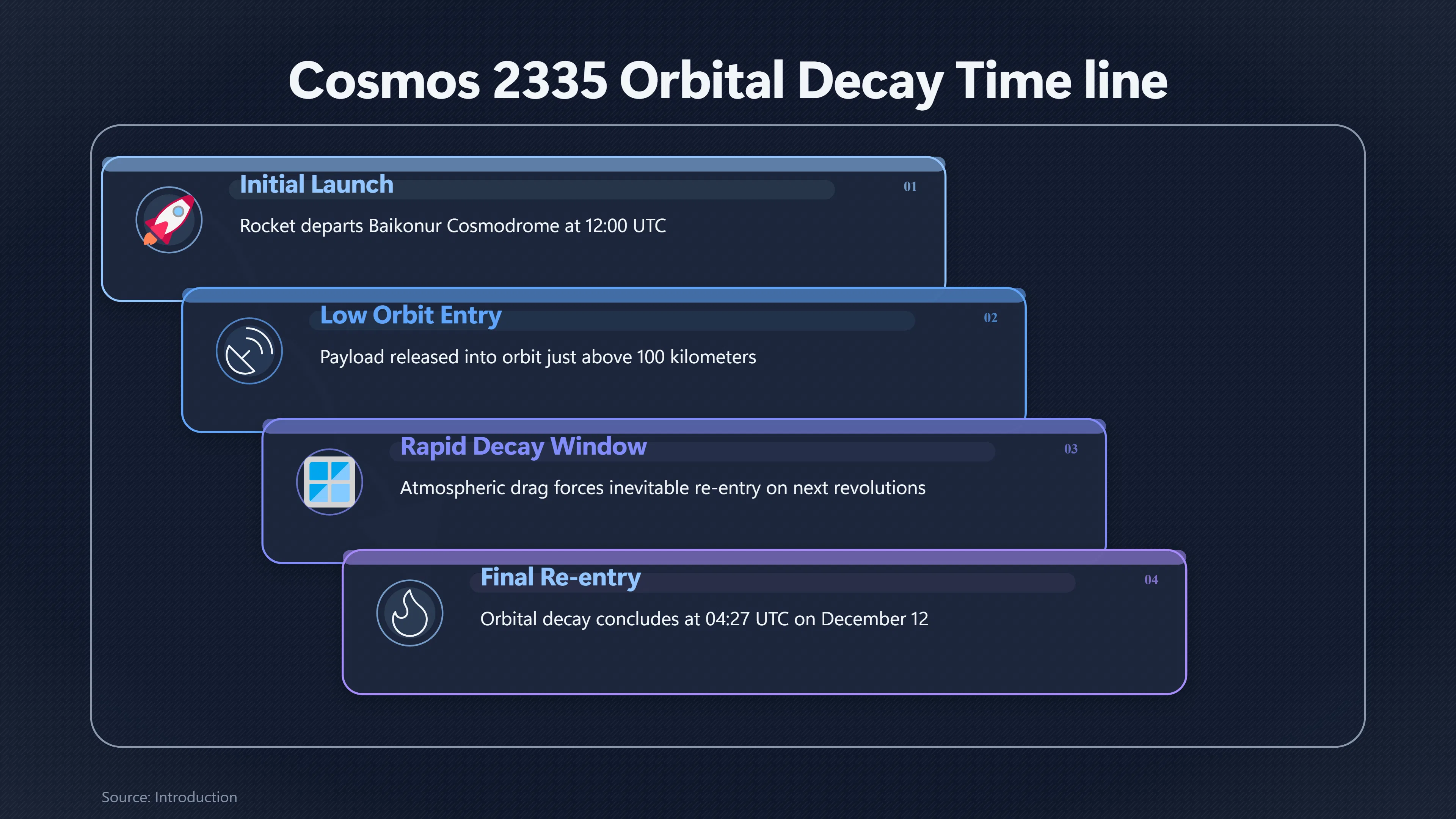
The launch itself occurred at approximately 12:00 UTC on 11 December 1996. Orbital tracking data showed that the second-stage rocket entered an unusually low orbit with a perigee only a little above 100 kilometres. Such an orbit guaranteed a rapid decay, making re-entry on the next few revolutions inevitable.[satobs.org]satobs.orgSee Sat-L Apr-12: Old Unknown Identified as a Re-entrySeeSat-L Apr-12: Old Unknown Identified as a Re-entryApril 30, 2012…
Contemporary satellite trackers recognised this immediately. On the day of launch, Alan Pickup noted from the available orbital elements that the rocket stage was likely to decay on 12 December UTC, equivalent to the evening of 11 December in Yukon. Updated tracking the following day confirmed that the final orbit ended during precisely that period.[satobs.org]satobs.orgSee Sat-L Dec-96: Re: Russian launchSee Sat-L Dec-96: Re: Russian launch
Modern compilations of observed satellite re-entries estimate the decay at approximately 04:27 UTC on 12 December 1996, corresponding to roughly 8:27 p.m. Yukon local time—remarkably close to the times recalled by many witnesses.[satobs.org]satobs.orgVisually Observed Natural Re-entries of Earth SatellitesFebruary 11, 2026…
How the Yukon ground track was reconstructed
The rocket explanation did not emerge from speculation but from orbital reconstruction.
In 2012, satellite analyst Ted Molczan examined archived USSTRATCOM orbital elements together with published witness reports from Fox Lake, Carmacks, Pelly Crossing and Mayo. Using decay prediction software and the final tracking data, he concluded that the rocket body would have been re-entering during the most probable viewing period reported by witnesses.[satobs.org]satobs.orgSee Sat-L Apr-12: Old Unknown Identified as a Re-entrySeeSat-L Apr-12: Old Unknown Identified as a Re-entryApril 30, 2012…
Shortly afterwards, German analyst Harro Zimmer independently refined the trajectory using more sophisticated methods. His calculations produced an even closer fit between the predicted re-entry path and the reported viewing locations. Molczan then revisited the case using Zimmer’s improved trajectory estimate, further strengthening the correlation.[satobs.org]satobs.orgSatellite Re-entriesSatellite Re-entries
Several aspects of the reconstruction are significant:
- the re-entry occurred during the correct evening rather than hours earlier or later;
- the predicted flight path passed within view of the communities reporting the phenomenon;
- observers separated by more than 200 kilometres could all have seen the same high-altitude event;
- the direction of travel broadly matched reported movement across the sky;
- the duration of several minutes is consistent with large orbital re-entries rather than ordinary meteors.[satobs.org]satobs.orgSee Sat-L Apr-12: Old Unknown Identified as a Re-entrySeeSat-L Apr-12: Old Unknown Identified as a Re-entryApril 30, 2012…
These are exactly the kinds of independent checks investigators seek when evaluating competing explanations.
Why the identification is considered strong
The Cosmos 2335 identification is regarded as persuasive because it explains multiple independent features simultaneously rather than matching only one aspect of the reports.
First, it accounts for the geographical spread. A re-entry occurring roughly 100 kilometres above the Earth can be visible across hundreds of kilometres, allowing witnesses in widely separated Yukon communities to observe the same event at nearly the same time.[satobs.org]satobs.orgSee Sat-L Apr-12: Old Unknown Identified as a Re-entrySeeSat-L Apr-12: Old Unknown Identified as a Re-entryApril 30, 2012…
Second, it explains the multiple lights. Re-entering rocket bodies commonly fragment into several glowing pieces while maintaining roughly the same overall direction and speed. Ground observers often perceive these fragments as lights attached to a single larger object.[satobs.org]satobs.orgSee Sat-L Jan-14: Misperception of Satellite Re-EntriesSeeSat-L Jan-14: Misperception of Satellite Re-Entries - Seein…
Third, it explains the lack of engine noise. The object was travelling at orbital altitude rather than flying low over the highway, so witnesses would not hear conventional aircraft sounds despite the apparent closeness created by the visual display.[satobs.org]satobs.orgSee Sat-L Apr-12: Old Unknown Identified as a Re-entrySeeSat-L Apr-12: Old Unknown Identified as a Re-entryApril 30, 2012…
Finally, it fits a recognised pattern seen elsewhere. Satellite observers have documented numerous historical cases in which atmospheric re-entries generated reports of gigantic structured UFOs, cigar-shaped craft or silent formations of lights. The Yukon event became one of the best-researched examples after its orbital match was identified.[satobs.org]satobs.orgSee Sat-L Jan-14: Misperception of Satellite Re-EntriesSeeSat-L Jan-14: Misperception of Satellite Re-Entries - Seein…
What the rocket explanation does not prove
Although the orbital evidence is unusually strong, it does not mean every individual witness description can be reconstructed perfectly.
Many accounts were collected months or years after the event, so remembered times and compass directions naturally vary. Witnesses also differed in whether they saw distinct lights, glowing fragments or an apparently solid dark object connecting them. Such differences are expected in observations of bright re-entry debris because human perception of distance, size and shape becomes unreliable against a dark sky lacking visual reference points.[satobs.org]satobs.orgSee Sat-L Jan-14: Misperception of Satellite Re-EntriesSeeSat-L Jan-14: Misperception of Satellite Re-Entries - Seein…
The rocket explanation therefore does not claim that every reported detail literally reflects the physical object. Instead, it argues that the underlying event—a spectacular atmospheric breakup of the Cosmos 2335 rocket stage—is sufficient to account for the central features shared across the reports.
Why this case remains important in Yukon UFO history
Within Yukon UFO history, the Cosmos 2335 re-entry represents a rare case where a dramatic mass sighting can be tested against independently recorded orbital data rather than relying solely on witness recollections.
The original reports remain valuable because they document how extraordinary the display appeared to ordinary observers. At the same time, the later trajectory analysis demonstrates how advances in satellite tracking and historical orbital reconstruction can resolve cases that once seemed inexplicable. Rather than undermining the witnesses, the identification shows that sincere observations of an exceptional natural and technological event can produce one of Canada’s most famous UFO reports while still yielding to careful technical investigation.[satobs.org]satobs.orgSatellite Re-entriesSatellite Re-entries

Amazon book picks
Further Reading
Books and field guides related to Was the Giant UFO a Falling Rocket?. Use these as the next step if you want deeper reading beyond the article.
The UFO Handbook: A Guide to Investigating, Evaluating, and R...
An explanation of the usual reasons for confusing IFOs (identified flying objects) with UFOs and a survey of the tools used to investigat...
Space Junk: The Dangers of Polluting Earth's Orbit
Scientists have identified at least 100 million pieces of space debris—from paint chips to nonoperational zombie satellites—floating in E...
Orbital Mechanics for Engineering Students
Orbital Mechanics for Engineering Students, Second Edition, provides an introduction to the basic concepts of space mechanics. These incl...
Fundamentals of Astrodynamics
Rating: 4.5/5 from 12 Google Books ratings
Teaching text developed by U.S. Air Force Academy and designed as a first course emphasizes the universal variable formulation. Develops...
eBay marketplace picks
Marketplace Samples
Live-tested eBay searches with available results related to this page.
Selected fromspace wall art oneBay.co.uk.



Endnotes
1.
Source: satobs.org
Title: See Sat-L Apr-12: Old Unknown Identified as a Re-entry
Link:https://www.satobs.org/seesat/Apr-2012/0331.html
Source snippet
SeeSat-L Apr-12: Old Unknown Identified as a Re-entryApril 30, 2012...
Published: April 30, 2012
2.
Source: satobs.org
Title: Satellite Re-entries
Link:https://satobs.org/decay.html
3.
Source: satobs.org
Title: See Sat-L Dec-96: Re: Russian launch
Link:https://www.satobs.org/seesat/Dec-1996/0064.html
4.
Source: satobs.org
Title: See Sat-L Jan-14: Misperception of Satellite Re-Entries
Link:https://satobs.org/seesat/Jan-2014/0039.html
Source snippet
SeeSat-L Jan-14: Misperception of Satellite Re-Entries - Seein...
5.
Source: satobs.org
Title: See Sat-L Dec-96: Re: Russian launch
Link:https://www.satobs.org/seesat/Dec-1996/0072.html
Source snippet
SeeSat-L Dec-96: Re: Russian launchDecember 12, 1996 — RE: RUSSIAN LAUNCH Alan Pickup (alan@wingar.demon.co.uk) Thu, 12 Dec 1996 20:31:1...
Published: December 12, 1996
6.
Source: satobs.org
Title: Visually Observed Natural Re-entries of Earth Satellites
Link:https://www.satobs.org/reentry/Visually_Observed_Natural_Re-entries_latest_draft.pdf
Source snippet
February 11, 2026...
Published: February 11, 2026
7.
Source: satobs.org
Title: Visually Observed Natural Re-entries of Earth Satellites
Link:https://satobs.org/seesat_ref/misc/Visually_Observed_Natural_Re-entries_DRAFT_10.pdf
8.
Source: satobs.org
Title: ) I have i
Link:https://www.satobs.org/seesat/Jan-1999/0061.html
Source snippet
SeeSat-L Jan-99: Re-entry of Cosmos 2335 observedJanuary 5, 1999 — RE-ENTRY OF COSMOS 2335 OBSERVED Alan Pickup (alan@wingar.demon.co.uk...
Published: January 5, 1999
9.
Source: satobs.org
Title: Still in orbit is their sister satellite
Link:https://www.satobs.org/seesat/Feb-1998/0158.html
Source snippet
SeeSat-L Feb-98: Demise of Cosmos satelliteFebruary 11, 1998 — DEMISE OF COSMOS SATELLITE Eberst (eberst@cableinet.co.uk) Wed, 11 Feb 19...
Published: February 11, 1998
11.
Source: wsatobs.org
Title: satobs.org See Sat-L Dec-96 by date
Link:https://wwww.satobs.org/seesat/Dec-1996/date.html
Source snippet
satobs.orgSeeSat-L Dec-96 by dateOctober 22, 1997 — SEESAT-L DEC-96 BY DATE Starting: Sun Dec 01 1996 - 00:00:-30873 MET Ending: Tue Dec...
Published: October 22, 1997
12.
Source: wsatobs.org
Title: satobs.org See Sat-L Dec-96 by thread
Link:https://wwww.satobs.org/seesat/Dec-1996/index.html
Source snippet
satobs.orgSeeSat-L Dec-96 by threadOctober 22, 1997 — SEESAT-L DEC-96 BY THREAD * Most recent messages * Messages sorted by: [ date ][ su...
Published: October 22, 1997
Additional References
13.
Source: fotocat.blogspot.com
Title: But Molczan is a rigorous orbital analyst and satellite tracker and a s
Link:https://fotocat.blogspot.com/2014_03_02_archive.html
Source snippet
UFO FOTOCAT BLOG: 2014/03/02March 1, 2014 — VISUALLY OBSERVED NATURAL RE-ENTRIES OF EARTH SATELLITES Ted Molczan likes to call himself ju...
Published: March 1, 2014
14.
Source: youtube.com
Link:https://www.youtube.com/watch?v=IFW-yimvVd0
Source snippet
SpaceX's Falcon 9 launch creates confusion over mistaken UFO sighting...
15.
Source: rr0.org
Title: Five witnesses from
Link:https://rr0.org/time/2/0/1/4/01/Bullard_IsTheAnomalistOnAFoolsErrand_Paranthropology/Yukon/
Source snippet
The Yukon “Giant Mothership” UFODozens of witnesses along a 200-mile stretch of the Klondike Highway, in Yukon Territory, Canada, reporte...
16.
Source: youtube.com
Title: Discover the truth behind the Yukon Encounter
Link:https://www.youtube.com/watch?v=WXeHkBLXG6A
Source snippet
Best Evidence: Top 10 UFO Sightings | Full Movie Length Director's Cut | Stanton Friedman...
17.
Source: youtube.com
Title: Thirty Witnesses Encounter The Biggest UFO Sighting Ever Reported
Link:https://www.youtube.com/watch?v=iDgDxav3d0E
Source snippet
Yukon Paranormal, Episode 2- Fox Lake- UFOs in the Yukon...
18.
Source: youtube.com
Title: Yukon Paranormal, Episode 2- Fox Lake- UFOs in the Yukon
Link:https://www.youtube.com/watch?v=Rx5YprfueAQ
Source snippet
Discover the truth behind the Yukon Encounter...
19.
Source: youtube.com
Title: Space X’s Falcon 9 launch creates confusion over mistaken UFO sighting
Link:https://www.youtube.com/watch?v=nSLgsvg_jIw