Within Fireballs
When a Fireball Looks Like a Craft
Changing colours, sparks, multiple lights and a terminal flash can make a natural meteor look like a structured craft breaking apart.
On this page
- Why one meteor can change colour
- How fragmentation creates multiple lights
- Which visual clues support a meteor explanation
Page outline Jump by section
Introduction
Changing colour, shedding sparks and apparently splitting into several glowing objects are often treated by witnesses as signs that they have seen an unusual craft. In fact, those same features are among the strongest indicators that a bright meteor, or fireball, was breaking up in the atmosphere. For Prince Edward Island and the wider Atlantic region, this distinction matters because some dramatic UFO reports have occurred on evenings when observers across several provinces described green, orange and red lights that were almost certainly different views of the same high-altitude event. The combination of changing colours, visible fragmentation and a bright terminal flash is therefore an important line of evidence when assessing whether a reported “craft” may instead have been a natural fireball.[American Meteor Society]amsmeteors.orgAmerican Meteor Society Fireball FAQsAmerican Meteor SocietyFireball FAQs - American Meteor Society…
When one fireball looks like several different objects
A common misunderstanding is that witnesses who describe different colours must have seen different phenomena. Fireballs do not behave that way. Their appearance depends on viewing angle, atmospheric conditions, brightness and the stage of atmospheric entry.
Someone on Prince Edward Island might describe a brilliant green oval, while another observer in Nova Scotia recalls an orange sphere with a glowing tail, and a third in New Brunswick reports a red light descending towards the horizon. These descriptions can all refer to the same meteor.
Several factors contribute to these differences:
- Chemical composition: Different elements emit characteristic colours as the meteoroid vaporises. Sodium often produces yellow-orange light, magnesium contributes blue-white tones, while nickel and related emission lines may contribute green colours.
- Speed: Faster meteors generally excite atmospheric gases more intensely, altering the apparent colour balance.
- Altitude: As the object descends and slows, its colour may change during a flight lasting only a few seconds.
- Human vision: Very bright lights can produce colour shifts and after-images, so witnesses observing from different locations may honestly remember different dominant colours.[American Meteor Society]amsmeteors.orgAmerican Meteor Society Fireball FAQsAmerican Meteor SocietyFireball FAQs - American Meteor Society…
For this reason, investigators should not treat inconsistent colour descriptions as evidence against a shared meteor explanation.
How fragmentation creates multiple lights
Perhaps the strongest source of confusion is fragmentation.
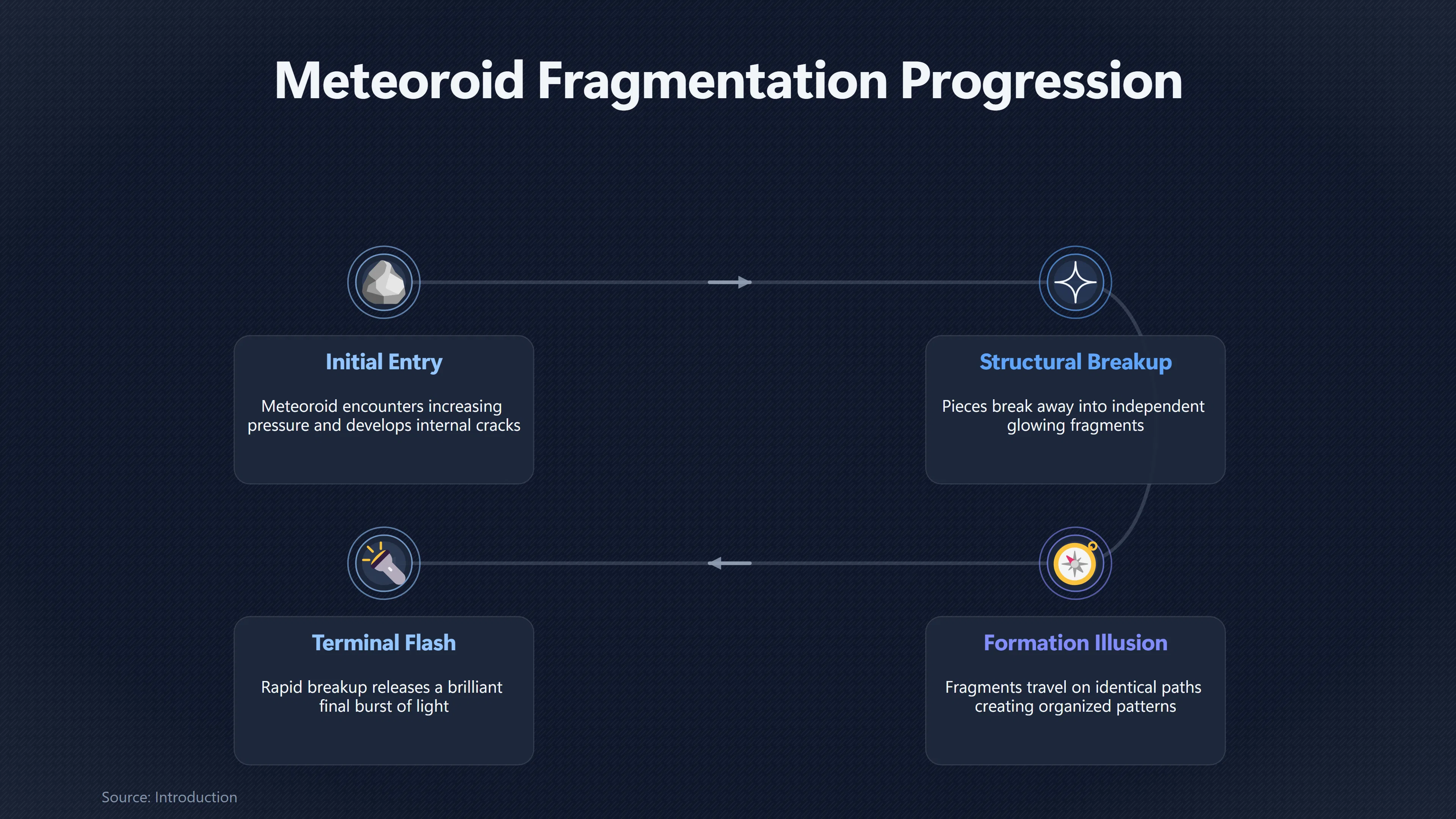
As a meteoroid encounters increasing atmospheric pressure, cracks develop within the rock. Pieces break away, each becoming an independent glowing fragment. To someone watching from the ground, what began as one bright object can suddenly resemble:
- two or three craft flying together;
- a formation of glowing spheres;
- sparks separating from a central object;
- smaller lights apparently changing course;
- a shower of glowing debris.
In meteor science this is entirely expected. Bright fireballs frequently fragment before extinguishing, and the most energetic examples—known as bolides—often end with a brilliant terminal flash as rapid breakup releases a large amount of light.[American Meteor Society]amsmeteors.orgAmerican Meteor Society FireballsAmerican Meteor SocietyFireballs - American Meteor Society…
The fragments usually continue on nearly identical paths because they all share essentially the same velocity. At ordinary viewing distances this can create the illusion of an organised formation rather than a disintegrating natural object.
Why witnesses often report a structured craft
Fragmentation does not simply produce several lights—it can create patterns that resemble manufactured objects.
A witness may see:
- one bright leading light with smaller lights behind it, resembling windows or escort craft;
- fragments appearing evenly spaced, suggesting deliberate formation flying;
- glowing pieces fading one after another, giving the impression that lights are switching off;
- a persistent glowing train that looks like exhaust or propulsion.
Because the event unfolds within only a few seconds, observers naturally interpret the pattern using familiar objects such as aircraft, helicopters or structured vehicles.
This is particularly relevant when reviewing Atlantic Canadian reports in which witnesses described green ovals, orange spheres or red-tailed lights without recognising that all these features are compatible with a single fragmenting meteor rather than multiple independent objects.[American Meteor Society]amsmeteors.orgAmerican Meteor Society Fireball FAQsAmerican Meteor SocietyFireball FAQs - American Meteor Society…
Which visual clues favour a meteor explanation?
No single feature proves that a sighting was a fireball, but several characteristics become persuasive when they occur together.
The strongest indicators include:
- rapid colour changes during a flight lasting only a few seconds;
- bright green, orange or white light with changing intensity;
- visible sparks or glowing fragments following the main object;
- a sudden terminal flash before disappearance;
- numerous reports spread across Prince Edward Island, Nova Scotia, New Brunswick and neighbouring regions at roughly the same time;
- witnesses describing different colours while agreeing on the general direction and timing.
Conversely, prolonged hovering, repeated manoeuvres over many minutes or behaviour inconsistent with ballistic atmospheric flight would require consideration of other explanations.
Investigators therefore examine the complete pattern rather than relying on a single descriptive word such as “green” or “fragmented.”

What this means for Prince Edward Island sightings
Within Prince Edward Island’s UFO history, colour alone should never be treated as evidence for an exotic object. Nor should reports of “multiple lights” automatically be interpreted as several craft.
The more useful question is whether the reported sequence matches the known behaviour of bright fireballs:
- progressive colour change;
- increasing brightness;
- fragmentation into several luminous pieces;
- a terminal flash;
- disappearance without continued manoeuvring.
When these features coincide with reports from a wide geographical area across Atlantic Canada, the balance of evidence generally shifts towards a high-altitude meteor rather than a nearby structured vehicle. This does not resolve every historical sighting associated with Prince Edward Island, including the broader discussions surrounding the 22 August 1990 reports, but it provides a well-established physical explanation for many accounts in which changing colours and apparent multiple objects initially suggested something far more mysterious.[amsmeteors.org]amsmeteors.orgAmerican Meteor Society Fireball FAQsAmerican Meteor SocietyFireball FAQs - American Meteor Society…
Amazon book picks
Further Reading
Books and field guides related to When a Fireball Looks Like a Craft. Use these as the next step if you want deeper reading beyond the article.
The Cambridge Encyclopedia of Meteorites
Beautifully illustrated with over 140 full colour images, The Cambridge Encyclopedia of Meteorites provides a thorough guide to these fas...
Meteorites: A Petrologic, Chemical and Isotopic Synthesis
Meteorite research is fundamental to our understanding of the origin and early history of the Solar System. Some meteorites were produced...
Rain Of Iron And Ice
John S. Lewis, a planetary scientist, details the recent scientific study which suggests that massive solid bodies from space pose a very...
eBay marketplace picks
Marketplace Samples
Live-tested eBay searches with available results related to this page.
Selected frommeteor poster oneBay.co.uk.
Endnotes
1.
Source: amsmeteors.org
Title: American Meteor Society Fireball FAQs
Link:https://www.amsmeteors.org/fireballs/faqf/
Source snippet
American Meteor SocietyFireball FAQs - American Meteor Society...
2.
Source: amsmeteors.org
Title: American Meteor Society Fireballs
Link:https://www.amsmeteors.org/fireballs/
Source snippet
American Meteor SocietyFireballs - American Meteor Society...
3.
Source: arxiv.org
Title: arXiv Meteoroid Structure and Fragmentation
Link:https://arxiv.org/abs/1903.06572
5.
Source: amsmeteors.org
Link:https://www.amsmeteors.org/fireballs/page/8/
Source snippet
Spurny A fireball is another term for a very bright meteor, generally brighter than magnitude -4, which is about the same magnitude of...
6.
Source: amsmeteors.org
Link:https://www.amsmeteors.org/fireballs/page/5/
Source snippet
Spurny A fireball is another term for a very bright meteor, generally brighter than magnitude...
7.
Source: imo.net
Title: Fireballs | IMOFIREBALLS Fireballs are meteors that appear brighter than normal
Link:https://www.imo.net/observations/fireballs/fireballs/
Source snippet
A great majority of the material orbiting in outer space are tiny sub-millimeter sized bits of stone, ice, or metal, or a combinatio...
Additional References
8.
Source: jpl.nasa.gov
Link:https://www.jpl.nasa.gov/news/meteor-likely-cause-of-southwest-us-light-show/
Source snippet
Light Show | NASA Jet Propulsion Laboratory (JPL)September 15, 2011 —.2 min read METEOR LIKELY CAUSE OF SOUTHWEST U.S. LIGHT SHOW Sept...
Published: September 15, 2011
9.
Source: science.nasa.gov
Link:https://science.nasa.gov/solar-system/meteors-meteorites/exploration/
Source snippet
and Meteorites: Exploration - NASA ScienceNovember 5, 2024 — Explore This Section Even the best, most high-tech telescopes available toda...
Published: November 5, 2024
10.
Source: fireballs.ndc.nasa.gov
Link:https://fireballs.ndc.nasa.gov/skyfalls/events/20260429-071216
Source snippet
20260429-071216April 29, 2026 — EVENT: 20260429-071216 Well over a hundred eyewitnesses in the states of Oregon and Washington and the Ca...
Published: April 29, 2026
11.
Source: nasa.gov
Title: It’s Fireball Season!
Link:https://www.nasa.gov/blogs/watch-the-skies/2026/03/26/its-fireball-season-answering-your-meteor-questions/
Source snippet
Answering Your Meteor Questions - NASAMarch 26, 2026 — WATCH THE SKIES Image Janet Sudnik March 26, 2026 5:18PM CATEGORIES Marshall Space...
Published: March 26, 2026
12.
Source: nasa.gov
Title: interesting fact of the month 2021
Link:https://www.nasa.gov/space-science-and-astrobiology-at-ames/interesting-fact-of-the-month-current/interesting-fact-of-the-month-2021/
Source snippet
What in the world is a fireball? According to the American Meteor Society, a fireball is another term for a...
13.
Source: youtube.com
Link:https://www.youtube.com/watch?v=Z7k5VCwMAmU
Source snippet
50 Meteors in 10 Minutes | Fifty Colors of Space Rocks Explained...
14.
Source: youtube.com
Title: Fireball that lit up UK skies likely to be piece of asteroid, say scientists
Link:https://www.youtube.com/watch?v=wUc0Tha6IVg
Source snippet
Scientists looking into “Bolide Boom” | Prof. Christopher Palma...
15.
Source: youtube.com
Title: 50 Meteors in 10 Minutes | Fifty Colors of Space Rocks Explained
Link:https://www.youtube.com/watch?v=j1Oj8KARyxc
Source snippet
Fireball that lit up UK skies likely to be piece of asteroid, say scientists...
16.
Source: cneos.jpl.nasa.gov
Link:https://cneos.jpl.nasa.gov/fireballs/intro.html
Source snippet
duction Map/Data Lightcurves Operational Notes INTRODUCTION Image: Fireball from the Perseid shower as seen from the Space Station on 201...
17.
Source: youtube.com
Title: Scientists looking into “Bolide Boom” | Prof. Christopher Palma
Link:https://www.youtube.com/watch?v=Hbv-oSMXyyI
Source snippet
Boston Sonic Boom Is A MUCH BIGGER Event Than Expected...