Within PEI
Did Anything Really Land at Ebenezer?
The 1990 Ebenezer sighting combined a regional fireball with a disputed woodland glow and later claims of a military recovery.
On this page
- What witnesses reported on 22 August 1990
- Why a regional fireball fits much of the evidence
- The woodland glow and later recovery claims
Page outline Jump by section
Introduction
The strongest explanation for the Ebenezer incident is that witnesses across Atlantic Canada saw a bright fireball on 22 August 1990, while the Prince Edward Island witnesses then associated a separate or misperceived light near the horizon with the object’s apparent descent. That interpretation fits the wide geographical spread, short duration and meteor-like colours reported elsewhere that evening. It does not, however, neatly explain the claim that a glow remained visible through woodland for roughly two hours.
That lingering glow is the case’s real unresolved element. No confirmed impact site, meteorite, spacecraft debris, photograph, radar track or authenticated recovery record has emerged. Later stories of military personnel, protective clothing and a tarpaulin-covered object depend mainly on an anonymous account first reported years afterwards. Ebenezer therefore remains important in Prince Edward Island’s UFO history not because a landing was proved, but because an ordinary-looking regional fireball became joined to a much harder-to-test local story.
What witnesses reported on 22 August 1990
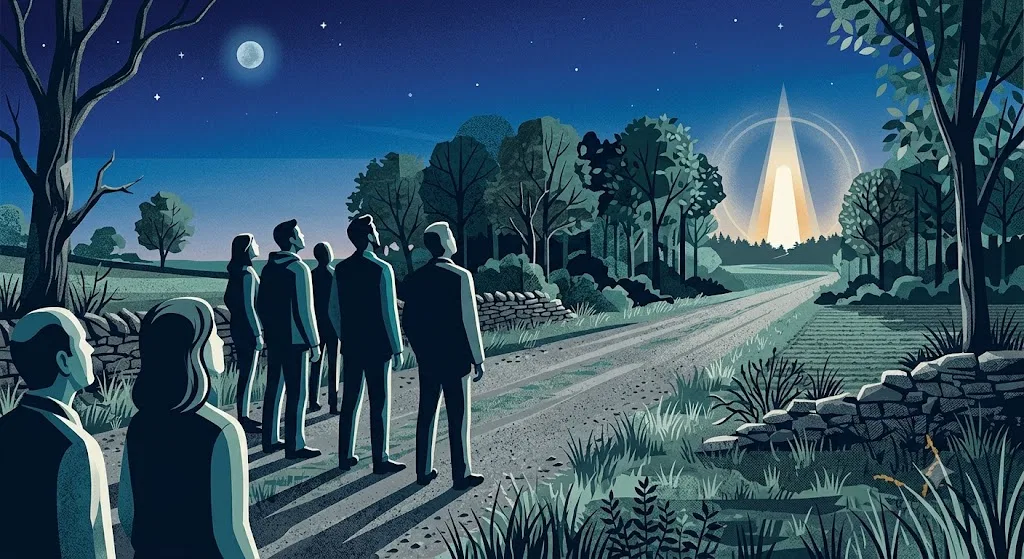
The best-known reconstruction comes from Canadian UFO researcher Chris Rutkowski, who cited National Research Council case N90/65. According to that summary, Shirley Yeo and members of her household in Ebenezer watched a bright white object between approximately 7.50 pm and 9.15 pm local time. It was described as resembling an ice-cream cone and appeared to descend into nearby woods. Helen Gallant, who lived with the family, recalled seeing what looked like a large round ball of light through the trees. The report further stated that the glow remained visible after the apparent descent, reportedly continuing for around two hours.[uforum.blogspot.com]uforum.blogspot.comUfology Research: Ebenezer's Ice Cream Cone: The PEI UFO of 1990…
The description should be read carefully. The surviving account says the object “landed”, but it does not establish that anyone saw physical contact with the ground. The crucial observation was made at a distance, partly through trees. A luminous object moving towards the horizon can appear to enter a nearby field or wood when it is actually many kilometres away and still high in the atmosphere. The later light among the trees may have been connected to the descending object, but the witnesses’ visual impression alone cannot prove that connection.
The incident nevertheless generated more than a single household report. The Charlottetown RCMP was said to have received over a dozen calls and sent two constables. One officer reportedly saw a light in the distance before losing sight of it. That lends support to the presence of some visible phenomenon, but it is not confirmation of a landed object: the officer apparently did not reach or inspect a luminous craft, debris field or impact point.[uforum.blogspot.com]uforum.blogspot.comUfology Research: Ebenezer's Ice Cream Cone: The PEI UFO of 1990…
The following morning, about 30 members of the Charlottetown Astronomy Club reportedly searched the suspected area and found nothing significant. Club president Clive Perry regarded the witnesses as sincere and doubted that a meteorite itself could have remained luminous for so long. York University astronomer Paul Delaney was also quoted as considering satellite debris because of the reported duration. These comments show why the case was not immediately satisfying to local observers, but they were informed opinions based on witness descriptions rather than laboratory examination of recovered material.[uforum.blogspot.com]uforum.blogspot.comUfology Research: Ebenezer's Ice Cream Cone: The PEI UFO of 1990…
Why a regional fireball fits much of the evidence
Ebenezer did not occur in isolation. Reports reached Canadian authorities from New Brunswick, Nova Scotia, the Îles-de-la-Madeleine and Prince Edward Island during the same general period. Descriptions included red, orange, yellow, green and white objects, sometimes with tails, generally travelling towards or below the horizon. Several observations lasted only a few seconds and were entered in National Research Council files as possible meteors. Notes associated with the evening described reports across a broad region, from the Anticosti Island area towards Halifax and from Newfoundland towards Maine.[uforum.blogspot.com]uforum.blogspot.comUfology Research: Ebenezer's Ice Cream Cone: The PEI UFO of 1990…
That geographical scale strongly favours an atmospheric event. A fireball travelling high above the Earth can be seen from several provinces and from widely separated communities that each perceive it against a different local horizon. Modern fireball records regularly show single events reported across several US states or Canadian provinces. Witnesses may sincerely believe the light passed over their town, entered a nearby wood or struck beyond a familiar landmark, even when reconstructed trajectories place it much farther away.[American Meteor Society]amsmeteors.orgAmerican Meteor Society Fireball seen over Eastern Great lakesBelow is the heat map of the witnesses location with the first estimated trajectory.The preliminary estimated trajectory plotted from the…
The colours also fit. Bright meteors can appear white, yellow, orange, red or green, while fragmentation can create the impression of sparks, pieces of metal or several objects travelling together. NASA defines exceptionally bright meteors as fireballs, and modern examples demonstrate that such events can be brilliant enough to cause widespread alarm and reports of aircraft accidents, explosions or objects reaching the ground.[NASA Science]science.nasa.govScience Meteors and Meteorites: FactsSometimes meteors can even appear brighter than Venus – that’s when we call them “fireballs.”… Meteor showers are usually named after…
The timing preserved in the records is less tidy. Some regional reports were logged around 7.00 to 7.30 pm, while the Ebenezer file gives a longer interval beginning at about 7.50 pm. The National Research Council note reportedly referred to calls arriving across roughly 90 minutes. This could mean that more than one meteor was seen, that times were approximate, or that witnesses continued observing unrelated lights after the main fireball. It weakens any claim that every reported light formed a single, precisely tracked object, but it does not undermine the broader conclusion that fireball activity dominated the evening’s calls.[uforum.blogspot.com]uforum.blogspot.comUfology Research: Ebenezer's Ice Cream Cone: The PEI UFO of 1990…
NORAD and military officials were reported in contemporary coverage as favouring a meteor explanation rather than a falling satellite. That conclusion is consistent with the brief, colourful reports from across the Maritimes. The surviving summaries do not, however, provide the radar plots, trajectory calculations or detailed astronomical analysis that would allow readers to test the official conclusion independently. The official position is therefore plausible and probably correct for the regional phenomenon, but less conclusive than a modern instrument-based fireball reconstruction.[uforum.blogspot.com]uforum.blogspot.comUfology Research: Ebenezer's Ice Cream Cone: The PEI UFO of 1990…
The woodland glow is the difficult part
A meteor cannot remain as a bright aerial object for two hours after its luminous flight ends. Most ordinary fireballs last only seconds; even unusually shallow events generally remain visible for seconds rather than hours. A surviving meteorite also does not normally sit on the ground shining like a large lamp. If the reported woodland glow truly persisted at a fixed location, it requires a second explanation.[American Meteor Society]amsmeteors.orgAmerican Meteor Society Mystery Event over ColoradoThe estimated 3D trajectory computed from the witness reports shows an extremely shallow entry angle, one that could be associated with a…
One possibility is simple misassociation. After seeing a dramatic object apparently descend, witnesses may have noticed an existing light in the same direction and interpreted it as the object on the ground. Through trees at night, the source’s distance, shape and size would have been extremely difficult to judge. A farm vehicle, house or yard light, fire, reflected light, aircraft landing light or other local source could appear enlarged and diffuse when viewed through branches or haze.
This explanation gains some support from the failure to find physical evidence the following morning. A search by dozens of astronomy-club members found no obvious crater or debris. That does not prove nothing fell: meteorites can be small, difficult to recognise and spread over a sizeable area. Modern recoveries often depend on accurate camera-derived trajectories, calculated fall zones and systematic searches extending over square kilometres. The Ebenezer search apparently lacked that level of positional information.[uforum.blogspot.com]uforum.blogspot.comUfology Research: Ebenezer's Ice Cream Cone: The PEI UFO of 1990…
Even so, the negative search matters more for claims of a large landed craft than for a small meteorite. A sizeable object capable of producing a conspicuous stationary glow should normally leave some combination of disturbed ground, damaged vegetation, heat effects, debris, photographs or a clearly identified recovery site. None has entered the publicly verifiable record.
A second possibility is a small fire or electrically illuminated scene in or beyond the woods. The surviving summaries do not establish whether investigators reached the exact apparent location while the glow was present, measured its bearing from more than one viewpoint or ruled out buildings, roads and farm activity. Without triangulation, “in the woods” may simply describe the direction in which the light appeared.
A third explanation sometimes proposed at the time was re-entering space debris. Satellite or rocket-body re-entry can be slower and longer-lasting than a meteor and can fragment into numerous glowing pieces. Large debris can sometimes survive to the surface, although the European Space Agency notes that most objects are destroyed during atmospheric entry. A re-entry would still not naturally account for one stationary light shining for hours, and NORAD was reportedly quoted as rejecting a satellite explanation.[European Space Agency]esa.intEuropean Space Agency ESAEuropean Space Agency ESA
Did military aircraft prove there was a recovery?
Witness accounts cited by Rutkowski said helicopters or aircraft circled the area. This became central to the later belief that the military had recovered something. Ebenezer was within flying range of Charlottetown Airport and the then military facilities at Summerside, so aircraft activity was not inherently anomalous. It could have been connected to search-and-rescue responses prompted by numerous reports of a burning aircraft, boat, satellite or object on the ground. It could also have been scheduled activity that witnesses noticed because their attention had been drawn to the sky.
The distinction matters: aircraft appearing after emergency calls is not the same as aircraft locating and removing a crashed vehicle. A convincing recovery case would require flight logs, tasking orders, crew names, communications records, photographs, a documented landing zone or testimony from several independently identified participants. Publicly available accounts have not produced that chain of evidence.
Canada’s reporting system at the time could make an incident look more officially investigated than it actually was. From 1967 until 1995, the National Research Council served as the principal federal recipient of UFO reports, collecting material forwarded by the RCMP, the Department of National Defence and other organisations. “Non-meteoritic sightings” was principally the name of a records file, not a declaration that an object was an extraterrestrial or advanced craft. The government’s Sky Canada review notes that many reports were collected or explained without a sustained field investigation.[ISED Canada]ised-isde.canada.caOpen source on canada.ca.
Likewise, the appearance of acronyms such as NORAD, rescue coordination centres and military commands on message distributions demonstrates that information circulated through aviation and defence channels. It does not by itself show that those organisations detected a solid object or launched a classified recovery. Reports of burning aircraft and falling debris would naturally be relevant to air-defence and search-and-rescue authorities.
The later recovery story
The most dramatic version of Ebenezer appeared years after the event. Rutkowski reported that an anonymous former Canadian Forces member, referred to as “A”, contacted UFO researchers in 1997. She allegedly said that she had served with a rescue or medical team at Canadian Forces Base Summerside and had been flown to the Ebenezer area aboard a Hercules transport aircraft. According to the story, the team carried yellow protective suits but was prevented from approaching the site for security reasons. She later recalled seeing a flatbed vehicle leave with a tarpaulin-covered load.[uforum.blogspot.com]uforum.blogspot.comUfology Research: Ebenezer's Ice Cream Cone: The PEI UFO of 1990…
The same source said that American military personnel later told her that the recovered object was a “spaceship”. This is the claim that transformed a difficult fireball report into a purported crash-retrieval case. Yet it is also the weakest major component of the story. The witness remained anonymous, the account emerged around seven years later, and the supposed identification came through an informal conversation rather than direct inspection, documentation or test results.[uforum.blogspot.com]uforum.blogspot.comUfology Research: Ebenezer's Ice Cream Cone: The PEI UFO of 1990…
Several practical questions remain unanswered. A Hercules transport would require a suitable airfield, not a landing in an ordinary woodland. A medical or rescue deployment should have generated personnel, transport and operational records. A flatbed recovery would involve drivers, security staff, routes and a destination. No authenticated document publicly links such an operation to Ebenezer on 22 August 1990.
The protective-suit detail is also ambiguous. Emergency crews may prepare for hazardous materials when an unidentified aircraft, satellite component or industrial object is thought to have crashed. Such precautions would not establish an exotic origin. Nor does a covered load necessarily imply concealment: debris and damaged equipment are routinely secured during transport. These details become extraordinary only after the anonymous witness’s interpretation is accepted.
Later storytelling therefore enlarged the case without strengthening its evidential base. The recovery narrative is interesting testimony that could justify further archival checking, but it cannot presently carry the weight placed upon it.
What the records do and do not prove
The archival context is valuable because it confirms that Canada maintained official channels for receiving such reports. Library and Archives Canada holds material originating with the Department of National Defence, Department of Transport, National Research Council and RCMP. The wider collection contains correspondence, reports, memoranda and procedural forms, although records can be difficult to locate because dates and locations were not recorded consistently.[Canada]canada.cas UFOs: The search for the unknowns UFOs: The search for the unknown
For Ebenezer, the cited case numbers and quoted message language indicate that contemporary reports existed within the National Research Council system. That is stronger than a story based solely on later folklore. It establishes that witnesses made reports and that officials received and circulated them.
It does not establish that a craft landed. An administrative record normally preserves what a witness or reporting agency said; it does not automatically verify the observation. Terms such as “landed in woods”, “debris” or “object” may reproduce callers’ descriptions rather than conclusions reached after examination.
The best evidence can therefore be ranked as follows:
- Strong: A bright regional aerial phenomenon was seen across Atlantic Canada on 22 August 1990 and generated numerous calls.
- Reasonably supported: The Yeo household reported an apparently descending object and a continuing light seen through trees near Ebenezer.
- Limited: Police attended and at least one officer reportedly saw a distant light.
- Unconfirmed: An object physically struck the ground near the witnesses.
- Unsupported by public physical evidence: A spacecraft, satellite or substantial vehicle was recovered.
- Weak and retrospective: The anonymous story of protective suits, a Hercules deployment, a covered flatbed and American officers identifying a spaceship.
Did anything really land at Ebenezer?
The available evidence does not justify saying that anything landed at Ebenezer. The regional portion of the incident is well explained by one or more fireballs. The apparent descent into local woodland can be understood as a common horizon and distance error, especially when a brilliant object is seen without reliable scale or triangulation.
The long-lasting glow prevents the case from being called completely solved, but it does not turn the sighting into proof of a crash. It is more likely to have been a separate terrestrial light, a small fire or an observation whose duration and position were recorded imprecisely. The absence of a confirmed site or recoverable trace substantially weakens every landing hypothesis.
Space debris remains physically possible in a broad sense, but no reliable identification, tracking record or fragment supports it here. A secret military recovery is less well supported still. It rests on aircraft sightings that may have had routine or emergency-response explanations and on an anonymous account made years later without corroborating documents.
Ebenezer is therefore best classified as a partly explained incident with an unresolved local observation, rather than a confirmed landing or a fully debunked fabrication. The witnesses appear to have experienced something striking, and there is no need to accuse them of dishonesty. The central lesson is that sincere testimony can preserve the appearance of an event while leaving its distance, sequence and causal connections uncertain. In Prince Edward Island’s UFO history, that tension—not evidence of a recovered spacecraft—is what makes Ebenezer enduring.
Amazon book picks
Further Reading
Books and field guides related to Did Anything Really Land at Ebenezer?. Use these as the next step if you want deeper reading beyond the article.
UFOs: Generals, Pilots, and Government Officials Go on the Re...
NEW YORK TIMES BESTSELLER • Impeccably researched, this riveting journalistic investigation separates fact from fiction, and documents th...
The UFO Experience: A Scientific Inquiry
Cited by the New York Review of Books as "the best brief for visitation," this classic study presents an analysis of UFO reports and conc...
Alien Worlds: Social and Religious Dimensions of Extraterrest...
This intriguing collection of essays presents reflections upon the birth, proliferation, enduring appeal, and future of extraterrestrial...
eBay marketplace picks
Marketplace Samples
Live-tested eBay searches with available results related to this page.
Selected frommeteorite display specimen oneBay.co.uk.
Endnotes
1.
Source: uforum.blogspot.com
Link:https://uforum.blogspot.com/2010/11/ebenezers-ice-cream-cone-pei-ufo-of.html
Source snippet
Ufology Research: Ebenezer's Ice Cream Cone: The PEI UFO of 1990...
2.
Source: science.nasa.gov
Title: Science Meteors and Meteorites: Facts
Link:https://science.nasa.gov/solar-system/meteors-meteorites/facts/
Source snippet
Sometimes meteors can even appear brighter than Venus – that’s when we call them “fireballs.”... Meteor showers are usually named after...
3.
Source: ised-isde.canada.ca
Link:https://ised-isde.canada.ca/site/science/en/office-chief-science-advisor/sky-canada-project/management-public-reporting-unidentified-aerial-phenomena-canada
4.
Source: canada.ca
Title: ‘s UFOs: The search for the unknown
Link:https://www.canada.ca/en/library-archives/collection/research-help/science-technology/ufos.html
5.
Source: science.nasa.gov
Title: study of pristine meteorite adds to story of ancient asteroids
Link:https://science.nasa.gov/science-research/astromaterials/nasa-study-of-pristine-meteorite-adds-to-story-of-ancient-asteroids/
6.
Source: canada.ca
Title: Library and Archives Canada
Link:https://www.canada.ca/en/library-archives.html
7.
Source: fireballs.ndc.nasa.gov
Link:https://fireballs.ndc.nasa.gov/skyfalls/events/20260602-024149
8.
Source: fireballs.ndc.nasa.gov
Link:https://fireballs.ndc.nasa.gov/skyfalls/events/20260311-040116
9.
Source: canada.ca
Title: Using Collection search
Link:https://www.canada.ca/en/library-archives/collection/basics/using-collection-search.html
10.
Source: science.nasa.gov
Title: meteors meteorites
Link:https://science.nasa.gov/solar-system/meteors-meteorites/
11.
Source: library-archives.canada.ca
Title: ca Search Library and Archives Canada’s collections
Link:https://library-archives.canada.ca/eng/collection/search-collections/pages/search-the-collection.aspx?interval=20&person_id_nbr=2168953
12.
Source: library-archives.canada.ca
Title: ca Search Library and Archives Canada’s collections
Link:https://library-archives.canada.ca/eng/collection/search-collections/pages/search-the-collection.aspx?census-1891%2Findex-e.html=
13.
Source: library-archives.canada.ca
Title: ca Search Library and Archives Canada’s collections
Link:https://library-archives.canada.ca/eng/collection/search-collections/Pages/search-the-collection.aspx?PHPSESSID=vc1kpd5kvei19ik8e122odnbn6&census-1871%2F001101-119.01-e.php%3Fperson_id_nbr=137862&interval=20&wbdisable=true
14.
Source: nasa.gov
Title: interesting fact of the month 2021
Link:https://www.nasa.gov/space-science-and-astrobiology-at-ames/interesting-fact-of-the-month-current/interesting-fact-of-the-month-2021/
15.
Source: ares.jsc.nasa.gov
Title: how to find meteorites
Link:https://ares.jsc.nasa.gov/meteorite-falls/how-to-find-meteorites/
16.
Source: science.nasa.gov
Title: instruments image fireball over bering sea
Link:https://science.nasa.gov/solar-system/nasa-instruments-image-fireball-over-bering-sea/
17.
Source: nasa.gov
Title: NAS A Instruments Image Fireball over Bering Sea
Link:https://www.nasa.gov/centers-and-facilities/goddard/nasa-instruments-image-fireball-over-bering-sea/
18.
Source: jpl.nasa.gov
Title: instruments image fireball over bering sea
Link:https://www.jpl.nasa.gov/news/nasa-instruments-image-fireball-over-bering-sea/
19.
Source: science.nasa.gov
Title: iron nickel meteorite zapped by mars rovers laser
Link:https://science.nasa.gov/resource/iron-nickel-meteorite-zapped-by-mars-rovers-laser/
20.
Source: uforum.blogspot.com
Link:https://uforum.blogspot.com/2016/06/crash-go-ufos-onto-canada.html
21.
Source: nasa.gov
Title: NAS A Cameras Capture Another Fireball
Link:https://www.nasa.gov/blogs/watch-the-skies/2014/03/03/nasa-cameras-capture-another-fireball/
22.
Source: nasa.gov
Title: Fireball in the Sky!
Link:https://www.nasa.gov/blogs/watch-the-skies/2013/05/17/fireball-in-the-sky/
23.
Source: jpl.nasa.gov
Title: meteor likely cause of southwest us light show
Link:https://www.jpl.nasa.gov/news/meteor-likely-cause-of-southwest-us-light-show/
24.
Source: nasa.gov
Title: Fireball in the Sky!
Link:https://www.nasa.gov/blogs/watch-the-skies/2010/10/04/fireball-in-the-sky-2/
25.
Source: library-archives.canada.ca
Title: ca Item – Theses Canada
Link:https://library-archives.canada.ca/eng/services/services-libraries/theses/Pages/item.aspx?idNumber=28017259
26.
Source: library-archives.canada.ca
Link:https://library-archives.canada.ca/eng/services/services-libraries/theses/Pages/item.aspx?idNumber=28023403
27.
Source: library-archives.canada.ca
Link:https://library-archives.canada.ca/eng/services/services-libraries/theses/Pages/item.aspx?idNumber=1019167761
28.
Source: library-archives.canada.ca
Link:https://library-archives.canada.ca/eng/services/services-libraries/theses/Pages/item.aspx?idNumber=178959428
29.
Source: library-archives.canada.ca
Link:https://library-archives.canada.ca/eng/services/services-libraries/theses/Pages/item.aspx?idNumber=437079587
30.
Source: archives.gov
Link:https://www.archives.gov/files/faa-inventory.pdf
31.
Source: orbitaldebris.jsc.nasa.gov
Link:https://orbitaldebris.jsc.nasa.gov/faq/
32.
Source: amsmeteors.org
Title: American Meteor Society Fireball seen over Eastern Great lakes
Link:https://amsmeteors.org/2016/10/fireball-over-eastern-great-lakes/
Source snippet
Below is the heat map of the witnesses location with the first estimated trajectory.The preliminary estimated trajectory plotted from the...
33.
Source: amsmeteors.org
Title: American Meteor Society Huge Fireball over Northeastern US
Link:https://www.amsmeteors.org/2016/05/huge-fireball-over-northeastern-us/
Source snippet
Below is the heatmap of the witnesses location and an estimation of the ground trajectory.... I waited a minute because I thought I’ll s...
34.
Source: apnews.com
Link:https://apnews.com/article/2b79039c94af28e4b63aaeabf06c6844
Source snippet
American Meteor Society program monitor Robert Lunsford said the group received dozens of reports from Delaware to Montreal with people e...
35.
Source: amsmeteors.org
Title: American Meteor Society Mystery Event over Colorado
Link:https://www.amsmeteors.org/2015/03/mystery-event-over-colorado/
Source snippet
The estimated 3D trajectory computed from the witness reports shows an extremely shallow entry angle, one that could be associated with a...
36.
Source: amsmeteors.org
Title: American Meteor Society Fireball FAQs
Link:https://www.amsmeteors.org/fireballs/faqf/
Source snippet
The American Meteor Society (AMS) collects fireball reports from throughout the world for use by our organization and other meteor organi...
37.
Source: esa.int
Title: European Space Agency ESA
Link:https://www.esa.int/Space_Safety/Space_Debris/Reentry_and_collision_avoidance
38.
Source: esa.int
Title: European Space Agency ESA
Link:https://www.esa.int/Space_Safety/Space_Debris/Space_Debris_FAQ_Frequently_asked_questions
39.
Source: amsmeteors.org
Title: Fireball report
Link:https://amsmeteors.org/members/imo_view/report/430144
40.
Source: fireballs.amsmeteors.org
Link:https://fireballs.amsmeteors.org/members/imo_view/event/2026/5183
41.
Source: fireball.amsmeteors.org
Link:https://fireball.amsmeteors.org/imo_view/event/2026/2433
42.
Source: fireball.amsmeteors.org
Link:https://fireball.amsmeteors.org/members/imo_view/report/387924
43.
Source: amsmeteors.org
Title: Fireball report
Link:https://amsmeteors.org/members/imo_view/report/381565
44.
Source: reentry.esoc.esa.int
Title: int ES A’s re-entry predictions
Link:https://reentry.esoc.esa.int/home/blog/cosmos-482-reentry
45.
Source: reentry.esoc.esa.int
Title: int ES A’s re-entry predictions
Link:https://reentry.esoc.esa.int/home/blog/cluster-reentry
46.
Source: blogs.esa.int
Title: int ER S-2 reentry – frequently asked questions – Rocket Science
Link:https://blogs.esa.int/rocketscience/2024/02/05/ers-2-reentry-frequently-asked-questions/
47.
Source: reentry.esoc.esa.int
Title: int ES A’s re-entry predictions
Link:https://reentry.esoc.esa.int/home/blog/ers-2-reentry
48.
Source: amsmeteors.org
Title: Fireball report
Link:https://www.amsmeteors.org/members/imo_view/report/208225
49.
Source: amsmeteors.org
Title: Fireball over Iowa and Illinois on July 8th
Link:https://www.amsmeteors.org/2018/07/fireball-over-iowa-and-illinois-on-july-8th/
50.
Source: amsmeteors.org
Title: Bright Fireball over San Diego, CA
Link:https://amsmeteors.org/2017/04/bright-fireball-over-san-diego-ca/
52.
Source: fireball.amsmeteors.org
Title: browse reports
Link:https://fireball.amsmeteors.org/members/imo_view/browse_reports?country=GB&month=1&search_by_month=1&year=1990
53.
Source: fireball.amsmeteors.org
Title: browse reports
Link:https://fireball.amsmeteors.org/members/imo_view/browse_reports?country=CA&month=3&page=1&search_by_month=1&year=2026
54.
Source: fireball.amsmeteors.org
Title: browse reports
Link:https://fireball.amsmeteors.org/imo_view/browse_reports/?page=28&report_status=pending
55.
Source: amsmeteors.org
Link:https://amsmeteors.org/fireballs/
57.
Source: fireball.amsmeteors.org
Link:https://fireball.amsmeteors.org/members/imo/report
58.
Source: amsmeteors.org
Link:https://www.amsmeteors.org/fireballs/page/2/
59.
Source: ufo-canada.branchoria.com
Link:https://ufo-canada.branchoria.com/ebenezer/
60.
Source: ufo-canada.branchoria.com
Title: prince edward island
Link:https://ufo-canada.branchoria.com/prince-edward-island/
61.
Source: reentry.esoc.esa.int
Link:https://reentry.esoc.esa.int/
62.
Source: esa.int
Link:https://www.esa.int/Space_Safety/Space_Debris/Space_Debris_FAQ_Frequently_asked_questions?wpmobileexternal=true
63.
Source: technology.esa.int
Link:https://technology.esa.int/page/re-entry-safety
64.
Source: esoc.esa.int
Link:https://esoc.esa.int/new-space-debris-mitigation-policy-and-requirements-effect
65.
Source: esa.int
Link:https://www.esa.int/Science_Exploration/Space_Science/Cluster/Frequently_asked_questions_Cluster_s_Salsa_reentry
66.
Source: nationalarchives.gov.uk
Title: UF O reports
Link:https://www.nationalarchives.gov.uk/explore-the-collection/explore-by-time-period/postwar/ufo-reports/
Additional References
67.
Source: arxiv.org
Link:https://arxiv.org/abs/2203.01466
68.
Source: uwe-repository.worktribe.com
Link:https://uwe-repository.worktribe.com/preview/7033524/A%20Legal%20Geography%20of%20the%20Right%20to%20Fish%20in%20English%20Coastal%20Waters%20-%20THESIS%20-%20Revised%20Version%20%28January%202021%29%20PDF.pdf
Published: January 2021
69.
Source: crkn-rcdr.ca
Link:https://www.crkn-rcdr.ca/sites/crkn/files/2020-09/CRKN_CanadianaCollectionsHeritage_2020-09-21.txt
70.
Source: facebook.com
Link:https://www.facebook.com/groups/1705426360142178/posts/1916518232366322/
71.
Source: dokumen.pub
Link:https://dokumen.pub/international-law-and-select-proceedings-of-the-european-society-of-international-law-9781509908134-9781509908165-9781509908158.html
72.
Source: facebook.com
Link:https://www.facebook.com/groups/324597220970200/posts/25959233430413227/
73.
Source: facebook.com
Link:https://www.facebook.com/groups/261580886793627/posts/1010198721931836/
74.
Source: amnh.org
Link:https://www.amnh.org/exhibitions/permanent/meteorites/meteorites/what-does-a-meteorite-look-like
75.
Source: reddit.com
Link:https://www.reddit.com/r/UFOB/comments/1gc39ws/why_different_craft_shapes/
76.
Source: recherche-collection-search.bac-lac.gc.ca
Link:https://recherche-collection-search.bac-lac.gc.ca/eng/home/record?IdNumber=35694&app=fonandcol&wbdisable=true