Within Arctic Skies
Why Arctic skies make lights seem closer and faster
Sparse lighting and featureless terrain make it unusually hard to judge how far away a light really is.
On this page
- Missing visual references
- Parallax from moving aircraft
- Why size and speed are misjudged
Page outline Jump by section
Introduction
One reason lights reported over Nunavut can appear extraordinary is that the Arctic often removes the visual clues people normally use to judge distance, size and speed. A bright light seen above dark, snow-covered terrain may seem surprisingly close, accelerate dramatically or pace an aircraft even when its actual motion is ordinary. These effects do not require unusual atmospheric phenomena or unreliable witnesses. They arise because the human visual system estimates distance by comparing an object with landmarks, horizons, shadows and other reference points—features that are frequently absent during long Arctic nights. Aviation safety organisations in Canada and internationally treat these as well-established visual illusions because they have affected experienced pilots as well as members of the public.[skybrary.aero]skybrary.aeroVisual Illusions | SKYbrary Aviation SafetyVisual Illusions | SKYbrary Aviation Safety…

Within Nunavut’s UFO history, this helps explain why sincere reports can describe lights that appear impossibly fast or unexpectedly nearby without implying that the object itself behaved in that way. The observation may be genuine while the estimated distance, size or speed remains highly uncertain.
Missing visual references make distance guesses unreliable
In most landscapes the brain constantly compares an object against familiar features such as trees, buildings, roads or hills. Those comparisons help answer simple questions: How far away is it? How large is it? Is it moving quickly?
Large parts of Nunavut provide very few of these cues. Winter darkness, frozen sea ice, snow-covered ground and sparsely populated terrain can leave an observer looking at a single bright point against an almost empty background. Without nearby objects for comparison, it becomes remarkably difficult to judge whether a light is a few hundred metres away or many kilometres distant.[Transportation Safety Board of Canada]tsb.gc.caTransportation Safety Board of CanadaAir transportation safety investigation report A19O0178 - Transportation Safety Board of Canada…
This uncertainty has an important consequence. Because apparent speed depends heavily on perceived distance, an incorrect estimate of range also produces an incorrect estimate of velocity. A distant aircraft or celestial object may therefore seem to cross the sky with startling speed, while a nearby object moving at the same angular rate would appear much slower.
The same lack of visual structure is recognised in Canadian aviation guidance as a contributor to the “black hole” illusion, where pilots operating over dark, featureless terrain lose reliable depth perception and can misjudge height and distance. Although that guidance is written for flight safety rather than UFO investigations, it demonstrates how profoundly empty visual environments affect human judgement.[canada.ca]tc.canada.caadvisory circular ac noTransport CanadaAdvisory Circular (AC) No. 603-001March 31, 2020…
How movement of the observer creates apparent movement
Another source of confusion is parallax—the apparent shift in an object’s position when the observer moves.
During flights across Nunavut, an aircraft may be turning, climbing or changing heading while the crew watches a bright light through a side window or windscreen. Nearby objects shift rapidly against the background, while distant objects move much less. If the true distance of the light is unknown, the observer can struggle to separate the aircraft’s own motion from that of the object being watched.
This is particularly relevant when watching a single isolated light for an extended period. Even small changes in the aircraft’s course can make the light appear to drift, follow the aircraft or change direction. If the light is actually a distant star, planet or aircraft, its apparent motion may reflect the observer’s changing viewpoint rather than any manoeuvre by the light itself. Autokinesis—the illusion that a stationary light is moving after prolonged fixation—can reinforce this impression.[Skybrary]skybrary.aeroAutokinetic Effect | SKYbrary Aviation SafetyAutokinetic Effect | SKYbrary Aviation Safety…
For this reason, aviation investigators are cautious about treating perceived motion alone as evidence that an unidentified light executed unusual flight characteristics.
Why lights often seem larger, faster or closer
A point of light carries surprisingly little information about its physical size. Two very different objects can produce almost identical visual impressions if their brightness happens to be similar.
For example:
- A bright planet can appear comparable in size to a distant aircraft light.
- A powerful aircraft landing light viewed head-on can look much larger than its true physical dimensions.
- A distant object crossing the observer’s line of sight can appear to cover enormous distances because its true range has been underestimated.
These errors combine easily. If a witness assumes the light is nearby, its apparent motion implies extraordinary speed. If it is actually tens or hundreds of kilometres away, the same observed angular movement may be entirely ordinary.
This explains why eyewitness descriptions sometimes include statements such as “it shot across the sky” or “it was keeping pace with us”. Such descriptions reflect the witness’s visual experience, but not necessarily the object’s measurable motion.
Why Nunavut is especially vulnerable to these illusions
The same visual illusion can occur anywhere, but several characteristics of Nunavut make it more common than in densely populated southern regions.
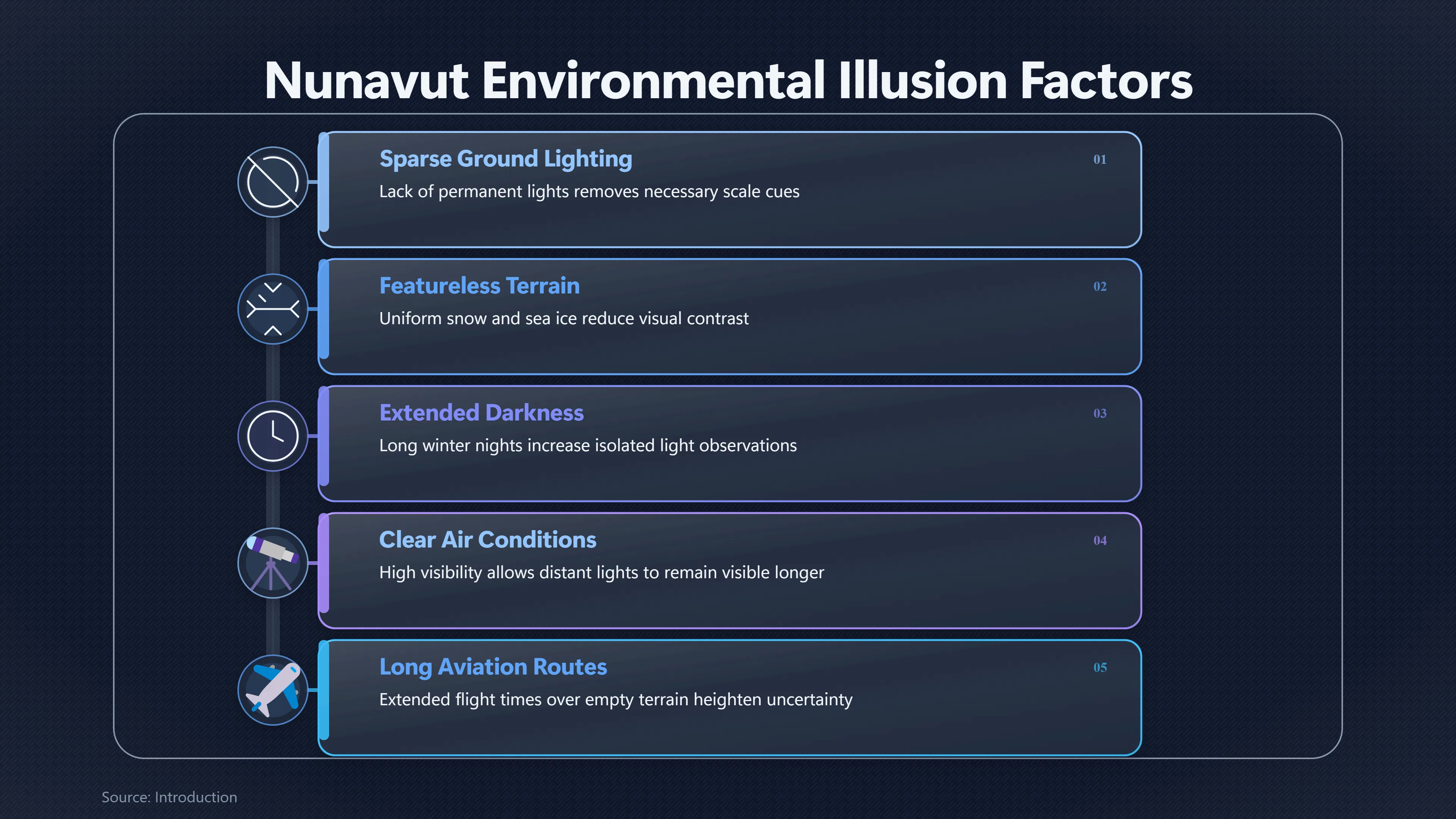
- Very sparse lighting: Outside communities, there are few permanent ground lights to provide scale.
- Featureless snow and sea ice: Uniform surfaces reduce contrast and remove familiar landmarks.
- Long periods of darkness: Extended winter nights increase opportunities for observing isolated lights.
- Long aviation routes: Flights often spend lengthy periods over terrain offering almost no external visual references.
- Exceptionally clear air: Under favourable conditions, distant lights remain visible for much longer than observers may expect, encouraging overestimates of their proximity.[nasa.gov]science.nasa.govScience Nighttime Lights Reveal Industrial Activity in the ArcticNASA ScienceNighttime Lights Reveal Industrial Activity in the Arctic - NASA ScienceDecember 9, 2024…
These factors do not create false sightings by themselves. Instead, they make otherwise ordinary lights more difficult to interpret accurately.
What this means for interpreting UFO reports
Distance and speed estimates are often among the least reliable parts of a night-time UFO report from remote Arctic environments. This does not mean witnesses fabricated what they saw. It means the human visual system was working with unusually little information.
Investigators therefore place greater weight on evidence that can independently establish range or motion, such as simultaneous observations from multiple locations, radar data, instrument recordings or photographs that allow geometric analysis. Where those forms of evidence are absent—as is true for many Nunavut sightings—claims about remarkable acceleration or impossible speed should be treated cautiously because they may depend on uncertain distance estimates rather than measured performance.[gc.ca]tsb.gc.caTransportation Safety Board of CanadaAir transportation safety investigation report A19O0178 - Transportation Safety Board of Canada…
Amazon book picks
Further Reading
Books and field guides related to Why Arctic skies make lights seem closer and faster. Use these as the next step if you want deeper reading beyond the article.
NightWatch: A Practical Guide to Viewing the Universe
A practical guide to viewing the universe.
Stick and Rudder: An Explanation of the Art of Flying
First published 1972. Subjects: Aerodynamics, Flight, Piloting, Airplanes, Airplanes, piloting.

Visual Intelligence
An engrossing guide to seeing—and communicating—more clearly from the groundbreaking course that helps FBI agents, cops, CEOs, ER docs, a...
eBay marketplace picks
Marketplace Samples
Live-tested eBay searches with available results related to this page.
Selected fromaviation poster oneBay.co.uk.
Endnotes
1.
Source: skybrary.aero
Title: Visual Illusions | SKYbrary Aviation Safety
Link:https://skybrary.aero/index.php/articles/visual-illusions
Source snippet
Visual Illusions | SKYbrary Aviation Safety...
2.
Source: tc.canada.ca
Title: Transport Canada Handbook for Civil Aviation Medical Examiners
Link:https://tc.canada.ca/en/aviation/publications/handbook-civil-aviation-medical-examiners-tp-13312
Source snippet
Transport CanadaHandbook for Civil Aviation Medical Examiners - TP 13312...
3.
Source: tc.canada.ca
Title: advisory circular ac no 603 001
Link:https://tc.canada.ca/en/aviation/reference-centre/advisory-circulars/advisory-circular-ac-no
Source snippet
Transport CanadaAdvisory Circular (AC) No. 603-001March 31, 2020...
Published: March 31, 2020
4.
Source: skybrary.aero
Title: Autokinetic Effect | SKYbrary Aviation Safety
Link:https://skybrary.aero/index.php/articles/autokinetic-effect
Source snippet
Autokinetic Effect | SKYbrary Aviation Safety...
5.
Source: science.nasa.gov
Title: Science Nighttime Lights Reveal Industrial Activity in the Arctic
Link:https://science.nasa.gov/earth/earth-observatory/nighttime-lights-reveal-industrial-activity-in-the-arctic-153659/
Source snippet
NASA ScienceNighttime Lights Reveal Industrial Activity in the Arctic - NASA ScienceDecember 9, 2024...
Published: December 9, 2024
6.
Source: tc.canada.ca
Title: Transport Canada Navigating the Hazards of Flat Light: A Guide for Aviators
Link:https://tc.canada.ca/en/aviation/publications/aviation-safety-letter/issue-4-2024/navigating-hazards-flat-light-guide-aviators
Source snippet
the Hazards of Flat Light: A Guide for AviatorsOctober 6, 2025 — NAVIGATING THE HAZARDS OF FLAT LIGHT: A GUIDE FOR AVIATORS * by Jason Ko...
Published: October 6, 2025
7.
Source: nasa.gov
Title: Characterizing the Visual Experience of Astronauts at the Lunar South Pole
Link:https://www.nasa.gov/centers-and-facilities/nesc/characterizing-the-visual-experience-of-astronauts-at-the-lunar-south-pole/
8.
Source: nasa.gov
Link:https://www.nasa.gov/missions/aim/rocket-launches-can-create-night-shining-clouds-away-from-the-poles-nasas-aim-mission-reveals/
9.
Source: science.nasa.gov
Title: the atmosphere earths security blanket
Link:https://science.nasa.gov/earth/earth-atmosphere/the-atmosphere-earths-security-blanket/
10.
Source: tc.canada.ca
Title: ca Black holes and little grey cells
Link:https://tc.canada.ca/en/aviation/general-operating-flight-rules/general-aviation-safety-video-gallery/black-holes-little-grey-cells-spatial-disorientation-during-nvfr
11.
Source: nasa.gov
Link:https://www.nasa.gov/centers-and-facilities/ames/the-dark-side-of-the-crater-how-light-looks-different-on-the-moon-and-what-nasa-is-doing-about-it/
12.
Source: science.nasa.gov
Title: scalloped terrain led to finding of buried ice on mars
Link:https://science.nasa.gov/resource/scalloped-terrain-led-to-finding-of-buried-ice-on-mars/
13.
Source: jpl.nasa.gov
Title: is a sleeping climate giant stirring in the arctic
Link:https://www.jpl.nasa.gov/news/is-a-sleeping-climate-giant-stirring-in-the-arctic/
14.
Source: tc.canada.ca
Title: ca Hazards Associated with Flying at Night
Link:https://tc.canada.ca/en/aviation/publications/system-safety-summer-briefing-kit-tp-14112/hazards-associated-flying-night-powerpoint-presentation
15.
Source: earthobservatory.nasa.gov
Title: Earth Perspectives
Link:https://earthobservatory.nasa.gov/Features/EarthPerspectives
16.
Source: science.nasa.gov
Title: watching the world go by
Link:https://science.nasa.gov/earth/earth-observatory/watching-the-world-go-by/
17.
Source: science.nasa.gov
Title: how on earth was this image made
Link:https://science.nasa.gov/earth/earth-observatory/how-on-earth-was-this-image-made/
18.
Source: robotics.jpl.nasa.gov
Title: military terrestrial
Link:https://robotics.jpl.nasa.gov/what-we-do/applications/military-terrestrial/
19.
Source: skybrary.aero
Link:https://skybrary.aero/index.php/articles/spatial-disorientation
20.
Source: skybrary.aero
Link:https://skybrary.aero/articles/vision-oghfa-bn
21.
Source: skybrary.aero
Link:https://skybrary.aero/index.php/articles/somatogravic-and-somatogyral-illusions
22.
Source: tsb.gc.ca
Link:https://www.tsb.gc.ca/eng/rapports-reports/aviation/2019/a19o0178/a19o0178.html
Source snippet
Transportation Safety Board of CanadaAir transportation safety investigation report A19O0178 - Transportation Safety Board of Canada...
23.
Source: tsb.gc.ca
Link:https://tsb.gc.ca/eng/rapports-reports/aviation/2000/a00a0051/a00a0051.html
Source snippet
Transportation Safety Board of CanadaAviation Investigation Report A00A0051 - Transportation Safety Board of Canada...
Additional References
24.
Source: youtube.com
Title: Back to Basics
Link:https://www.youtube.com/watch?v=dptvV9u8nNQ
Source snippet
Spatial Disorientation Explained: Deadly Flight Illusions Every Pilot Must Know...
25.
Source: faa.gov
Title: Chapter 8
Link:https://www.faa.gov/air_traffic/publications/atpubs/aim_html/chap8_section_1.html?pubDate=20250723
Source snippet
Medical Facts for PilotsJuly 23, 2025 — 8-1-3. HYPERVENTILATION IN FLIGHT 1. Hyperventilation, or an abnormal increase in the volume of a...
Published: July 23, 2025
26.
Source: faa.gov
Link:https://www.faa.gov/air_traffic/publications/atpubs/aip_html/chap8_section_1.html
27.
Source: faraim.org
Link:https://www.faraim.org/faa/aim/chapter-8/section-8-1-5.html
28.
Source: nature.com
Title: Terrain influences the accurate judgement of distance | Nature
Link:https://www.nature.com/articles/26747
29.
Source: youtube.com
Title: PPGS Lesson 14.2 | Aeromedical: Illusions
Link:https://www.youtube.com/watch?v=ZBPmFaqECdM
Source snippet
Part FCL 040 - Human Factors: The Sensory System...
30.
Source: youtube.com
Title: Spatial Disorientation Explained: Deadly Flight Illusions Every Pilot Must Know
Link:https://www.youtube.com/watch?v=6BD9fyyIJzY
Source snippet
SmartPilot | Whiteouts...
31.
Source: flight-study.com
Link:https://www.flight-study.com/2019/09/night-illusions.html
32.
Source: youtube.com
Title: Smart Pilot | Whiteouts
Link:https://www.youtube.com/watch?v=l-utDX1OIv8
Source snippet
PPGS Lesson 14.2 | Aeromedical: Illusions...
33.
Source: faa.gov
Title: Chapter 8. Medical Facts for Pilots
Link:https://www.faa.gov/air_traffic/publications/atpubs/aim/aim0801.html