Within UFO Archives
Does This Northwest Territories UFO Report Belong to Nunavut?
A report filed under the old Northwest Territories label belongs to Nunavut only if its community, island, district, coordinates or route can be confirmed.
On this page
- Why the old territorial label is not enough
- Checking communities, islands, districts and coordinates
- Handling flight routes and broad Arctic descriptions
Page outline Jump by section
Introduction
A UFO report labelled simply as “Northwest Territories” should not automatically be treated as a Nunavut case. Before 1 April 1999, the Northwest Territories covered both today’s Northwest Territories and the land that became Nunavut. As a result, many older Canadian UFO files use an administrative label that no longer matches modern geography. The key task is therefore to verify where the reported event actually occurred before including it in a history of Nunavut sightings.[Canada]canada.cas UFOs: The search for the unknownCanada's UFOs: The search for the unknown - Canada.caMarch 2, 2026…

For researchers, the territorial label is only the starting point. The decisive evidence usually comes from the named community, island, district, map coordinates, flight route or other geographical clues recorded in the original report. Using those details avoids accidentally assigning western Arctic cases to Nunavut or excluding genuine Nunavut sightings that were filed under the former Northwest Territories administration.
Why the old territorial label is not enough
Most Canadian federal UFO files were created decades before Nunavut became a separate territory. Government departments, police detachments and aviation authorities naturally recorded locations according to the administrative boundaries that existed at the time. A report dated 1975 and marked “Northwest Territories” could refer to communities now located in either territory.[Canada]canada.cas UFOs: The search for the unknownCanada's UFOs: The search for the unknown - Canada.caMarch 2, 2026…
The problem is compounded because many federal documents identify only a broad jurisdiction rather than a precise place. Library and Archives Canada notes that only about half of the digitised UFO documents specify a particular sighting location, meaning researchers often have to reconstruct the location from other details within the file rather than relying on the catalogue entry alone.[Canada]canada.cas UFOs: The search for the unknownCanada's UFOs: The search for the unknown - Canada.caMarch 2, 2026…
For a Nunavut-focused history, this means administrative labels should never be treated as proof of geographical location.
Checking communities, islands, districts and coordinates
The most reliable approach is to work from the smallest geographical detail available rather than the territorial heading.
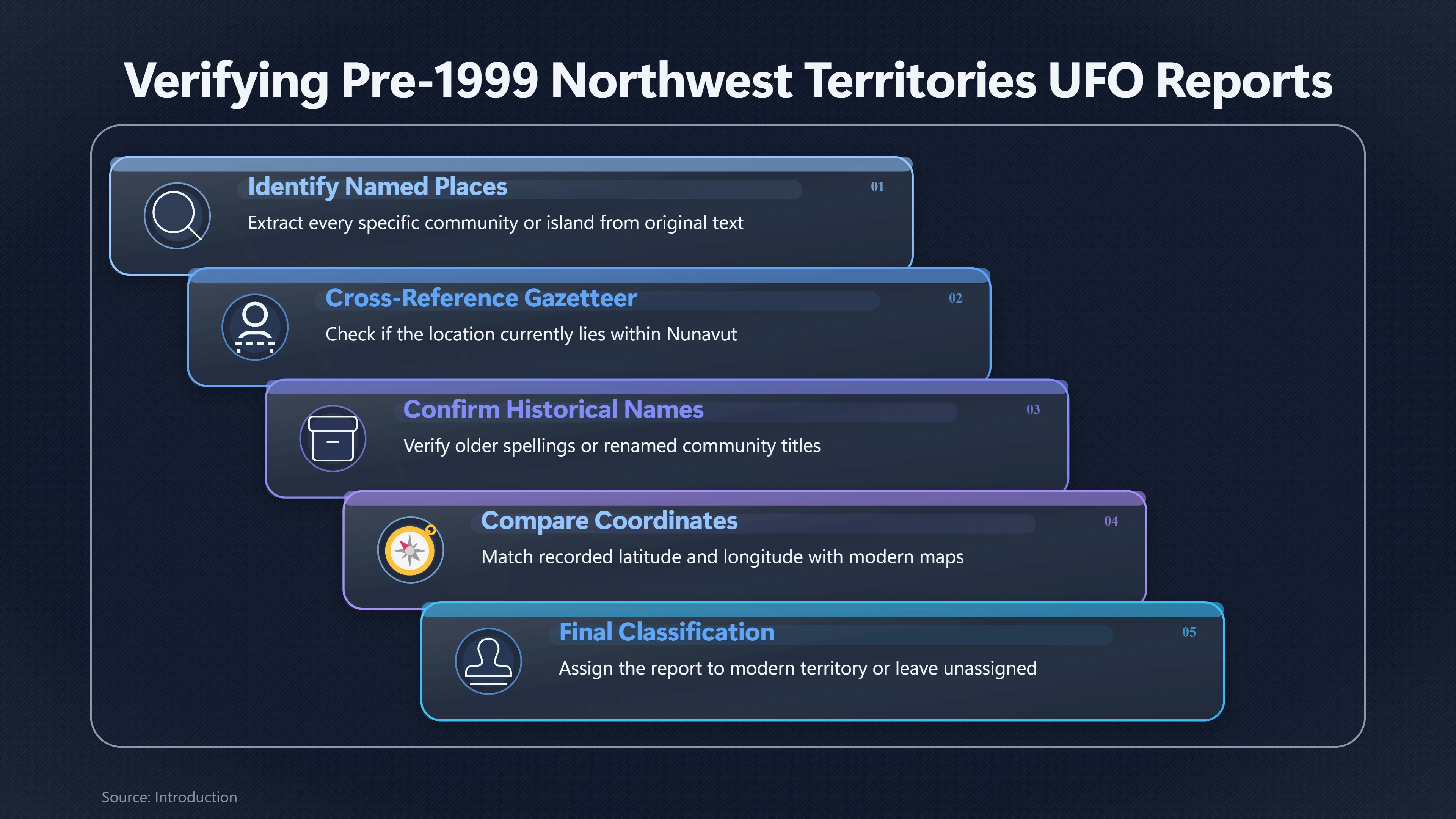
A practical verification sequence is:
- Identify every named place in the original report, not just the catalogue description.
- Check whether that place now lies within Nunavut using an authoritative Canadian gazetteer.
- Confirm historical names because many communities have been renamed or standardised since the report was filed.
- Compare any recorded latitude and longitude with modern maps.
- Only then classify the report as belonging to Nunavut or the modern Northwest Territories.
Natural Resources Canada’s Canadian Geographical Names Database is particularly valuable because it allows searches by official name, historical name, feature type and coordinates, making it possible to match older reports with present-day geography. It also records formerly approved names alongside current official ones.[Natural Resources Canada]natural-resources.canada.caNatural Resources Canada Canadian Geographical Names DatabaseNatural Resources CanadaCanadian Geographical Names Database - Natural Resources Canada…
This matters because older reports may use names that no longer appear on modern road maps.
Examples include:
- Frobisher Bay, now Iqaluit, in Nunavut.
- Historical territorial districts whose names no longer correspond to current administrative boundaries.
- Older spellings or English versions of northern place names that have since been standardised.
A report mentioning one of these places may clearly belong to Nunavut even though the territorial heading reads “Northwest Territories.”
Historical districts can be more useful than the territory name
Some reports identify a district rather than a settlement.
Before Nunavut’s creation, the eastern Arctic formed part of historical districts such as Baffin, Keewatin and Franklin within the Northwest Territories. These district names often provide stronger evidence than the territorial heading itself because they point towards a particular region of the former territory.
However, even district names deserve careful checking. Administrative boundaries changed over time, and district terminology evolved before the 1999 territorial division. The safest practice is to compare the district named in the report with historical maps and official geographical records rather than assuming a modern equivalent.[Natural Resources Canada]natural-resources.canada.caNatural Resources Canada Canadian Geographical Names DatabaseNatural Resources CanadaCanadian Geographical Names Database - Natural Resources Canada…
Handling flight routes and broad Arctic descriptions
Some aviation reports never mention a settlement at all.
Instead, they describe locations such as:
- “over Baffin Island”
- “north of Hudson Bay”
- “between Yellowknife and Resolute”
- “Arctic Ocean”
- “en route to Frobisher Bay”
These reports require a different method.
Rather than assigning the entire flight to one territory, identify where the observation actually occurred. Pilots often recorded approximate coordinates, navigation fixes, altitude or elapsed flying time. Even a brief reference to the nearest airport or waypoint can indicate whether the observation happened over present-day Nunavut or elsewhere.
Particular care is needed with flights crossing territorial boundaries. A report may originate from an airport in the modern Northwest Territories while describing an observation over Nunavut airspace, or vice versa. The filing office is not necessarily the sighting location.
Similarly, descriptions such as “Eastern Arctic” or “Canadian Arctic” are geographical regions rather than administrative boundaries. They should be treated as descriptive language until additional location evidence is found.

Common mistakes when classifying reports
Several recurring errors can distort provincial and territorial UFO histories.
- Using the filing jurisdiction as the sighting location. RCMP detachments, military offices or Transport Canada stations often received reports from elsewhere.
- Ignoring historical place names. A renamed community may appear to be missing unless older names are recognised.
- Assuming every pre-1999 Northwest Territories report belongs to the modern Northwest Territories. Many actually describe places now located in Nunavut.
- Treating broad regional descriptions as precise locations. “Eastern Arctic” is not equivalent to Nunavut.
- Overlooking coordinates. Latitude and longitude usually outweigh an administrative heading when the two conflict.
Each mistake can lead to duplicated case lists or incorrectly attributed sightings.
When the location cannot be confirmed
Sometimes the available evidence simply is not sufficient.
If a report contains only the label “Northwest Territories” with no identifiable community, coordinates, island, district or route, it is usually better to leave the case unassigned than to force it into a modern territorial category.
A transparent classification such as “Northwest Territories (pre-1999, exact modern territory uncertain)” preserves historical accuracy while acknowledging the limits of the evidence. This approach avoids inflating Nunavut’s historical UFO record with cases that cannot confidently be placed within its present-day boundaries.
For a project centred on Nunavut, geographical verification is therefore not an optional extra but the essential mechanism that determines whether an older federal UFO report genuinely belongs in the territory’s documented history.
Amazon book picks
Further Reading
Books and field guides related to Does This Northwest Territories UFO Report Belong to Nunavut?. Use these as the next step if you want deeper reading beyond the article.
UFOs and Government
Governments around the world have had to deal with the UFO phenomenon for a good part of a century. How and why they did so is the subjec...

The Canadian Encyclopedia
First published 1985. Subjects: Encyclopedias and dictionaries.
The Arctic: A History
First published 1994. Subjects: History, Ethnology, Antiquities, Histoire, Arctic regions.

The World Atlas of Exploration
First published 1974. Subjects: Atlases, British, British Atlases, Atlases.
eBay marketplace picks
Marketplace Samples
Live-tested eBay searches with available results related to this page.
Selected fromUFO patch oneBay.co.uk.


Endnotes
1.
Source: canada.ca
Title: ‘s UFOs: The search for the unknown
Link:https://www.canada.ca/en/library-archives/collection/research-help/science-technology/ufos.html
Source snippet
Canada's UFOs: The search for the unknown - Canada.caMarch 2, 2026...
Published: March 2, 2026
2.
Source: natural-resources.canada.ca
Title: Natural Resources Canada Canadian Geographical Names Database
Link:https://natural-resources.canada.ca/maps-tools-publications/tools-applications/canadian-geographical-names-database
Source snippet
Natural Resources CanadaCanadian Geographical Names Database - Natural Resources Canada...
3.
Source: natural-resources.canada.ca
Title: Natural Resources Canada About the Canadian Geographical Names Database
Link:https://natural-resources.canada.ca/maps-tools-publications/maps/geographical-names-board-canada/about-canadian-geographical-names-database?wbdisable=true
Source snippet
the Canadian Geographical Names Database - Natural Resources CanadaFebruary 26, 2025 — ABOUT THE CANADIAN GEOGRAPHICAL NAMES DATABASE You...
Published: February 26, 2025
4.
Source: canada.ca
Title: Four regions make up
Link:https://www.canada.ca/en/library-archives/collection/research-help/indigenous-history/inuit-genealogy.html
Source snippet
Inuit genealogy - Canada.caApril 7, 2026 — INUIT GENEALOGY The term Inuit refers to the diverse Indigenous peoples who live in the Arctic...
Published: April 7, 2026
5.
Source: canada.ca
Title: We need your help to identify people, places and ac
Link:https://www.canada.ca/en/library-archives/collection/research-help/indigenous-history/project-naming.html
Source snippet
Project Naming - Canada.caSeptember 24, 2025 — PROJECT NAMING Library and Archives Canada (LAC) has photographs of First Nations, Inuit a...
Published: September 24, 2025
6.
Source: natural-resources.canada.ca
Link:https://natural-resources.canada.ca/maps-tools-publications/maps/geographical-names-canada/download-geographical-names-data
Source snippet
Geographical Names Data - Natural Resources CanadaJune 13, 2025 — DOWNLOAD GEOGRAPHICAL NAMES DATA Content advisory: The Canadian Geograp...
Published: June 13, 2025
7.
Source: library-archives.canada.ca
Title: We need your help to identify people, places and ac
Link:https://library-archives.canada.ca/eng/collection/research-help/indigenous-heritage/Pages/project-naming.aspx?wbdisable=true
Source snippet
NamingJune 6, 2025 — PROJECT NAMING Library and Archives Canada (LAC) has photographs of First Nations, Inuit and Métis Nation Peoples th...
Published: June 6, 2025
8.
Source: ised-isde.canada.ca
Title: ca Management of Public Reporting of Unidentified Aerial Phenomena in Canada
Link:https://ised-isde.canada.ca/site/science/en/office-chief-science-advisor/sky-canada-project/management-public-reporting-unidentified-aerial-phenomena-canada
Source snippet
of Public Reporting of Unidentified Aerial Phenomena in CanadaJune 1, 2025 — MANAGEMENT OF PUBLIC REPORTING OF UNIDENTIFIED AERIAL PHENOM...
Published: June 1, 2025
9.
Source: open.canada.ca
Title: ca Canadian Geographical Names
Link:https://open.canada.ca/data/en/dataset/e27c6eba-3c5d-4051-9db2-082dc6411c2c
10.
Source: open.canada.ca
Link:https://open.canada.ca/data/en/dataset/cc80865e-8893-11e0-a66e-6cf049291510
11.
Source: publications.aws.tpsgc-pwgsc.cloud-nuage.canada.ca
Link:https://publications.aws.tpsgc-pwgsc.cloud-nuage.canada.ca/site/eng/9.851476/publication.html
Additional References
12.
Source: youtube.com
Title: One of Canada’s Strangest Sightings (S5) | The Proof Is Out There
Link:https://www.youtube.com/watch?v=aTr84e04SbE
Source snippet
This video discusses historical UFO investigations in Canada, including the iconic Clan Lake case from the Northwest Territories, providi...
13.
Source: youtube.com
Title: UFO sighting in Northern Canada
Link:https://www.youtube.com/watch?v=gG6iN2UIfXA
Source snippet
The Summer of UFOs: Canada's 1975 Wave (with Chris Rutkowski)...
14.
Source: youtube.com
Link:https://www.youtube.com/watch?v=oL4E6YRuvN0
Source snippet
What the Canadian government knows about UFOs...
15.
Source: youtube.com
Title: What the Canadian government knows about UFOs
Link:https://www.youtube.com/watch?v=ntyUWhbtcqM
Source snippet
One of Canada's Strangest Sightings (S5) | The Proof Is Out There...
16.
Source: youtube.com
Title: Did a UFO Crash at Clan Lake?
Link:https://www.youtube.com/watch?v=Q5kKcOBEvG8
Source snippet
UFO sighting in Northern Canada - W5 speaks to eyewitnesses (1972)...
17.
Source: nwttimeline.ca
Title: The Division of NWT and Nunavut
Link:https://www.nwttimeline.ca/stories/the-division-of-nwt-and-nunavut/
18.
Source: epe.lac-bac.gc.ca
Title: lac-bac.gc.ca Thematic Guides
Link:https://epe.lac-bac.gc.ca/100/201/301/new_books/2011/10/the-public/005-1142.20-e.html?nodisclaimer=1
19.
Source: geonames.nrcan.gc.ca
Title: nrcan.gc.ca Place names
Link:https://geonames.nrcan.gc.ca/search-place-names/search.php?lang=en
20.
Source: geonames.nrcan.gc.ca
Title: nrcan.gc.ca Place names
Link:https://geonames.nrcan.gc.ca/search-place-names/search?id=LAARR
21.
Source: geonames.nrcan.gc.ca
Title: nrcan.gc.ca Place names
Link:https://geonames.nrcan.gc.ca/search-place-names/unique