Within Kensington
Why the Missing Horizon Changes Everything
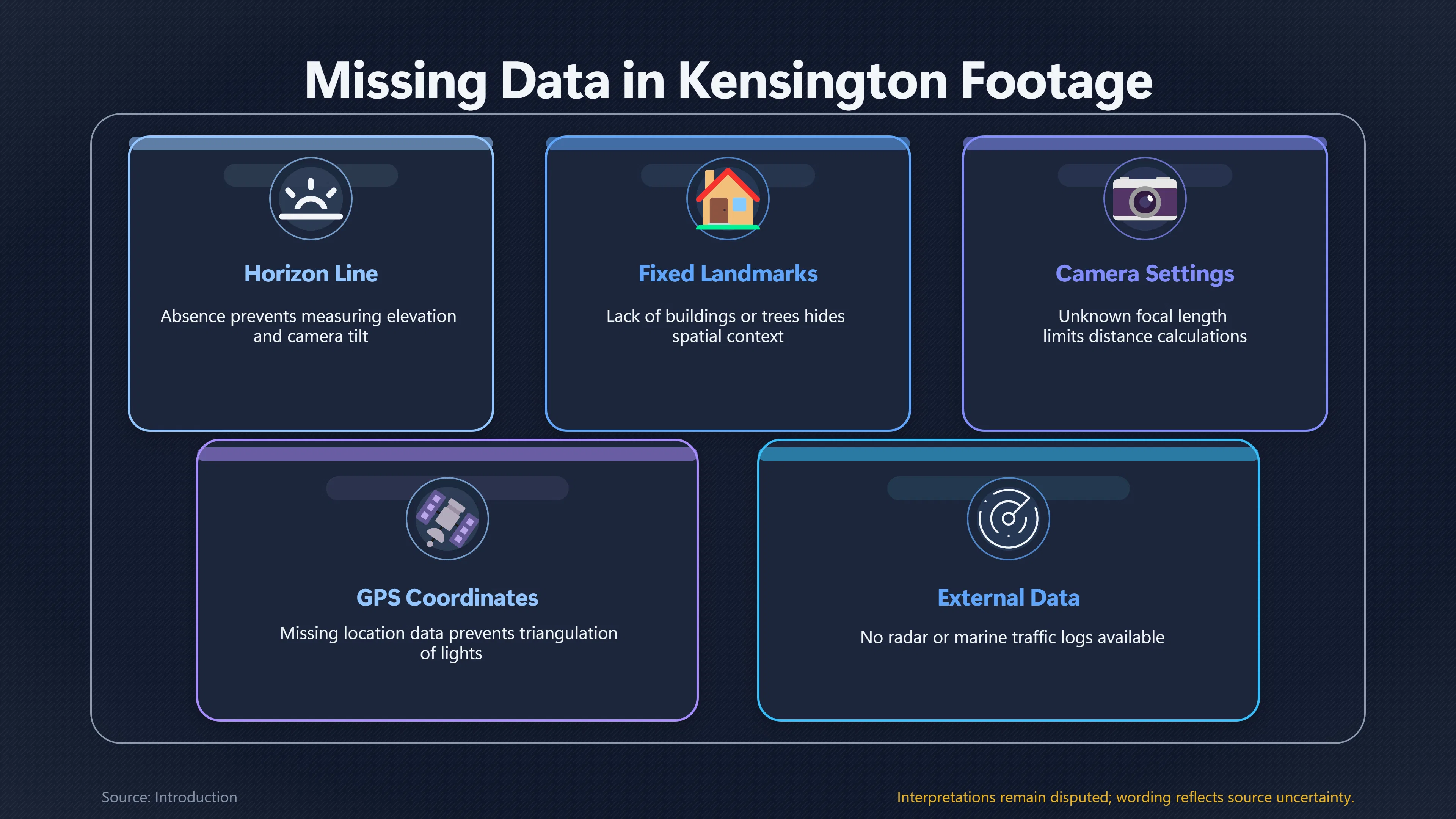
Without a visible horizon or fixed landmarks, the recording cannot reliably reveal the lights' distance, size or speed.
On this page
- Why the horizon matters
- Distance, size and speed limits
- What extra data would be needed
Page outline Jump by section
Introduction
The Kensington lights video is important because it preserves a genuine observation, but one of its biggest limitations is also one of its least obvious: the recording does not show a clear horizon or other fixed reference points. That missing information means the video cannot reliably measure how far away the lights were, how large they were, how fast they travelled or how high they were above the Gulf of St Lawrence. Without those measurements, investigators cannot distinguish confidently between a nearby small light and a much larger but far more distant source.
This limitation does not make the recording worthless. It simply defines what conclusions the footage can and cannot support. For the Prince Edward Island case, the absence of a visible horizon is one of the main reasons the video remains an unresolved observation rather than evidence for any particular explanation.
Why the horizon matters
A visible horizon provides the camera with a stable geometric reference. Together with known landmarks such as the shoreline, buildings or navigation lights, it allows investigators to estimate the camera’s orientation and the angular position of an object above the landscape.
In the available Kensington footage, the scene is dominated by a black sky with isolated points of light. The sea, coastline and horizon are largely invisible. As a result, later viewers cannot establish several basic quantities:
- the elevation angle of the lights above the horizon;
- whether the camera is level or tilted;
- whether the lights were above the sea, above distant land or aligned with features hidden in darkness;
- whether apparent movement comes from the lights, the camera, or both.
This problem is well recognised in aviation. Night operations become significantly more difficult when the natural horizon disappears because pilots lose the external visual reference needed for accurate spatial judgement. Aviation guidance notes that loss of the visible horizon forces greater reliance on instruments because external visual cues become unreliable.[EASA]easa.europa.euEASAEasy Access Rules for Air OperationsRevision 24, March 2026 | EASAMarch 27, 2026…
The same principle applies when analysing a handheld night-time recording. Without an external frame of reference, the image contains far less measurable information than many viewers assume.
Why distance, size and speed cannot be calculated
A phone camera records the angular position of light on its sensor rather than the physical distance to the source. Converting that angle into real-world measurements requires additional information that the Kensington recording does not provide.
For example, a bright light occupying five pixels in the image could represent:
- a drone a few hundred metres away;
- an aircraft many kilometres away;
- a distant vessel’s light;
- an astronomical object distorted by camera motion or optics.
Those very different situations can produce remarkably similar images.
The relationship between apparent size and true distance is fundamentally ambiguous unless the object’s real size is already known. Vision science has long shown that a two-dimensional image cannot recover absolute distance from apparent size alone because multiple combinations of object size and distance produce the same angular appearance.[DOI]doi.orgCan People Infer Distance in a 2D Scene Using the Visual Size and Position of an Object?May 4, 2022…
The same uncertainty affects estimates of speed. Suppose a light shifts slightly across the frame over several seconds. Without knowing its distance, there is no way to convert that angular movement into metres per second.
A simple comparison illustrates the problem:
- A nearby object moving slowly can sweep across several degrees of view.
- A distant aircraft travelling hundreds of kilometres per hour may produce exactly the same apparent motion.
Both produce similar video despite vastly different physical speeds.
Why open water makes the problem worse
The filming location on Prince Edward Island’s north shore looks across the Gulf of St Lawrence. At night, open water offers very few visible depth cues.
During daylight, observers unconsciously estimate distance using features such as:
- shoreline texture;
- waves;
- buildings;
- trees;
- roads;
- terrain.
Most of those references disappear after dark.
Large expanses of dark water are particularly difficult because there is little contrast between sea and sky. Aviation guidance specifically recognises over-water night operations as challenging because visual references become sparse and the natural horizon may be difficult or impossible to distinguish.[EASA]easa.europa.euEASAEasy Access Rules for Air OperationsRevision 24, March 2026 | EASAMarch 27, 2026…
Consequently, even someone present at the scene may misjudge how far away a light appears. A later viewer examining only the video loses even more contextual information.
Apparent movement is not necessarily real movement
When viewers watch a bright point against an otherwise black frame, it is easy to assume the object itself is moving dramatically.
However, several effects can create apparent motion without requiring unusual behaviour:
- small hand movements by the person filming;
- digital image stabilisation shifting the frame;
- autofocus adjustments;
- slight changes in zoom;
- atmospheric shimmer over long viewing distances;
- changes in brightness that alter the apparent centre of a glowing light.
Night observations are also susceptible to well-documented visual illusions. A stationary light viewed against a dark background can appear to drift or wander when stared at for extended periods, a phenomenon known as autokinesis. Likewise, the absence of reliable visual references can distort judgement of position and movement.[Skybrary]skybrary.aeroVisual Illusions | SKYbrary Aviation SafetyVisual Illusions | SKYbrary Aviation Safety…
These possibilities do not prove that the Kensington lights were stationary, but they mean apparent motion in the video cannot automatically be treated as measured physical movement.

What extra data would be needed
The recording could have supported much stronger measurements if it had included additional reference information. Useful evidence would include:
- a clearly visible sea horizon;
- recognisable shoreline features;
- stars or planets allowing accurate camera orientation;
- the camera’s focal length and zoom settings;
- GPS position and precise viewing direction;
- simultaneous recordings from another location;
- radar, aircraft tracking or marine traffic data corresponding to the same period.
Multiple viewpoints would be especially valuable. If two observers filmed the same light from different locations with accurately timed recordings, investigators could potentially estimate its position by triangulation. A single viewpoint generally cannot achieve this.
What this means for the Kensington case
The missing horizon is not a minor technical detail. It is one of the central reasons why the Kensington footage cannot establish the lights’ true distance, altitude, size or speed.
The video successfully demonstrates that unusual lights were observed and recorded over the Gulf of St Lawrence. It also preserves the duration of the event better than memory alone could. What it does not provide is the geometric information needed to convert a night-time image into reliable physical measurements.
For that reason, the recording remains consistent with several possible explanations ranging from distant conventional lights to genuinely unidentified aerial phenomena. The absence of a visible horizon does not favour any one explanation. Instead, it limits how confidently investigators can eliminate the alternatives.
Amazon book picks
Further Reading
Books and field guides related to Why the Missing Horizon Changes Everything. Use these as the next step if you want deeper reading beyond the article.
Understanding Exposure
Rating: 4.5/5 from 19 Google Books ratings
Provides detailed lessons on the elements of exposure and how each relates to depth of field, freezing and blurring action, and shooting...
The Demon-Haunted World: Science as a Candle in the Dark
NEW YORK TIMES BESTSELLER • From the renowned astronomer and author of Cosmos comes a “powerful [and] stirring defense of informed ration...
The UFO Experience: A Scientific Inquiry
Cited by the New York Review of Books as "the best brief for visitation," this classic study presents an analysis of UFO reports and conc...
eBay marketplace picks
Marketplace Samples
Live-tested eBay searches with available results related to this page.
Selected fromUFO poster oneBay.co.uk.
Current eBay listing
I Want To Believe UFO Poster Giclée Fine Art Heavyweight Print

Current eBay listing
VINTAGE UFO FLYING SAUCERS COMIC ADVERTISING A2 POSTER PRINT

Endnotes
1.
Source: easa.europa.eu
Title: EASAEasy Access Rules for Air Operations
Link:https://www.easa.europa.eu/en/document-library/easy-access-rules/online-publications/easy-access-rules-air-operations?erules-id=ERULES-1963177438-21073
Source snippet
Revision 24, March 2026 | EASAMarch 27, 2026...
Published: March 27, 2026
2.
Source: doi.org
Link:https://doi.org/10.3390/vision6020025
Source snippet
Can People Infer Distance in a 2D Scene Using the Visual Size and Position of an Object?May 4, 2022...
Published: May 4, 2022
3.
Source: skybrary.aero
Title: Visual Illusions | SKYbrary Aviation Safety
Link:https://skybrary.aero/index.php/articles/visual-illusions
Source snippet
Visual Illusions | SKYbrary Aviation Safety...
4.
Source: skybrary.aero
Link:https://skybrary.aero/index.php/articles/runway-visual-perspective
5.
Source: skybrary.aero
Link:https://skybrary.aero/index.php/articles/night-visual-approaches
Additional References
6.
Source: pubmed.ncbi.nlm.nih.gov
Link:https://pubmed.ncbi.nlm.nih.gov/31731532/
Source snippet
of the Accuracy of Determining the Angular Position of the Unmanned Bathymetric Surveying Vehicle Based on the Sea Horizon Image - PubMed...
7.
Source: caa.co.uk
Title: The results of the survey were co
Link:https://www.caa.co.uk/newsroom/news/new-study-on-electronic-conspicuity-published-by-aviation-regulator/
Source snippet
New study on Electronic Conspicuity published by aviation regulator | UK Civil Aviation AuthorityNovember 16, 2023 — The milestone report...
Published: November 16, 2023
8.
Source: atsb.gov.au
Title: This is due to a wide
Link:https://www.atsb.gov.au/investigations/2022-001
Source snippet
Aircraft performance and cockpit visibility study supporting [investigation]({{ 'investigation/' | relative_url }}) into the mid-air collision involving VH-AEM and VH-JQF, near M...
9.
Source: pmc.ncbi.nlm.nih.gov
Link:https://pmc.ncbi.nlm.nih.gov/articles/PMC6864606/
Source snippet
2019 Oct 25;19(21):4644. doi: 10.3390/s19214644 ASSESSMENT OF THE ACCURACY OF DETERMINING THE ANGULAR POSITION OF THE UNMANNED BATHYMETRI...
10.
Source: youtube.com
Title: 轻1. Explained: “Go Fast” UFO Video
Link:https://www.youtube.com/watch?v=PLyEO0jNt6M
Source snippet
Aguadilla - UFO Analysis with Lines of Sight...
11.
Source: atsb.gov.au
Title: ATSBAvoidable Accidents No. 7
Link:https://www.atsb.gov.au/publications/avoidable-accidents/2013/aviation/avoidable-accidents-no-7-visual-flight-night
Source snippet
Visual flight at night accidents: What you can't see can still hurt you | ATSB...
12.
Source: youtube.com
Title: Night Illusions (Private Pilot Lesson 15d)
Link:https://www.youtube.com/watch?v=y_HvgmQ3NJs
Source snippet
Spatial Disorientation Explained: Deadly Flight Illusions Every Pilot Must Know...
13.
Source: tandfonline.com
Link:https://www.tandfonline.com/doi/abs/10.1080/10508414.2013.833755
14.
Source: flatearth.ws
Link:https://flatearth.ws/t/zoom
15.
Source: youtube.com
Title: Utah Drone UFO
Link:https://www.youtube.com/watch?v=xDkqKa_NQAo
Source snippet
Night Illusions (Private Pilot Lesson 15d)...