Within Official Reports
What Nunavut Pilots Should Report During a Sighting
Pilots can use Canada's CIRVIS procedure to send time, position, appearance and movement details to the nearest air traffic unit.
On this page
- When a CIRVIS report is appropriate
- What information pilots are expected to provide
- Why missing details can leave sightings unresolved
Page outline Jump by section
Introduction
For pilots flying over Nunavut, an unidentified object is first and foremost an aviation safety issue rather than a mystery to be solved. Canada’s established procedure is to make a CIRVIS (Communications Instructions for Reporting Vital Intelligence Sightings) report to the nearest air traffic services unit whenever an object or activity appears unidentified, suspicious or potentially hazardous. In Nunavut’s immense, sparsely populated airspace, where radar coverage is more limited than in southern Canada and aircraft may be the only witnesses, pilot reports are one of the most important ways unusual observations enter official Canadian systems. Those reports can then become Aviation Occurrence Reports within NAV CANADA and, where appropriate, public entries in Transport Canada’s Civil Aviation Daily Occurrence Reporting System (CADORS).[Innovation Canada]ised-isde.canada.caInnovation CanadaManagement of Public Reporting of Unidentified Aerial Phenomena in CanadaJune 1, 2025…
This process is designed to protect aviation, not to determine whether an object was extraordinary. A report records operational facts so that air traffic, safety and security authorities can assess whether the observation could involve another aircraft, a balloon, a meteor, space activity or another potential hazard.
When a CIRVIS report is appropriate
Canada’s Aeronautical Information Manual retains the CIRVIS procedure as part of its operational reporting guidance. Although the name dates from the Cold War, the procedure remains relevant because pilots may still encounter objects or activities that cannot immediately be identified.
For flights over Nunavut, a CIRVIS report is appropriate when a pilot observes an airborne or surface object whose identity or behaviour raises genuine operational concern. The emphasis is on whether the sighting could affect safety or security, not whether it appears unusual in a popular or paranormal sense. Examples include:
- an unidentified airborne object whose position or movement creates uncertainty;
- unusual aerial activity in remote or polar regions;
- an object that cannot readily be identified as known air traffic or another expected phenomenon;
- any observation that could represent a collision hazard or require other aircraft to be warned.
The report should be made as soon as practical to the nearest air traffic control unit, flight service station or other air traffic services facility while the observation is still current. Early reporting allows controllers to compare the information with radar returns, known aircraft movements, notices to airmen, weather information and other operational data before evidence disappears.[Innovation Canada]ised-isde.canada.caInnovation CanadaManagement of Public Reporting of Unidentified Aerial Phenomena in CanadaJune 1, 2025…
What information pilots are expected to provide
A useful CIRVIS report depends on specific observations rather than conclusions. Pilots are not expected to identify the object; they are expected to describe it accurately.
Canadian guidance asks pilots to provide, as far as possible:
- aircraft identification;
- the date and time in Coordinated Universal Time (UTC);
- precise position and altitude;
- the object’s apparent position relative to the aircraft;
- its size, shape, colour or lighting;
- apparent direction of travel and speed;
- altitude, if it can reasonably be estimated;
- duration of the observation;
- any manoeuvres or changes in appearance;
- any possible identification if one later becomes apparent.
In practice, controllers may also ask follow-up questions about weather conditions, visibility, cloud layers, the phase of flight, whether the object was seen visually or on onboard equipment, and whether other crew members observed the same thing. These operational details often prove more valuable than subjective impressions because they allow later comparison with known aircraft, astronomical events or atmospheric phenomena.[Innovation Canada]ised-isde.canada.caInnovation CanadaManagement of Public Reporting of Unidentified Aerial Phenomena in CanadaJune 1, 2025…
Why detail matters in Nunavut
Nunavut presents particular reporting challenges. Flights frequently operate across enormous distances with few ground observers, limited communications infrastructure in some areas and long periods of darkness during parts of the year. That means an airline crew or charter pilot may be the only available witness.
These conditions make accurate reporting especially valuable. A precise position, heading and time can be checked against:
- other aircraft operating nearby;
- NAV CANADA operational records;[navcanada.ca]navcanada.caSource details in endnotes.
- satellite launches or re-entry events;
- meteor observations;
- weather balloon releases;
- military or other authorised aviation activity where appropriate.
Without those details, investigators may have little objective evidence beyond the witness account. Even experienced pilots can struggle to estimate the distance, size or speed of an unfamiliar light against a featureless Arctic sky, particularly at night or over snow and sea ice where visual references are scarce. Consequently, an observation may remain officially “unidentified” simply because there is insufficient information to distinguish between several ordinary possibilities, not because it represents evidence of an extraordinary object.[Innovation Canada]ised-isde.canada.caInnovation CanadaManagement of Public Reporting of Unidentified Aerial Phenomena in CanadaJune 1, 2025…
From the cockpit to Canada’s official systems
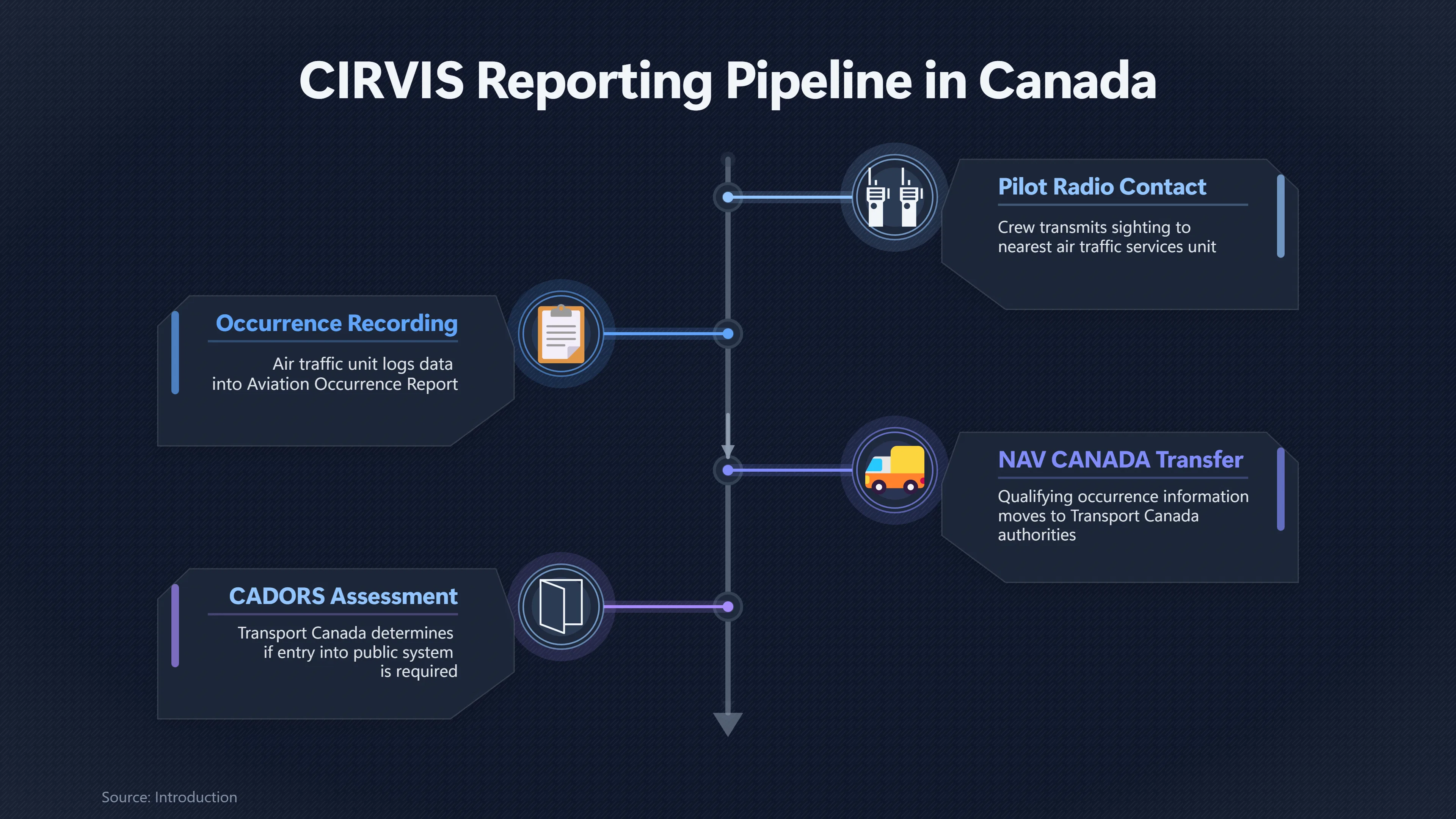
Once the report reaches an air traffic services unit, the information becomes part of Canada’s aviation reporting process.
Typically:
- The pilot reports the sighting by radio to the nearest air traffic services unit.
- The air traffic unit records the information in an Aviation Occurrence Report.
- NAV CANADA forwards qualifying occurrence information to Transport Canada.
- Transport Canada assesses whether the occurrence should be entered into CADORS under the appropriate operational category.
This sequence explains why some Nunavut sightings later appear in publicly searchable aviation records while many others do not. Publication depends on aviation reporting criteria rather than on whether a sighting generated public interest. A CADORS entry records that an occurrence was reported; it does not confirm that the object was extraordinary or unexplained after investigation.[Innovation Canada]ised-isde.canada.caInnovation CanadaManagement of Public Reporting of Unidentified Aerial Phenomena in CanadaJune 1, 2025…
Why some pilot sightings remain unresolved
Pilot testimony carries obvious value because flight crews are trained observers operating in a regulated environment. Even so, professional experience does not eliminate the practical limitations of observing distant objects in the sky.
Several factors can prevent a firm identification:
- the object was visible only briefly;
- no radar or sensor data were available;
- distance and altitude could not be estimated reliably;
- atmospheric conditions distorted appearance;
- only one aircraft observed the event;
- no photographs or independent observations existed for comparison.
The Office of the Chief Science Advisor’s 2025 Sky Canada Project concluded that Canadian UAP reporting remains fragmented and that most reports receive little detailed analysis unless they relate directly to aviation safety, public safety or national security. The report also notes that pilot sightings usually enter the system through air traffic services before reaching Transport Canada’s reporting process.[Innovation Canada]ised-isde.canada.caInnovation CanadaManagement of Public Reporting of Unidentified Aerial Phenomena in CanadaJune 1, 2025…
For Nunavut, that makes careful pilot reporting particularly significant. In a territory where vast distances and low population density limit other sources of evidence, a well-documented CIRVIS report is often the clearest path by which an unusual aerial observation becomes part of Canada’s official aviation record.
Amazon book picks
Further Reading
Books and field guides related to What Nunavut Pilots Should Report During a Sighting. Use these as the next step if you want deeper reading beyond the article.
UFOs: Generals, Pilots, and Government Officials Go on the Re...
NEW YORK TIMES BESTSELLER • Impeccably researched, this riveting journalistic investigation separates fact from fiction, and documents th...
Stick and Rudder
First published 1972. Subjects: Aerodynamics, Flight, Piloting, Airplanes, Airplanes, piloting.
Pilot's Handbook of Aeronautical Knowledge
Pilot's Handbook of Aeronautical Knowledge, created by the Federal Aviation Administration, is the official reference manual for pilots a...
eBay marketplace picks
Marketplace Samples
Live-tested eBay searches with available results related to this page.
Selected fromPilot UFO patch oneBay.co.uk.
Endnotes
1.
Source: ised-isde.canada.ca
Link:https://ised-isde.canada.ca/site/science/en/office-chief-science-advisor/sky-canada-project/management-public-reporting-unidentified-aerial-phenomena-canada
Source snippet
Innovation CanadaManagement of Public Reporting of Unidentified Aerial Phenomena in CanadaJune 1, 2025...
Published: June 1, 2025
2.
Source: ised-isde.canada.ca
Title: Innovation Canada Sky Canada Project
Link:https://ised-isde.canada.ca/site/science/en/office-chief-science-advisor/sky-canada-project
Source snippet
Canada ProjectDecember 3, 2025 — SKY CANADA PROJECT DISCLAIMER It should be noted that the Sky Canada Project is not intended to access a...
Published: December 3, 2025
3.
Source: ised-isde.canada.ca
Title: ca Projet Ciel Canada
Link:https://ised-isde.canada.ca/site/science/fr/bureau-conseillere-scientifique-chef/projet-ciel-canada
Source snippet
Ciel CanadaDecember 3, 2025 — PROJET CIEL CANADA AVERTISSEMENT Il convient de noter que le projet Ciel Canada n’est pas destiné à accéder...
Published: December 3, 2025
4.
Source: tc.canada.ca
Title: ca Civil Aviation Daily Occurrence Reporting System (CADORS) Manual
Link:https://tc.canada.ca/en/aviation/aviation-publications/civil-aviation-daily-occurrence-reporting-system-cadors-manual-tp-4044
Source snippet
Aviation Daily Occurrence Reporting System (CADORS) Manual - TP 4044September 5, 2025 — CIVIL AVIATION DAILY OCCURRENCE REPORTING SYSTEM...
Published: September 5, 2025
5.
Source: publications.aws.tpsgc-pwgsc.cloud-nuage.canada.ca
Link:https://publications.aws.tpsgc-pwgsc.cloud-nuage.canada.ca/site/fra/9.954480/publication.html
Source snippet
Iu37-59/2025E-PDF - Publications du gouvernement du Canada - Canada.caJune 1, 2025 — MANAGEMENT OF PUBLIC REPORTING OF UNIDENTIFIED AERIA...
Published: June 1, 2025
6.
Source: ised-isde.canada.ca
Link:https://ised-isde.canada.ca/site/science/en/office-chief-science-advisor/sky-canada-project/preview-sky-canada-report-ocsa
7.
Source: ised-isde.canada.ca
Title: ca Questions and Answers about the Sky Canada Project
Link:https://ised-isde.canada.ca/site/science/en/office-chief-science-advisor/sky-canada-project/questions-and-answers-about-sky-canada-project
8.
Source: canada.ca
Link:https://www.canada.ca/en/environment-climate-change/services/weather-manuals-documentation/manobs-surface-observations.html
9.
Source: publications.gc.ca
Link:https://publications.gc.ca/site/eng/9.954481/publication.html
10.
Source: publications.gc.ca
Link:https://publications.gc.ca/site/fra/9.954481/publication.html
11.
Source: navcanada.ca
Link:https://www.navcanada.ca/en/flight-planning/drone-flight-planning/how-to-report-a-flyaway-drone.aspx
12.
Source: navcanada.ca
Link:https://www.navcanada.ca/en/aeronautical-information/operational-guides.aspx
13.
Source: navcanada.ca
Link:https://www.navcanada.ca/en/nav-drone-web-user-guide.aspx
14.
Source: navcanada.ca
Link:https://www.navcanada.ca/en/contact-us.aspx
Additional References
15.
Source: publications.gc.ca
Link:https://publications.gc.ca/pub?id=9.954480&sl=0
Source snippet
Management of public reporting of unidentified aerial phenomena in Canada: report of the Sky Canada Project.: Iu37-59/2025E-PDF - Govern...
16.
Source: canadacommons.ca
Link:https://canadacommons.ca/artifacts/53274763/report-of-the-sky-canada-project/54173224/
17.
Source: unidentifiedphenomena.com
Link:https://unidentifiedphenomena.com/topics/public-reporting-of-unidentified-aerial-phenomena-in-canada/
18.
Source: nunatsiaq.com
Title: Pilots report UFO sighting over Nunavut’s northern Baffin Island
Link:https://nunatsiaq.com/stories/article/65674pilots_spot_possible_ufo_above_nunavuts_northern_baffin_island/
19.
Source: youtube.com
Link:https://www.youtube.com/watch?v=9bBsWjjCChg
20.
Source: youtube.com
Link:https://www.youtube.com/watch?v=DgbNKOK7lr4
21.
Source: youtube.com
Link:https://www.youtube.com/watch?v=Q6JgyhoCyi8
22.
Source: youtube.com
Link:https://www.youtube.com/watch?v=hgZ_2Y0_6d4
23.
Source: youtube.com
Link:https://www.youtube.com/watch?v=hrxW9jrbtmM
24.
Source: publications.gc.ca
Title: marc Xml
Link:https://publications.gc.ca/site/eng/9.954480/marcXml.html?MODS=1