Within Arctic Skies
Why do fixed lights seem to move over Nunavut?
Aviation's autokinesis illusion can make fixed lights appear to move during long Arctic night flights.
On this page
- How autokinesis works
- Why Arctic flights are vulnerable
- Limits of pilot observations
Page outline Jump by section
Introduction
Autokinesis is one of the best-understood visual illusions in aviation and provides an important framework for interpreting some pilot UFO reports in Nunavut. The effect occurs when a person stares at a single point of light against a dark, featureless background. Although the light is stationary, it can appear to drift, accelerate, stop or change direction. In the Canadian Arctic, where flights often take place during prolonged winter darkness over snow, sea ice and sparsely lit terrain, the conditions that encourage this illusion are unusually common. Transport Canada specifically warns pilots about autokinesis as part of normal flight training because it has contributed to aviation accidents and misidentification of lights.[Transport Canada]tc.canada.caTransport Canada Handbook for Civil Aviation Medical ExaminersTransport CanadaHandbook for Civil Aviation Medical Examiners - TP 13312May 6, 2019…
This matters for Nunavut’s UFO history because several reported aerial mysteries have consisted primarily of isolated lights seen by experienced flight crews rather than structured craft observed at close range. Understanding autokinesis does not mean dismissing pilot testimony. Instead, it explains why sincere, trained observers can accurately report what they perceived while still misjudging whether a distant light was actually moving.
Why do fixed lights seem to move over Nunavut?
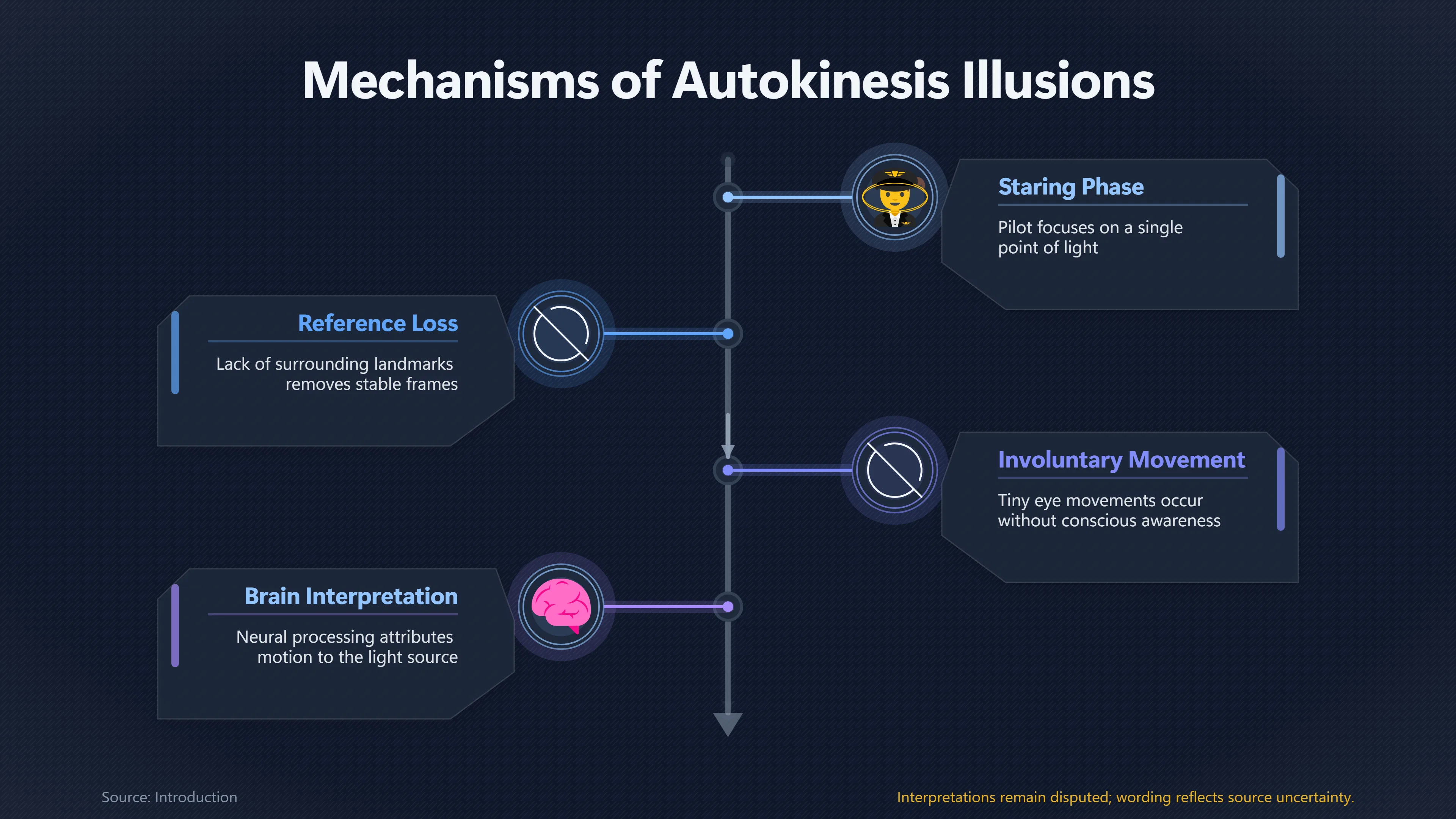
Autokinesis is not caused by movement in the light itself. Instead, it results from tiny involuntary eye movements combined with the brain’s attempt to interpret a point of light that lacks any surrounding visual reference. Under normal daytime conditions, buildings, trees, mountains or the horizon provide a stable frame against which motion can be judged. During an Arctic night flight, many of those references disappear.
A pilot looking at a bright star, planet or distant ground light for several seconds may therefore experience the impression that it is:
- drifting sideways;
- climbing or descending;
- pacing the aircraft;
- approaching before suddenly stopping; or
- making abrupt changes of direction.
Transport Canada’s aviation medical guidance specifically notes that stars and distant ground lights watched intently at night can appear to move and be mistaken for other aircraft. The guidance emphasises that this is a recognised physiological limitation rather than a failure of pilot competence.[Transport Canada]tc.canada.caTransport Canada Handbook for Civil Aviation Medical ExaminersTransport CanadaHandbook for Civil Aviation Medical Examiners - TP 13312May 6, 2019…
Why Arctic flights are especially vulnerable
Nunavut combines several factors that make autokinesis more persuasive than in many southern flying environments.
First, long periods of darkness mean pilots may observe the same unidentified light for many minutes rather than only briefly. Extended viewing increases the opportunity for the illusion to develop.
Second, much of the territory offers remarkably few visual reference points. Flights between communities, mines and remote airstrips frequently cross hundreds of kilometres of frozen coastline, sea ice or tundra with almost no artificial lighting. Without nearby landmarks, estimating a light’s distance or true motion becomes far more difficult.
Third, crews often make small heading, altitude or bank corrections during routine flight. Because the aircraft itself is moving, an apparently fixed celestial object may seem to respond to those manoeuvres. Human perception naturally attributes the changing geometry to the light rather than to the observer’s own motion.
Finally, bright stars and planets often appear exceptionally prominent under the Arctic’s dark, clear winter skies. A very bright celestial object can become the focus of prolonged observation, creating ideal conditions for autokinesis even before atmospheric effects such as twinkling or colour changes are considered.[Transport Canada]tc.canada.caTransport CanadaTransport Canada Aeronautical Information Manual (TC AIM) - TP 14371…
The 2018 northern Baffin pilot report
One of Nunavut’s best-known modern aviation UFO reports illustrates why autokinesis is considered alongside more conventional astronomical explanations.
On 24 November 2018, pilots flying a Nolinor Aviation Boeing 737 from Iqaluit towards the Mary River mine reported an unusual bright light over northern Baffin Island. The occurrence was entered into Transport Canada’s Civil Aviation Daily Occurrence Reporting System (CADORS), and the report was passed to NORAD through established aviation reporting procedures. Importantly, the report stated that flight operations were unaffected.[Nunatsiaq News]nunatsiaq.comNews Pilots report UFO sighting over Nunavut’s northern Baffin IslandNunatsiaq NewsPilots report UFO sighting over Nunavut’s northern Baffin IslandNovember 27, 2018…
According to later comments reported by Nunatsiaq News, the observed light appeared to change between red, green and white. The airline’s vice-president explained that after speaking with the pilot, the crew themselves considered a natural explanation—possibly a star or meteor—to remain likely.[Nunatsiaq News]nunatsiaq.comNews Pilots report UFO sighting over Nunavut’s northern Baffin IslandNunatsiaq NewsPilots report UFO sighting over Nunavut’s northern Baffin IslandNovember 27, 2018…
That combination of observations is significant because colour-changing stationary lights are consistent with atmospheric scintillation, while apparent movement during sustained viewing is compatible with autokinesis. Neither explanation can be proven after the event because there were no publicly available photographs, radar tracks or precise astronomical reconstruction tied to the crew’s exact line of sight. Nevertheless, the known viewing conditions fit recognised aviation illusions without requiring extraordinary assumptions.
Why pilot observations still deserve careful attention
Autokinesis should not be used to dismiss every pilot UFO report.
Pilots receive extensive training in visual scanning, aircraft recognition and night operations. They also understand the operational importance of accurately reporting unusual hazards. The fact that trained crews can experience autokinesis is precisely why Transport Canada and aviation medicine include the illusion in standard safety guidance. Experience reduces the risk of misinterpretation but cannot eliminate the underlying physiology.[Transport Canada]tc.canada.caTransport CanadaTransport Canada Aeronautical Information Manual (TC AIM) - TP 14371…
Equally important, a report of an unidentified light does not automatically imply that the crew believed they had encountered an extraordinary craft. Aviation reporting systems encourage pilots to document unusual observations even when the cause is uncertain. In the 2018 Nunavut case, the available reporting consistently reflected that uncertainty rather than claiming confirmation of an anomalous vehicle.[Nunatsiaq News]nunatsiaq.comNews Pilots report UFO sighting over Nunavut’s northern Baffin IslandNunatsiaq NewsPilots report UFO sighting over Nunavut’s northern Baffin IslandNovember 27, 2018…
The limits of pilot observations
Autokinesis highlights an important distinction between an honest observation and a confirmed identification.
A pilot may reliably report:
- seeing a bright light;
- its apparent colour;
- the duration of the sighting;
- where it appeared relative to the aircraft; and
- how it seemed to behave.
Those observations are valuable evidence. What becomes much less reliable under Arctic night conditions is the inferred behaviour of the light itself. Without independent references, observers cannot confidently determine whether a light actually changed course, accelerated, maintained formation or remained stationary.
For investigators examining Nunavut UFO reports, this means that isolated visual sightings carry less evidential weight than cases supported by multiple independent observation points, calibrated imaging, radar data or other corroborating measurements. When only a single distant light is involved, autokinesis remains one of the most plausible mechanisms that can transform an ordinary astronomical or terrestrial light into a convincing report of apparent aerial manoeuvres.
Amazon book picks
Further Reading
Books and field guides related to Why do fixed lights seem to move over Nunavut?. Use these as the next step if you want deeper reading beyond the article.
Pilot's Handbook of Aeronautical Knowledge
Pilot's Handbook of Aeronautical Knowledge, created by the Federal Aviation Administration, is the official reference manual for pilots a...
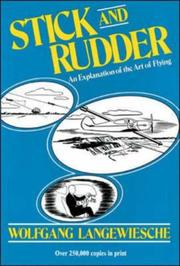
Stick and Rudder
First published 1972. Subjects: Aerodynamics, Flight, Piloting, Airplanes, Airplanes, piloting.
Human Factors in Flight
First published 1987. Subjects: Human engineering, Airplanes, Design and construction, Flight, Flight, physiological aspects.

eBay marketplace picks
Marketplace Samples
Live-tested eBay searches with available results related to this page.
Selected fromaviation poster oneBay.co.uk.

Endnotes
1.
Source: tc.canada.ca
Title: Transport Canada Handbook for Civil Aviation Medical Examiners
Link:https://tc.canada.ca/en/aviation/publications/handbook-civil-aviation-medical-examiners-tp-13312
Source snippet
Transport CanadaHandbook for Civil Aviation Medical Examiners - TP 13312May 6, 2019...
Published: May 6, 2019
2.
Source: tc.canada.ca
Link:https://tc.canada.ca/en/aviation/publications/transport-canada-aeronautical-information-manual-tc-aim-tp-14371
Source snippet
Transport CanadaTransport Canada Aeronautical Information Manual (TC AIM) - TP 14371...
3.
Source: nunatsiaq.com
Title: News Pilots report UFO sighting over Nunavut’s northern Baffin Island
Link:https://nunatsiaq.com/stories/article/65674pilots_spot_possible_ufo_above_nunavuts_northern_baffin_island/
Source snippet
Nunatsiaq NewsPilots report UFO sighting over Nunavut’s northern Baffin IslandNovember 27, 2018...
Published: November 27, 2018
4.
Source: nunatsiaq.com
Title: News Pilots report UFO sighting over Nunavut’s northern Baffin Island
Link:https://nunatsiaq.com/stories/article/pilots-report-ufo-sighting-over-nunavuts-northern-baffin-island/
Source snippet
Nunatsiaq NewsPilots report UFO sighting over Nunavut’s northern Baffin Island...
5.
Source: tc.canada.ca
Title: advisory circular ac no 603 001
Link:https://tc.canada.ca/en/aviation/reference-centre/advisory-circulars/advisory-circular-ac-no
6.
Source: nunatsiaq.com
Title: our top 10 stories of 2018
Link:https://nunatsiaq.com/stories/article/our-top-10-stories-of-2018/
7.
Source: nunatsiaq.com
Title: Canadian military to gather feedback on “pinging noise” in North Baffin
Link:https://nunatsiaq.com/stories/article/65674joint_task_force_patrol_to_gather_feedback_on_pinging_noise_in_nunavut/
8.
Source: tc.canada.ca
Title: ca Hazards Associated with Flying at Night
Link:https://tc.canada.ca/en/aviation/publications/system-safety-summer-briefing-kit-tp-14112/hazards-associated-flying-night-powerpoint-presentation
9.
Source: nunatsiaq.com
Title: NORA D radar hones in on fat, jolly elf
Link:https://nunatsiaq.com/stories/article/norad_radar_hones_in_on_fat_jolly_elf/
10.
Source: publications.gc.ca
Title: Transport Canada
Link:https://publications.gc.ca/collections/collection_2017/tc/T52-103-2004-eng.pdf
11.
Source: skybrary.aero
Link:https://skybrary.aero/index.php/articles/visual-illusions
Additional References
12.
Source: ufoinsight.com
Title: The Flight NRL796 UFO Incident: Another Aerial Anomaly Over The Nunavut Region
Link:https://www.ufoinsight.com/ufos/cover-ups/the-flight-nrl796-ufo-incident
Source snippet
UFO InsightApril 11, 2025 — THE FLIGHT NRL796 UFO INCIDENT: ANOTHER AERIAL ANOMALY OVER THE NUNAVUT REGION By Marcus Lowth Image: Publish...
Published: April 11, 2025
13.
Source: tsb.gc.ca
Link:https://www.tsb.gc.ca/eng/rapports-reports/aviation/2021/a21w0001/a21w0001.html
Source snippet
Air transportation safety investigation report A21W0001 - Transportation Safety Board of CanadaMay 11, 2022 — 1.18.4 NIGHT VISUAL FLIGHT...
Published: May 11, 2022
14.
Source: faa.gov
Title: Where does it come from? Can tra
Link:https://www.faa.gov/pilots/training/airman_education/topics_of_interest/spatial_disorientation
Source snippet
Airman Education Programs | Federal Aviation AdministrationDecember 16, 2024 — AIRMAN EDUCATION PROGRAMS TOPICS OF INTEREST Spatial Disor...
Published: December 16, 2024
15.
Source: youtube.com
Title: Illusions In Flight Spaitial Disorientation Mzero A com
Link:https://www.youtube.com/watch?v=fIZpxEOsTg0
Source snippet
Spatial disorientation autokinesis pilot illusion Spatial Disorientation Explained: Deadly Flight Illusions Every Pilot Must Know Epic Fl...
16.
Source: youtube.com
Link:https://www.youtube.com/watch?v=Q6JgyhoCyi8
Source snippet
Spatial Disorientation Explained: Deadly Flight Illusions Every Pilot Must Know...
17.
Source: youtube.com
Title: PPGS Lesson 14.2 | Aeromedical: Illusions
Link:https://www.youtube.com/watch?v=ZBPmFaqECdM
Source snippet
Air traffic control audio: [Pilot reports]({{ 'pilot-reports/' | relative_url }}) unusual lights over northern Canada on Jan. 30, 2023...
18.
Source: faa.gov
Link:https://www.faa.gov/Air_traffic/publications/atpubs/aim_html/chap8_section_1.html
19.
Source: faa.gov
Link:https://www.faa.gov/air_traffic/publications/atpubs/aip_html/chap8_section_1.html
20.
Source: faraim.org
Link:https://faraim.org/faa/aim/chapter-8/section-8-1-5.html
21.
Source: faraim.org
Link:https://faraim.org/faa/aim/chapter-8/section-8-1-6.html