Within Sky Explanations
Fireball or Re entry: What Changes the View?
Speed, flight angle and fragmentation can make one atmospheric entry look like a brief blaze and another like a slow formation of lights.
On this page
- Why natural meteors can produce flashes trails and booms
- Why rocket debris can form long processions of lights
- Which visual clues help separate the two explanations
Page outline Jump by section
Introduction
Some of the most dramatic objects seen over Yukon have later proved to be either natural meteors or the re-entry of human-made space hardware. To an observer on the ground, however, the distinction is not always obvious. Both can appear as brilliant lights crossing the sky, both may fragment into multiple glowing pieces, and both can prompt reports of unusually large or structured unidentified objects.
The key difference lies in how the object enters the atmosphere. Natural meteoroids usually arrive from deep space at extremely high speeds, producing a brief but intense fireball. Rocket stages and satellites are already travelling in Earth orbit at much lower speeds and often break apart gradually, creating long processions of lights that can remain visible for much longer. Understanding these different entry patterns helps explain why some Yukon UFO reports have later been identified as meteors while others matched documented satellite or rocket re-entries.[NASA]reentry.arc.nasa.govHyperseed MAC: SRC Entry Observing Campaign, information on natural fireballsHyperseed MAC: SRC Entry Observing Campaign, information on natural fireballsJune 23, 2005…
Fireball or Re-entry: What Changes the View?
The atmosphere acts differently on natural rocks than it does on artificial spacecraft because they begin their descent under very different conditions.
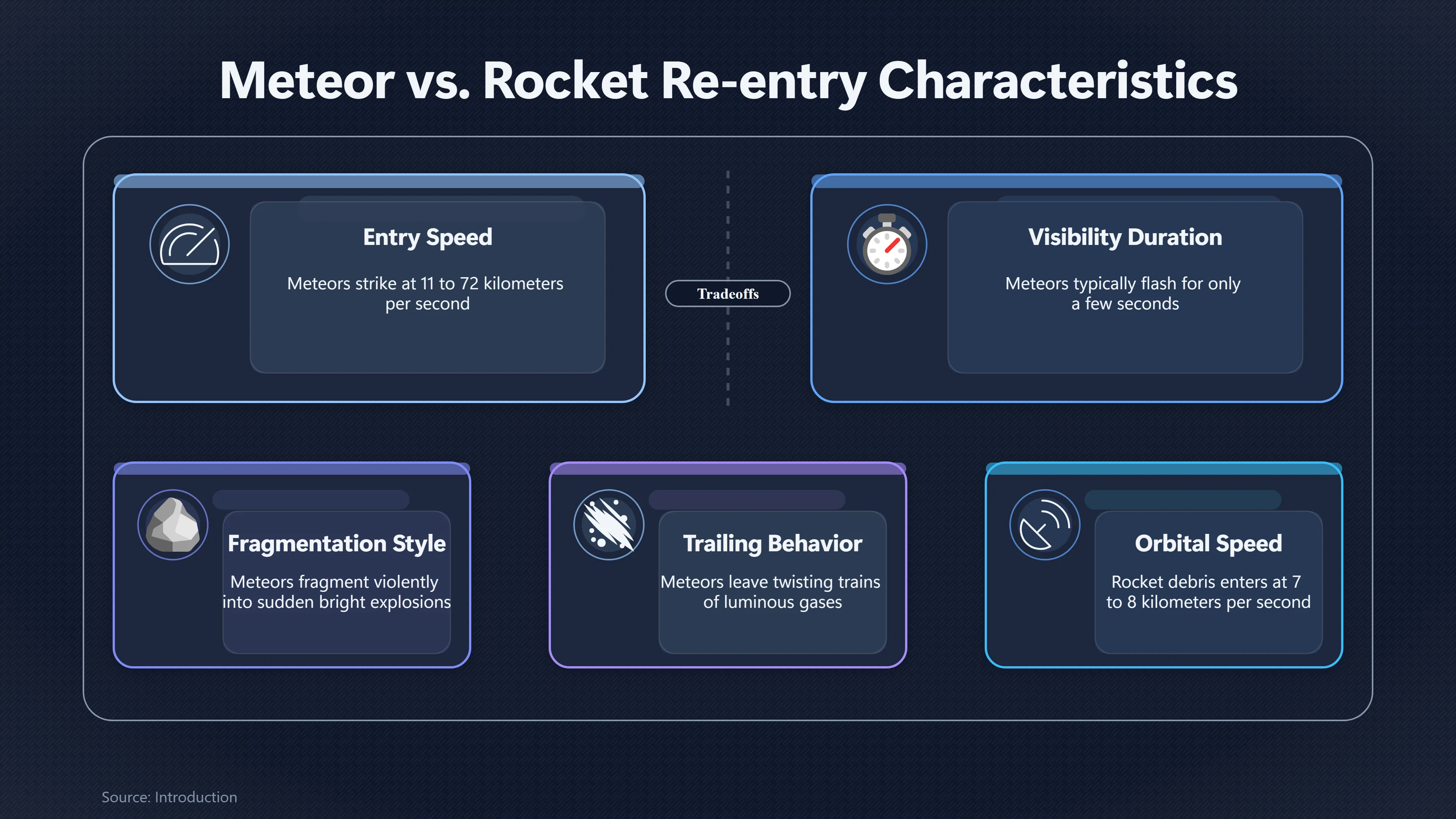
A meteoroid typically strikes the atmosphere at between about 11 and 72 kilometres per second. The enormous energy released during this rapid deceleration heats both the object and the surrounding air, producing an exceptionally bright flash known as a fireball or bolide. Even large fireballs often complete their visible flight in only a few seconds before exploding or burning away.[NASA Jet Propulsion Laboratory (JPL)]jpl.nasa.govNASA Jet Propulsion Laboratory (JPL)Additional Details on the Large Feb. 15 Fireball over Russia | NASA Jet Propulsion Laboratory (JPL)Fe…
A rocket body or satellite re-entry is much slower. Objects returning from low Earth orbit travel at roughly 7 to 8 kilometres per second before atmospheric braking rapidly slows them further. Because they begin at orbital speed rather than interplanetary speed, they often remain visible for tens of seconds or even several minutes as they descend across a long section of sky.[European Space Agency]esa.intEuropean Space Agency ESAEuropean Space AgencyESA - Fireball camera spots rocket reentry burn…
For witnesses, this difference in duration is one of the strongest clues. A brilliant object lasting one or two seconds is far more consistent with a meteor. A formation of lights drifting steadily across the sky for a minute or longer is much more characteristic of re-entering space debris.
Why Natural Meteors Can Produce Flashes, Trails and Booms
A natural fireball is rarely just a single point of light.
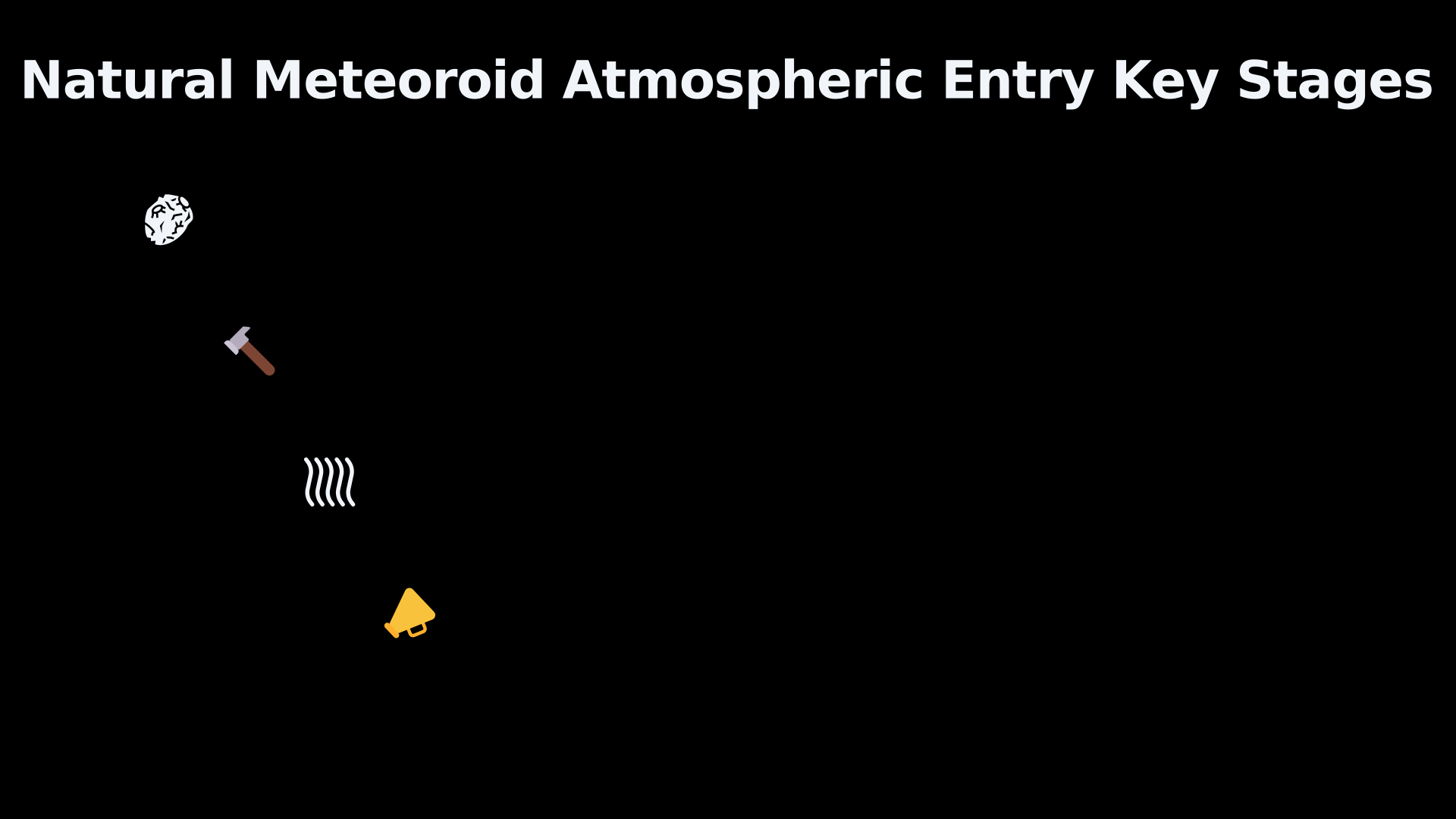
As pressure builds during atmospheric entry, the meteoroid often fragments violently. Each break-up exposes fresh material, causing sudden increases in brightness that can look like explosions or deliberate manoeuvres. Large fragments may continue briefly before disappearing, creating the impression of multiple independent objects even though they originated from one body.[NASA Jet Propulsion Laboratory (JPL)]jpl.nasa.govNASA Jet Propulsion Laboratory (JPL)Additional Details on the Large Feb. 15 Fireball over Russia | NASA Jet Propulsion Laboratory (JPL)Fe…
Some fireballs also leave persistent glowing trains. These are not smoke in the ordinary sense but luminous gases and fine dust left behind at very high altitude. Sunlight or chemical reactions can keep these trails visible for several minutes, while upper-atmospheric winds twist and distort them into corkscrew or zigzag shapes long after the meteor itself has vanished.[NASA]nasa.govFireball Leaves Persistent Train over Western SkiesFireball Leaves Persistent Train over Western Skies - NASADecember 20, 2018…
Large fireballs may also produce delayed sonic booms. Because sound travels much more slowly than light, witnesses often hear loud bangs or rumbling several minutes after seeing the flash. This delay can make the event feel even more mysterious, particularly if observers are unaware that the sound originated from the earlier fireball.[NASA]reentry.arc.nasa.govHyperseed MAC: SRC Entry Observing Campaign, information on natural fireballsHyperseed MAC: SRC Entry Observing Campaign, information on natural fireballsJune 23, 2005…
The Tagish Lake event of January 2000 illustrates these processes well. Witnesses across southern Yukon reported an intensely bright fireball, a lingering atmospheric trail and delayed booms before meteorite fragments were recovered on the frozen surface of Tagish Lake in neighbouring British Columbia. Independent photographs, seismic records, satellite observations and recovered meteorites all confirmed that the spectacular display was produced by a natural meteoroid rather than an unknown craft.[NASA Astrobiology]astrobiology.nasa.govAstrobiology NASA Astrobiology InstituteNASA AstrobiologyNASA Astrobiology InstituteJanuary 28, 2002…
Why Rocket Debris Can Form Long Processions of Lights
Artificial objects behave differently because they are built from many separate components.
As a rocket stage or satellite descends, heat weakens tanks, insulation, solar panels and structural elements. Instead of one sudden fragmentation, many pieces separate gradually. Each fragment continues glowing, producing a line or loose formation of lights that can stretch across a large part of the sky. Because all the fragments continue along broadly similar paths, observers sometimes interpret the display as a fleet of aircraft or an enormous structured object.[European Space Agency]esa.intEuropean Space Agency ESAEuropean Space AgencyESA - Fireball camera spots rocket reentry burn…
Unlike most meteors, re-entering spacecraft may also appear to move relatively slowly. Their lower entry speed, combined with a shallow angle through the upper atmosphere, allows the display to remain visible for much longer than a typical fireball. Individual fragments may brighten or fade independently, adding to the impression of controlled motion even though the process is entirely governed by atmospheric drag and structural failure.[European Space Agency]esa.intEuropean Space Agency ESAEuropean Space AgencyESA - Fireball camera spots rocket reentry burn…
This mechanism helps explain the widely reported lights seen over Yukon on 11 December 1996. Later reconstruction matched the observations with the documented atmospheric re-entry of a Russian rocket stage. Witnesses described multiple bright lights travelling together—exactly the sort of appearance expected when a large artificial object breaks apart during re-entry rather than when a single meteoroid burns up.[European Space Agency]esa.intEuropean Space Agency ESAEuropean Space AgencyESA - Fireball camera spots rocket reentry burn…
Which Visual Clues Help Separate the Two Explanations
No single feature provides absolute proof, but several clues become useful when considered together.
- Duration: Meteors are usually visible for only a few seconds. Re-entries often remain visible for tens of seconds or longer.[NASA Jet Propulsion Laboratory (JPL)]jpl.nasa.govNASA Jet Propulsion Laboratory (JPL)Additional Details on the Large Feb. 15 Fireball over Russia | NASA Jet Propulsion Laboratory (JPL)Fe…
- Formation: A single brilliant object that fragments suddenly favours a meteor. A long procession of evenly spaced lights is more typical of spacecraft debris.[European Space Agency]esa.intEuropean Space Agency ESAEuropean Space AgencyESA - Fireball camera spots rocket reentry burn…
- Brightness changes: Meteors often flare dramatically during fragmentation. Re-entering debris tends to brighten and fade more gradually as separate pieces heat at different rates.[NASA Jet Propulsion Laboratory (JPL)]jpl.nasa.govNASA Jet Propulsion Laboratory (JPL)Additional Details on the Large Feb. 15 Fireball over Russia | NASA Jet Propulsion Laboratory (JPL)Fe…
- Persistent trail: Both can leave trails, but meteor trains frequently twist under high-altitude winds after the object has disappeared, whereas debris re-entries usually leave multiple glowing fragments moving together.[NASA]nasa.govFireball Leaves Persistent Train over Western SkiesFireball Leaves Persistent Train over Western Skies - NASADecember 20, 2018…
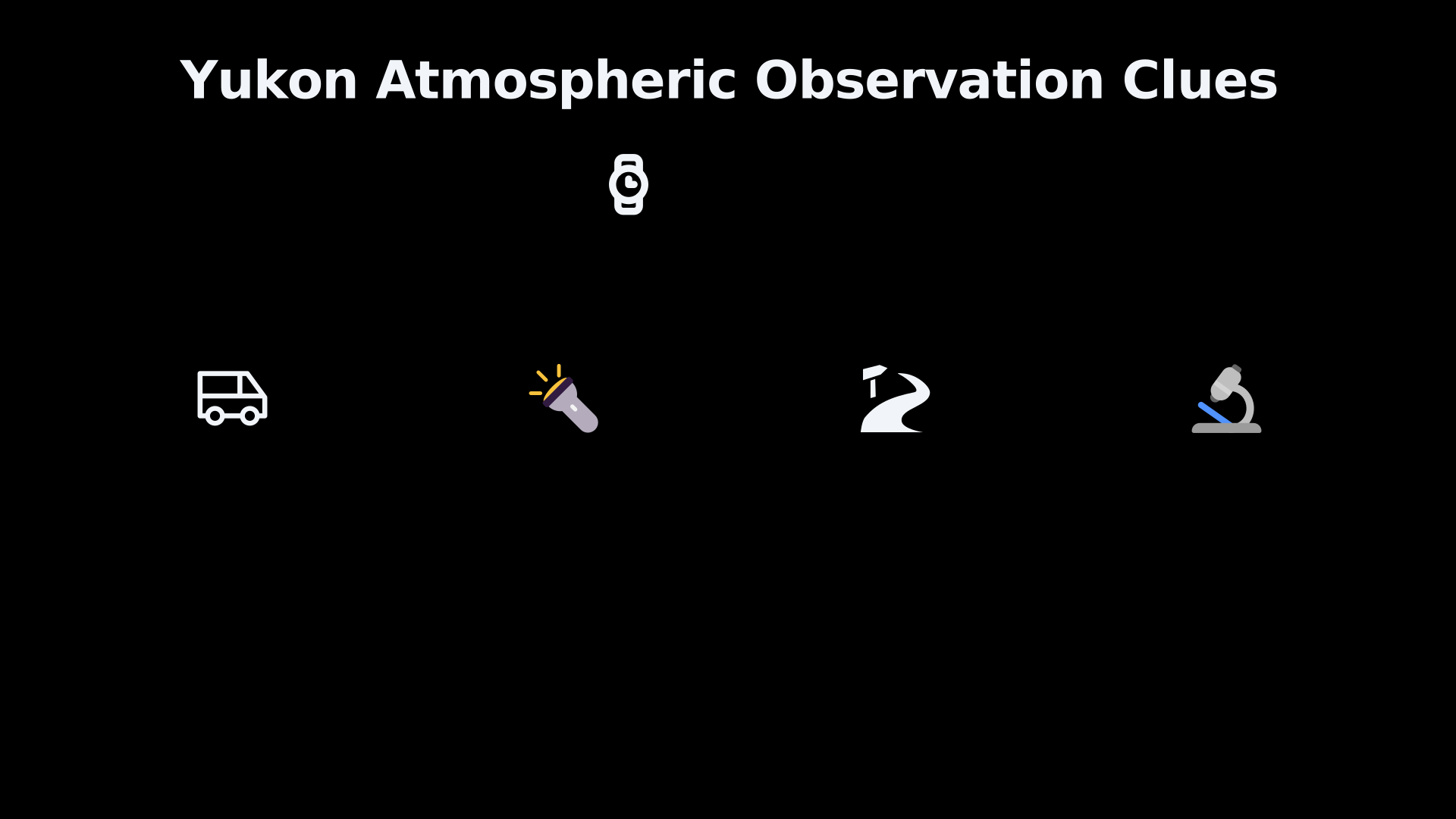
- Independent confirmation: Meteor camera networks, satellite detections, orbital tracking and recovered meteorites or debris often allow investigators to identify the event even when eyewitness descriptions initially suggest something extraordinary.[nasa.gov]cneos.jpl.nasa.govOpen source on nasa.gov.
Why This Matters for Yukon UFO Reports
Yukon’s vast landscapes, dark skies and relatively sparse population create excellent conditions for seeing spectacular atmospheric events. At the same time, the lack of nearby reference points can make it difficult to judge altitude, speed or size accurately. A bright meteor may appear enormous, while a distant line of re-entering rocket fragments can resemble a massive structured craft.
The territory’s best-known examples show that remarkable sightings do not lose their significance when they receive conventional explanations. The Tagish Lake fireball remains scientifically important because it led to the recovery of an exceptionally rare meteorite, while the 1996 procession of lights demonstrates how orbital tracking can retrospectively identify a dramatic re-entry. Together they illustrate why investigators compare eyewitness testimony with astronomical observations, orbital data and physical evidence before deciding whether a striking object in the Yukon sky remains unexplained.[nasa.gov]astrobiology.nasa.govAstrobiology NASA Astrobiology InstituteNASA AstrobiologyNASA Astrobiology InstituteJanuary 28, 2002…
Amazon book picks
Further Reading
Books and field guides related to Fireball or Re entry What Changes the View?. Use these as the next step if you want deeper reading beyond the article.
Meteorites: The Story of Our Solar System
Meteorite tells the fascinating story of the stones from outer space scattered across our planet. From the impact that finished off the d...
Rocks from Space: Meteorites and Meteorite Hunters
Appendices A-C: Meteorite verification laboratories, Commercial meteorite dealers, Selected list of suspected impact craters worldwide.
The Cambridge Encyclopedia of Meteorites
Beautifully illustrated with over 140 full colour images, The Cambridge Encyclopedia of Meteorites provides a thorough guide to these fas...
Space Junk: The Dangers of Polluting Earth's Orbit
Scientists have identified at least 100 million pieces of space debris—from paint chips to nonoperational zombie satellites—floating in E...
eBay marketplace picks
Marketplace Samples
Live-tested eBay searches with available results related to this page.
Selected frommeteorite display oneBay.co.uk.

Endnotes
1.
Source: reentry.arc.nasa.gov
Title: Hyperseed MAC: SRC Entry Observing Campaign, information on natural fireballs
Link:https://reentry.arc.nasa.gov/scienceastro.html
Source snippet
Hyperseed MAC: SRC Entry Observing Campaign, information on natural fireballsJune 23, 2005...
Published: June 23, 2005
2.
Source: jpl.nasa.gov
Link:https://www.jpl.nasa.gov/news/additional-details-on-the-large-feb-15-fireball-over-russia/
Source snippet
NASA Jet Propulsion Laboratory (JPL)Additional Details on the Large Feb. 15 Fireball over Russia | NASA Jet Propulsion Laboratory (JPL)Fe...
3.
Source: cneos.jpl.nasa.gov
Link:https://cneos.jpl.nasa.gov/fireballs/
4.
Source: nasa.gov
Title: Fireball Leaves Persistent Train over Western Skies
Link:https://www.nasa.gov/blogs/watch-the-skies/2018/12/20/fireball-leaves-persistent-train-over-western-skies/
Source snippet
Fireball Leaves Persistent Train over Western Skies - NASADecember 20, 2018...
Published: December 20, 2018
5.
Source: nasa.gov
Title: interesting fact of the month 2021
Link:https://www.nasa.gov/space-science-and-astrobiology-at-ames/interesting-fact-of-the-month-current/interesting-fact-of-the-month-2021/
Source snippet
What in the world is a fireball? According to the American Meteor Society, a fireball is another term for a...
6.
Source: astrobiology.nasa.gov
Title: Astrobiology NASA Astrobiology Institute
Link:https://astrobiology.nasa.gov/nai/articles/2002/1/28/the-tagish-lake-meteorite/index.html
Source snippet
NASA AstrobiologyNASA Astrobiology InstituteJanuary 28, 2002...
Published: January 28, 2002
7.
Source: nasa.gov
Title: It’s Fireball Season!
Link:https://www.nasa.gov/blogs/watch-the-skies/2026/03/26/its-fireball-season-answering-your-meteor-questions/
Source snippet
Answering Your Meteor Questions - NASAMarch 26, 2026 — WATCH THE SKIES Image Janet Sudnik March 26, 2026 5:18PM CATEGORIES Marshall Space...
Published: March 26, 2026
8.
Source: fireballs.ndc.nasa.gov
Link:https://fireballs.ndc.nasa.gov/skyfalls/events/20181220-013502
9.
Source: cneos.jpl.nasa.gov
Title: fireball 130301
Link:https://cneos.jpl.nasa.gov/news/fireball_130301.html
10.
Source: cneos.jpl.nasa.gov
Link:https://cneos.jpl.nasa.gov/fireballs/intro.html
11.
Source: esa.int
Title: European Space Agency ESA
Link:https://www.esa.int/ESA_Multimedia/Videos/2021/09/Fireball_camera_spots_rocket_reentry_burn/%28lang%29/en
Source snippet
European Space AgencyESA - Fireball camera spots rocket reentry burn...
12.
Source: esa.int
Title: ES A Television
Link:https://www.esa.int/esatv/Videos/2021/09/Fireball_camera_spots_rocket_reentry_burn
Additional References
13.
Source: arxiv.org
Link:https://arxiv.org/abs/2109.01004
14.
Source: youtube.com
Link:https://www.youtube.com/watch?v=4B7Q7o0lllQ
15.
Source: youtube.com
Link:https://www.youtube.com/watch?v=8OBbq5yiM-Y
16.
Source: youtube.com
Link:https://www.youtube.com/watch?v=IBuI2n6_uro
17.
Source: youtube.com
Link:https://www.youtube.com/watch?v=p6cIzpEZWLQ
18.
Source: youtube.com
Link:https://www.youtube.com/watch?v=y5bYAjCMcwM