Within Sky Explanations
Why the Tagish Lake Meteorite Was So Valuable
The unusually fresh carbon-rich fragments helped identify the fireball and preserved rare material from the early Solar System.
On this page
- How fragments were found and protected on the ice
- What made the meteorite chemically unusual
- How laboratory analysis strengthened the Yukon identification
Page outline Jump by section
Introduction
The Tagish Lake meteorite became scientifically important not simply because a spectacular fireball crossed the skies near Yukon on 18 January 2000, but because researchers recovered unusually fresh fragments before they were significantly altered by Earth’s environment. That combination is exceptionally rare. The frozen recovery conditions allowed scientists to connect eyewitness reports of a dramatic fireball directly to primitive material from the earliest history of the Solar System, turning what could have remained a striking atmospheric spectacle into one of the most valuable meteorite falls ever studied. Within the broader history of Yukon fireballs and reports sometimes mistaken for UFOs, Tagish Lake stands out because physical evidence confirmed exactly what observers had seen and provided discoveries that reached far beyond explaining the lights in the sky.[PubMed]pubmed.ncbi.nlm.nih.govThe fall, recovery, orbit, and composition of the Tagish Lake meteorite: a new type of carbonaceous chondrite - PubMedOctober 13, 2000…
How fragments were found and protected on the ice
The scientific value of the Tagish Lake meteorite depended as much on how it was recovered as on what it contained.
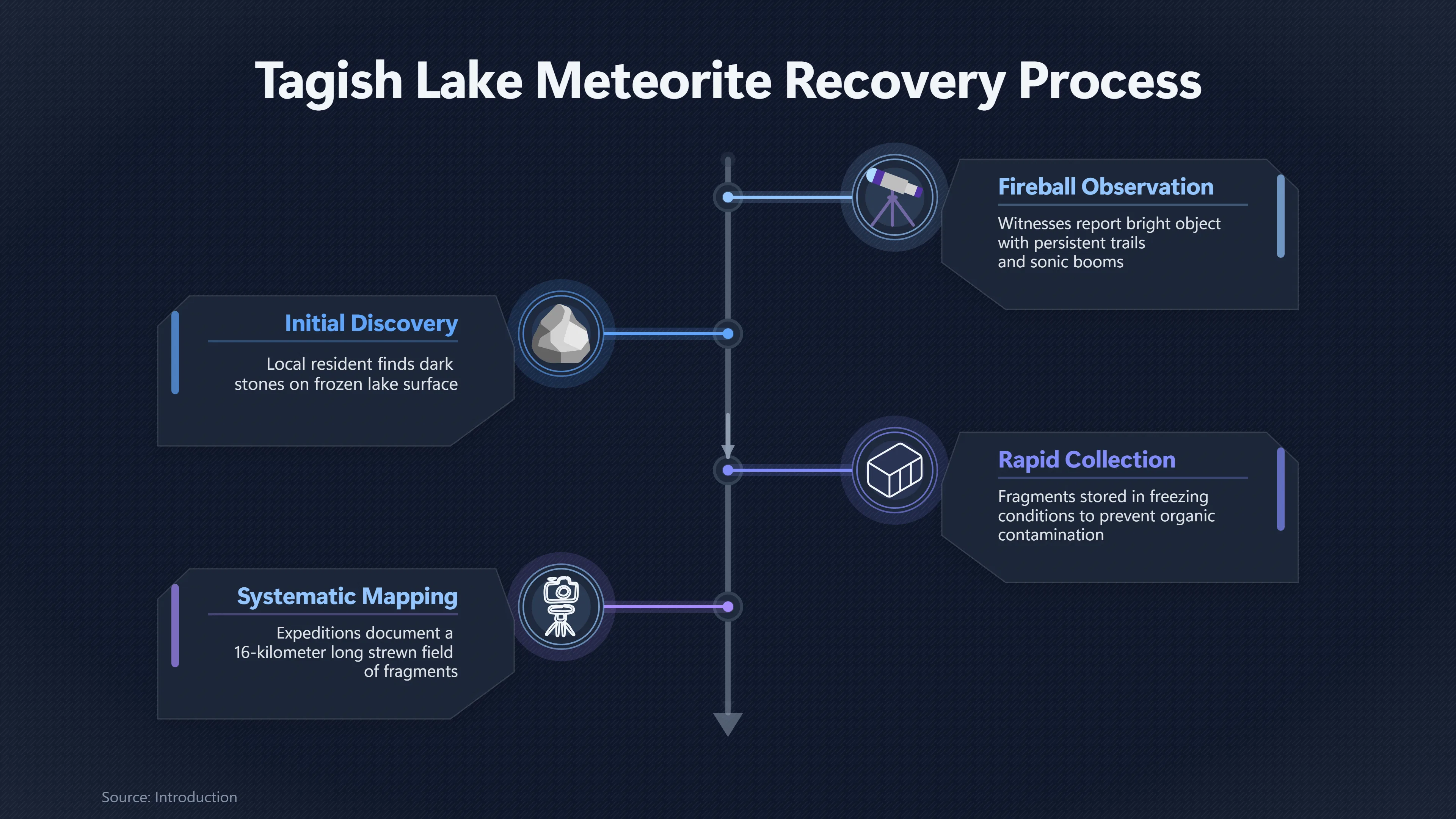
Eight days after the fireball, local resident Jim Brook located dark stones resting on the frozen surface of Tagish Lake. Instead of lying in soil, vegetation or flowing water, many fragments had landed on clean winter ice. Some were collected while still frozen and stored in freezing conditions, greatly reducing contamination from microbes, moisture and terrestrial organic material. Later expeditions systematically searched the frozen lake and documented a strewn field roughly 16 kilometres long, recovering fragments from hundreds of mapped locations.[Wiley Online Library]onlinelibrary.wiley.comOnline Library The fall and recovery of the Tagish Lake meteoriteWiley Online LibraryThe fall and recovery of the Tagish Lake meteorite - Hildebrand - 2006 - Meteoritics & Planetary Science - Wiley Onli…
Those recovery conditions were unusually favourable because carbon-rich meteorites are among the most fragile meteorites known. If left exposed to rain or thawing ground, their minerals and organic compounds begin to change rapidly. By recovering frozen material so quickly, researchers obtained samples much closer to their original state than is normally possible.
For planetary scientists, this meant they could analyse genuine extraterrestrial chemistry rather than a mixture of space material and Earth’s environmental effects. That distinction explains why the Tagish Lake fall attracted international scientific attention almost immediately.[NASA Astrobiology]astrobiology.nasa.govAstrobiology Carbonaceous Clues to the Early Solar System | News | AstrobiologyNASA AstrobiologyCarbonaceous Clues to the Early Solar System | News | AstrobiologyOctober 12, 2001…
What made the meteorite chemically unusual
Laboratory examination showed that the recovered stones did not fit comfortably into the familiar categories of carbonaceous meteorites already known. Instead, Tagish Lake proved to be an exceptionally primitive carbon-rich meteorite with mineralogical, chemical and oxygen-isotope characteristics intermediate between established groups, leading researchers to classify it as an unusual ungrouped C2 carbonaceous chondrite.[PubMed]pubmed.ncbi.nlm.nih.govThe fall, recovery, orbit, and composition of the Tagish Lake meteorite: a new type of carbonaceous chondrite - PubMedOctober 13, 2000…
Its importance came from several unusual features:
- Exceptional primitiveness. The rock had undergone relatively little geological alteration since the Solar System formed about 4.6 billion years ago.
- Rich carbon content. It preserved abundant carbon-bearing compounds that offered clues to chemical processes operating before planets fully formed.
- High porosity and low density. Its physical properties closely resembled those inferred for dark, primitive asteroids rather than the denser stony meteorites more commonly recovered on Earth.
- Distinctive isotopic composition. Oxygen-isotope measurements showed that it occupied an unusual position among known meteorites, helping researchers refine models of early Solar System materials.[PNNL]pnnl.govThe Fall and Recovery of the Tagish Lake Meteorite | Journal Article | PNNLThe Fall and Recovery of the Tagish Lake Meteorite | Journal Article | PNNL…
Subsequent studies of its organic chemistry suggested that Tagish Lake preserved a different record of carbon evolution from better-known meteorites such as Murchison. Rather than simply adding another example to existing collections, it expanded scientists’ understanding of the diversity of primitive asteroid material reaching Earth.[NASA Astrobiology]astrobiology.nasa.govAstrobiology Carbonaceous Clues to the Early Solar System | News | AstrobiologyNASA AstrobiologyCarbonaceous Clues to the Early Solar System | News | AstrobiologyOctober 12, 2001…

How laboratory analysis strengthened the Yukon identification
The recovered fragments also strengthened the identification of the fireball itself.
Eyewitness accounts from Yukon, northern British Columbia and Alaska described an extraordinarily bright object with persistent trails and delayed sonic booms. Normally, such reports alone would leave room for uncertainty or speculation. Instead, researchers combined witness observations with photographs, seismic recordings, infrasound detections, satellite data and the physical meteorite fragments. Together these independent lines of evidence allowed investigators to reconstruct the object’s atmospheric path, fragmentation and original orbit with unusual confidence.[Wiley Online Library]onlinelibrary.wiley.comOnline Library The fall and recovery of the Tagish Lake meteoriteWiley Online LibraryThe fall and recovery of the Tagish Lake meteorite - Hildebrand - 2006 - Meteoritics & Planetary Science - Wiley Onli…
Analysis indicated that the incoming body had an estimated pre-entry mass of roughly 200,000 kilograms before atmospheric fragmentation. Its reconstructed orbit linked it with dark, low-albedo asteroid populations rather than any artificial object or cometary source, although later modelling has refined ideas about its precise source region within the asteroid belt. The key point for Yukon history is that the recovered meteorite transformed a spectacular visual event into one of the best-documented natural fireballs ever investigated.[PubMed]pubmed.ncbi.nlm.nih.govThe fall, recovery, orbit, and composition of the Tagish Lake meteorite: a new type of carbonaceous chondrite - PubMedOctober 13, 2000…
This combination of physical specimens and independently reconstructed trajectory provides an important contrast with many reported UFO sightings. Rather than relying solely on witness recollection, investigators could test competing explanations against measurable evidence. The recovered fragments therefore became the decisive proof that the brilliant object seen over southern Yukon was a natural meteoroid whose remains could be examined in laboratories around the world.
Why the fragments still matter
More than two decades after the fall, Tagish Lake remains one of the world’s most scientifically significant meteorite recoveries because it united three exceptionally rare circumstances: a widely observed fireball, rapid recovery under frozen conditions and laboratory access to unusually pristine primitive material.[Wiley Online Library]onlinelibrary.wiley.comOnline Library The fall and recovery of the Tagish Lake meteoriteWiley Online LibraryThe fall and recovery of the Tagish Lake meteorite - Hildebrand - 2006 - Meteoritics & Planetary Science - Wiley Onli…
Within the history of Yukon sky phenomena, its importance extends beyond meteoritics. The case demonstrates how a dramatic object that might initially be interpreted as mysterious can ultimately be explained through careful collection of physical evidence. Instead of diminishing the event, that explanation made it even more remarkable, because the fragments provided an unusually well-preserved sample of the material from which the early Solar System evolved.

Amazon book picks
Further Reading
Books and field guides related to Why the Tagish Lake Meteorite Was So Valuable. Use these as the next step if you want deeper reading beyond the article.
Meteorites: The Story of Our Solar System
Meteorite tells the fascinating story of the stones from outer space scattered across our planet. From the impact that finished off the d...
Rocks from Space: Meteorites and Meteorite Hunters
Appendices A-C: Meteorite verification laboratories, Commercial meteorite dealers, Selected list of suspected impact craters worldwide.
The Cambridge Encyclopedia of Meteorites
Beautifully illustrated with over 140 full colour images, The Cambridge Encyclopedia of Meteorites provides a thorough guide to these fas...
Meteorites and Their Parent Planets
Thoroughly revised second edition of a highly successful book describing all aspects of meteorites.
eBay marketplace picks
Marketplace Samples
Live-tested eBay searches with available results related to this page.
Selected fromUFO disclosure print oneBay.co.uk.




Endnotes
1.
Source: onlinelibrary.wiley.com
Title: Online Library The fall and recovery of the Tagish Lake meteorite
Link:https://onlinelibrary.wiley.com/doi/10.1111/j.1945-5100.2006.tb00471.x
Source snippet
Wiley Online LibraryThe fall and recovery of the Tagish Lake meteorite - Hildebrand - 2006 - Meteoritics & Planetary Science - Wiley Onli...
2.
Source: pnnl.gov
Title: The Fall and Recovery of the Tagish Lake Meteorite | Journal Article | PNNL
Link:https://www.pnnl.gov/publications/fall-and-recovery-tagish-lake-meteorite
Source snippet
The Fall and Recovery of the Tagish Lake Meteorite | Journal Article | PNNL...
3.
Source: astrobiology.nasa.gov
Title: Astrobiology Carbonaceous Clues to the Early Solar System | News | Astrobiology
Link:https://astrobiology.nasa.gov/news/carbonaceous-clues-to-the-early-solar-system/
Source snippet
NASA AstrobiologyCarbonaceous Clues to the Early Solar System | News | AstrobiologyOctober 12, 2001...
Published: October 12, 2001
4.
Source: onlinelibrary.wiley.com
Title: j.1945 5100.2006.tb00471.x
Link:https://onlinelibrary.wiley.com/doi/abs/10.1111/j.1945-5100.2006.tb00471.x
5.
Source: ntrs.nasa.gov
Link:https://ntrs.nasa.gov/citations/20030068413
6.
Source: ntrs.nasa.gov
Link:https://ntrs.nasa.gov/search.jsp?R=20020017759
7.
Source: pnnl.gov
Link:https://www.pnnl.gov/publications/fall-recovery-orbit-and-composition-tagish-lake-meteorite-new-type-carbonaceous
8.
Source: youtube.com
Title: Tagish Lake meteorite
Link:https://www.youtube.com/watch?v=WjA3MsA5gIU
Source snippet
Iconic: Tagish Lake Meteorite...
9.
Source: pubmed.ncbi.nlm.nih.gov
Link:https://pubmed.ncbi.nlm.nih.gov/11030647/
Source snippet
The fall, recovery, orbit, and composition of the Tagish Lake meteorite: a new type of carbonaceous chondrite - PubMedOctober 13, 2000...
Published: October 13, 2000
10.
Source: pubmed.ncbi.nlm.nih.gov
Link:https://pubmed.ncbi.nlm.nih.gov/17138898/
11.
Source: pubmed.ncbi.nlm.nih.gov
Link:https://pubmed.ncbi.nlm.nih.gov/11520948/
Additional References
12.
Source: rom.on.ca
Title: Looking Back at a New-Year Meteorite Discovery | Royal Ontario Museum
Link:https://www.rom.on.ca/magazine/looking-back-new-year-meteorite-discovery
Source snippet
January 5, 2022 — LOOKING BACK AT A NEW-YEAR METEORITE DISCOVERY ROM holds one of the rarest meteorites found on Earth PUBLISHED January...
Published: January 5, 2022
13.
Source: youtube.com
Title: Terrifying Discoveries Inside Meteorites That Could Be Alive
Link:https://www.youtube.com/watch?v=4EG5Y7O7hV8
Source snippet
Space rocks impacted this Costa Rican village in more ways than one...
14.
Source: aquarid.physics.uwo.ca
Title: ca Meteor Physics
Link:https://aquarid.physics.uwo.ca/research/fireball/events/tagish/recovery.html
Source snippet
PhysicsDecember 14, 2011 — FIREBALL EVENTS THE TAGISH LAKE FIREBALL AND METEORITE [18-JAN-2000] METEORITE RECOVERY On January 25 near dus...
Published: December 14, 2011
15.
Source: youtube.com
Title: Canadian Meteorite Could Hold Clue To The Origins Of Life
Link:https://www.youtube.com/watch?v=5ANBqYqyez4
Source snippet
Terrifying Discoveries Inside Meteorites That Could Be Alive...
16.
Source: arxiv.org
Title: arXiv Identification of meteorite source regions in the Solar System
Link:https://arxiv.org/abs/1804.07229
17.
Source: academic.oup.com
Link:https://academic.oup.com/astrogeo/article/52/4/4.7/218500
Source snippet
activity on early asteroids | Astronomy & Geophysics | Oxford AcademicAugust 1, 2011 — HYDROTHERMAL ACTIVITY ON EARLY ASTEROIDS Get acces...
Published: August 1, 2011
18.
Source: researchgate.net
Link:https://www.researchgate.net/publication/235240616_The_Fall_Recovery_Orbit_and_Composition_of_the_Tagish_Lake_Meteorite_A_New_Type_of_Carbonaceous_Chondrite
19.
Source: researchgate.net
Link:https://www.researchgate.net/publication/230169441_Fragmentation_model_analysis_of_the_observed_atmospheric_trajectory_of_the_Tagish_Lake_fireball?_tp=eyJjb250ZXh0Ijp7InBhZ2UiOiJwdWJsaWNhdGlvbiIsInByZXZpb3VzUGFnZSI6InNjaWVudGlmaWNDb250cmlidXRpb25zIiwic3ViUGFnZSI6bnVsbH19
20.
Source: cambridge.org
Link:https://www.cambridge.org/core/journals/international-journal-of-astrobiology/article/abs/microstructure-and-elemental-composition-of-the-tagish-lake-meteorite-and-its-astrobiological-implications/9A4B9C98D00C3FC5CAEA47290D0FA2A4
21.
Source: sciencedirect.com
Link:https://www.sciencedirect.com/science/article/pii/S0016703704007938