Within Charlie Redstar
Why Charlie Redstar Seemed to Move So Strangely
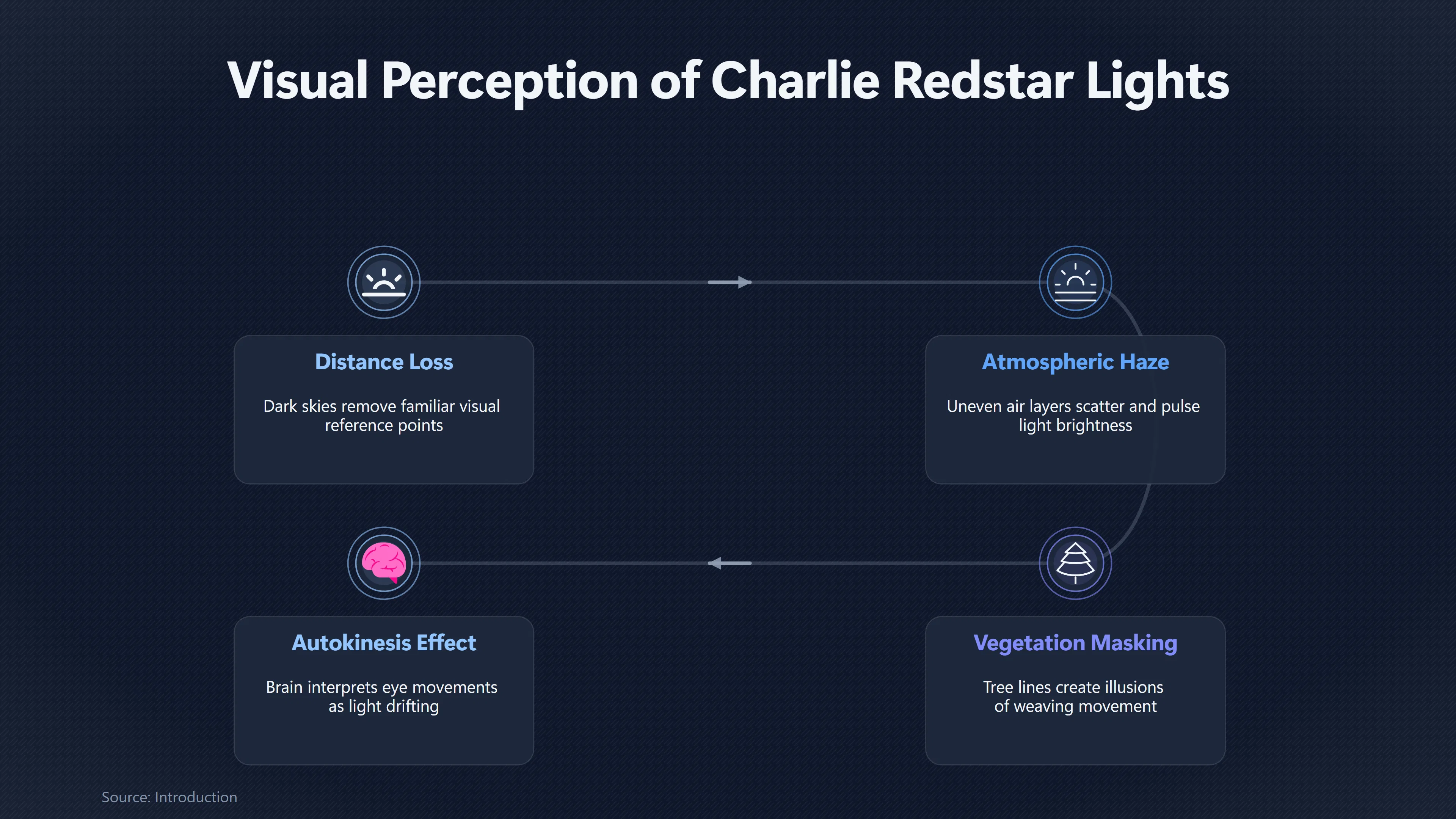
Dark skies, haze and missing distance cues could make stars, aircraft and tower lights appear to hover, approach or change direction.
On this page
- How darkness removes reliable distance and scale cues
- Why haze, trees and dimming can mimic low flight
- Which reported movements remain difficult to reconstruct
Page outline Jump by section
Introduction
One reason the Charlie Redstar wave became so compelling is that many witnesses sincerely believed they were watching a nearby object manoeuvring over fields and tree lines. Yet in most cases there were no reliable measurements of distance, altitude or speed. Against the exceptionally dark prairie skies of southern Manitoba, a single bright light could appear much closer than it really was, while subtle changes in brightness, atmospheric conditions and the observer’s own visual perception could create a convincing impression of hovering, approaching or changing direction. These effects do not explain every report, but they do explain why many sightings were difficult to interpret and why investigators found it hard to reconstruct exactly what witnesses had seen.[Federal Aviation Administration]faa.govFederal Aviation Administration Chapter 8. Medical Facts for PilotsFederal Aviation Administration Chapter 8. Medical Facts for Pilots
Understanding these visual mechanisms is important because they sit at the heart of the Charlie Redstar story. The central question is often not whether witnesses saw a light—they almost certainly did—but whether the apparent movement belonged to the object itself or arose from the way distant lights are perceived under night-time prairie conditions.
How darkness removes reliable distance and scale cues
Southern Manitoba’s open farmland provides long, unobstructed views, but at night it removes many of the visual references people normally use to judge distance. When a bright point of light is viewed against a featureless sky, the brain has little information from which to estimate whether it is hundreds of metres away or many kilometres distant.
Unlike daytime objects, a distant light offers almost no clues about:
- its true size;
- its distance;
- whether it is moving towards the observer or simply brightening;
- whether it is high above the ground or merely appearing low because it lies near the horizon.
Without nearby buildings, hills or clearly illuminated terrain for comparison, even experienced observers can overestimate how close a light appears. A bright aircraft landing light, an illuminated tower beacon or a bright astronomical object near the horizon may therefore seem to hover just beyond a line of trees when it is actually much farther away.[Federal Aviation Administration]faa.gov19 phak ch17Federal Aviation AdministrationPHAK Chapter 17May 3, 2023…
This lack of depth cues is particularly relevant to Charlie Redstar because many observations were made from rural roads, fields and farmyards after dark, where few fixed reference points existed.
Why haze, trees and dimming can mimic low flight
Many Charlie Redstar descriptions include reports that the light seemed to descend behind trees, emerge again, or move slowly at low altitude. Those impressions can arise from several ordinary visual effects acting together.
Atmospheric haze reduces contrast and scatters light. As a distant light passes through layers of uneven air, its brightness may fluctuate dramatically. Rather than appearing steadily illuminated, it can pulse or fade, creating the impression of controlled movement or changes in altitude. Aviation guidance recognises that haze also distorts perceived distance, making it difficult to judge how far away lights actually are.[Federal Aviation Administration]faa.govFederal Aviation Administration Chapter 8. Medical Facts for PilotsFederal Aviation AdministrationChapter 8. Medical Facts for PilotsJanuary 8, 2015…
Tree lines can reinforce the illusion. A distant light partially hidden by branches may appear to weave between them even though only the observer’s viewing angle is changing. Likewise, slight changes in terrain or roadside position can make a distant object disappear behind vegetation before reappearing moments later, suggesting deliberate manoeuvring.
Brightness itself also influences perceived distance. A light that suddenly intensifies may seem to be approaching, while one that fades can appear to recede or turn away, even if its position changes very little. On clear prairie nights these changes can be surprisingly convincing because there are so few competing visual references.

Why stationary lights sometimes appear to move
One of the best-studied night-time perception effects is autokinesis. When a person stares at a single bright light against an otherwise dark background for several seconds, the light may appear to drift, zigzag or circle despite remaining stationary.
This illusion has been recognised for decades in aviation because pilots have mistaken stars, planets or distant aircraft lights for moving traffic. It occurs because tiny involuntary eye movements are interpreted by the brain as movement of the light when no surrounding reference points are available. Aviation authorities therefore advise pilots to avoid prolonged fixation on isolated lights and instead scan the wider scene.[faasafety.gov]faasafety.govYour Senses In The ShadowsYour Senses in the Shadows. Nighttime Visual Illusions and Spatial… | by FAA Safety Briefing Magazine | Jan, 2025 | Medium…
The effect does not produce dramatic high-speed manoeuvres, but it can create convincing impressions of:
- slow sideways drift;
- hovering followed by slight movement;
- gentle climbs or descents;
- hesitation before moving again.
Those descriptions resemble parts of numerous Charlie Redstar accounts, particularly observations involving a single distant red or orange light watched for extended periods.
Which reported movements remain difficult to reconstruct
These perceptual effects explain why investigators are cautious about treating estimated speeds, distances or flight paths in the Charlie Redstar wave as precise observations. Most reports lacked photographs with measurable reference points, simultaneous observations from separated locations or radar confirmation. As a result, later researchers often cannot determine whether witnesses were describing one object, several unrelated lights, or different interpretations of similar atmospheric conditions.
That does not mean every reported movement can be dismissed as illusion. Some accounts involved multiple observers viewing the same light simultaneously, while others described changes that are impossible to reconstruct because the necessary observational data were never recorded. In many cases the available evidence is simply insufficient to distinguish confidently between a distant aircraft, an astronomical object affected by atmospheric conditions, an isolated tower light seen under unusual viewing geometry, or something genuinely unidentified.
For that reason, historians of the Manitoba wave increasingly treat apparent manoeuvring as evidence that people perceived unusual movement rather than proof that the light physically executed those manoeuvres. This distinction helps explain why Charlie Redstar remains an important episode in Manitoba’s UFO history: not because every movement has been explained or confirmed, but because the combination of dark prairie skies, repeated observation and human visual perception made reliable reconstruction exceptionally difficult.
Amazon book picks
Further Reading
Books and field guides related to Why Charlie Redstar Seemed to Move So Strangely. Use these as the next step if you want deeper reading beyond the article.
The Demon-Haunted World: Science as a Candle in the Dark
NEW YORK TIMES BESTSELLER • From the renowned astronomer and author of Cosmos comes a “powerful [and] stirring defense of informed ration...
The UFO Experience: A Scientific Inquiry
Cited by the New York Review of Books as "the best brief for visitation," this classic study presents an analysis of UFO reports and conc...
UFOs: Generals, Pilots, and Government Officials Go on the Re...
NEW YORK TIMES BESTSELLER • Impeccably researched, this riveting journalistic investigation separates fact from fiction, and documents th...
Mistakes Were Made (But Not by Me)
Renowned social psychologists Carol Tavris and Elliot Aronson take a compelling look into how the brain is wired for self-justification....
eBay marketplace picks
Marketplace Samples
Live-tested eBay searches with available results related to this page.
Selected fromUFO wall art oneBay.co.uk.
Endnotes
1.
Source: faasafety.gov
Title: Your Senses In The Shadows
Link:https://www.faasafety.gov/files/events/SO/SO15/2024/SO15134204/YourSensesInTheShadows.pdf
Source snippet
Your Senses in the Shadows. Nighttime Visual Illusions and Spatial… | by FAA Safety Briefing Magazine | Jan, 2025 | Medium...
2.
Source: faasafety.gov
Link:https://www.faasafety.gov/gslac/ALC/libview_chapter.aspx?chapter=Illusions+-+Have+I+Considered+Them%3F&id=6580
3.
Source: faa.gov
Title: Federal Aviation Administration Chapter 8. Medical Facts for Pilots
Link:https://www.faa.gov/Air_traffic/publications/atpubs/aim_html/chap8_section_1.html
4.
Source: faa.gov
Title: 19 phak ch17
Link:https://www.faa.gov/sites/faa.gov/files/19_phak_ch17.pdf
Source snippet
Federal Aviation AdministrationPHAK Chapter 17May 3, 2023...
Published: May 3, 2023
5.
Source: faa.gov
Title: Federal Aviation Administration Chapter 8. Medical Facts for Pilots
Link:https://www.faa.gov/air_traffic/publications/atpubs/aim/aim0801.html
Source snippet
Federal Aviation AdministrationChapter 8. Medical Facts for PilotsJanuary 8, 2015...
Published: January 8, 2015
6.
Source: faa.gov
Title: Federal Aviation Administration Fitness for Flight
Link:https://www.faa.gov/air_traffic/publications/atpubs/aip_html/chap8_section_1.html
7.
Source: en.everybodywiki.com
Title: Charlie Redstar
Link:https://en.everybodywiki.com/Charlie_Redstar
Source snippet
Redstar - EverybodyWiki Bios & WikiDecember 17, 2024 — CHARLIE REDSTAR From EverybodyWiki Bios & Wiki Jump to:navigation, search Charlie...
Published: December 17, 2024
8.
Source: faa.gov
Link:https://www.faa.gov/air_traffic/publications/atpubs/aip_html/part2_enr_section_6.2.html
Additional References
9.
Source: listennotes.com
Title: Un-X News: Grant Cameron and his UFO contacts!
Link:https://www.listennotes.com/podcasts/un-x-news-with/un-x-news-grant-cameron-and-tZ_UrjMneQv/
Source snippet
Un-X News with Margie Kay (podcast) | Listen NotesJune 28, 2024 — UN-X NEWS: GRANT CAMERON AND HIS UFO CONTACTS! June 28, 2024 · transcri...
Published: June 28, 2024
10.
Source: unidentifiedphenomena.com
Title: Grant Cameron – Unidentified Phenomena
Link:https://unidentifiedphenomena.com/people/grant-cameron/
Source snippet
February 7, 2023 — Unidentified Phenomena My UFO and Alien Abduction True Story GRANT CAMERON February 7, 2023 Image: grant cameron Grant...
Published: February 7, 2023
11.
Source: youtube.com
Link:https://www.youtube.com/watch?v=zsZHfZz4Vr8
Source snippet
VATSIM Night VFR Tutorial! Realistic & Beautiful Night Flying using MSFS...
12.
Source: youtube.com
Title: Chapter 17 Aeromedical Factors | PHAK | AGPIAL Audio/Video Book
Link:https://www.youtube.com/watch?v=n1UYc615ZTQ
Source snippet
Night Flying Ground Lesson for Private Pilot: Logging, Illusions and 3 Types of Night...
13.
Source: youtube.com
Title: VATSIM Night VFR Tutorial! Realistic & Beautiful Night Flying using MSFS!
Link:https://www.youtube.com/watch?v=TFA5s2U-X4A
Source snippet
How 'Spatial Disorientation' Can Be Fatal To Pilots In Flight...
14.
Source: ufouap.net
Link:https://www.ufouap.net/en/explainers/autokinesis-stationary-light-illusion
Source snippet
Autokinesis: Why a Stationary Light Seems to Move | Global UFO ArchiveJuly 11, 2026 — Evidence / Updated 2026-07-11 / 7 min read AUTOKINE...
Published: July 11, 2026
15.
Source: youtube.com
Title: PPGS Lesson 14.2 | Aeromedical: Illusions
Link:https://www.youtube.com/watch?v=ZBPmFaqECdM
Source snippet
Chapter 17 Aeromedical Factors | PHAK | AGPIAL Audio/Video Book...
16.
Source: faraim.org
Link:https://www.faraim.org/faa/aim/chapter-8/section-8-1-5.html
17.
Source: skybrary.aero
Link:https://skybrary.aero/index.php/articles/autokinetic-effect
18.
Source: canadacommons.ca
Link:https://canadacommons.ca/artifacts/1880923/charlie-red-star/2630359/