Within Pilot Sighting
Was the Baffin Light a Twinkling Star?
A low star seen through unstable Arctic air could appear to flash red, green, white and blue without changing its true colour.
On this page
- How stars can appear to change colour
- Why Arctic night flying complicates visual judgement
- What observations would confirm or weaken this explanation
Page outline Jump by section
Introduction
One of the most plausible natural explanations for the colour-changing light reported by a Nolinor Aviation Boeing 737 crew over northern Baffin Island in November 2018 is atmospheric scintillation. This is the familiar “twinkling” effect that makes bright stars appear to flash rapidly between white, red, green and blue, especially when they are low in the sky. The pilots’ description of a bright light changing colour is therefore consistent with a well-understood optical phenomenon. However, the available public evidence is not detailed enough to show that scintillation was definitely responsible. The explanation remains plausible rather than proven because key observational details—such as the object’s exact bearing, elevation and duration—were never released.[nunatsiaq.com]nunatsiaq.comNews Pilots report UFO sighting over Nunavut’s northern Baffin IslandNunatsiaq NewsPilots report UFO sighting over Nunavut’s northern Baffin IslandNovember 27, 2018…
How stars can appear to change colour
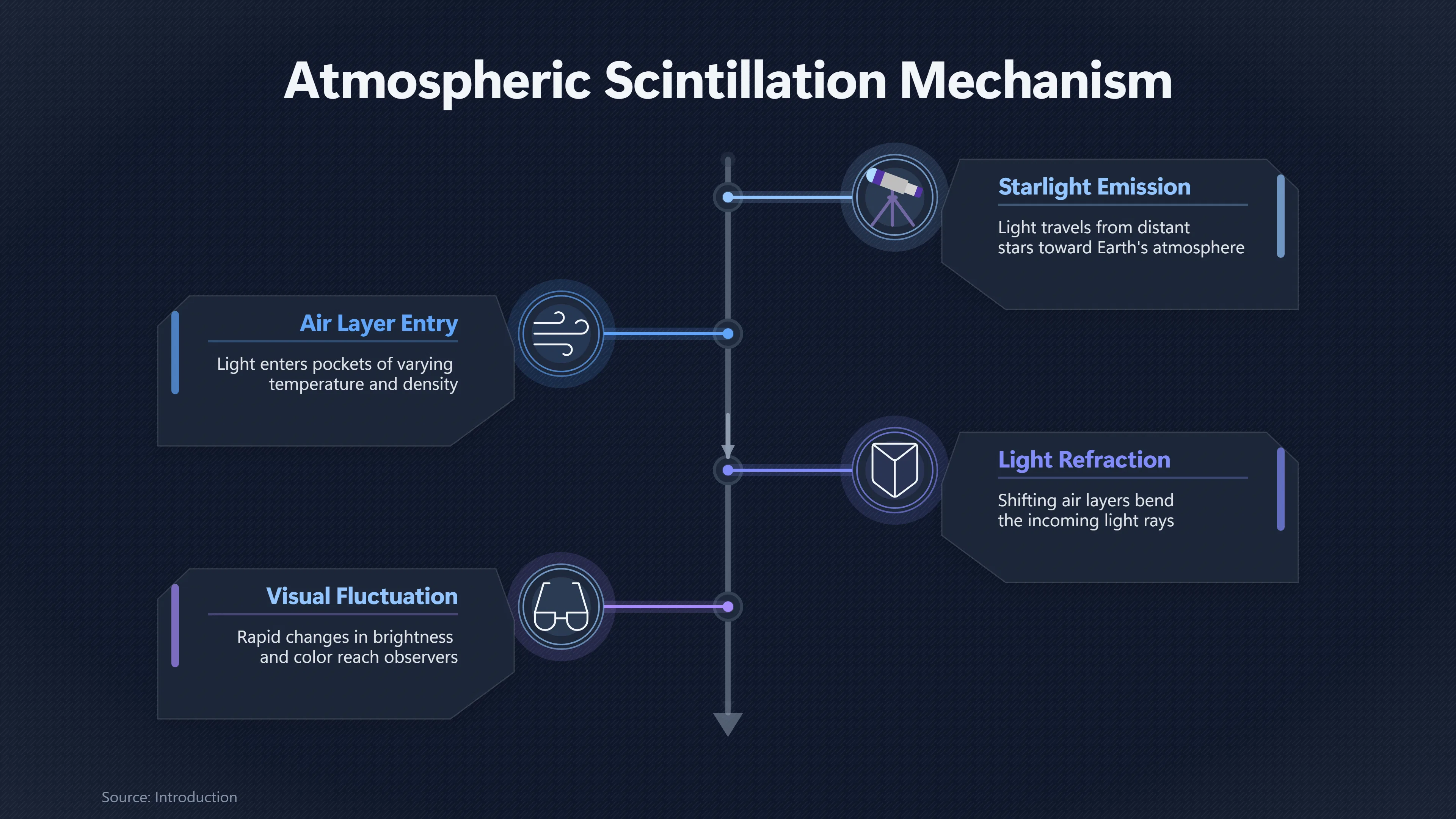
Atmospheric scintillation occurs because starlight passes through constantly shifting pockets of air with different temperatures and densities. These layers bend the incoming light by tiny amounts, causing rapid fluctuations in brightness, apparent position and colour. The star itself is not changing colour; the Earth’s atmosphere is altering how its light reaches the observer.[skyandtelescope.org]skyandtelescope.orgSky & Telescope Stellar Scintillation: Why Stars TwinkleSky & TelescopeStellar Scintillation: Why Stars Twinkle - Sky & Telescope…
Bright stars are particularly striking because the human eye easily notices these rapid changes. Under poor viewing conditions, observers can see a sequence of flashes that appear red, green, white and occasionally blue within fractions of a second. This effect is strongest for objects close to the horizon because their light travels through a much greater thickness of atmosphere before reaching the observer. The World Meteorological Organization explicitly notes that scintillation can alter a distant light’s apparent brightness, position and colour.[wmo.int]cloudatlas.wmo.intInternational Cloud Atlas Scintillation | International Cloud AtlasInternational Cloud Atlas Scintillation | International Cloud Atlas
The colours reported publicly after the Baffin Island sighting—red, green and white, with some later accounts also mentioning blue—fall comfortably within the range commonly described for strong stellar scintillation.[Nunatsiaq News]nunatsiaq.comNews Pilots report UFO sighting over Nunavut’s northern Baffin IslandNunatsiaq NewsPilots report UFO sighting over Nunavut’s northern Baffin IslandNovember 27, 2018…
Why Arctic night flying complicates visual judgement
The circumstances of the November 2018 sighting make a scintillation explanation worthy of serious consideration without making it certain.
The aircraft was flying at night across northern Baffin Island, where there are few ground lights and very little visual reference outside the cockpit. In such conditions, pilots can accurately report what they see while still finding it difficult to judge a light’s true distance or altitude. A single bright point against a dark sky provides few visual cues from which to estimate whether it is nearby or extremely distant.[Nunatsiaq News]nunatsiaq.comNews Pilots report UFO sighting over Nunavut’s northern Baffin IslandNunatsiaq NewsPilots report UFO sighting over Nunavut’s northern Baffin IslandNovember 27, 2018…
Cold Arctic conditions can also create strong temperature differences between layers of air. These gradients contribute to atmospheric turbulence that produces scintillation, although cold weather alone does not guarantee unusually strong colour changes. The important factor is the optical path through unstable air rather than temperature by itself.[skyandtelescope.org]skyandtelescope.orgSky & Telescope Stellar Scintillation: Why Stars TwinkleSky & TelescopeStellar Scintillation: Why Stars Twinkle - Sky & Telescope…
An aircraft’s own motion adds another complication. As the aircraft changes heading or position, a distant celestial object may appear to shift relative to the cockpit windows even though it is effectively stationary. Without precise measurements of angular movement, apparent motion alone is not enough to distinguish a star from a closer object.

What observations would confirm or weaken this explanation
The principal weakness of the scintillation hypothesis is not the physics but the lack of detailed observational data.
Evidence that would strengthen the explanation includes:
- the light remaining fixed against the background stars;
- a low elevation above the horizon;
- no independent radar or airborne target;
- an appearance lasting long enough for normal stellar observation;
- astronomical reconstruction showing a bright star or planet in the reported direction.[skyandtelescope.org]skyandtelescope.orgSky & Telescope Stellar Scintillation: Why Stars TwinkleSky & TelescopeStellar Scintillation: Why Stars Twinkle - Sky & Telescope…
Conversely, the explanation would become much less convincing if reliable evidence showed:
- sustained movement independent of the observing aircraft;
- measured changes in bearing inconsistent with a distant celestial object;
- corroborating radar returns from the same location;
- multiple independent observers reporting structured features rather than a point of light;
- instrument data demonstrating rapid manoeuvres.[Nunatsiaq News]nunatsiaq.comNews Pilots report UFO sighting over Nunavut’s northern Baffin IslandNunatsiaq NewsPilots report UFO sighting over Nunavut’s northern Baffin IslandNovember 27, 2018…
None of those stronger indicators has been made public in connection with the Baffin Island case.
How well does scintillation fit the reported sighting?
The public record is unusually restrained. Nolinor’s vice-president said the pilot described a shining light that changed from red to green to white and suggested it might have been a star, a meteor or “probably something natural.” The official CADORS entry records that the observation had no operational impact and should be regarded as preliminary rather than a confirmed identification.[Nunatsiaq News]nunatsiaq.comNews Pilots report UFO sighting over Nunavut’s northern Baffin IslandNunatsiaq NewsPilots report UFO sighting over Nunavut’s northern Baffin IslandNovember 27, 2018…
That combination of facts makes atmospheric scintillation a credible explanation for one specific aspect of the sighting: the reported colour changes. It does not automatically explain every feature that the crew may have observed, because the publicly available reports omit crucial details such as the light’s precise position in the sky, its apparent motion and the length of the observation.
The most evidence-based conclusion is therefore a limited one. Atmospheric scintillation offers a straightforward physical mechanism capable of producing exactly the kind of rapidly changing colours described by the crew, particularly if they were observing a bright, low-lying celestial object through turbulent Arctic air. At the same time, the surviving evidence is too sparse to confirm that this is what happened, leaving the explanation plausible but unverified.[nunatsiaq.com]nunatsiaq.comNews Pilots report UFO sighting over Nunavut’s northern Baffin IslandNunatsiaq NewsPilots report UFO sighting over Nunavut’s northern Baffin IslandNovember 27, 2018…

Amazon book picks
Further Reading
Books and field guides related to Was the Baffin Light a Twinkling Star?. Use these as the next step if you want deeper reading beyond the article.
NightWatch: A Practical Guide to Viewing the Universe
A practical guide to viewing the universe.
Turn Left at Orion
With over 100,000 copies sold since first publication, this is one of the most popular astronomy books of all time. It is a unique guideb...
The UFO Experience: A Scientific Inquiry
Cited by the New York Review of Books as "the best brief for visitation," this classic study presents an analysis of UFO reports and conc...
Astrophysics for People in a Hurry
Rating: 4.5/5 from 7 Google Books ratings
Over a year on the New York Times bestseller list and more than a million copies sold. The essential universe, from our most celebrated a...
eBay marketplace picks
Marketplace Samples
Live-tested eBay searches with available results related to this page.
Selected fromastronomy poster oneBay.co.uk.
Endnotes
1.
Source: nunatsiaq.com
Title: News Pilots report UFO sighting over [Nunavut]({{ ‘what-really-lies-behind-nunavuts-ufo/’ | relative_url }})’s northern Baffin Island
Link:https://nunatsiaq.com/stories/article/pilots-report-ufo-sighting-over-nunavuts-northern-baffin-island/
Source snippet
Nunatsiaq NewsPilots report UFO sighting over Nunavut’s northern Baffin IslandNovember 27, 2018...
Published: November 27, 2018
2.
Source: nunatsiaq.com
Title: our top 10 stories of 2018
Link:https://nunatsiaq.com/stories/article/our-top-10-stories-of-2018/
3.
Source: youtube.com
Title: Why Do Stars Twinkle but Planets Don’t?
Link:https://www.youtube.com/watch?v=rCBUutvDCAE
Source snippet
Atmospheric Scintillation | #astronoMYtime | To twinkle or not to twinkle...
4.
Source: youtube.com
Title: Atmospheric Scintillation | #astrono MYtime | To twinkle or not to twinkle
Link:https://www.youtube.com/watch?v=kOf3diELYQE
Source snippet
Understand why stars and planets twinkle?...
5.
Source: skyandtelescope.org
Title: Sky & Telescope Stellar Scintillation: Why Stars Twinkle
Link:https://skyandtelescope.org/astronomy-resources/why-do-stars-twinkle/
Source snippet
Sky & TelescopeStellar Scintillation: Why Stars Twinkle - Sky & Telescope...
6.
Source: cloudatlas.wmo.int
Title: International Cloud Atlas Scintillation | International Cloud Atlas
Link:https://cloudatlas.wmo.int/en/scintillation.html
7.
Source: astronomy.com
Title: Why do some stars appear to twinkle while others don’t?
Link:https://www.astronomy.com/observing/why-do-some-stars-appear-to-twinkle-while-others-dont/
Source snippet
Stars twinkle and sometimes appear to move around due to our atmosphere “scrambling” their light as it travels to...
Additional References
8.
Source: sciencetimes.com
Link:https://www.sciencetimes.com/articles/61059/20260102/why-stars-twinkle-flickering-explained-atmospheric-turbulence-light-distortion.htm
Source snippet
January 2, 2026 — WHY STARS TWINKLE: FLICKERING EXPLAINED BY ATMOSPHERIC TURBULENCE AND LIGHT DISTORTION By Glanze Patrick...
Published: January 2, 2026
9.
Source: youtube.com
Title: Twinkling Stars vs. Steady Planets: The Science Behind the Phenomenon
Link:https://www.youtube.com/watch?v=vStgYmm_gQI
Source snippet
This video from FACETS OF THE STARS - Stellar scintillation in real-time 4K is particularly relevant because it visually demonstrates rea...
10.
Source: earthsky.org
Title: Why do stars twinkle, but planets don’t?
Link:https://earthsky.org/space/why-dont-planets-twinkle-as-stars-do/
Source snippet
Posted by Deborah Byrd Image June 28, 2026 The more atmosphere you are peering through, the more stars (or sometimes planets) appear to t...
Published: June 28, 2026
11.
Source: skyatnightmagazine.com
Title: Why do stars twinkle?
Link:https://www.skyatnightmagazine.com/space-science/why-do-stars-twinkle
Source snippet
BBC Sky at Night MagazineMay 2, 2025 — WHY DO STARS TWINKLE? What makes stars appear to twinkle in the night sky, as seen from Earth? A...
Published: May 2, 2025
12.
Source: spaceweather.gov
Link:https://www.spaceweather.gov/phenomena/ionospheric-scintillation
13.
Source: arxiv.org
Link:https://arxiv.org/abs/1305.0615
14.
Source: youtube.com
Title: Understand why stars and planets twinkle?
Link:https://www.youtube.com/watch?v=qvIPlYUqPxQ
Source snippet
Twinkling Stars vs. Steady Planets: The Science Behind the Phenomenon...
15.
Source: frontiersin.org
Link:https://www.frontiersin.org/journals/astronomy-and-space-sciences/articles/10.3389/fspas.2018.00026/full
16.
Source: nrc-publications.canada.ca
Link:https://nrc-publications.canada.ca/eng/view/object/?id=c62279f8-dd35-48e1-9f3a-ee136f649932
17.
Source: superstitioustimes.com
Link:https://superstitioustimes.com/baffin-island-ufo-nothing-more-than-a-star-on-the-horizon/