Within Nunavut UFOs
Why Do Arctic Lights Look So Unusual?
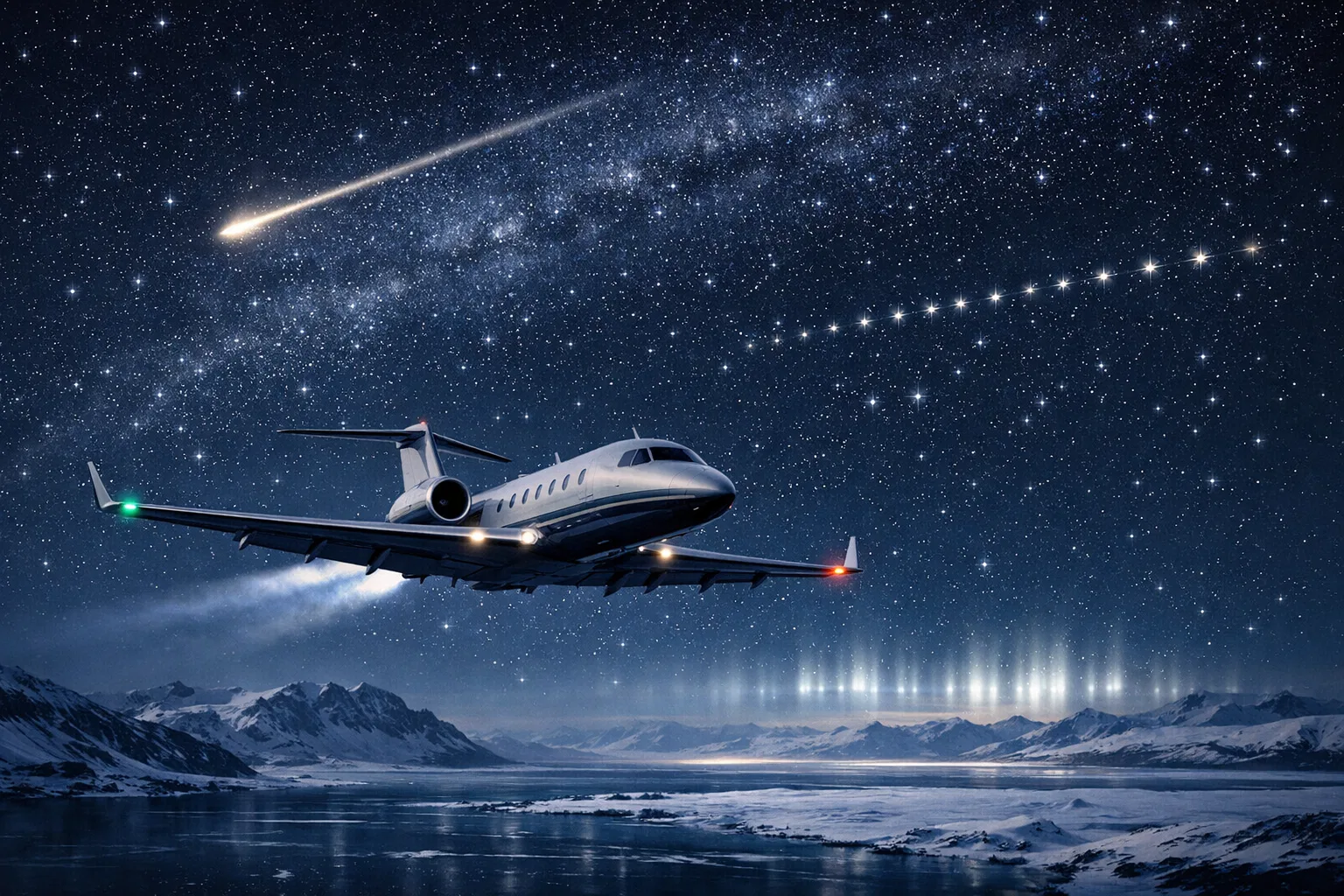
Stars, meteors, satellites and atmospheric effects can look unfamiliar from a moving aircraft during the long Arctic night.
On this page
- Stars, planets and atmospheric colour changes
- Aircraft motion, distance and false movement
- Meteors, satellites, balloons and ice crystals
Page outline Jump by section
Introduction
Arctic skies can produce convincing UFO reports without anything extraordinary being present. In Nunavut, the combination of long winter darkness, exceptionally sparse ground lighting, vast distances and lengthy flights over featureless terrain removes many of the visual cues people normally use to judge an object’s size, range and speed. A bright star may appear to move; atmospheric turbulence can make it flash red, green, blue and white; and an ordinary satellite or meteor may seem unusually prominent against a very dark sky.
These mechanisms matter because Nunavut’s best-known modern UFO report involved precisely this kind of observation. On 24 November 2018, pilots flying from Iqaluit towards the Mary River mine reported a bright, colour-changing light over northern Baffin Island. The pilots treated the sighting seriously and reported it through aviation channels, but one of them also acknowledged that a star or meteor remained possible. With no public photograph, radar track or measured distance, the case illustrates how an honest and striking observation can remain unresolved because the viewing conditions make identification unusually difficult.[Nunatsiaq News]nunatsiaq.com65674pilots spot possible ufo above nunavuts northern baffin island24, as they flew from Iqaluit to the Mary River mine in north Baffin Island.Read more…
Why darkness changes what observers think they see
Nunavut’s long Arctic night does more than provide extra hours for looking at the sky. It can leave observers with almost no visual frame of reference. Away from settlements, mines and airports, there may be few roads, buildings or ground lights against which to compare an airborne or celestial light. Snow, cloud and darkness can also obscure the natural horizon.
That absence matters because a point of light contains very little information by itself. Unless its true size is known, the eye cannot reliably tell whether it is a small nearby object or a large distant one. A bright light several kilometres away may look much like a planet millions of kilometres away. Apparent brightness is not a dependable guide to range because it depends on the source’s intensity, atmospheric clarity and viewing angle as well as distance.
Research near Eureka on Ellesmere Island shows just how favourable the Canadian High Arctic can be for seeing point sources. During two winter observing seasons, skies were free of thick cloud and potentially usable for astronomy for much of the recorded period, with dark conditions sometimes persisting for more than 100 hours. These findings concern a scientific observing site rather than every part of Nunavut, but they demonstrate why stars, planets and satellites can appear unusually crisp and conspicuous in the territory’s winter sky.[arXiv]arxiv.orgarXiv Astronomical Sky Quality Near Eureka, in the Canadian High ArcticAstronomical Sky Quality Near Eureka, in the Canadian High ArcticDecember 13, 2011…
Darkness can also produce autokinesis, a well-known aviation illusion in which a stationary light seems to wander when stared at against a black, featureless background. Aviation safety guidance warns that a star or isolated ground light can appear to move across an aircraft’s path even though it is fixed. The effect is not evidence of poor training or an unreliable witness; it is a limitation of human vision that trained pilots are specifically taught to recognise.[faa.gov]faa.gov4 pagesFederal Aviation AdministrationSpatial Disorientation: Visual IllusionsSeptember 15, 2016 — The Autokinetic Illusion gives you the impres…
In Nunavut, the conditions that encourage autokinesis are common on winter flights: prolonged darkness, few ground lights and long periods during which a crew may watch one unexplained point. A light that first appears stationary may seem to drift, approach, retreat or alter course. Once the observer’s own aircraft is banking, climbing or changing heading, the apparent motion can become more persuasive.
Why stars and planets appear to change colour
A description such as “flashing red, green, blue and white” sounds mechanical because it resembles coloured navigation or warning lights. Yet bright stars can produce the same impression through atmospheric scintillation, the technical term for twinkling.
Starlight passes through moving layers of air with slightly different temperatures and densities. These layers bend and focus the light unevenly, creating rapid changes in apparent brightness, position and colour. The effect is strongest when a star is low above the horizon because its light must travel through more atmosphere before reaching the observer. The Chandra X-ray Observatory’s public astronomy guidance specifically notes that Sirius can appear to change rapidly between red, green and white because Earth’s atmosphere behaves like a shifting prism.[Astronomy Magazine]astronomy.comMagazine Why do some stars appear to twinkle while others don't?Magazine Why do some stars appear to twinkle while others don't?
From a moving aircraft, the effect can be especially confusing. A bright star may remain in roughly the same direction for a long time, yet appear to pulse or jump as the aircraft passes through changing air masses. The cockpit windows can introduce additional reflections or distortions, while small movements of the observer’s head alter the relationship between the light and the window.
Planets generally twinkle less than stars because they appear as tiny discs rather than perfect points, allowing some atmospheric fluctuations to average out. Nevertheless, a bright planet close to the horizon can still appear unstable, especially through haze, thin cloud or layers of sharply differing temperature. Without a recognisable horizon or a star chart matched to the aircraft’s position and time, an observer may have no immediate reason to classify it as astronomical.
This makes a stellar explanation relevant to the 2018 Baffin Island report. The colour sequence described by the pilot is compatible with strong scintillation, and the pilot himself reportedly raised a star as one possibility. Compatibility is not proof: the published account does not preserve enough information about the light’s elevation, bearing or duration to identify a particular star or planet retrospectively. The case therefore remains unresolved, but the reported colours do not require an object carrying multiple lamps.[Nunatsiaq News]nunatsiaq.com65674pilots spot possible ufo above nunavuts northern baffin island24, as they flew from Iqaluit to the Mary River mine in north Baffin Island.Read more…
How aircraft motion creates false movement
Even when the observed light is genuinely moving, its apparent behaviour may differ sharply from its real path. Pilots see other objects from a platform travelling hundreds of kilometres per hour, sometimes while changing altitude or direction. This creates several related perception problems.
Parallax occurs when the observer’s changing position makes nearer objects appear to shift against a more distant background. A balloon, another aircraft or a light below the flight path can therefore seem to accelerate or change direction as the observing aircraft moves past it.
The reverse problem affects very distant objects. A star or planet is effectively fixed at aviation distances, so a turn by the aircraft can make it appear to slide rapidly across the windscreen. A crew member who does not immediately register the aircraft’s changing orientation may interpret that movement as belonging to the light.
Distance is also easily misjudged when the object has no visible outline. If witnesses assume that a light is nearby, even modest angular movement may be translated mentally into very high speed. If the same light is actually much farther away, its true motion may be slow or nonexistent. Claims that an unidentified light “kept pace” with an aircraft can arise for a similar reason: a distant celestial source remains at nearly the same bearing while the aircraft covers a considerable distance.
These effects do not mean that every pilot report is mistaken. Pilots are trained observers and may notice aerial hazards that people on the ground would miss. But professional experience cannot supply missing range data. Unless a light is tracked by radar, photographed against stars, compared with another aircraft or observed from more than one location, estimates of its size, distance and speed may remain highly uncertain.
Meteors, satellites and balloons
Not every Arctic UFO report involves a stationary or slowly wandering light. Short-lived objects can be equally convincing because they appear suddenly and may vanish before observers can gather useful information.
Meteors and re-entering debris
A meteor can brighten abruptly, change colour, fragment and disappear within seconds. Its apparent path depends on the observer’s geometry: a meteor moving almost directly towards an aircraft may show little sideways motion before flaring, while one crossing the field of view can resemble a fast craft. Bright meteors may also leave glowing trains that persist after the main object has vanished.
Artificial space debris can produce more elaborate displays. During atmospheric re-entry, a rocket body or satellite may break into several glowing fragments moving together. Such events can resemble formations of lights, sparks or objects travelling at extraordinary speed. Space-agency observations of documented re-entries show that they may appear as groups of meteor-like sources crossing a large part of the sky.[ESA Proceedings Database]conference.sdo.esoc.esa.intOpen source on esa.int.
A meteor was one of the ordinary possibilities raised in reporting on the 2018 Baffin Island sighting. That explanation would fit a brief luminous event better than a light observed steadily for a long period, but the available public summaries do not provide a sufficiently detailed duration or trajectory to test the idea properly.[Nunatsiaq News]nunatsiaq.com65674pilots spot possible ufo above nunavuts northern baffin island24, as they flew from Iqaluit to the Mary River mine in north Baffin Island.Read more…
Satellites and sudden flares
Satellites are visible because they reflect sunlight, not because they normally carry bright external lamps. An observer may be in darkness while a satellite hundreds of kilometres above remains illuminated by the Sun. It then appears as a steady moving point, often without the flashing pattern expected from an aircraft.
Brightness can change dramatically as the satellite’s orientation shifts. A reflective surface may briefly direct sunlight towards the observer, producing a flare, after which the object fades or disappears as it enters Earth’s shadow. Groups of recently launched satellites can travel in a line, while tumbling spacecraft or debris may brighten at repeated intervals.
High-latitude skies are particularly relevant because many Earth-observation and weather satellites use near-polar orbits. NOAA notes that polar-orbiting satellites may be visible to the unaided eye from sufficiently dark locations. Nunavut’s low level of light pollution makes faint moving points easier to notice than they would be over a southern city.[NOAA NESDIS]nesdis.noaa.govNESDISSeeing Satellites | NESDISNESDISSeeing Satellites | NESDIS
Satellite-tracking software can often identify a candidate if the report preserves an exact time, location, bearing and direction. Without those details, “satellite” remains only a plausible category rather than a completed explanation.
Weather balloons
Weather balloons are routine components of northern forecasting but can appear strange when seen at an unfamiliar angle. A balloon may remain sunlit after the ground has entered darkness, making it look like a bright white or coloured point. Winds at different altitudes can carry it in a direction that does not match surface conditions, and its apparent motion may seem erratic when viewed from a moving aircraft.
Iqaluit has a long history of upper-air balloon launches. A local account of the weather station described balloons being released twice daily and rising to roughly 36,000 metres before bursting. That does not link a balloon to any particular Nunavut UFO report, but it establishes that high-altitude balloons are ordinary objects in the territory’s airspace and should be checked when times and trajectories permit.[Nunatsiaq News]nunatsiaq.comweather or notweather or not
Ice crystals can reshape familiar lights
Cold Arctic air introduces another source of unusual appearances: suspended ice crystals. In very low temperatures, tiny crystals may form in high cloud or near the ground as “diamond dust”. They reflect and refract light, producing halos, arcs, bright spots and vertical pillars.
A light pillar can appear to extend above or below the Sun, Moon or a powerful artificial source. Bright lamps around an airport, mine or settlement may create several pillars that look like objects hovering in formation. Halos around the Moon can include concentrated patches of light, while thin ice-crystal layers may make a source brighten, split or take on colour.
These displays are not exclusive to the Arctic, but polar conditions make them especially relevant. Research on the Canadian High Arctic has found that atmospheric ice crystals can be present even under conditions that otherwise appear clear. Scientific and meteorological explanations describe halos as products of reflection and refraction through airborne crystals, with the crystals’ shape and orientation determining whether observers see rings, arcs, spots or columns.[alaska.edu]gi.alaska.eduice crystal halosice crystal halos
Atmospheric optics are more persuasive as explanations when a reported light remains aligned with the Moon, Sun or a known artificial source. They are less suitable for an object that crosses a large portion of the sky independently. As with other candidate explanations, geometry and timing are essential.
Why reports stay unresolved
Nunavut’s sky conditions can create compelling observations, but its geography makes those observations difficult to reconstruct. A report may come from an aircraft hundreds of kilometres from the nearest community, with no second observer on the ground and no convenient landmark beneath the light. By the time the account reaches a database or journalist, crucial details may have been reduced to a few sentences.
Transport Canada’s Civil Aviation Daily Occurrence Reporting System, or CADORS, records preliminary aviation-occurrence information. It is valuable because it preserves reports that might otherwise disappear, but the presence of an entry does not mean that Transport Canada has scientifically identified—or failed to identify—a physical object after a full investigation. The department cautions that CADORS information may be preliminary, unsubstantiated and subject to change.[canada.ca]tc.canada.cacivil aviation daily occurrence reporting system cadorscivil aviation daily occurrence reporting system cadors
Canada’s Sky Canada Project has likewise found that public reporting of unidentified aerial phenomena is divided among systems with different purposes and responsibilities. Aviation channels are chiefly concerned with safety, security and operational awareness rather than detailed astronomical reconstruction. Consequently, an unusual light can be reported appropriately and still receive no public resolution.[Science.gc.ca]science.gc.caOpen source on gc.ca.
For an Arctic sighting to move beyond speculation, investigators would ideally need:
- the exact time and coordinates;
- the aircraft’s heading, altitude and manoeuvres;
- the light’s bearing and elevation over time;
- its duration, colour pattern and apparent brightness;
- weather, cloud and ice-crystal conditions;
- satellite, balloon, meteor and air-traffic data;
- photographs, cockpit video or independent observations;
- radar or other sensor information, where available.
When these elements are missing, an unresolved label says more about the quality of the surviving data than about the nature of the object.

What the Arctic explanation does—and does not—prove
Arctic conditions do not automatically debunk every Nunavut UFO report. A sighting with clear multi-angle observations, reliable range measurements or corroborating sensor data would require case-specific analysis. Nor should descriptions from pilots or remote-community witnesses be dismissed simply because ordinary explanations exist.
The stronger conclusion is narrower: Nunavut combines several conditions known to produce sincere misidentifications. Bright celestial objects are more conspicuous; stars may flash in several colours; featureless darkness encourages autokinesis; aircraft movement distorts apparent motion; satellites, meteors and balloons can appear without familiar visual cues; and ice crystals can transform ordinary light into dramatic shapes.
That combination explains why an observation may be both credible and unresolved. The witness may accurately report seeing a striking light, while the available evidence remains inadequate to determine what produced it. In Nunavut’s UFO history, the central challenge is therefore not choosing between “fabrication” and “extraordinary craft”. It is separating an unusual object from an unusual view of an ordinary one.
Amazon book picks
Further Reading
Books and field guides related to Why Do Arctic Lights Look So Unusual?. Use these as the next step if you want deeper reading beyond the article.
NightWatch: A Practical Guide to Viewing the Universe
A practical guide to viewing the universe.
The Report on Unidentified Flying Objects
Book Excerpt: ing can never be positively identified. It might have been a hallucination or it might have been some vehicle from outer sp...
UFOs
NEW YORK TIMES BESTSELLER • Impeccably researched, this riveting journalistic investigation separates fact from fiction, and documents th...
Arctic Dreams
To write this book, the author travelled widely in the Arctic, with Eskimos, biologists, archaeologists and landscape painters, among oth...
eBay marketplace picks
Marketplace Samples
Example marketplace items related to this page. Use the search link to explore similar finds on eBay.
Selected fromCanadian Arctic map oneBay.co.uk.

Endnotes
1.
Source: nunatsiaq.com
Title: 65674pilots spot possible ufo above nunavuts northern baffin island
Link:https://nunatsiaq.com/stories/article/65674pilots_spot_possible_ufo_above_nunavuts_northern_baffin_island/
Source snippet
24, as they flew from Iqaluit to the Mary River mine in north Baffin Island.Read more...
2.
Source: arxiv.org
Title: arXiv Astronomical Sky Quality Near Eureka, in the Canadian High Arctic
Link:https://arxiv.org/abs/1112.3067
Source snippet
Astronomical Sky Quality Near Eureka, in the Canadian High ArcticDecember 13, 2011...
Published: December 13, 2011
3.
Source: arxiv.org
Title: arXiv Characterizing Near-Infrared Sky Brightness in the Canadian High Arctic
Link:https://arxiv.org/abs/1206.6901
4.
Source: faa.gov
Title: 4 pages
Link:https://www.faa.gov/pilots/safety/pilotsafetybrochures/media/spatiald_visillus.pdf
Source snippet
Federal Aviation AdministrationSpatial Disorientation: Visual IllusionsSeptember 15, 2016 — The Autokinetic Illusion gives you the impres...
Published: September 15, 2016
5.
Source: skybrary.aero
Link:https://skybrary.aero/articles/visual-illusions
Source snippet
Visual Illusions | SKYbrary Aviation SafetyAutokinesis: When flying at night, if a pilot stares at a stationary light in the dist...
6.
Source: faa.gov
Link:https://www.faa.gov/sites/faa.gov/files/regulations_policies/handbooks_manuals/aviation/airplane_handbook/12_afh_ch11.pdf
Source snippet
Two illusions that lead to spatial disorientation, false horizon and autokinesis, concern the visual... 14 pages...
7.
Source: astronomy.com
Title: Magazine Why do some stars appear to twinkle while others don’t?
Link:https://www.astronomy.com/observing/why-do-some-stars-appear-to-twinkle-while-others-dont/
8.
Source: conference.sdo.esoc.esa.int
Link:https://conference.sdo.esoc.esa.int/proceedings/neosst2/paper/19
9.
Source: esa.int
Title: European Space Agency ESA
Link:https://www.esa.int/Space_Safety/Space_Debris/Moving_satellites_to_meet_a_plane_for_rare_reentry_data
10.
Source: nesdis.noaa.gov
Title: NESDISSeeing Satellites | NESDIS
Link:https://www.nesdis.noaa.gov/news/seeing-satellites
11.
Source: arxiv.org
Link:https://arxiv.org/pdf/2109.04328
12.
Source: nunatsiaq.com
Title: weather or not
Link:https://nunatsiaq.com/stories/article/weather_or_not/
13.
Source: gi.alaska.edu
Title: ice crystal halos
Link:https://www.gi.alaska.edu/alaska-science-forum/ice-crystal-halos
14.
Source: atoptics.org.uk
Link:https://www.atoptics.org.uk/halosim.htm
15.
Source: tc.canada.ca
Title: civil aviation daily occurrence reporting system cadors
Link:https://tc.canada.ca/en/aviation/publications/aviation-safety-letter/issue-2-2021/civil-aviation-daily-occurrence-reporting-system-cadors
16.
Source: search.open.canada.ca
Link:https://search.open.canada.ca/qpnotes/record/tc%2CTC-2022-QP-00005
17.
Source: tc.canada.ca
Title: civil aviation daily occurrence reporting system cadors manual tp 4044
Link:https://tc.canada.ca/en/aviation/aviation-publications/civil-aviation-daily-occurrence-reporting-system-cadors-manual-tp-4044
18.
Source: science.gc.ca
Link:https://science.gc.ca/site/science/en/office-chief-science-advisor/sky-canada-project/management-public-reporting-unidentified-aerial-phenomena-canada
19.
Source: facebook.com
Link:https://www.facebook.com/groups/2029111367249882/posts/2812779188883092/
20.
Source: tc.canada.ca
Title: ca4. High Altitude Object Incidents
Link:https://tc.canada.ca/en/binder/4-high-altitude-object-incidents
21.
Source: canada.ca
Link:https://www.canada.ca/en/library-archives/collection/research-help/science-technology/ufos.html
22.
Source: tc.canada.ca
Title: ca Standard 621
Link:https://tc.canada.ca/en/corporate-services/acts-regulations/list-regulations/canadian-aviation-regulations-sor-96-433/standards/standard-621-obstacle-marking-lighting-canadian-aviation-regulations-cars
23.
Source: skybrary.aero
Link:https://skybrary.aero/articles/general-aviation-night-flying-guidance
24.
Source: skybrary.aero
Link:https://skybrary.aero/sites/default/files/bookshelf/2087.pdf
25.
Source: skybrary.aero
Link:https://skybrary.aero/sites/default/files/bookshelf/1816.pdf
26.
Source: skybrary.aero
Link:https://skybrary.aero/sites/default/files/bookshelf/3424.pdf
27.
Source: skybrary.aero
Link:https://skybrary.aero/sites/default/files/bookshelf/2037.pdf
28.
Source: skybrary.aero
Title: I I!!I~ II II IIII Iliil II
Link:https://skybrary.aero/sites/default/files/bookshelf/4078.pdf
29.
Source: skybrary.aero
Link:https://skybrary.aero/sites/default/files/bookshelf/6021.pdf
30.
Source: skybrary.aero
Link:https://skybrary.aero/sites/default/files/bookshelf/3445.pdf
31.
Source: skybrary.aero
Link:https://skybrary.aero/sites/default/files/bookshelf/611.pdf
32.
Source: Wikipedia
Link:https://en.wikipedia.org/wiki/Twinkling
33.
Source: indico.esa.int
Title: CSD2024 Pieters DarkSkies
Link:https://indico.esa.int/event/516/contributions/9998/attachments/6295/10805/CSD2024_Pieters_DarkSkies.pdf
34.
Source: esa.int
Link:https://www.esa.int/Enabling_Support/Space_Transportation/Types_of_orbits
35.
Source: conference.sdo.esoc.esa.int
Title: SDC8 paper243
Link:https://conference.sdo.esoc.esa.int/proceedings/sdc8/paper/243/SDC8-paper243.pdf
36.
Source: conference.sdo.esoc.esa.int
Link:https://conference.sdo.esoc.esa.int/proceedings/sdc8/paper/66/SDC8-paper66.pdf
37.
Source: esa.int
Title: Mother of Dragons comet visible in the night sky
Link:https://www.esa.int/Space_Safety/Planetary_Defence/Mother_of_Dragons_comet_visible_in_the_night_sky
38.
Source: conference.sdo.esoc.esa.int
Link:https://conference.sdo.esoc.esa.int/proceedings/sdc9/paper/194/SDC9-paper194.pdf
39.
Source: conference.sdo.esoc.esa.int
Link:https://conference.sdo.esoc.esa.int/proceedings/sdc7/paper/732/SDC7-paper732.pdf
40.
Source: conference.sdo.esoc.esa.int
Link:https://conference.sdo.esoc.esa.int/proceedings/sdc7/paper/535/SDC7-paper535.pdf
41.
Source: repository.library.noaa.gov
Title: noaa 56580 DS1
Link:https://repository.library.noaa.gov/view/noaa/56580/noaa_56580_DS1.pdf
42.
Source: repository.library.noaa.gov
Title: noaa 29253 DS1
Link:https://repository.library.noaa.gov/view/noaa/29253/noaa_29253_DS1.pdf
43.
Source: noaa.gov
Title: 2024 noaa education report
Link:https://www.noaa.gov/education/reports/2024-noaa-education-report
44.
Source: ngdc.noaa.gov
Title: afd 131104 184 air force weather heritage
Link:https://www.ngdc.noaa.gov/stp/space-weather/online-publications/miscellaneous/afrl_publications/afd-131104-184_air-force-weather_heritage.pdf
45.
Source: nesdis.noaa.gov
Title: 2023 JPSS Annual Science Digest Mobile2
Link:https://www.nesdis.noaa.gov/s3/2024-01/2023-JPSS-Annual-Science-Digest-Mobile2.pdf
46.
Source: nesdis.noaa.gov
Title: 2017 science seminar digest
Link:https://www.nesdis.noaa.gov/s3/2021-12/2017_science_seminar_digest.pdf
47.
Source: library.oarcloud.noaa.gov
Link:https://library.oarcloud.noaa.gov/docs.lib/htdocs/rescue/wb_topicsandpersonnel/1949.pdf
48.
Source: repository.library.noaa.gov
Title: noaa 59391 DS1
Link:https://repository.library.noaa.gov/view/noaa/59391/noaa_59391_DS1.pdf
49.
Source: aoml.noaa.gov
Link:https://www.aoml.noaa.gov/general/lib/AOML%20History/harris%20b%20stewart/Stewart_Discoverer.pdf
50.
Source: ncei.noaa.gov
Title: climate assessment 2010 lo rez
Link:https://www.ncei.noaa.gov/pub/data/cmb/bams-sotc/climate-assessment-2010-lo-rez.pdf
51.
Source: noaa.gov
Link:https://www.noaa.gov/changing-seasons-at-north-pole
52.
Source: faa.gov
Link:https://www.faa.gov/sites/faa.gov/files/19_phak_ch17.pdf
53.
Source: faa.gov
Link:https://www.faa.gov/sites/faa.gov/files/about/office_org/headquarters_offices/avs/MP-086-20.pdf
54.
Source: faa.gov
Link:https://www.faa.gov/sites/faa.gov/files/2022-01/NovDec2015.pdf
55.
Source: faa.gov
Title: FA A Safety Briefing
Link:https://www.faa.gov/sites/faa.gov/files/2022-01/SepOct2015.pdf
56.
Source: faa.gov
Link:https://www.faa.gov/sites/faa.gov/files/regulations_policies/handbooks_manuals/aviation/faa-h-8083-21.pdf
57.
Source: youtube.com
Link:https://www.youtube.com/watch?v=h2lzcB_4ges
58.
Source: nunatsiaq.com
Title: pilots report ufo sighting over nunavuts northern baffin island
Link:https://nunatsiaq.com/stories/article/pilots-report-ufo-sighting-over-nunavuts-northern-baffin-island/
59.
Source: nunatsiaq.com
Title: our top 10 stories of 2018
Link:https://nunatsiaq.com/stories/article/our-top-10-stories-of-2018/
60.
Source: weather.gov
Link:https://www.weather.gov/arx/why_halos_sundogs_pillars
61.
Source: weather.gov
Link:https://www.weather.gov/ilx/ua-tour
62.
Source: science.gov
Link:https://www.science.gov/topicpages/b/baffin%2Bisland%2Bnunavut
63.
Source: antarctica.gov.au
Title: icy celebrations for world meteorological day
Link:https://www.antarctica.gov.au/news/2008/icy-celebrations-for-world-meteorological-day/
Additional References
64.
Source: arctictoday.com
Title: pilots report ufo sighting nunavuts northern baffin island
Link:https://www.arctictoday.com/pilots-report-ufo-sighting-nunavuts-northern-baffin-island/
Source snippet
Pilots report UFO sighting over Nunavut's northern Baffin...28 Nov 2018 — Pilots report UFO sighting over Nunavut's northern...
65.
Source: youtube.com
Title: Spatial Disorientation Explained: Deadly Flight Illusions Every Pilot Must Know
Link:https://www.youtube.com/watch?v=6BD9fyyIJzY
Source snippet
Why Do Stars Twinkle but Planets Don't? | Atmospheric Refraction Explained...
66.
Source: youtube.com
Title: Why Do Stars Twinkle but Planets Don’t? | Atmospheric Refraction Explained
Link:https://www.youtube.com/watch?v=OvA_kCOVsxI
Source snippet
What is Superior Mirage? Why the Ship looks Floating?...
67.
Source: youtube.com
Title: PPGS Lesson 14.2 | Aeromedical: Illusions
Link:https://www.youtube.com/watch?v=ZBPmFaqECdM
Source snippet
Spatial Disorientation Explained: Deadly Flight Illusions Every Pilot Must Know...
68.
Source: researchgate.net
Link:https://www.researchgate.net/publication/258612267_Observing_polar_regions_from_space_Advantages_of_a_satellite_system_on_a_highly_elliptical_orbit_versus_a_constellation_of_low_Earth_polar_orbiters
69.
Source: facebook.com
Link:https://www.facebook.com/FoxWeather/videos/all-about-balance%EF%B8%8F-as-northern-alaska-takes-on-polar-night-with-64-days-of-darkn/3820099948297811/
70.
Source: walshmedicalmedia.com
Link:https://www.walshmedicalmedia.com/open-access/brief-note-on-polar-orbiting-environmental-satellites.pdf
71.
Source: documentcloud.org
Link:https://www.documentcloud.org/documents/23845493-1-cirvis-procedures-combined/
72.
Source: reddit.com
Link:https://www.reddit.com/r/UFOs/comments/198e3pq/canadian_ufo_flight_reports/
73.
Source: chandra.harvard.edu
Link:https://chandra.harvard.edu/resources/faq/astrophysics/astrophysics-27.html