Within Remote Reports
When Does Interpretation Become Cultural Projection?
Individual testimony should be assessed on its evidence without turning one person's sighting into a claim about an entire Indigenous culture.
On this page
- Why one witness does not speak for a community
- How exoticising narratives distort the record
- A respectful standard for presenting remote reports
Page outline Jump by section
Introduction
When reports of unusual aerial phenomena come from Indigenous witnesses in Yukon, the most respectful and accurate approach is to treat them as individual testimony unless there is clear evidence that the relevant First Nation has itself presented the account as part of a broader cultural tradition. This matters because remote northern sightings are often retold through popular UFO literature in ways that blur the distinction between a person’s experience and an entire community’s beliefs. In Yukon, where some of the best-known remote UFO accounts involve First Nations witnesses from the Old Crow area, the historical record is strongest when it separates what the witness reported from what later writers inferred. That approach protects both the integrity of the evidence and the autonomy of Indigenous communities.
When Does Interpretation Become Cultural Projection?
The central question is not whether an Indigenous witness should be believed more or less than any other witness. Rather, it is whether later commentators attribute meanings that the witness never expressed.
The best-known remote Yukon reports associated with the Old Crow region illustrate this point. The published accounts describe what individual witnesses remembered seeing, such as intense lights, unusual shapes or unexpected events during travel on the land. They do not claim to represent Vuntut Gwitchin beliefs as a whole, nor do they present themselves as traditional teachings. The published records are personal recollections gathered by civilian UFO investigators years after the reported events rather than official community statements.
Problems arise when later writers move beyond the available evidence by suggesting that a single report reveals “Indigenous knowledge of extraterrestrials”, proves ancient contact with non-human intelligence, or reflects a shared spiritual interpretation. Such claims generally exceed what the witnesses themselves reported and are not supported by reliable historical documentation.
A balanced reading therefore distinguishes three separate questions:
- What did the individual witness say they observed?
- What evidence exists to evaluate that observation?
- Has the relevant First Nation itself interpreted the event within its own cultural traditions?
Those questions should not be merged.
Why One Witness Does Not Speak for a Community
Like any population, Yukon First Nations include people with different experiences, beliefs and interpretations of unusual events. One person’s account cannot automatically be treated as representative of an entire Nation, family or cultural tradition.
This distinction is especially important because Indigenous peoples have frequently been represented through generalisations rather than as individuals. Modern research ethics increasingly emphasise that First Nations should determine how information about their communities is collected, interpreted and shared. In Canada, the widely recognised OCAP® principles (Ownership, Control, Access and Possession) reflect this broader commitment to First Nations authority over information relating to their communities. Although originally developed for research and data governance rather than UFO investigations, the underlying principle—that communities should not have meanings imposed upon their knowledge by outsiders—is directly relevant to responsible historical writing.[fnigc.ca]fnigc.caThe First Nations Principles of OCAP®The First Nations Information Governance Centre…
In practical terms, this means avoiding statements such as:
- “The Gwitchin believe these lights were alien craft.”
- “First Nations traditions confirm modern UFO sightings.”
- “Indigenous witnesses possess hidden knowledge about UFOs.”[youtube.com]youtube.comNative American (Navajo) UFO Encounters…
Unless a recognised Indigenous authority or community publication explicitly makes such claims, they should not be attributed to the community.
How Exoticising Narratives Distort the Record
Remote northern settings have often encouraged romantic or sensational interpretations that would receive greater scrutiny elsewhere.
Several recurring patterns deserve caution:
Linking every unexplained light to traditional spirituality. A witness may simply describe an unusual observation without assigning any spiritual significance.
Treating remoteness as evidence. Isolation may reduce opportunities for immediate investigation, but it does not make extraordinary explanations either more or less likely.
Assuming cultural authority from ancestry. An Indigenous person’s observation is still an eyewitness account requiring the same careful assessment applied to any other report.
Collapsing different knowledge systems together. Traditional ecological knowledge, oral history, spiritual practice and modern UFO reports are distinct categories. They should only be connected where Indigenous knowledge holders themselves explicitly make that connection.
These distortions ultimately weaken both historical accuracy and respectful representation. They risk replacing the witness’s own words with an outsider’s preferred narrative.
A Respectful Standard for Presenting Remote Reports
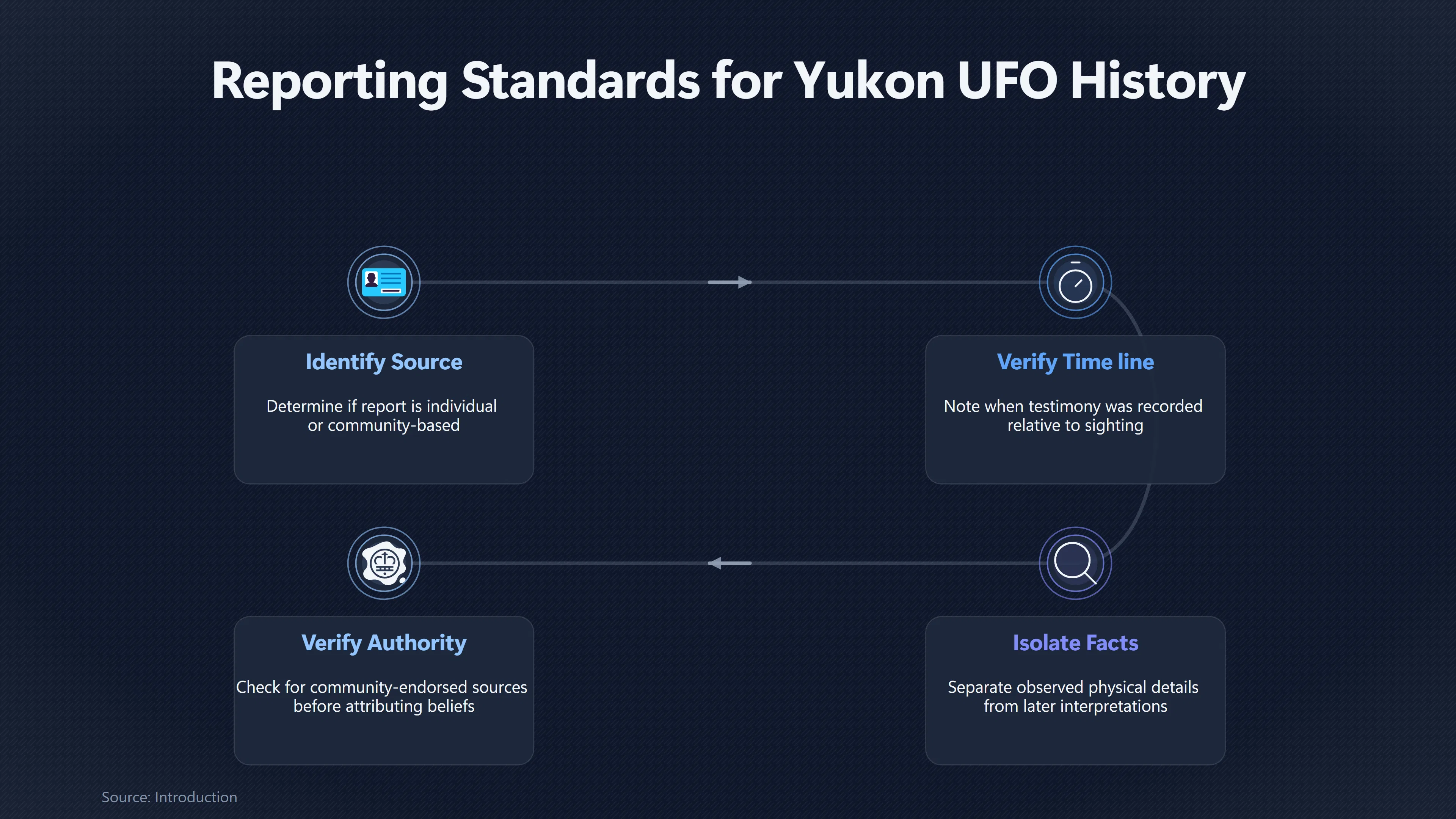
Within Yukon UFO history, a careful reporting standard helps readers understand both the strengths and limitations of the available evidence.
A responsible account should:
- Clearly identify whether the report comes from an individual witness, multiple witnesses or an official community source.
- State when testimony was recorded, particularly if recollections were collected years after the reported event.
- Separate observed facts from later interpretations.
- Avoid attributing collective cultural beliefs unless supported by community-endorsed sources.
- Consider ordinary explanations alongside unusual ones without dismissing sincere testimony.
- Acknowledge when evidence is insufficient to determine what was observed.
This approach neither discounts Indigenous witnesses nor grants their testimony automatic confirmation. Instead, it applies the same evidence-based standards while recognising the importance of cultural respect and accurate attribution.
What This Means for Yukon UFO History
The Yukon record contains relatively few well-documented cases involving remote Indigenous communities. That scarcity makes careful interpretation even more important.
The Old Crow reports remain historically significant because they broaden the territorial record beyond urban centres and aviation corridors. They also demonstrate how difficult it is to investigate observations made in isolated regions where contemporary documentation, photographs, radar information or official reports may be unavailable.
Their value therefore lies primarily in preserving eyewitness testimony rather than proving extraordinary phenomena. Presenting these accounts faithfully means acknowledging both the sincerity of the witnesses and the limits of the surviving evidence.
For readers studying Yukon UFO history, the most reliable approach is straightforward: evaluate each reported sighting on its own evidential merits, recognise that Indigenous witnesses deserve the same careful consideration as any other observers, and resist turning individual experiences into unsupported claims about an entire culture or community.
Amazon book picks
Further Reading
Books and field guides related to When Does Interpretation Become Cultural Projection?. Use these as the next step if you want deeper reading beyond the article.
Decolonizing Methodologies: Research and Indigenous Peoples
To the colonized, the term 'research' is conflated with European colonialism; the ways in which academic research has been implicated in...
Research Is Ceremony: Indigenous Research Methods
Indigenous researchers are knowledge seekers who work to progress Indigenous ways of being, knowing and doing in a modern and constantly...
The Seven Sins of Memory
Rating: 3.5/5 from 5 Google Books ratings
A New York Times Notable Book: A psychologist's "gripping and thought-provoking" look at how and why our brains sometimes fail us (Steven...

Braiding Sweetgrass: Indigenous Wisdom, Scientific Knowledge...
Rating: 4.6/5 from 13 Google Books ratings
First published 2013. Subjects: Botany, Ecology, Potawatomi Indians, Indian philosophy, Philosophy of nature.
eBay marketplace picks
Marketplace Samples
Live-tested eBay searches with available results related to this page.
Selected fromYukon map print oneBay.co.uk.
Endnotes
1.
Source: fnigc.ca
Title: The First Nations Principles of OCAP®
Link:https://fnigc.ca/ocap-training/
Source snippet
The First Nations Information Governance Centre...
2.
Source: fnigc.ca
Title: About FNIGC
Link:https://fnigc.ca/about-fnigc/
Source snippet
The First Nations Information Governance Centre...
3.
Source: canada.ca
Title: Yukon Sharing Circle What We Heard
Link:https://www.canada.ca/en/office-federal-ombudsperson-victims-crime/publications/specialreports-rapportsspeciaux/ysc-cpy.html
4.
Source: fnigc.ca
Link:https://fnigc.ca/
5.
Source: fnigc.ca
Title: Education and Training
Link:https://fnigc.ca/what-we-do/education-and-training/
6.
Source: fnigc.ca
Title: OCA P® Library
Link:https://fnigc.ca/ocap-library/
7.
Source: uphere.ca
Link:https://uphere.ca/community/old-crow
Additional References
8.
Source: tandfonline.com
Link:https://www.tandfonline.com/doi/abs/10.1080/02604027.2025.2592181
Source snippet
November 24, 2025 — FROM DESCRIPTION TO MEANING – EPISTEMOLOGICAL PROBLEMS OF SCIENTIFIC UAP RESEARCH AND ETHICS OF CONTACT Michael Bohla...
Published: November 24, 2025
9.
Source: vgfn.ca
Link:https://www.vgfn.ca/news-releases-and-statements/vuntut-gwitchin-first-nation-calls-for-meaningful-partnership-at-our-arctic-summit
Source snippet
March 3, 2026 — VUNTUT GWITCHIN FIRST NATION CALLS FOR MEANINGFUL PARTNERSHIP AT OUR ARCTIC SUMMIT March 3, 2026 Old Crow, Yukon On Febru...
Published: March 3, 2026
10.
Source: vgfn.ca
Title: Vuntut Gwitchin First Nation
Link:https://www.vgfn.ca/
Source snippet
July 10, 2026 — We, the Vuntut Gwitchin First Nation of the North Yukon, having boundless pride in our ancient cultural heritage and ance...
Published: July 10, 2026
11.
Source: youtube.com
Title: Thirty Witnesses Encounter The Biggest UFO Sighting Ever Reported
Link:https://www.youtube.com/watch?v=iDgDxav3d0E
Source snippet
UFO Phenomenon, Shamanic Initiations, Native American Wisdom & Altered State of Consciousness...
12.
Source: youtube.com
Title: Flying object downed in Yukon sparks conversations about arctic security
Link:https://www.youtube.com/watch?v=m6wwCW6lyBU
Source snippet
Thirty Witnesses Encounter The Biggest UFO Sighting Ever Reported...
13.
Source: youtube.com
Title: Yukon Paranormal, Episode 2- Fox Lake- UFOs in the Yukon
Link:https://www.youtube.com/watch?v=Rx5YprfueAQ
Source snippet
Flying object downed in Yukon sparks conversations about arctic security...
14.
Source: link.springer.com
Link:https://link.springer.com/chapter/10.1007/978-3-031-56806
Source snippet
First Nations Principles of OCAP® | Springer Nature LinkAugust 31, 2024 — ADVANCING FIRST NATIONS PRINCIPLES OF OCAP^{®} * Chapter * Open...
Published: August 31, 2024
15.
Source: ethics.gc.ca
Link:https://ethics.gc.ca/eng/tcps2-eptc2_2022_chapter9-chapitre9.html?wbdisable=false
Source snippet
KEY CONCEPTS AND DEFINITIONS Definitions of key concepts used in this chapter are provided to assist in applying the guidance in this Pol...
16.
Source: youtube.com
Link:https://www.youtube.com/watch?v=vLQlhQAvWeY
Source snippet
Native American (Navajo) UFO Encounters...
17.
Source: durham-repository.worktribe.com
Link:https://durham-repository.worktribe.com/output/4822613
Source snippet
Description to Meaning – Epistemological problems of scientific UAP research and ethics of contactNovember 24, 2025 — FROM DESCRIPTION TO...
Published: November 24, 2025