Within Why Unresolved
The Small Details That Decide a UFO Case
Without exact bearings, timings, reference points and weather data, analysts cannot reliably distinguish aircraft, meteors or atmospheric effects.
On this page
- Which measurements investigators need from witnesses
- Why photos and videos often fail to establish size or speed
- How incomplete times and locations block later checks
Page outline Jump by section
Introduction
Many unresolved UFO reports from the Northwest Territories remain unresolved for a simple reason: they lack the measurements needed to test ordinary explanations. A witness may sincerely describe a fast-moving light or unusual object, yet if the report omits the viewing direction, exact time, weather conditions, reference points or observing location, investigators cannot reliably compare it with aircraft movements, satellites, meteors, atmospheric effects or astronomical objects. In practice, an “unidentified” case often reflects missing evidence rather than an inexplicable phenomenon. This problem has been recognised in Canada’s recent review of unidentified aerial phenomena (UAP) reporting, which found that inconsistent and fragmented data collection severely limits meaningful scientific analysis.[Innovation Canada]ised-isde.canada.caInnovation CanadaManagement of Public Reporting of Unidentified Aerial Phenomena in CanadaJune 1, 2025…
In the Northwest Territories, these gaps are magnified by the region’s immense distances, sparse population and limited opportunities for rapid follow-up. Once the original observations have faded from memory, the measurements that might have distinguished an ordinary event from a genuinely unusual one are usually impossible to reconstruct.
Which measurements investigators need from witnesses
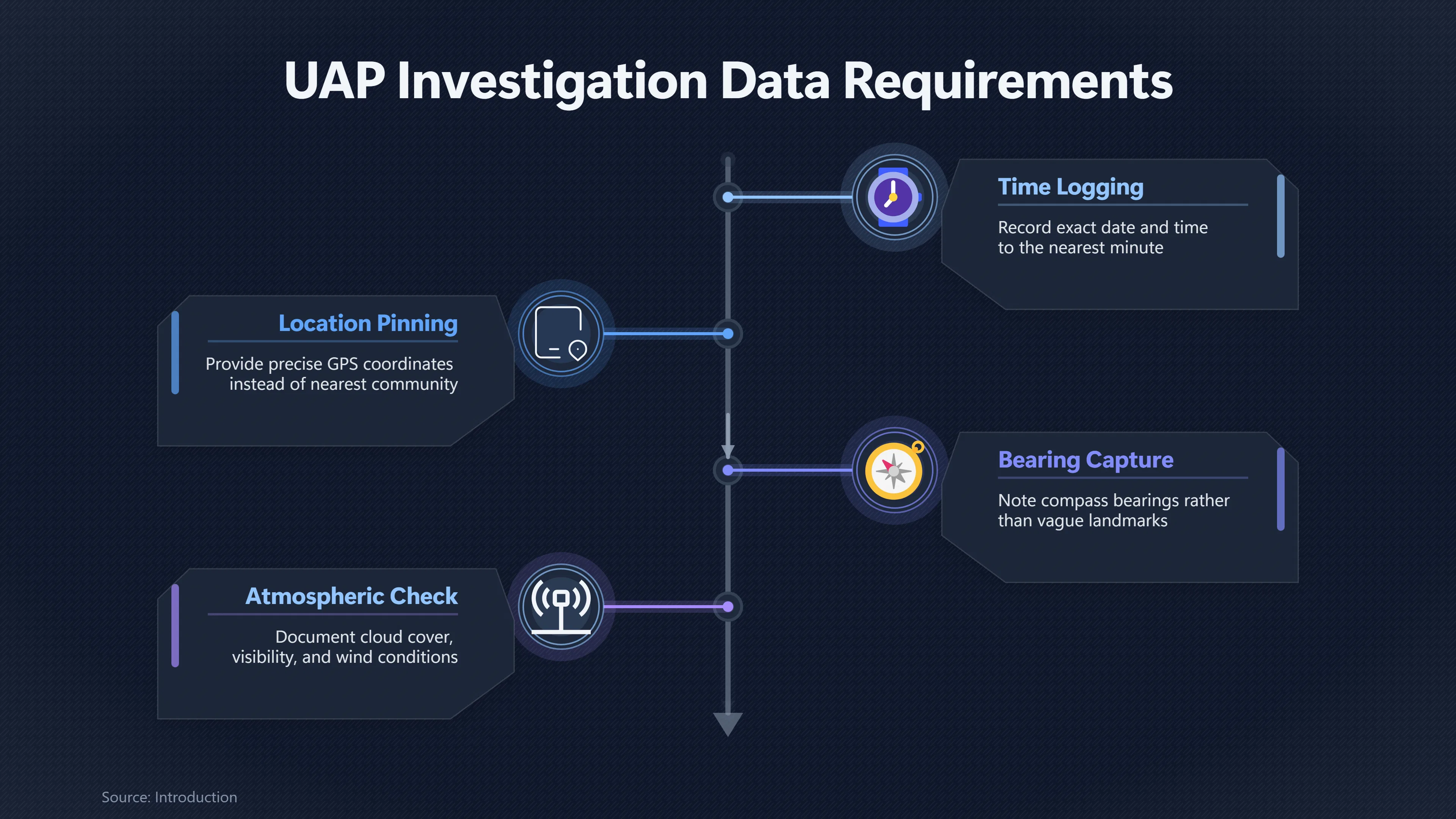
The most valuable information in a UFO report is often the least dramatic. Investigators generally need a combination of simple observational details before they can begin testing explanations.
The most useful measurements include:
- Exact date and time, preferably to the nearest minute, allowing comparisons with astronomical software, satellite passes, meteor records and flight activity.
- Observer location, ideally with GPS coordinates rather than only the nearest community.
- Viewing direction, using compass bearings instead of descriptions such as “towards the lake” or “over the hills”.
- Estimated elevation above the horizon, helping distinguish low-flying aircraft from high-altitude objects.
- Duration, preferably measured rather than guessed.
- Weather conditions, including cloud cover, visibility, wind, precipitation and the presence of ice crystals or haze.
- Reference objects, such as mountains, buildings, transmission towers or known stars, against which apparent movement can be judged.
- Multiple independent witnesses, especially if they observed from different locations.
These details allow investigators to ask practical questions rather than speculative ones. Was a commercial aircraft following an established route? Did a bright meteor pass through the region at the reported time? Was a satellite flare visible from that location? Could a temperature inversion have altered the apparent position of distant lights? Without basic measurements, many of these checks become impossible. Canadian government reviews have identified inconsistent reporting standards as one of the principal obstacles to meaningful investigation.[Innovation Canada]ised-isde.canada.caInnovation CanadaManagement of Public Reporting of Unidentified Aerial Phenomena in CanadaJune 1, 2025…
Why photos and videos often fail to establish size or speed
Modern smartphones have increased the number of images associated with unusual sightings, but they have not solved the underlying measurement problem.
A photograph records only a two-dimensional image. Unless the object’s distance is independently known, investigators cannot calculate its actual size. A nearby insect can appear enormous against the night sky, while a distant aircraft can resemble a small bright point.
The same limitation affects estimates of speed. Apparent rapid motion across the image may reflect:
- a nearby object crossing the field of view;
- camera movement;
- digital image stabilisation;
- zoom effects;
- changing perspective as the observer moves.
Without an independently measured distance, angular motion cannot be converted into actual velocity. Two objects producing identical images may differ enormously in size and speed simply because one is close while the other is many kilometres away.
This is particularly important in the Northwest Territories, where reports frequently involve isolated lights against dark skies with few visible landmarks. A video showing a bright point against empty sky rarely contains enough information to determine altitude, distance or acceleration with confidence. Modern scientific approaches to UAP research likewise emphasise calibrated observations with known timing, position and multiple sensors because isolated imagery usually cannot support reliable physical measurements.[arXiv]arxiv.orgA New Method to Derive an Empirical Lower Limit on the Mass Density of a UFODecember 9, 2024…
How incomplete times and locations block later checks
Many ordinary explanations depend on precise timing.
A reported sighting at 10:15 pm may coincide with a known satellite pass, while the same report at 10:45 pm may not. Likewise, meteor observing networks can often confirm a bright fireball only if the observation time is reasonably accurate.
When witnesses later remember only that something happened “late in the evening” or “after dark”, investigators lose the ability to compare the event against:
- aviation records;
- satellite predictions;
- astronomical software;
- meteor observations;
- weather observations;
- auroral activity;
- military or civil aviation logs where relevant.
The same applies to location. A report describing an object “north of Yellowknife” may cover hundreds of square kilometres. Even a small error in the observer’s position changes the apparent viewing angle, making trajectory reconstruction unreliable.
These missing measurements become even more significant in northern Canada because observers may be separated by vast distances. Two witnesses describing the “same light” may actually have observed entirely different objects if their positions and viewing directions are not carefully documented.
A Northwest Territories example of missing evidence
The 1960 Clan Lake incident illustrates how incomplete measurements can leave a case unresolved even after considerable investigation.
Witnesses reported hearing a loud aerial sound followed by what appeared to be an object entering the lake. Subsequent investigations examined the area, searched the lakebed and looked for radioactive material, but no object was recovered. Investigators considered several conventional possibilities, including meteorite debris and falling aerospace hardware.
Crucially, however, no complete physical dataset emerged. The proposed magnetometer survey—which might have detected buried metallic material beneath the lakebed—was never carried out because appropriate equipment and operators were unavailable. Without those additional measurements, neither a conventional explanation nor a more unusual interpretation could be conclusively confirmed or excluded.
The case therefore demonstrates an important principle in Northwest Territories UFO history: unresolved does not necessarily mean inexplicable. Sometimes it simply means that the decisive measurement was never obtained.
Why northern conditions make missing data even harder to replace
In many populated parts of Canada, investigators may be able to supplement incomplete witness accounts using nearby surveillance cameras, numerous independent observers or extensive transportation records.
The Northwest Territories rarely offers those advantages.
Many sightings occur:
- far from permanent weather stations;
- outside areas covered by public cameras;
- with only one or two witnesses;
- in locations requiring aircraft access;
- under rapidly changing atmospheric conditions.
By the time investigators receive a report, cloud conditions have changed, snow has covered tracks, and witnesses may struggle to reconstruct precise timings or directions from memory. Even highly credible observers cannot accurately recover measurements that were never recorded.
The result is that otherwise sincere reports remain permanently difficult to test.
What would make future northern reports more useful
Better data collection does not require specialised scientific equipment. Relatively simple observations can greatly improve the chances of identifying an unusual aerial event.
Witnesses who safely observe an unexpected object can improve the evidential value of their report by noting:
- the exact time from a phone or watch;
- their precise location;
- the compass direction of the object;
- nearby stars, planets or landmarks;
- estimated elevation above the horizon;
- weather and cloud conditions;
- whether the object changed brightness, colour or direction;
- whether other witnesses observed it independently.
These measurements rarely prove that an object was extraordinary. More often, they allow investigators to eliminate ordinary explanations with greater confidence—or identify one that would otherwise remain hidden.
For the Northwest Territories, where geography already limits rapid investigation, these seemingly small details often determine whether a sighting becomes a testable case or remains permanently unresolved. Canada’s recent review of UAP reporting concluded that improving the consistency and quality of collected observations is one of the most important steps towards more rigorous analysis, precisely because missing measurements prevent many reports from advancing beyond anecdotal accounts.[Innovation Canada]ised-isde.canada.caInnovation CanadaManagement of Public Reporting of Unidentified Aerial Phenomena in CanadaJune 1, 2025…
Amazon book picks
Further Reading
Books and field guides related to The Small Details That Decide a UFO Case. Use these as the next step if you want deeper reading beyond the article.
The UFO Experience: A Scientific Inquiry
Cited by the New York Review of Books as "the best brief for visitation," this classic study presents an analysis of UFO reports and conc...
UFOs: Generals, Pilots, and Government Officials Go on the Re...
NEW YORK TIMES BESTSELLER • Impeccably researched, this riveting journalistic investigation separates fact from fiction, and documents th...
The Report on Unidentified Flying Objects
Book Excerpt: ing can never be positively identified. It might have been a hallucination or it might have been some vehicle from outer sp...
The Demon-Haunted World
NEW YORK TIMES BESTSELLER • From the renowned astronomer and author of Cosmos comes a “powerful [and] stirring defense of informed ration...
eBay marketplace picks
Marketplace Samples
Live-tested eBay searches with available results related to this page.
Selected fromUFO poster oneBay.co.uk.

Current eBay listing
I Want To Believe UFO Poster Giclée Fine Art Heavyweight Print


Current eBay listing
VINTAGE UFO FLYING SAUCERS COMIC ADVERTISING A2 POSTER PRINT

Endnotes
1.
Source: ised-isde.canada.ca
Link:https://ised-isde.canada.ca/site/science/en/office-chief-science-advisor/sky-canada-project/management-public-reporting-unidentified-aerial-phenomena-canada
Source snippet
Innovation CanadaManagement of Public Reporting of Unidentified Aerial Phenomena in CanadaJune 1, 2025...
Published: June 1, 2025
2.
Source: arxiv.org
Link:https://arxiv.org/abs/2412.12142
Source snippet
A New Method to Derive an Empirical Lower Limit on the Mass Density of a UFODecember 9, 2024...
Published: December 9, 2024
3.
Source: ised-isde.canada.ca
Link:https://ised-isde.canada.ca/site/science/en/office-chief-science-advisor/sky-canada-project/preview-sky-canada-report-ocsa
Additional References
4.
Source: uapsightings.org
Title: canada 2025 uapsrs case no 249
Link:https://uapsightings.org/canada-2025-uapsrs-case-no-249/
Source snippet
249 - UAP Sightings Reporting SystemJuly 16, 2025 — CANADA, 2025: UAPSRS CASE NO. 249 CANADA, 2025: UAPSRS CASE NO. 249 Country | Canada...
Published: July 16, 2025
5.
Source: openskyprotocol.com
Title: Air Force cases Records linke
Link:https://www.openskyprotocol.com/
Source snippet
Open Sky — The UFO archive that investigates itselfApril 27, 2026 — 2026-04-27 14:21 UTC READ Ingestor-Prime · NASA UAP study addendum ·...
Published: April 27, 2026
6.
Source: science.gc.ca
Title: Sky Canada Project
Link:https://science.gc.ca/site/science/en/office-chief-science-advisor/sky-canada-project
Source snippet
December 3, 2025 — SKY CANADA PROJECT DISCLAIMER It should be noted that the Sky Canada Project is not intended to access and collect fir...
Published: December 3, 2025
7.
Source: youtube.com
Title: {#1}1. Canada Gets Serious About UFOs
Link:https://www.youtube.com/watch?v=QGf_HpSxhM8
Source snippet
The Canadian UAP Report Released (w/ Chris Rutkowski)...
8.
Source: youtube.com
Title: Did a UFO Crash at Clan Lake?
Link:https://www.youtube.com/watch?v=Q5kKcOBEvG8
Source snippet
Sky Canada Project Report Preview Chris Rutkowski Canada Gets Serious About UFOs - the Sky Canada Project Report Preview (with Chris Rutk...
9.
Source: youtube.com
Title: Document reveals first known Canadian UFO study in nearly 30 years
Link:https://www.youtube.com/watch?v=OGCggCRTh1c
Source snippet
The Summer of UFOs: Canada's 1975 Wave (with Chris Rutkowski)...
10.
Source: youtube.com
Title: The Canadian UAP Report Released (w/ Chris Rutkowski)
Link:https://www.youtube.com/watch?v=0Cy-nmLGlFY
Source snippet
Document reveals first known Canadian UFO study in nearly 30 years...
11.
Source: ufouap.net
Title: Speed ca
Link:https://www.ufouap.net/en/explainers/parallax-in-uap-videos
Source snippet
Parallax in UAP Videos: Why Objects Seem Fast | Global UFO ArchiveJuly 11, 2026 — Evidence / Updated 2026-07-11 / 7 min read PARALLAX IN...
Published: July 11, 2026
12.
Source: publications.gc.ca
Link:https://publications.gc.ca/pub?id=9.954480&sl=0
Source snippet
Management of public reporting of unidentified aerial phenomena in Canada: report of the Sky Canada Project.: Iu37-59/2025E-PDF - Govern...
13.
Source: bufora.org.uk
Link:https://www.bufora.org.uk/sightings/analysis-of-ufo-photographs