Within Sky Effects
Why a Planet Can Seem to Chase Your Car
Venus, Jupiter and bright stars can appear to hover, pace a moving car or drift when the night sky offers few visual reference points.
On this page
- Why distant lights barely shift against the windscreen
- How autokinesis creates apparent motion in darkness
- Clues that separate planets from nearby aircraft
Page outline Jump by section
Introduction
A bright light that seems to follow your car can be deeply unsettling, especially on a quiet road through rural Quebec where there are few buildings, streetlights or other visual landmarks. Yet one of the most common explanations is also one of the simplest: the light is an extremely distant planet, usually Venus or Jupiter, or occasionally a bright star. Because these objects are so far away, they change position against your windscreen far more slowly than nearby trees, hills and road signs. The result is a powerful visual illusion that makes a stationary celestial object appear to pace your vehicle.[NASA Science]science.nasa.govScience Identifying UFOs and UAPsNASA ScienceIdentifying UFOs and UAPs - NASA ScienceDecember 1, 2013…
This effect is especially relevant to long-duration reports from Quebec in which a bright, silent object appears to hover for many minutes, remains at roughly the same height above the horizon, or seems to “chase” a driver along country roads. Such descriptions often match well-understood astronomical and perceptual effects rather than the behaviour of a nearby aircraft.
Why distant lights barely shift against the windscreen
The key to the illusion is distance.
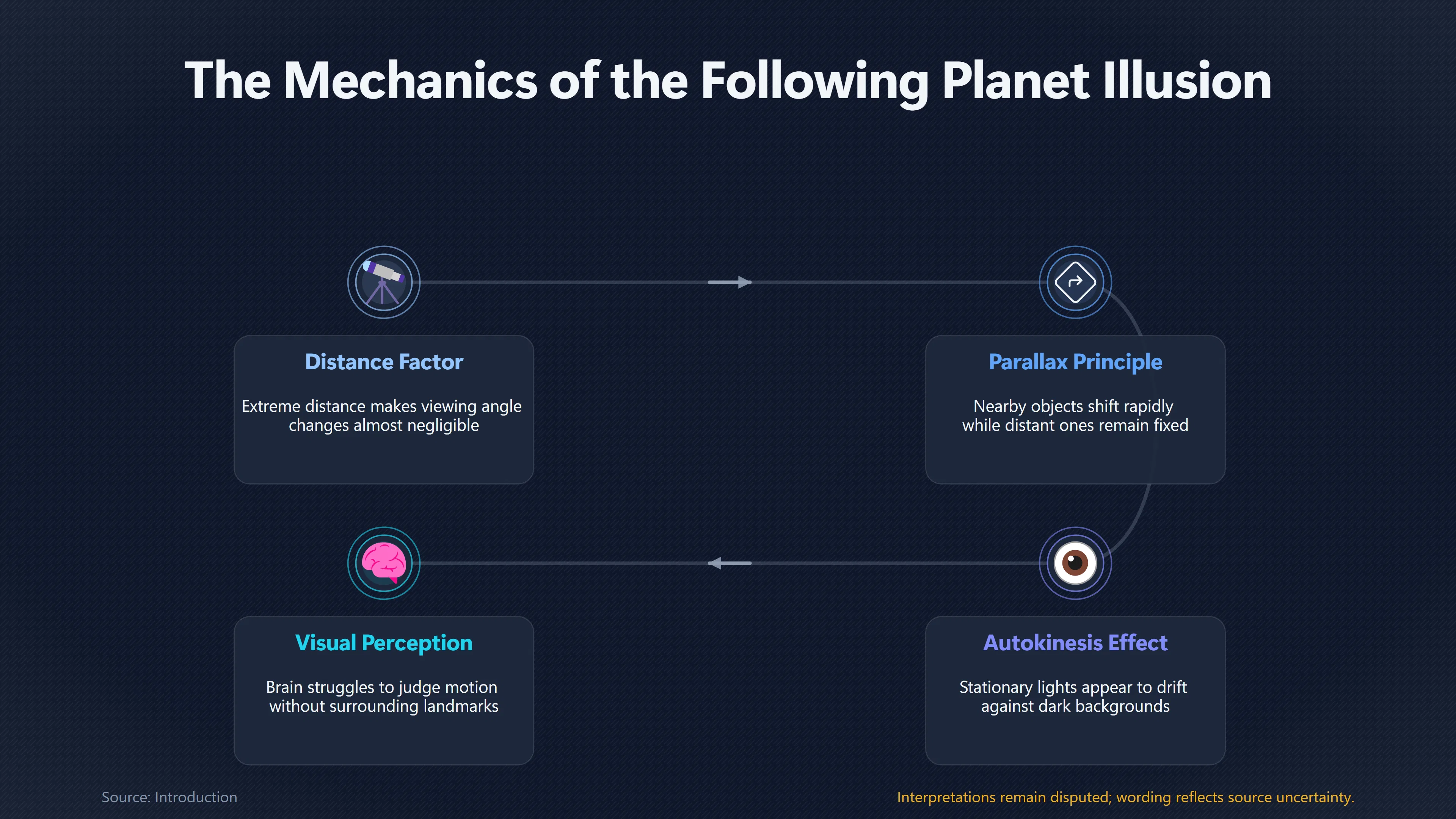
A road sign a few metres away sweeps rapidly across your field of view as you drive. A farmhouse several kilometres away moves much more slowly. A planet, however, is tens or hundreds of millions of kilometres from Earth. From the driver’s perspective, the change in viewing angle over a few kilometres of travel is almost negligible. The planet therefore appears to stay in nearly the same place relative to the windscreen while the foreground rushes past.[European Space Agency]esa.intEuropean Space Agency ESAEuropean Space AgencyESA - Parallax…
This is closely related to the principle of parallax. Nearby objects appear to shift dramatically as the observer moves, while extremely distant objects hardly shift at all. Astronomers use this same principle to measure stellar distances, but in everyday life it explains why mountains, the Moon and bright planets can seem almost fixed as a vehicle travels underneath them.[European Space Agency]esa.intEuropean Space Agency ESAEuropean Space AgencyESA - Parallax…
In Quebec, the illusion can be particularly convincing on:
- Long rural highways with unobstructed horizons.
- Winter roads where snow removes many visual reference points.
- Forested routes that briefly reveal a bright planet through gaps in the trees.
- Open farmland south of the St Lawrence Valley, where a low western or eastern horizon allows Venus or Jupiter to remain visible for extended periods.
None of these settings changes the planet’s position. They simply reduce the nearby visual cues that normally help the brain judge distance and motion.
How autokinesis creates apparent motion in darkness
Another illusion often reinforces the “following planet” effect: autokinesis.
Autokinesis is a well-documented perceptual phenomenon in which a small, stationary light viewed against a dark, featureless background appears to drift, wobble or zigzag. The movement occurs in the observer’s perception rather than in the light itself. Transport Canada includes autokinesis in its night-flying guidance because pilots can mistakenly interpret fixed lights or stars as moving aircraft when few visual references are available.[NASA Science]science.nasa.govScience Identifying UFOs and UAPsNASA ScienceIdentifying UFOs and UAPs - NASA ScienceDecember 1, 2013…
For drivers, the same conditions can occur on isolated Quebec roads after dark. A bright planet seen through the windscreen may appear to:
- drift sideways as the car slows or stops;
- make slight zigzag movements;
- appear to climb or descend;
- seem to react to changes in the vehicle’s direction.
These apparent movements are usually small, irregular and inconsistent. They differ from the deliberate manoeuvres expected from an aircraft flying nearby.
The illusion becomes stronger when someone concentrates on a single isolated light for a prolonged period. Without surrounding landmarks, the brain struggles to judge whether the light is actually stationary.
Why Venus is the usual suspect
Among all celestial objects, Venus generates the greatest number of mistaken UFO reports worldwide.
Several characteristics make it especially convincing:
- It is often the brightest object in the sky after the Moon.
- It commonly appears low above the horizon shortly after sunset or before sunrise.
- Atmospheric turbulence near the horizon can make it sparkle, flash different colours or appear to shimmer.
- It can remain visible for a long time without noticeably changing position.
NASA’s Night Sky Network specifically identifies Venus as one of the most frequently misidentified astronomical objects, with Jupiter, Sirius and occasionally Mercury also contributing to reports of mysterious lights.[NASA Science]science.nasa.govScience Identifying UFOs and UAPsNASA ScienceIdentifying UFOs and UAPs - NASA ScienceDecember 1, 2013…
These characteristics match many Quebec reports describing a brilliant, silent object that remains visible for twenty minutes or longer while apparently pacing a vehicle.
Clues that separate planets from nearby aircraft
Several practical clues help distinguish a distant planet from an aircraft or another nearby object.
A planet is more likely when the light:
- remains in roughly the same compass direction throughout the journey;
- produces no engine sound despite its apparent brightness;
- shows no flashing navigation lights;
- appears almost motionless over many minutes;
- is visible to other observers many kilometres away at the same time.
By contrast, a nearby aircraft usually changes bearing steadily, displays red, green or white navigation lights, produces engine noise under suitable conditions, and eventually passes overhead or disappears behind terrain.
Checking a planetarium app or astronomical chart afterwards is often enough to resolve the mystery. If Venus or Jupiter occupied the reported position at the relevant date and time, the apparent pursuit of the vehicle is readily explained without requiring an unknown object.[NASA Science]science.nasa.govScience Identifying UFOs and UAPsNASA ScienceIdentifying UFOs and UAPs - NASA ScienceDecember 1, 2013…
Why this matters for Quebec’s UFO history
Understanding the “following planet” illusion helps place many Quebec sightings into context without dismissing witnesses. Drivers genuinely experience a bright object maintaining its position relative to the vehicle, and the effect can be remarkably convincing.
In the broader history of unusual-light reports across Quebec, these cases illustrate an important distinction: a sincere observation is not necessarily an observation of an unusual object. Reports describing a bright, silent light that appears to keep pace with a moving car are often consistent with the combined effects of immense astronomical distance, parallax and autokinesis. Recognising these mechanisms helps separate sightings that are readily explained from those that remain genuinely unresolved because the available evidence is incomplete.
Amazon book picks
Further Reading
Books and field guides related to Why a Planet Can Seem to Chase Your Car. Use these as the next step if you want deeper reading beyond the article.
NightWatch: A Practical Guide to Viewing the Universe
A practical guide to viewing the universe.
The Backyard Astronomer's Guide
Discusses the practical aspects of stargazing, including how to choose appropriate equipment, contending with light pollution, taking suc...
The Demon-Haunted World: Science as a Candle in the Dark
NEW YORK TIMES BESTSELLER • From the renowned astronomer and author of Cosmos comes a “powerful [and] stirring defense of informed ration...
The Invisible Gorilla: How Our Intuitions Deceive Us
NEW YORK TIMES BESTSELLER • Our minds don’t work the way we think they do. Two renowned psychologists explain how and why our intuitions...
eBay marketplace picks
Marketplace Samples
Live-tested eBay searches with available results related to this page.
Selected fromplanet model oneBay.co.uk.
Endnotes
1.
Source: science.nasa.gov
Title: Science Identifying UFOs and UAPs
Link:https://science.nasa.gov/solar-system/skywatching/night-sky-network/identifying-ufos-and-uaps/
Source snippet
NASA ScienceIdentifying UFOs and UAPs - NASA ScienceDecember 1, 2013...
Published: December 1, 2013
2.
Source: space.com
Title: What Is Parallax?
Link:https://www.space.com/30417-parallax.html
Source snippet
What Is Parallax? - How Astronomers Measure Stellar Distance | Space...
3.
Source: starchild.gsfc.nasa.gov
Title: Star Child Parallax
Link:https://starchild.gsfc.nasa.gov/docs/StarChild/questions/parallax.html
4.
Source: science.nasa.gov
Title: hubble glossary
Link:https://science.nasa.gov/mission/hubble/multimedia/hubble-glossary/
Source snippet
SPHERE If cross-sections of a spherical surface and a parabolic surface were made by slicing each surface in half, these would be the sha...
5.
Source: science.nasa.gov
Link:https://science.nasa.gov/venus/venus-facts/
Source snippet
nasa.govVenus: Facts - NASA ScienceJune 23, 2026 — Explore This Section VENUS FACTS Venus is the second planet from the Sun, and our clos...
Published: June 23, 2026
6.
Source: nightsky.jpl.nasa.gov
Link:https://nightsky.jpl.nasa.gov/news/437/
Source snippet
MAY'S NIGHT SKY NOTES: HOW DO WE FIND EXOPLANETS? * 04/17/2025 This is an image of the star HR 8799 taken by Hubble's Nea...
7.
Source: nightsky.jpl.nasa.gov
Link:https://nightsky.jpl.nasa.gov/news/190/
Source snippet
Sky Network News & ResourcesMarch 1, 2023 — NEWS & RESOURCES Image: Spot the Morning and Evening Star: Observe Venus SPOT THE MORNING AND...
Published: March 1, 2023
8.
Source: nasa.gov
Link:https://www.nasa.gov/missions/aim/rocket-launches-can-create-night-shining-clouds-away-from-the-poles-nasas-aim-mission-reveals/
9.
Source: nasa.gov
Title: NAS A’s Parker Solar Probe Discovers Natural Radio Emission in Venus’ Atmosphere
Link:https://www.nasa.gov/science-research/heliophysics/nasas-parker-solar-probe-discovers-natural-radio-emission-in-venus-atmosphere/
10.
Source: nasa.gov
Title: 45 Years Ago: Mariner 10 flies by Venus
Link:https://www.nasa.gov/history/45-years-ago-mariner-10-flies-by-venus/
11.
Source: nightsky.jpl.nasa.gov
Link:https://nightsky.jpl.nasa.gov/news/344/
12.
Source: astrobiology.nasa.gov
Title: know thy star know thy planet
Link:https://astrobiology.nasa.gov/news/know-thy-star-know-thy-planet/
13.
Source: nasa.gov
Title: Mystery of Purple Lights in Sky Solved With Help From Citizen Scientists
Link:https://www.nasa.gov/science-research/heliophysics/mystery-of-purple-lights-in-sky-solved-with-help-from-citizen-scientists/
14.
Source: nasa.gov
Title: Scientists Study Atmosphere of Venus through Transit Images
Link:https://www.nasa.gov/solar-system/scientists-study-atmosphere-of-venus-through-transit-images/
15.
Source: esa.int
Title: European Space Agency ESA
Link:https://www.esa.int/Science_Exploration/Space_Science/Gaia/Parallax
Source snippet
European Space AgencyESA - Parallax...
16.
Source: weather.gov.hk
Link:https://www.weather.gov.hk/en/education/astronomy-and-time/astronomy/00405-apparent-motion-of-planets-explained.html
17.
Source: esa.int
Link:https://www.esa.int/Science_Exploration/Space_Science/Gaia/How_does_Gaia_study_the_Milky_Way
18.
Source: eg.bucknell.edu
Link:https://www.eg.bucknell.edu/physics/astronomy/astr101/specials/parallax.html
19.
Source: eg.bucknell.edu
Link:https://www.eg.bucknell.edu/physics/astronomy/as102-spr00/specials/parallax.html
Additional References
20.
Source: theweathernetwork.com
Title: What was that?
Link:https://www.theweathernetwork.com/en/news/science/space/rocket-from-weather-satellite-launch-causes-glowing-spiral-above-ontario-quebec?jwpseg=16000001%2C16010001%2C12011002%2C12024160%2C12032160%2C12032165%2C12032170%2C12032175%2C12032180%2C12032185%2C13011001%2C15010223%2C15010237%2C15010379%2C15010381%2C15030104%2C15030118%2C15030140%2C50191001%2C50201001%2C50511001%2C50512004%2C50522050%2C50522501%2C50522502%2C50531034%2C52020002%2C52020009%2C52020032%2C52020041%2C52030002%2C52040001%2C52040019%2C52040020%2C52040021%2C52040022%2C52040023%2C52040025%2C52040026%2C52040028%2C52040029%2C52040030%2C52040031%2C52040032%2C52040033%2C52040034%2C52040035%2C52040036%2C52040037
Source snippet
Strange spiral of light appears on the night of the Perseids - The Weather NetworkAugust 14, 2025 — WHAT WAS THAT? STRANGE SPIRAL OF LIGH...
Published: August 14, 2025
21.
Source: youtube.com
Title: The Moon Follows You? Here’s The Real Reason
Link:https://www.youtube.com/watch?v=qfXl9d2uCw0
Source snippet
Why Does The Moon Seem To Follow Us? | Parallax | BYJU'S Fun Facts...
22.
Source: youtube.com
Title: Jupiter and Venus ‘could be mistaken for UFOs’
Link:https://www.youtube.com/watch?v=P-ymwG9mDhE
Source snippet
Venus -the Morning Star and Evening Star...
23.
Source: youtube.com
Title: Stellar parallax and measuring distance
Link:https://www.youtube.com/watch?v=iwlMmJs1f5o
Source snippet
Jupiter and Venus 'could be mistaken for UFOs'...
24.
Source: youtube.com
Title: Why Does The Moon Seem To Follow Us? | Parallax | BYJU’S Fun Facts
Link:https://www.youtube.com/watch?v=hZfoAVF1zuA
Source snippet
Stellar parallax and measuring distance...
25.
Source: asc-csa.gc.ca
Title: Stargazing tips | Canadian Space Agency
Link:https://www.asc-csa.gc.ca/eng/astronomy/tips-tricks/stargazing-tips.asp
26.
Source: youtube.com
Title: Venus -the Morning Star and Evening Star
Link:https://www.youtube.com/watch?v=Ov3fYgGwy60