Within New Brunswick UFOs
What Do New Brunswick's Official UFO Files Prove?
RCMP and federal records confirm that several New Brunswick sightings were formally documented, but none produced decisive physical proof.
On this page
- How Canadian UFO reports entered federal files
- The Acadie Siding, Sheffield and Pont Landry cases
- What the surviving records can and cannot establish
Page outline Jump by section
Introduction
New Brunswick’s official UFO files prove that several unusual sightings were reported, recorded by the Royal Canadian Mounted Police and forwarded into Canada’s federal system. They do not prove that the witnesses saw extraterrestrial craft. The most revealing group dates from November 1978 to July 1979 and concerns named witnesses at Acadie Siding, Sheffield and Pont-Landry.
These files matter because they preserve more than rumours. They contain dates, locations, police correspondence, witness statements and, in one case, a check with Canadian Forces Base Chatham. Yet they also expose the limits of the process: there were no photographs, radar returns, instrument readings, recovered materials or measurements capable of establishing an object’s distance and speed. The reports are therefore genuine official records of unresolved observations, not official confirmation of extraordinary vehicles.[canada.ca]canada.caCanada's UFOs: The search for the unknown2 Mar 2026 —… UFOs. There are approximately 9,500 digitized documents in a variety of f…
How reports entered Canada’s federal files
Canada did not operate a direct equivalent of the United States Air Force’s Project Blue Book during the late 1970s. Instead, UFO paperwork accumulated through several institutions with different responsibilities, principally the Department of National Defence, Department of Transport, National Research Council and RCMP. Library and Archives Canada now describes a collection of roughly 15,000 pages, including about 9,500 digitised documents created between 1947 and the early 1980s. The material includes sighting reports, letters, memoranda, forms and instructions for handling reports.[Canada]canada.caCanada's UFOs: The search for the unknown2 Mar 2026 —… UFOs. There are approximately 9,500 digitized documents in a variety of f…
By the period covered here, the RCMP often acted as the local intake point. A witness contacted a detachment; an officer obtained a statement or completed a report; divisional headquarters then forwarded the material to the National Research Council’s Planetary Sciences Section. That route gave reports an official paper trail, but it did not necessarily produce a detailed scientific investigation. The federal government’s later Sky Canada review notes that historical files served several purposes, including documenting observations, trying to explain some cases and answering public enquiries. It does not describe every forwarded report as a full technical inquiry.[science.gc.ca]science.gc.caManagement of Public Reporting of Unidentified AerialLibrary and Archives Canada (LAC), which presently holds these records. LAC's collection of UFO documents, estimated at 15,000 pages, of…
This distinction is essential when reading the New Brunswick documents. A letter headed “Royal Canadian Mounted Police” or “National Research Council” proves that an agency handled the report. It does not mean that the agency endorsed the witness’s interpretation. In several files, phrases such as “forwarded for your information” or “concluded here” suggest an administrative endpoint rather than an open-ended investigation.[Internet Archive]archive.orgOpen source on archive.org.
The archive itself also has search limitations. Library and Archives Canada warns that searching by location or date produces only partial results because those details do not appear consistently in the surviving records. The three cases below should therefore be treated as a documented cluster, not necessarily a complete list of everything reported in New Brunswick during 1978–79.[Canada]canada.caCanada's UFOs: The search for the unknown2 Mar 2026 —… UFOs. There are approximately 9,500 digitized documents in a variety of f…
What happened at Acadie Siding?
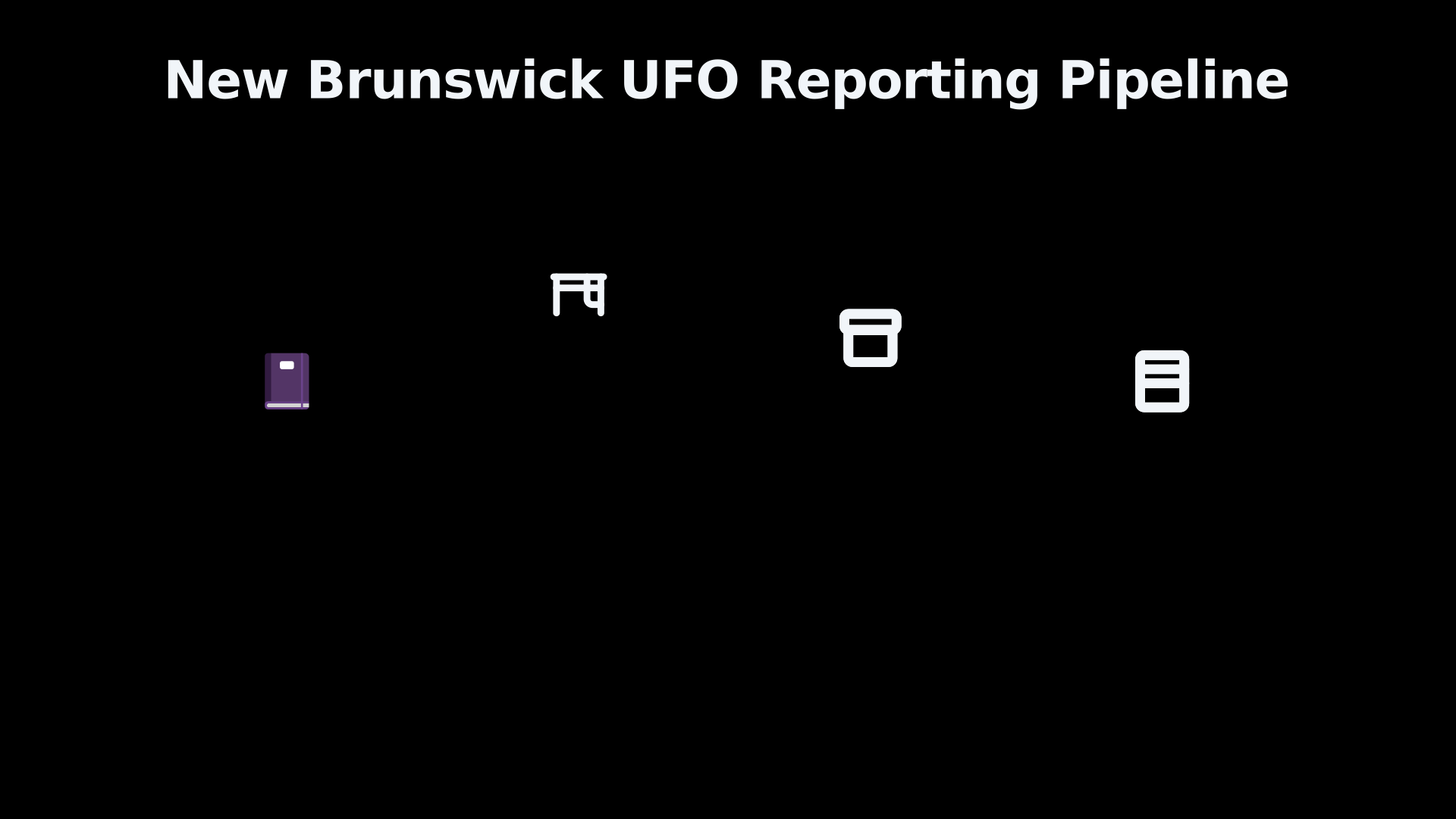
The Acadie Siding case began on 12 November 1978, when Mrs Edmond Robichaud contacted the Rogersville RCMP detachment. The police report placed the witnesses at her home, about three kilometres south of Rogersville, and identified her children Larry and Sandra as additional observers. The object was described as a distant circular light, flashing red and bluish-green, moving east and west before apparently rising and becoming star-like. The report estimated that it was roughly a mile away, while acknowledging that a precise description was impossible at that distance.[Internet Archive]archive.orgOpen source on archive.org.
The surviving paperwork contains an important aviation check. An officer contacted Lieutenant Dean at Canadian Forces Base Chatham. A Voodoo interceptor had flown in the area at approximately midnight, but the officer recorded that the aircraft’s lighting did not include the blue or green lights described by the family. This weakens a simple claim that the witnesses merely saw that particular aircraft, although it does not exclude another aircraft, a mistaken colour perception or a combination of moving and stationary lights.[Internet Archive]archive.orgOpen source on archive.org.
The witness statements also contain details that point towards a less exotic possibility. Mrs Robichaud said that the light eventually looked like a star and remained visible when she went to bed. Larry similarly stated that after it moved and gradually climbed, he thought it was a bright star. Those remarks do not prove an astronomical explanation, because the witnesses also reported lateral movement and coloured flashing. They do, however, raise the possibility that at least part of the observation involved a bright celestial object seen through atmospheric turbulence, perhaps combined with an aircraft seen earlier in the episode.[Internet Archive]archive.orgOpen source on archive.org.
The quality of the record is mixed. Its strengths are multiple named witnesses, statements obtained soon afterwards and a documented military enquiry. Its weaknesses are the absence of a measured bearing, elevation, angular size, reliable distance, photographs or independent tracking. The written times are also difficult to reconcile perfectly across the report and statements, a reminder that the digitised copy and its optical text transcription contain typographical and scanning errors. The case is best classified as formally documented but inadequately measured, with plausible conventional explanations left unresolved.
Why the Sheffield report looks astronomical
On 20 January 1979, Murray Douglas Patrick Bulmer reported seeing a bright object at about 4.15 am, initially from the Oromocto Bridge and later from his home at Sheffield in Sunbury County. Five other people at the house were said to have seen it as well. The sky was clear and star-filled, and the light remained visible for roughly three hours, until about 7.15 am.[Internet Archive]archive.orgOpen source on archive.org.
The object was described as brighter than surrounding stars, bluish-white and variable in intensity. To the unaided eye it appeared oval; through binoculars, witnesses thought it resembled two adjacent spheres. It made no sound and moved only slightly south over the three-hour period. Although the report placed it visually about 100 feet above the treetops, that estimate was based on its apparent position against the landscape, not a measured range. Without knowing its distance, the record cannot establish its actual altitude or size.[Internet Archive]archive.orgOpen source on archive.org.
These features make a bright astronomical object a strong possibility. Long duration, slow apparent movement, silence, visibility in a clear sky and changing brightness are all compatible with a planet or bright star. Atmospheric disturbance near the horizon can make a point source flicker, change colour or appear to alter shape, while binoculars that are out of focus or affected by hand movement can turn one bright point into distorted or doubled images. That is an interpretation rather than a conclusion preserved in the RCMP file, because the surviving report does not include a recorded compass direction or an astronomical comparison precise enough to identify the object retrospectively.
The presence of six observers adds confidence that a bright light was genuinely visible, but it does not establish that the light was a nearby craft. People standing together normally share the same viewing angle, environmental conditions and conversational expectations. Multiple witnesses therefore strengthen the reality of the observation while doing much less to establish its nature.
Compared with the other two reports, Sheffield is the clearest example of why “unidentified” can result from missing information rather than extraordinary behaviour. The object did not perform a documented rapid acceleration, approach the witnesses or interact with the environment. The report ended after recording the descriptions and was forwarded by the Fredericton RCMP detachment to the National Research Council. No surviving conclusion, radar corroboration or physical evidence accompanies it.[Internet Archive]archive.orgOpen source on archive.org.
What makes the Pont-Landry account different?
Roger Brideau’s report concerns an observation at about 2.20 am on 5 July 1979 while he was driving from the Tracadie area towards Bathurst. His statement described a very large red light that initially resembled a sunset or a building on fire. As he drove, it seemed to remain ahead of him above the telephone poles, disappearing and reappearing before eventually appearing stationary in the distance. He estimated that the closest-looking phase placed it only about 15 to 20 feet above the poles, although again this was a visual estimate without a known distance.[Internet Archive]archive.orgOpen source on archive.org.
Brideau described the object as intensely red and, when stopped, shaped like the popular image of a flying saucer, with a raised portion on top. He heard no sound and said the clearest stationary view lasted at least five or six minutes. The constable noted that Brideau was a non-drinker and considered him stable and reliable. Divisional correspondence repeated that assessment before forwarding the statement to the National Research Council.[Internet Archive]archive.orgOpen source on archive.org.
That credibility note is significant but easy to overread. It indicates that the officer had no obvious reason to suspect intoxication or deliberate fabrication. It does not validate the witness’s estimates of size, altitude or motion. A sincere observer can misjudge a distant light at night, especially while moving along a road without fixed distance cues.
The report contains a classic perceptual complication sometimes called the autokinetic or vehicle-following effect. A distant stationary light can appear to keep pace with a moving observer because its direction changes very little relative to the road and horizon. Telephone poles, hills and bends can make it seem to move, stop or reappear. A low astronomical object, distant aircraft, tower light or other remote source can therefore appear much closer than it really is. The file lacks the compass bearings, route-by-route timings, weather detail and independent observation needed to test those possibilities.
Brideau mentioned that another person had reportedly seen something similar the previous week, but the surviving section does not provide a full corroborating statement from that individual. Nor does it contain a photograph, ground trace, aircraft report or radar record. The RCMP detachment marked the matter concluded after obtaining Brideau’s testimony. Pont-Landry is consequently the most vivid of the three accounts, but not the strongest evidentially.[Internet Archive]archive.orgOpen source on archive.org.

What the files establish — and what they do not
Taken together, the Acadie Siding, Sheffield and Pont-Landry records establish several points about New Brunswick’s UFO history.
- People made identifiable reports. These were not merely anonymous stories collected decades later. The files preserve named witnesses, dates, communities and statements taken by police.
- The RCMP followed an established reporting route. Local detachments gathered information and sent it through “J” Division headquarters in Fredericton to the National Research Council.
- At least one conventional explanation was checked. In the Acadie Siding case, the RCMP contacted CFB Chatham about a Voodoo aircraft operating in the area.
- The cases remained evidentially incomplete. None includes decisive photographs, radar data, instrument readings, physical effects or accurately reconstructed trajectories.
- Official attention varied in depth. The records show documentation and forwarding, but little evidence of prolonged field investigation or a final scientific determination.[archive.org]archive.orgOpen source on archive.org.
The documents also show why witness credibility and object identification must be kept separate. A person can be honest, sober and regarded as reliable while still misidentifying a planet, aircraft or distant light. Conversely, the absence of a complete explanation does not mean nothing unusual was observed. It means the surviving data are insufficient to discriminate confidently among possibilities.
Later archival access strengthens the historical claim that these reports occurred and were processed by Canadian institutions. It weakens more expansive versions of the stories that imply secret confirmation, recovered technology or proof of alien visitation. The surviving paperwork is comparatively ordinary: statements, forms and correspondence moving from a police detachment to an Ottawa office. Its value lies precisely in that ordinariness. It shows what Canada’s UFO-reporting machinery actually did when New Brunswick residents called the authorities.
Do the official files prove anything extraordinary?
No decisive extraordinary event emerges from the 1978–79 records. Acadie Siding has multiple witnesses and a useful military check, but the light ultimately appeared star-like and was never instrumentally tracked. Sheffield’s three-hour, slowly shifting object strongly invites an astronomical explanation, although the missing direction prevents a firm identification. Pont-Landry contains a sincere and striking driving account, but its estimates depend heavily on night-time depth perception and apparent motion.
The fairest verdict is that all three are unresolved within their surviving files, but they are not equally mysterious. Sheffield appears plausibly astronomical; Acadie Siding may involve an aircraft, a celestial object or both; Pont-Landry remains too poorly constrained to identify. “Unresolved” here means that the available paperwork does not settle the matter. It should not be treated as a positive category of exotic craft.
For New Brunswick, the main historical significance is therefore institutional rather than extraterrestrial. The reports demonstrate that residents’ accounts could pass from rural RCMP detachments to federal scientific files, leaving a record that can now be examined in detail. What those records preserve is evidence of reporting, observation and official administration — not decisive physical proof of what was in the sky.
Amazon book picks
Further Reading
Books and field guides related to What Do New Brunswick's Official UFO Files Prove?. Use these as the next step if you want deeper reading beyond the article.
The UFO Experience: A Scientific Inquiry
Cited by the New York Review of Books as "the best brief for visitation," this classic study presents an analysis of UFO reports and conc...
UFOs: Generals, Pilots, and Government Officials Go on the Re...
NEW YORK TIMES BESTSELLER • Impeccably researched, this riveting journalistic investigation separates fact from fiction, and documents th...
The Demon-Haunted World
NEW YORK TIMES BESTSELLER • From the renowned astronomer and author of Cosmos comes a “powerful [and] stirring defense of informed ration...

The Canadian Encyclopedia
First published 1985. Subjects: Encyclopedias and dictionaries.
eBay marketplace picks
Marketplace Samples
Live-tested eBay searches with available results related to this page.
Selected fromUFO poster oneBay.co.uk.

Current eBay listing
I Want To Believe UFO Poster Giclée Fine Art Heavyweight Print

Current eBay listing
VINTAGE UFO FLYING SAUCERS COMIC ADVERTISING A2 POSTER PRINT

Endnotes
1.
Source: canada.ca
Link:https://www.canada.ca/en/library-archives/collection/research-help/science-technology/ufos.html
Source snippet
Canada's UFOs: The search for the unknown2 Mar 2026 —... UFOs. There are approximately 9,500 digitized documents in a variety of f...
2.
Source: science.gc.ca
Title: Management of Public Reporting of Unidentified Aerial
Link:https://science.gc.ca/site/science/en/office-chief-science-advisor/sky-canada-project/management-public-reporting-unidentified-aerial-phenomena-canada
Source snippet
Library and Archives Canada (LAC), which presently holds these records. LAC's collection of UFO documents, estimated at 15,000 pages, of...
3.
Source: archive.org
Link:https://archive.org/stream/CanadaUFO/Canada%20-%20FOIA%20Part%2014%20-%20Pages%203901-4200_djvu.txt
4.
Source: archive.org
Title: Full text of “Sessional papers of the Dominion of Canada
Link:https://archive.org/stream/n06sessionalpaper59canauoft/n06sessionalpaper59canauoft_djvu.txt
Source snippet
Acadie Siding Ada Adair Adams Adams Lake Adderley Addington Forks Adelard (closed 11-7-21) Aden Admaston Admiral Rock Advance Af ton Afto...
5.
Source: ised-isde.canada.ca
Link:https://ised-isde.canada.ca/site/science/sites/default/files/documents/Sky-Canada-Preview-January-2025.pdf
6.
Source: ised-isde.canada.ca
Title: sky canada project
Link:https://ised-isde.canada.ca/site/science/en/office-chief-science-advisor/sky-canada-project
7.
Source: youtube.com
Title: How Canada tracks UFOs
Link:https://www.youtube.com/watch?v=hWistYd7Vng
Source snippet
Canada's UFO Files Declassified with Chris Rutkowski...
8.
Source: youtube.com
Title: Canada’s UFO Files Declassified with Chris Rutkowski
Link:https://www.youtube.com/watch?v=VNTh1JMO8bc
Source snippet
Chris Rutkowski launch of Canada's UFOs: Declassified...
9.
Source: documents.theblackvault.com
Title: Canada FOIA Part 14 Pages 3901 4200
Link:https://documents.theblackvault.com/documents/ufos/canada/Canada%20-%20FOIA%20Part%2014%20-%20Pages%203901-4200.pdf
Additional References
10.
Source: huggingface.co
Link:https://huggingface.co/microsoft/cocolm-base/resolve/main/dict.txt?download=true
Source snippet
736 kB1 government 1 own 1 state ・ 14 1 led 1 clear 1 isn 1 13 1 father 1 officials 1 son 1 black 1 St 1 problem 1 security 1 talk 1 proj...
11.
Source: publications.gc.ca
Link:https://publications.gc.ca/site/eng/9.954480/publication.html
Source snippet
orical federal government practices for UAP reporting...
12.
Source: youtube.com
Title: Book explores UFOs in Canada
Link:https://www.youtube.com/watch?v=eMUmy3Ubcbw
Source snippet
Canadian UFO files Library Archives Canada official reports Book explores UFOs in Canada CTV News...
13.
Source: youtube.com
Title: Chris Rutkowski launch of Canada’s UFOs: Declassified
Link:https://www.youtube.com/watch?v=bcSI4rw0M4Q
Source snippet
UFOs Part 1 — Canadian Reports, Research & Disclosure...
14.
Source: facebook.com
Link:https://www.facebook.com/604Now/posts/a-major-ufo-conference-is-coming-to-canada-for-the-first-time-this-summer-bringi/1727744582690384/
15.
Source: facebook.com
Link:https://www.facebook.com/groups/tbsalltalk/posts/1337625533570184/
16.
Source: facebook.com
Link:https://www.facebook.com/LibraryArchives/posts/we-may-not-be-area-51-but-did-you-know-that-we-hold-a-vast-collection-of-ufo-fil/588151890149717/
17.
Source: instagram.com
Link:https://www.instagram.com/p/DWY4H01kbNF/
18.
Source: login.blockchain.com
Link:https://login.blockchain.com/legacy-pages/js/mnemonic/mnemonic_words_v3.txt
19.
Source: mit.edu
Link:https://www.mit.edu/~ecprice/wordlist.100000