Within Newfoundland UFOs
What Do Canada's UFO Files Actually Prove?
Canadian agencies preserved thousands of UFO documents, but a formal file records a report rather than confirming the witness's interpretation.
On this page
- Which Canadian agencies collected reports
- How police, transport and defence records were created
- The difference between documented and verified
Page outline Jump by section
Introduction
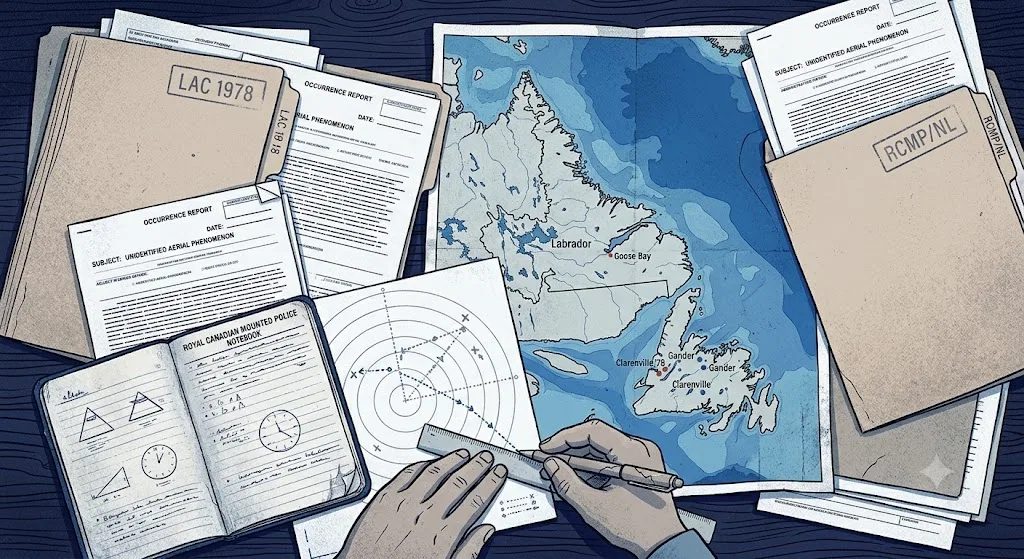
Canada’s official UFO files prove that people reported unusual things in the sky and that government employees sometimes recorded, circulated or investigated those reports. They do not prove that the witnesses correctly identified extraterrestrial craft. This distinction is especially important in Newfoundland and Labrador, where reports could pass through the Royal Canadian Mounted Police (RCMP), aviation authorities, defence organisations and, in some Cold War cases, United States military channels.
The surviving records are valuable because they preserve dates, locations, witness statements and the responses of officials. They can strengthen confidence that an incident was genuinely reported, as happened after the widely witnessed Clarenville sighting of 26 October 1978. Yet the evidential quality varies sharply. Some files contain little more than a message or summary; others include interviews, weather checks, radar information or correspondence with scientific advisers. “Unidentified” usually means that the available information did not support a firm explanation—not that an extraordinary vehicle was established.[canada.ca]canada.cas UFOs: The search for the unknownCanada's UFOs: The search for the unknown - Canada.ca…
Which Canadian agencies collected reports?
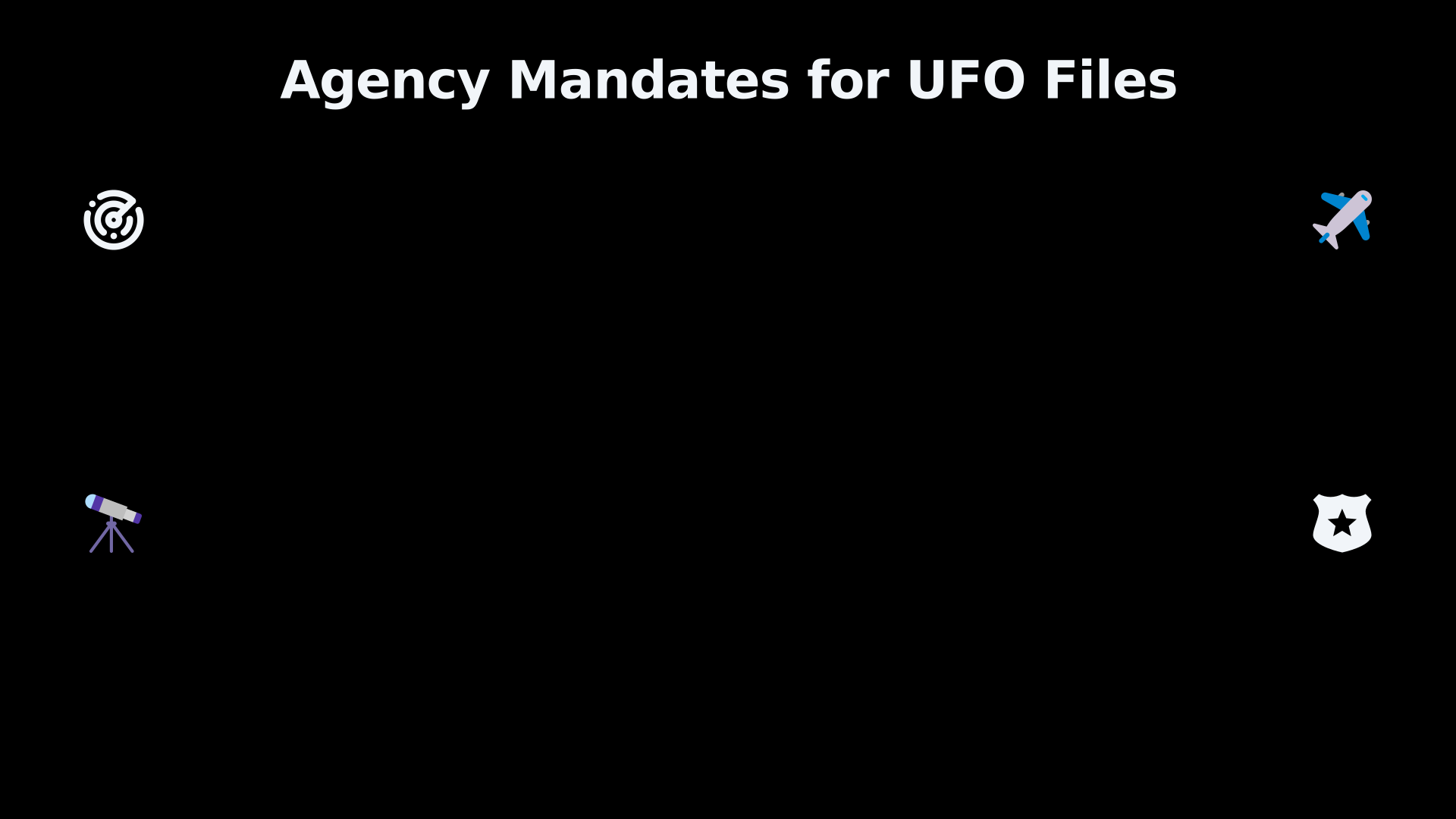
Library and Archives Canada’s historical UFO collection brings together records from four main federal bodies: the Department of National Defence, the Department of Transport, the National Research Council of Canada and the RCMP. The documents accumulated between 1947 and the early 1980s include reports, correspondence, memoranda, procedures and reporting forms. About 9,500 documents have been digitised, although the wider collection has been estimated at roughly 15,000 pages.[Canada]canada.cas UFOs: The search for the unknownCanada's UFOs: The search for the unknown - Canada.ca…
This was never one continuous Canadian equivalent of the United States Air Force’s Project Blue Book. Responsibility shifted according to institutional priorities.
The Department of National Defence was chiefly concerned with unidentified objects as possible security or air-defence problems. In 1952, the Defence Research Board formed Project Second Storey, a committee involving military and scientific representatives. It developed a standard reporting form but did not itself conduct a comprehensive investigation of individual sightings. After six meetings, it concluded that UFOs presented neither a security threat nor sufficient scientific interest to justify continued military investigation.[ised-isde.canada.ca]ised-isde.canada.caManagement of Public Reporting of Unidentified Aerial Phenomena in Canada *These units file an Aviation Occurrence Report (AOR) with NAV CANADA, which subsequently gets sent to Transport Canada’s CADORS team for…
The Department of Transport encountered reports through its responsibility for civil aviation. It also briefly supported engineer Wilbert Smith’s Project Magnet, which explored highly speculative ideas about propulsion and attempted to determine whether UFO reports represented a genuine physical phenomenon. The department ended the project in 1954 after Smith failed to persuade colleagues of its value. Its surviving papers are therefore evidence of an official experiment and bureaucratic debate, not confirmation that Smith’s theories were correct.[ised-isde.canada.ca]ised-isde.canada.caManagement of Public Reporting of Unidentified Aerial Phenomena in Canada *These units file an Aviation Occurrence Report (AOR) with NAV CANADA, which subsequently gets sent to Transport Canada’s CADORS team for…
The National Research Council became the principal federal recipient of public UFO reports in 1967. Its astronomer Peter Millman and his colleagues considered familiar explanations such as meteors, planets, stars and optical effects. Most reports were placed in a file known as “Non-Meteoric Sightings”. The name was an administrative category: it did not mean that every entry had been proved anomalous. The council stopped collecting reports in 1995, after which the material was transferred to the national archives.[ised-isde.canada.ca]ised-isde.canada.caManagement of Public Reporting of Unidentified Aerial Phenomena in Canada *These units file an Aviation Occurrence Report (AOR) with NAV CANADA, which subsequently gets sent to Transport Canada’s CADORS team for…
The RCMP received reports because it policed large rural and remote areas, including much of Newfoundland and Labrador. An officer might attend a scene, interview witnesses, contact an airport or record an occurrence. The police purpose, however, was normally to assess public safety, possible criminal activity or an aviation issue—not to determine whether alien technology was present. Canada’s 2025 Sky Canada review found that the RCMP still had no dedicated UFO classification or reporting policy. Calls might be filed under broad headings such as “suspicious vehicle” or a non-criminal Aeronautics Act occurrence, making them difficult to retrieve systematically.[ised-isde.canada.ca]ised-isde.canada.caManagement of Public Reporting of Unidentified Aerial Phenomena in Canada *These units file an Aviation Occurrence Report (AOR) with NAV CANADA, which subsequently gets sent to Transport Canada’s CADORS team for…
How a Newfoundland and Labrador report became a file
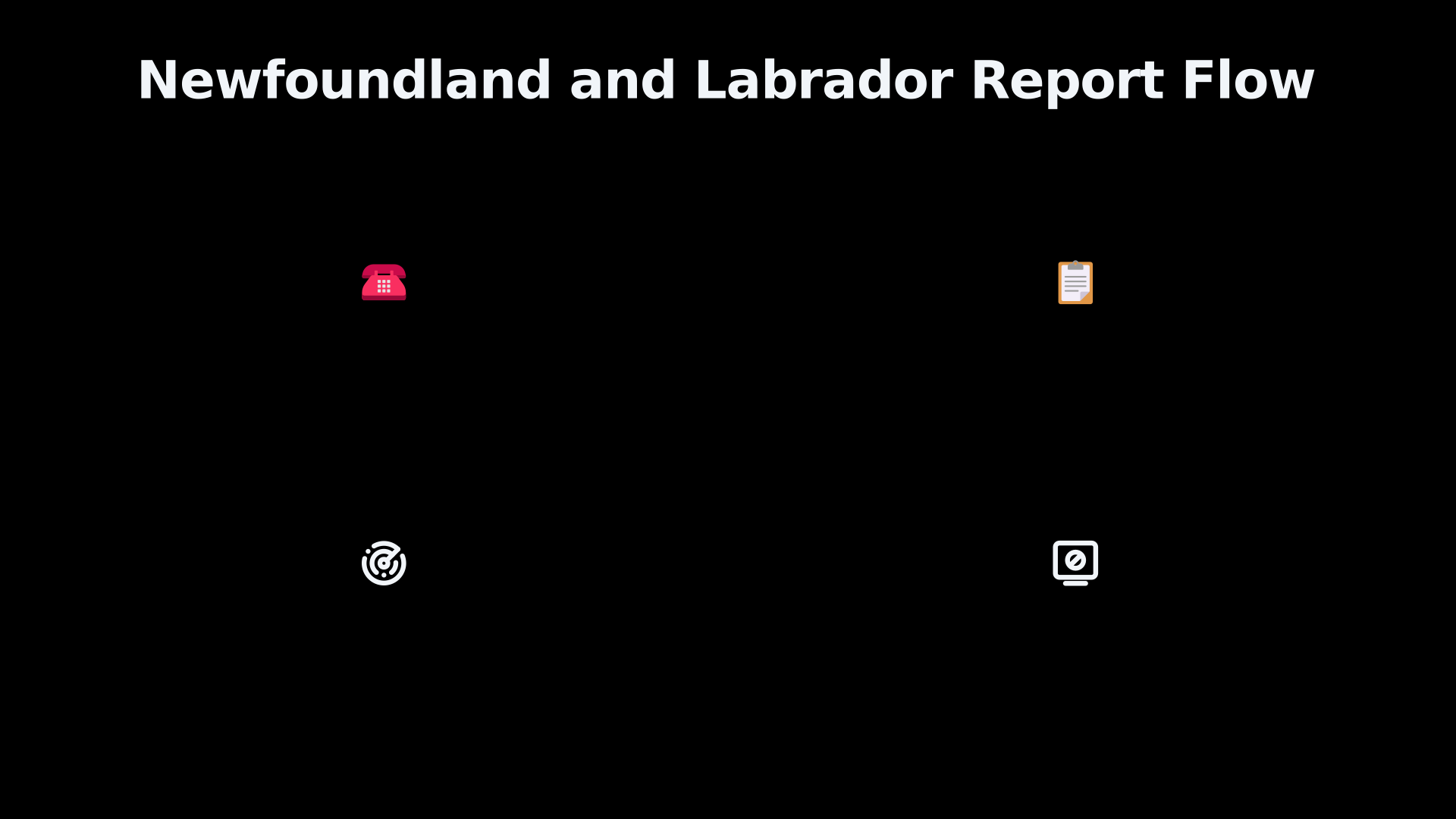
An official file was usually created because an agency had been contacted, not because officials had accepted the witness’s interpretation. In Newfoundland and Labrador, the route depended on who observed the event and what possible risk it presented.
A member of the public might telephone an RCMP detachment. A pilot would normally report an observation to an air traffic control tower, flight service station or another air-traffic unit. That unit could prepare an Aviation Occurrence Report for NAV CANADA, which would then be sent to Transport Canada’s Civil Aviation Daily Occurrence Reporting System, known as CADORS. Military personnel or radar operators could report through defence or NORAD chains when the observation appeared relevant to airspace security.[ised-isde.canada.ca]ised-isde.canada.caManagement of Public Reporting of Unidentified Aerial Phenomena in Canada *These units file an Aviation Occurrence Report (AOR) with NAV CANADA, which subsequently gets sent to Transport Canada’s CADORS team for…
Officials generally began with practical questions:
- Was an aircraft missing, in distress or operating without authorisation?
- Did radar or air-traffic records show known traffic?
- Could the object have been a balloon, drone, meteor, satellite or aircraft?
- Were the direction, elevation and duration recorded accurately?
- Did several witnesses observe the same thing independently?
- Was there a photograph, radar return or other instrument reading?
- Did the report indicate a criminal, safety or national-security concern?
The answers determined how far the matter went. A police officer might make local enquiries but stop once no danger or offence was apparent. Transport officials might retain the account as an aviation occurrence without conducting a scientific identification study. Defence organisations were more likely to act when an object might represent an aircraft, missile, surveillance platform or airspace intrusion.
This mandate-based approach helps explain why some famous provincial stories generated official paperwork but no definitive conclusion. The Clarenville case entered the historical record because residents contacted police and RCMP Constable James Blackwood attended, becoming a direct witness himself. Canada’s Sky Canada report now lists the 1978 incident among the country’s notable historical cases. That confirms its standing as a documented event involving an identified officer; it does not establish what the light or object actually was.[ised-isde.canada.ca]ised-isde.canada.caManagement of Public Reporting of Unidentified Aerial Phenomena in Canada *These units file an Aviation Occurrence Report (AOR) with NAV CANADA, which subsequently gets sent to Transport Canada’s CADORS team for…
What did officials actually assess?
Canadian organisations were not all trying to answer the same question. Their assessments reflected their legal and operational responsibilities.
For the RCMP, the first question was often whether anything required a police response. An officer’s presence could improve a report by fixing the time, recording several accounts and reducing the possibility that the entire story was fabricated later. Even so, police training and honesty do not automatically supply accurate estimates of altitude, size or distance at night.
For transport authorities, the central issue was aviation safety. CADORS collects preliminary information about occurrences involving Canadian aircraft, Canadian airports and airspace for which Canada has accepted responsibility. Transport Canada explicitly warns that these entries are preliminary, unsubstantiated and subject to change. A CADORS description containing the term “UFO” may refer to a drone, balloon, meteor, bird, weather phenomenon or another object that was merely unidentified at the time of reporting.[Transport Canada]tc.canada.caTransport Canada4. High Altitude Object IncidentsTransport Canada4. High Altitude Object Incidents
For defence organisations, the relevant question was whether the observation might be a threat. This is particularly important around Goose Bay, which had major Cold War air-defence and military functions and was used by both Canadian and American forces. A report from Labrador could therefore appear in a United States intelligence or Project Blue Book file. That does not convert the event into an American incident, nor does American classification make it more extraordinary. It reflects the shared defence arrangements and cross-border military presence of the period.
Project Blue Book records provide a useful comparison because the programme’s case files included witness reports, official correspondence, newspaper material and analyses of photographs or physical claims. The United States Air Force ultimately said it had found no evidence that its unidentified cases represented a national-security threat, technology beyond contemporary scientific knowledge or extraterrestrial vehicles. Those conclusions remain disputed by some UFO researchers, but they demonstrate that an archive may preserve unresolved cases while the investigating institution rejects the larger extraterrestrial interpretation.[National Archives]archives.govNational ArchivesPublic Interest in UFOs Persists 50 Years After Project Blue…Dec 5, 2019 — Each case file relates to one sighting or…
Why “unidentified” was not a single verdict
Official files commonly blur several different outcomes that readers should keep separate.
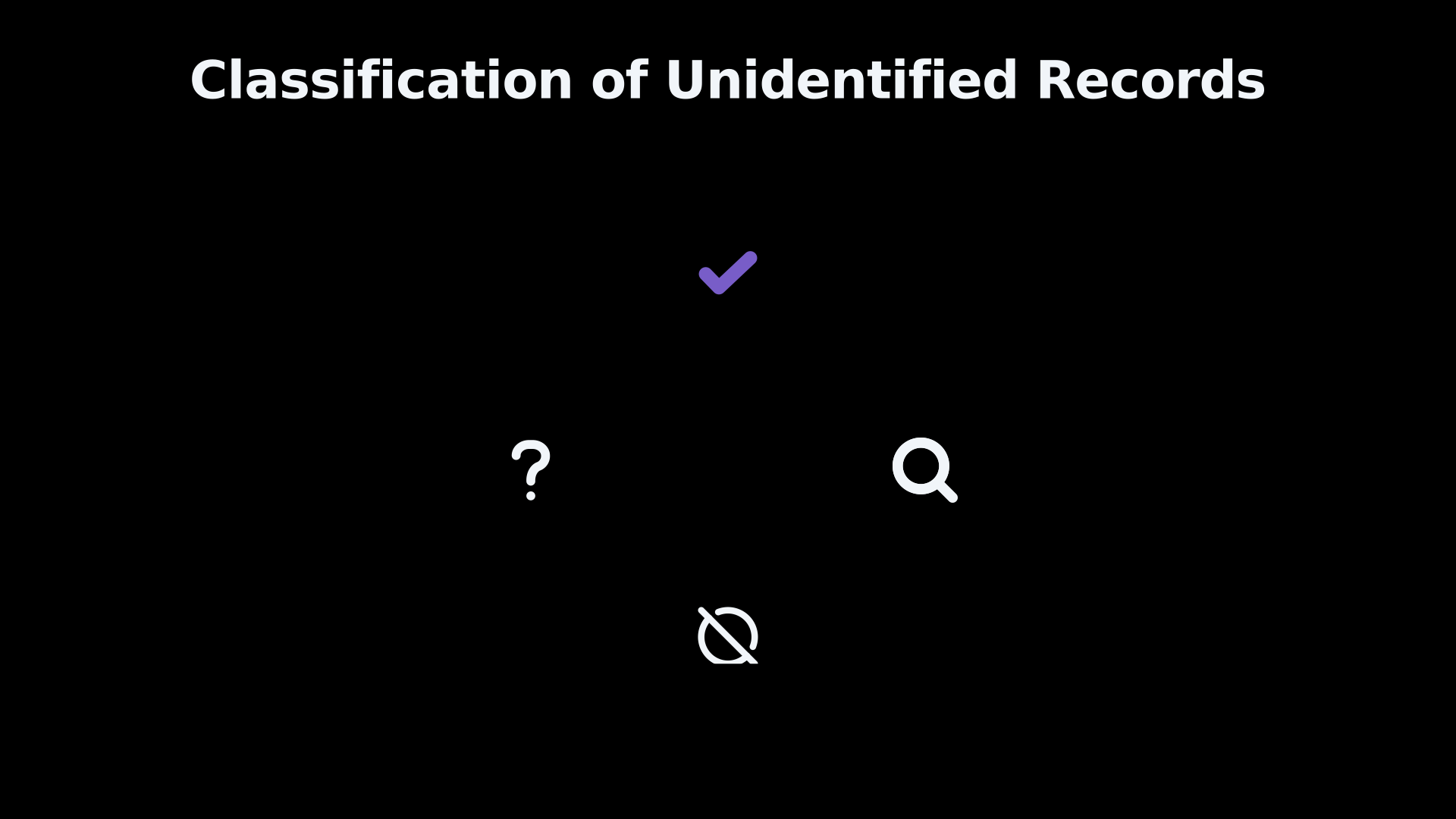
Identified meant that investigators found a sufficiently convincing conventional explanation, such as an aircraft, planet, meteor or balloon.
Probably identified meant that one explanation fitted most of the evidence, although some details remained uncertain. Historical files did not always label this distinction consistently.
Insufficient information meant that the report lacked the timing, direction, duration, weather information, instrument data or witness detail needed for a dependable assessment.
Unresolved meant that no explanation was established from the material available. It did not mean that ordinary explanations had been disproved.
This last category is the most easily misunderstood. A report can remain unresolved because it is unusually strong, but it can also remain unresolved because it is unusually weak. A distant light reported without an accurate bearing or time may never be matched with an aircraft or astronomical object. The absence of a solution can therefore measure missing data rather than genuine strangeness.
The federal Sky Canada review found that Canada’s fragmented reporting system has often made rigorous comparison difficult. Different agencies collected different fields, reports were not consistently compiled and most organisations did not analyse sightings unless they raised safety or security concerns. In many instances, witnesses received no follow-up.[ised-isde.canada.ca]ised-isde.canada.capreview sky canada report ocsapreview sky canada report ocsa
What makes an official case stronger?
A government letterhead adds provenance, not necessarily proof. The most useful files contain information that can be checked independently.
A comparatively strong case would include a precise time and location, contemporaneous notes, several genuinely independent witnesses, recorded angles or bearings, reliable duration estimates and instrument evidence that can be compared with weather, astronomy and aircraft movements. Radar can help, but only when the equipment, operator interpretation and correlation with visual observations are adequately documented.
A weaker file may consist of a summary written days later, a newspaper clipping, an anonymous telephone report or correspondence repeating an account from another source. Copying the same claim between departments does not create several independent confirmations. It can simply produce several official-looking versions of one original story.
Witness occupation also needs careful treatment. Police officers, pilots, radar operators and military personnel may be skilled observers within their areas of expertise. They can be especially valuable when describing procedures, aircraft behaviour or instrument readings. They are still subject to perceptual errors, particularly when viewing an unfamiliar light without a clear horizon or known distance.
For Newfoundland and Labrador cases, environmental and geographic conditions matter as well. Observations over dark water can lack reference points. Weather changes rapidly, and atmospheric refraction or cloud can alter the appearance of distant lights. Busy routes around Gander and Goose Bay introduce aircraft, while military exercises and balloon activity may not have been immediately known to civilians. These possibilities do not explain every report, but a credible assessment must test them before treating unusual appearance as evidence of unusual technology.
The archive has important gaps
Library and Archives Canada cautions that its database cannot be searched as though it were a complete modern case-management system. Only about half of its records name a particular sighting location. Dates may refer either to the event or to the creation of the document, and historical date formats are inconsistent. Searching only for “Newfoundland”, “Labrador” or a single year can therefore miss relevant material.[Canada]canada.cas UFOs: The search for the unknownCanada's UFOs: The search for the unknown - Canada.ca…
Some files were never digitised, some reports may have been filed under broad administrative categories, and others may not have been retained. A Labrador observation sent through an American military chain might be located in United States archives rather than the Canadian collection. Conversely, duplicate correspondence may make the paper trail look more extensive than the underlying investigation was.
There is also a chronological gap. The main digitised federal collection concentrates on records accumulated from 1947 to the early 1980s, while the National Research Council’s central receiving role ended in 1995. Later reports are dispersed among CADORS, police systems, defence channels, private organisations and media archives. The absence of a sighting from the historic database therefore cannot prove that it was never reported.[Canada]canada.cas UFOs: The search for the unknownCanada's UFOs: The search for the unknown - Canada.ca…
Did modern policy improve the evidence?
Canada’s Sky Canada Project was created to examine the management of public reports, not to reinvestigate famous sightings or decide whether extraterrestrial visitors exist. Its central finding was that Canada still lacked a coherent, standardised system through which the public could report an unusual observation and receive a transparent assessment. Reports remained scattered among organisations whose interest depended on separate mandates such as policing, aviation safety or national security.[ised-isde.canada.ca]ised-isde.canada.caManagement of Public Reporting of Unidentified Aerial Phenomena in Canada *These units file an Aviation Occurrence Report (AOR) with NAV CANADA, which subsequently gets sent to Transport Canada’s CADORS team for…
The project recommended better coordination, common reporting standards, greater public access to data and more scientific involvement. Such changes would be especially useful in Newfoundland and Labrador, where remoteness, North Atlantic aviation and military activity can place relevant information in several institutional systems at once.
Standardisation would not guarantee spectacular discoveries. Its main benefit would be more modest and more useful: better separation of explainable events, reports too incomplete to judge and the smaller number of observations that remain genuinely puzzling after adequate checks. The Sky Canada report emphasised that conventional aircraft, weather, astronomical objects, balloons, drones, satellites, optical effects and human error account for many unfamiliar observations. It also accepted that some cases with usable data can remain unexplained.[ised-isde.canada.ca]ised-isde.canada.caManagement of Public Reporting of Unidentified Aerial Phenomena in Canada *These units file an Aviation Occurrence Report (AOR) with NAV CANADA, which subsequently gets sent to Transport Canada’s CADORS team for…
Documented is not the same as verified
The official files establish several things with reasonable confidence. Canada’s government received UFO reports over many decades. Police, transport, scientific and defence bodies sometimes recorded or examined them. Newfoundland and Labrador produced reports involving civilians, police officers, aviation personnel and strategically important military locations. Some observations were never conclusively identified.
What the files do not establish is a verified extraterrestrial presence. A report’s inclusion in an RCMP, defence, National Research Council or Transport Canada archive tells the reader who received it and how it was handled. It may support the authenticity of the original complaint, the identity of the witness or the fact that officials made enquiries. It does not automatically validate estimated speeds, dimensions, distances or claims about the object’s origin.
The fairest reading is therefore neither “the files prove alien craft” nor “every report was nonsense”. They reveal a more complicated administrative history: credible people sometimes saw things they could not identify; agencies assessed those observations according to practical mandates; many reports had ordinary or probable explanations; and others remained open because the evidence was incomplete or genuinely inconclusive. For Newfoundland and Labrador, that distinction is the key to understanding why cases such as Clarenville remain historically important without becoming scientifically verified encounters.
Amazon book picks
Further Reading
Books and field guides related to What Do Canada's UFO Files Actually Prove?. Use these as the next step if you want deeper reading beyond the article.
The Hynek UFO Report
The ultimate guide to Project Blue Book by one of the lead astronomers for the US Air Force program to investigate UFO sightings—and feat...

The UFO Files: The Inside Story of Real-Life Sightings
First published 2010. Subjects: Unidentified flying objects, Sightings and encounters, Research, Military Aeronautics, Unidentified flyin...
UFOs and Government: A Historical Inquiry
Governments around the world have had to deal with the UFO phenomenon for a good part of a century. How and why they did so is the subjec...
The Report on Unidentified Flying Objects
Book Excerpt: ing can never be positively identified. It might have been a hallucination or it might have been some vehicle from outer sp...
eBay marketplace picks
Marketplace Samples
Live-tested eBay searches with available results related to this page.
Selected fromUFO poster oneBay.co.uk.


Current eBay listing
I Want To Believe UFO Poster Giclée Fine Art Heavyweight Print
Current eBay listing
VINTAGE UFO FLYING SAUCERS COMIC ADVERTISING A2 POSTER PRINT

Endnotes
1.
Source: canada.ca
Title: ‘s UFOs: The search for the unknown
Link:https://www.canada.ca/en/library-archives/collection/research-help/science-technology/ufos.html
Source snippet
Canada's UFOs: The search for the unknown - Canada.ca...
2.
Source: ised-isde.canada.ca
Title: Management of Public Reporting of Unidentified Aerial Phenomena in Canada *
Link:https://ised-isde.canada.ca/site/science/en/office-chief-science-advisor/sky-canada-project/management-public-reporting-unidentified-aerial-phenomena-canada
Source snippet
These units file an Aviation Occurrence Report (AOR) with NAV CANADA, which subsequently gets sent to Transport Canada’s CADORS team for...
3.
Source: ised-isde.canada.ca
Link:https://ised-isde.canada.ca/site/science/sites/default/files/documents/report-sky-canada-project.pdf
Source snippet
REPORT OF THE SKY CANADA PROJECT. # 37. Management of UAP reports in Europe.Read more...
4.
Source: tc.canada.ca
Title: Transport Canada4. High Altitude Object Incidents
Link:https://tc.canada.ca/en/binder/4-high-altitude-object-incidents
5.
Source: archives.gov
Link:https://www.archives.gov/news/articles/project-blue-book-50th-anniversary
Source snippet
National ArchivesPublic Interest in UFOs Persists 50 Years After Project Blue...Dec 5, 2019 — Each case file relates to one sighting or...
6.
Source: archives.gov
Title: National Archives Project BLUE BOOK
Link:https://www.archives.gov/research/military/air-force/ufos
Source snippet
As a result of these investigations and studies and experience gained from investigating UFO reports since 1948, the conclusions of Proje...
7.
Source: ised-isde.canada.ca
Title: preview sky canada report ocsa
Link:https://ised-isde.canada.ca/site/science/en/office-chief-science-advisor/sky-canada-project/preview-sky-canada-report-ocsa
8.
Source: ised-isde.canada.ca
Link:https://ised-isde.canada.ca/site/science/en/office-chief-science-advisor/sky-canada-project
9.
Source: canada.ca
Title: Flight Safety Investigation Reports
Link:https://www.canada.ca/en/air-force/programs/flight-safety/investigation-reports.html
10.
Source: rcmp.ca
Link:https://www.rcmp.ca/en/nl/news/2026/06/4353980
11.
Source: canada.ca
Link:https://www.canada.ca/en/fisheries-oceans/news/2026/05/fisheries-and-oceans-canada-releases-management-approach-for-the-food-fishery-in-newfoundland-and-labrador.html
12.
Source: ised-isde.canada.ca
Title: 2026 27 departmental plan
Link:https://ised-isde.canada.ca/site/planning-performance-reporting/en/departmental-plans/2026-27-departmental-plan
13.
Source: ised-isde.canada.ca
Title: annual report chief science advisor 2024 2025
Link:https://ised-isde.canada.ca/site/science/en/office-chief-science-advisor/annual-reports/annual-report-chief-science-advisor
14.
Source: science.ised-isde.canada.ca
Title: ca Datasets and Portals
Link:https://science.ised-isde.canada.ca/site/science/en/open-science/datasets-and-portals
15.
Source: ised-isde.canada.ca
Title: ca Projet Ciel Canada
Link:https://ised-isde.canada.ca/site/science/fr/bureau-conseillere-scientifique-chef/projet-ciel-canada
16.
Source: tc.canada.ca
Title: ca Civil Aviation Daily Occurrence Reporting System (CADORS) Manual
Link:https://tc.canada.ca/en/aviation/aviation-publications/civil-aviation-daily-occurrence-reporting-system-cadors-manual-tp-4044
17.
Source: rcmp.ca
Title: Newfoundland and Labrador RCMP publications | Royal Canadian Mounted Police
Link:https://www.rcmp.ca/en/nl/corporate-information/publications-and-manuals
18.
Source: rcmp.ca
Link:https://rcmp.ca/en/nl/detachments?wbdisable=false
19.
Source: ised-isde.canada.ca
Title: ca Questions and Answers about the Sky Canada Project
Link:https://ised-isde.canada.ca/site/science/en/office-chief-science-advisor/sky-canada-project/questions-and-answers-about-sky-canada-project
20.
Source: canada.ca
Title: Key Issues – High-Altitude Objects
Link:https://www.canada.ca/en/department-national-defence/corporate/reports-publications/proactive-disclosure/nddn-7-march-23/key-issues.html
21.
Source: tc.canada.ca
Title: ca The Civil Aviation Daily Occurrence Reporting System (CADORS)
Link:https://tc.canada.ca/en/aviation/publications/aviation-safety-letter/issue-2-2021/civil-aviation-daily-occurrence-reporting-system-cadors
22.
Source: canada.ca
Link:https://www.canada.ca/en/department-national-defence/corporate/reports-publications/audit-evaluation/evaluation-named-grant-institute-environmental-monitoring-research.html
23.
Source: ised-isde.canada.ca
Title: ca Evaluation of the Communications Research Centre
Link:https://ised-isde.canada.ca/site/audits-evaluations/en/evaluation-reports/evaluation-communications-research-centre/evaluation-communications-research-centre
24.
Source: canada.ca
Link:https://www.canada.ca/en/news/archive/2007/03/tsb-releases-final-investigation-report-canadian-coast-guard-helicopter-accident-marystown-newfoundland-labrador-2005.html
25.
Source: tc.canada.ca
Link:https://tc.canada.ca/en/aviation/reference-centre/aerodrome-safety-circulars/aerodrome-safety-circular-asc-no-97-002a
26.
Source: canada.ca
Title: episode 053
Link:https://www.canada.ca/en/library-archives/collection/engage-learn/podcasts/discover/episode-053.html
27.
Source: canada.ca
Title: episode 054
Link:https://www.canada.ca/en/library-archives/collection/engage-learn/podcasts/discover/episode-054.html
28.
Source: canada.ca
Title: history archives library
Link:https://www.canada.ca/en/department-national-defence/services/military-history/history-heritage/history-archives-library.html
29.
Source: canada.ca
Title: short billed dowitcher 2024
Link:https://www.canada.ca/en/environment-climate-change/services/species-risk-public-registry/cosewic-assessments-status-reports/short-billed-dowitcher-2024.html
30.
Source: canada.ca
Link:https://www.canada.ca/en/library-archives.html
31.
Source: canada.ca
Title: preventing substance use problems among young people best practices
Link:https://www.canada.ca/en/health-canada/services/health-concerns/reports-publications/alcohol-drug-prevention/preventing-substance-use-problems-among-young-people-best-practices.html
32.
Source: canada.ca
Title: macropis cuckoo bee 2025
Link:https://www.canada.ca/en/environment-climate-change/services/species-risk-public-registry/cosewic-assessments-status-reports/macropis-cuckoo-bee-2025.html
33.
Source: ised-isde.canada.ca
Title: rapport sky canada
Link:https://ised-isde.canada.ca/site/science/sites/default/files/documents/rapport-sky-canada.pdf
34.
Source: inspection.canada.ca
Title: rmd 08 02
Link:https://inspection.canada.ca/en/plant-health/invasive-species/directives/pest-risk-management/rmd
35.
Source: canada.ca
Link:https://www.canada.ca/content/dam/hc-sc/migration/hc-sc/hc-ps/alt_formats/hecs-sesc/pdf/pubs/adp-apd/prevent/young-jeune-eng.pdf
36.
Source: canada.ca
Title: before you visit
Link:https://www.canada.ca/en/library-archives/collection/basics/before-you-visit.html
37.
Source: canada.ca
Title: black tailed prairie dog 2024
Link:https://www.canada.ca/en/environment-climate-change/services/species-risk-public-registry/cosewic-assessments-status-reports/black-tailed-prairie-dog-2024.html
38.
Source: ised-isde.canada.ca
Link:https://ised-isde.canada.ca/site/science/fr/bureau-conseillere-scientifique-chef/projet-ciel-canada/gestion-signalements-publics-phenomenes-aeriens-non-identifies-canada?ref=uaplogbook.com
39.
Source: canada.ca
Title: least bittern 2024
Link:https://www.canada.ca/en/environment-climate-change/services/species-risk-public-registry/cosewic-assessments-status-reports/least-bittern-2024.html
40.
Source: canada.ca
Link:https://www.canada.ca/en/environment-climate-change/services/species-risk-public-registry/imminent-threat-assessments/caribou-rangifer-tarandus-boreal-population.html
41.
Source: science.ised-isde.canada.ca
Title: annual report chief science advisor 2024 2025
Link:https://science.ised-isde.canada.ca/site/science/en/office-chief-science-advisor/annual-reports/annual-report-chief-science-advisor
42.
Source: ised-isde.canada.ca
Title: chief science advisor annual report 2022 23
Link:https://ised-isde.canada.ca/site/science/en/office-chief-science-advisor/annual-reports/chief-science-advisor-annual-report
43.
Source: ised-isde.canada.ca
Link:https://ised-isde.canada.ca/site/science/en/safeguarding-your-research/guidelines-and-tools-implement-research-security/emerging-technology-trend-cards/beyond-line-sight
44.
Source: nrc-publications.canada.ca
Title: ca LEWE X ‘87
Link:https://nrc-publications.canada.ca/eng/view/object/?id=cbd939a3-21bd-48cf-9f6e-84f792447f79
45.
Source: publications-cnrc.canada.ca
Title: ca LEWE X ‘87
Link:https://publications-cnrc.canada.ca/eng/view/object/?id=cbd939a3-21bd-48cf-9f6e-84f792447f79
46.
Source: archives.gov
Link:https://www.archives.gov/news/articles
47.
Source: archives.gov
Title: uap bulk download
Link:https://www.archives.gov/research/catalog/catalog-bulk-downloads/uap-bulk-download
48.
Source: archives.gov
Title: Project BLUE BOOK
Link:https://www.archives.gov/foia/ufos.html
49.
Source: archives.gov
Title: moving images and sound
Link:https://www.archives.gov/research/topics/uaps/moving-images-and-sound
50.
Source: prologue.blogs.archives.gov
Title: invasion of privacy
Link:https://prologue.blogs.archives.gov/2018/04/09/invasion-of-privacy/
51.
Source: prologue.blogs.archives.gov
Title: saucers over washington the history of project blue book
Link:https://prologue.blogs.archives.gov/2019/12/19/saucers-over-washington-the-history-of-project-blue-book/
52.
Source: unwritten-record.blogs.archives.gov
Title: project blue book
Link:https://unwritten-record.blogs.archives.gov/tag/project-blue-book/
53.
Source: archives.gov
Title: rg collections
Link:https://www.archives.gov/research/topics/uaps/rg-collections
54.
Source: unwritten-record.blogs.archives.gov
Title: aliens at the archives
Link:https://unwritten-record.blogs.archives.gov/2017/04/26/aliens-at-the-archives/
55.
Source: archives.gov
Link:https://www.archives.gov/research/topics/uaps/photographs
56.
Source: youtube.com
Title: Chris Rutkowski launch of Canada’s UFOs: Declassified
Link:https://www.youtube.com/watch?v=bcSI4rw0M4Q
Source snippet
Canada's Famous Officially Investigated UFO Incident...
57.
Source: youtube.com
Title: Canada’s Famous Officially Investigated UFO Incident
Link:https://www.youtube.com/watch?v=AffaetLkx2U
Source snippet
UFOs Part 1 — Canadian Reports, Research & Disclosure...
58.
Source: media.nationalarchives.gov.uk
Link:https://media.nationalarchives.gov.uk/index.php/ufo-file-release-august-2009/
Additional References
59.
Source: youtube.com
Title: UFOs Part 1 — Canadian Reports, Research & Disclosure
Link:https://www.youtube.com/watch?v=CS2z-V6Qjsg
Source snippet
This list provides relevant videos on Canadian government UFO investigations, including the 1978 Clarenville incident referenced in the e...
60.
Source: ufomagazines.com
Link:https://www.ufomagazines.com/canadian-ufo-report-magor-canadian-ufo-report-vol-5-no-1-1978-79/
61.
Source: documentcloud.org
Link:https://www.documentcloud.org/documents/21273403-canadian-government-releases-20-years-of-ufo-reports/
62.
Source: publications.gc.ca
Link:https://publications.gc.ca/pub?id=9.954481&sl=1
63.
Source: publications.gc.ca
Link:https://publications.gc.ca/site/eng/9.954480/marcXml.html?MODS=1
64.
Source: publications.gc.ca
Link:https://publications.gc.ca/site/eng/9.954480/publication.html
65.
Source: productofnewfoundland.ca
Link:https://www.productofnewfoundland.ca/articles/ufos-of-newfoundland
66.
Source: publications.gc.ca
Link:https://publications.gc.ca/collections/collection_2025/isde-ised/Iu4-443-2024-1-eng.pdf
67.
Source: af.mil
Link:https://www.af.mil/About-Us/Fact-Sheets/Display/Article/104590/unidentified-flying-objects-and-air-force-project-blue-book/
68.
Source: osi.af.mil
Link:https://www.osi.af.mil/News/Features/Display/Article/2302429/project-blue-book-part-1-ufo-reports/