Within RCMP Reports
Why the Inuvik Sighting Divided the Detachment
The 1967 Inuvik report shows how police balanced witness credibility, internal scepticism and the lack of independent verification.
On this page
- What Constable Ford reported
- Why Inspector Smith defended the report
- Why the object remained unidentified
Page outline Jump by section
Introduction
The January 1967 Inuvik sighting is one of the most revealing Royal Canadian Mounted Police (RCMP) UFO-related records from the Northwest Territories, not because it provides strong evidence of an extraordinary object, but because it documents how police officers handled disagreement within their own ranks. The central question was never simply what Constable Ford had seen. It was whether a trained police officer’s observation deserved careful investigation even when colleagues suspected an ordinary explanation. The surviving correspondence shows an unusual combination of confidence in the witness, scepticism about the interpretation, and frustration over the way the report was initially treated. As a result, the case remains an important example of RCMP investigative culture rather than a persuasive piece of evidence for an unidentified craft.[Digital Collections]trentu.caA History of Canada s UFO InvestigationDigital CollectionsA HISTORY OF CANADA’S UFO INVESTIGATION, 1950-1995July 29, 2019
Why the Inuvik Sighting Divided the Detachment
In January 1967, RCMP Constable Ford reported observing an unusual aerial object in the vicinity of Inuvik. The original file has survived through Library and Archives Canada’s collection of federal UFO records and is cited in later historical research on Canada’s official handling of unidentified flying object reports.[Digital Collections]trentu.caA History of Canada s UFO InvestigationDigital CollectionsA HISTORY OF CANADA’S UFO INVESTIGATION, 1950-1995July 29, 2019
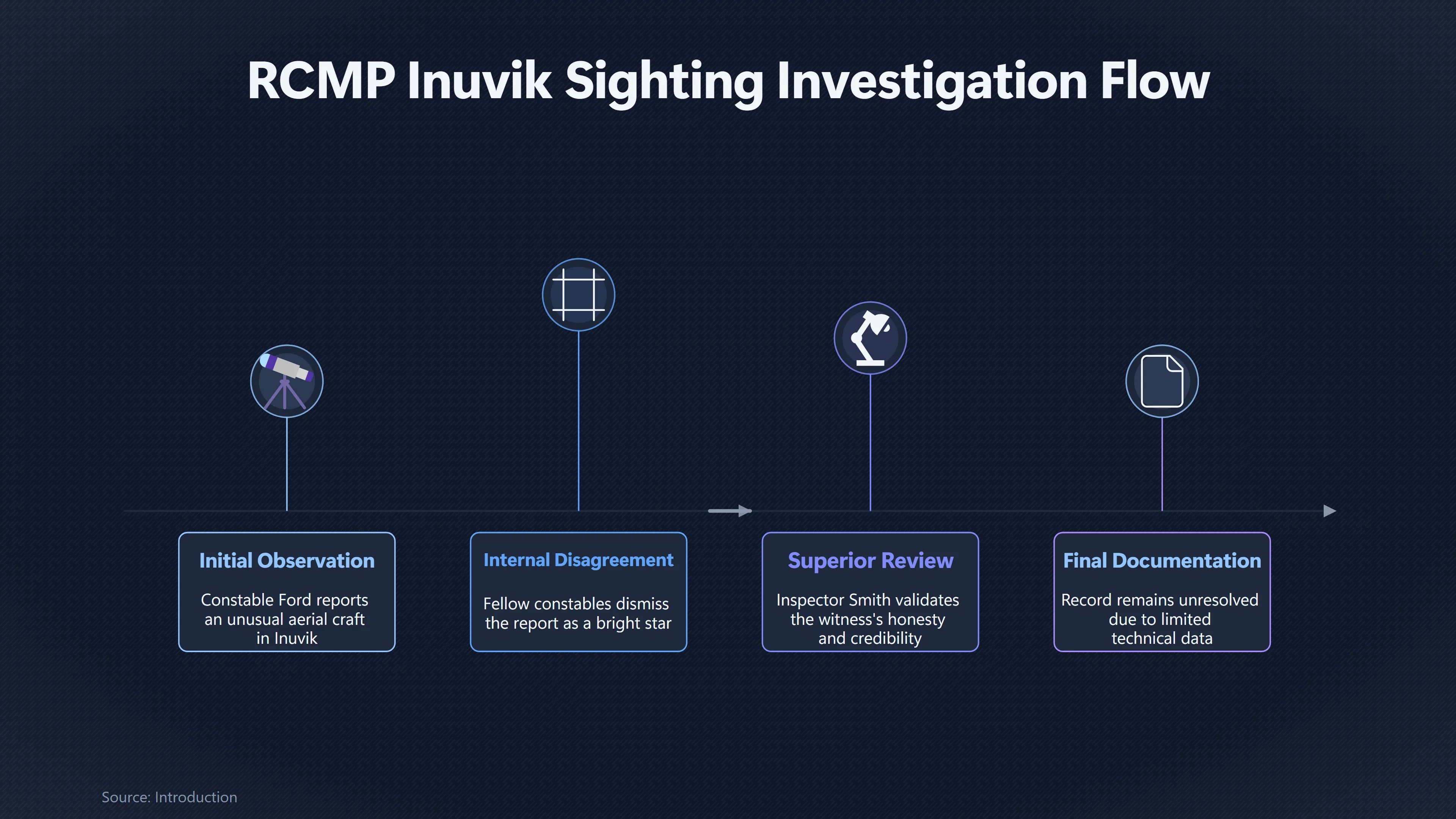
What makes the incident distinctive is that the disagreement arose within the detachment itself rather than between police and the public. Ford’s immediate superior, Inspector K. D. Smith, accepted that Ford had accurately described what he believed he had seen. At the same time, two fellow constables, St-Jean and Kaminski, were unconvinced almost from the outset. According to Smith’s memorandum, they made only a limited attempt to verify the observation, looking out of a window in the general direction indicated before concluding that the object was simply a star.[Digital Collections]trentu.caA History of Canada s UFO InvestigationDigital CollectionsA HISTORY OF CANADA’S UFO INVESTIGATION, 1950-1995July 29, 2019
The surviving record therefore documents two separate questions:
- whether Ford genuinely observed something unusual; and
- whether the object itself was unusual.
Inspector Smith clearly answered the first question positively. The second remained unresolved.
What Constable Ford Reported
The surviving documentation contains only a limited description of the object itself. Unlike some better-known Canadian UFO cases, there are no accompanying photographs, radar records, instrument readings or extensive witness interviews preserved alongside the report. Nor does the file contain sufficient positional information to reconstruct exactly what celestial or atmospheric object might have been visible from Inuvik at the relevant time.[Digital Collections]trentu.caA History of Canada s UFO InvestigationDigital CollectionsA HISTORY OF CANADA’S UFO INVESTIGATION, 1950-1995July 29, 2019
That lack of technical detail is significant. Modern investigators attempting to reassess historical sightings often rely on precise information such as:
- exact observation time;
- viewing direction and elevation;
- duration;
- weather conditions;
- apparent motion; and
- nearby aviation activity.
For the Inuvik report, much of this information is either absent or too limited to support a confident retrospective identification. Consequently, the surviving record documents an unexplained observation rather than providing enough evidence to determine what produced it.[Digital Collections]trentu.caA History of Canada s UFO InvestigationDigital CollectionsA HISTORY OF CANADA’S UFO INVESTIGATION, 1950-1995July 29, 2019

Why Inspector Smith Defended the Report
The most striking feature of the case is Inspector Smith’s response.
His memorandum did not argue that extraterrestrial craft or other extraordinary explanations were likely. Instead, he focused on professional conduct. Smith wrote that he had “no doubt” Ford had seen what he described, making clear that he regarded Ford as a credible and honest observer. He also criticised the dismissive attitude shown by the other constables, suggesting they had assumed Ford was joking because of the subject matter rather than making a sincere report.[Digital Collections]trentu.caA History of Canada s UFO InvestigationDigital CollectionsA HISTORY OF CANADA’S UFO INVESTIGATION, 1950-1995July 29, 2019
Smith explained that all three constables were single members living in barracks and believed the sceptical reaction arose because UFO reports invited humour and embarrassment. He nevertheless instructed St-Jean and Kaminski that they were expected to be more receptive when fellow officers reported unusual observations.[Digital Collections]trentu.caA History of Canada s UFO InvestigationDigital CollectionsA HISTORY OF CANADA’S UFO INVESTIGATION, 1950-1995July 29, 2019
This distinction is important. Smith’s memorandum defended:
- the credibility of the witness;
- the need for professional investigation; and
- respectful treatment of reports from fellow officers.
It did not endorse any extraordinary explanation for the object itself.
Why the Object Remained Unidentified
Despite Inspector Smith’s confidence in Ford’s sincerity, the available evidence was insufficient to identify the object conclusively.
The alternative explanation proposed by Ford’s colleagues—a bright star—cannot simply be dismissed. Bright stars or planets viewed low above the northern horizon can appear to shimmer, change colour and seem to move because of atmospheric turbulence, particularly during cold Arctic conditions. Such effects have accounted for many historical UFO reports around the world.
Equally, the surviving file does not provide enough observational detail to confirm that explanation. Without accurate bearings, astronomical reconstruction or independent witnesses who recorded the same object, neither the star hypothesis nor any competing interpretation can be demonstrated conclusively.[Digital Collections]trentu.caA History of Canada s UFO InvestigationDigital CollectionsA HISTORY OF CANADA’S UFO INVESTIGATION, 1950-1995July 29, 2019
For that reason, historians generally treat the Inuvik report as unresolved in a narrow documentary sense. It remains unidentified because the surviving evidence is incomplete, not because the available evidence strongly points towards an extraordinary phenomenon.
What the Case Reveals About RCMP Practice
Within the broader history of RCMP sighting reports across northern communities, the Inuvik incident illustrates how police organisations balanced witness credibility against evidential standards.
Several features stand out:
- Witness credibility mattered. Smith explicitly separated confidence in Ford’s honesty from confidence in his interpretation.
- Internal scepticism was accepted. Fellow officers were free to suggest an ordinary explanation.
- Procedure was expected. Smith’s criticism centred on the lack of proper verification rather than disagreement over the conclusion.
- Evidence remained paramount. No attempt was made to treat the report as proof of an extraordinary event without corroborating information.[Digital Collections]trentu.caA History of Canada s UFO InvestigationDigital CollectionsA HISTORY OF CANADA’S UFO INVESTIGATION, 1950-1995July 29, 2019
These characteristics are consistent with many surviving Canadian federal UFO files, which frequently record sincere witnesses alongside limited physical evidence.

Why the Inuvik Case Still Matters
The Inuvik sighting occupies a modest but significant place in the UFO history of the Northwest Territories. It is not remembered because it produced compelling physical evidence or a dramatic investigation. Instead, it survives because the internal RCMP correspondence captures an unusual moment when questions of professionalism, witness credibility and institutional scepticism became more important than the unidentified object itself.
That makes the case valuable for understanding how northern police handled uncertain reports during the 1960s. Rather than demonstrating the existence of an extraordinary craft, the surviving documents illustrate the limits of investigation in remote communities, where independent confirmation was often unavailable and official conclusions depended as much on careful judgement as on physical evidence.[Digital Collections]trentu.caA History of Canada s UFO InvestigationDigital CollectionsA HISTORY OF CANADA’S UFO INVESTIGATION, 1950-1995July 29, 2019
Amazon book picks
Further Reading
Books and field guides related to Why the Inuvik Sighting Divided the Detachment. Use these as the next step if you want deeper reading beyond the article.
The UFO Experience: A Scientific Inquiry
Cited by the New York Review of Books as "the best brief for visitation," this classic study presents an analysis of UFO reports and conc...
UFOs: Generals, Pilots, and Government Officials Go on the Re...
NEW YORK TIMES BESTSELLER • Impeccably researched, this riveting journalistic investigation separates fact from fiction, and documents th...
The Believing Brain
Synthesizing thirty years of research, psychologist and science historian, Michael Shermer upends the traditional thinking about how huma...
eBay marketplace picks
Marketplace Samples
Live-tested eBay searches with available results related to this page.
Selected fromUFO figure collectible oneBay.co.uk.



Endnotes
1.
Source: canada.ca
Title: ‘s UFOs: The search for the unknown
Link:https://www.canada.ca/en/library-archives/collection/research-help/science-technology/ufos.html
Source snippet
2, 2026 — CANADA'S UFOS: THE SEARCH FOR THE UNKNOWN The Library and Archives Canada collection of government records on UFOs was acquired...
2.
Source: ised-isde.canada.ca
Title: ca Management of Public Reporting of Unidentified Aerial Phenomena in Canada
Link:https://ised-isde.canada.ca/site/science/en/office-chief-science-advisor/sky-canada-project/management-public-reporting-unidentified-aerial-phenomena-canada
Source snippet
of Public Reporting of Unidentified Aerial Phenomena in CanadaJune 1, 2025 — Library and Archives Canada (LAC) The LAC’s collection of go...
Published: June 1, 2025
3.
Source: library-archives.canada.ca
Title: We are working to resolve the problem. Search for library and archive digital re
Link:https://library-archives.canada.ca/eng/collection/search-collections/Pages/search-the-collection.aspx?PHPSESSID=vc1kpd5kvei19ik8e122odnbn6&census-1871%2F001101-119.01-e.php%3Fperson_id_nbr=137862&interval=20&wbdisable=true
Source snippet
Library and Archives Canada's collectionsMay 21, 2025 — SEARCH LIBRARY AND ARCHIVES CANADA'S COLLECTIONS You may experience technical dif...
Published: May 21, 2025
4.
Source: digitalcollections.trentu.ca
Title: A History of Canada s UFO Investigation 1950 1995
Link:https://digitalcollections.trentu.ca/_flysystem/fedora/2022-04/A_History_of_Canada_s_UFO_Investigation_1950_1995.pdf
Source snippet
Digital CollectionsA HISTORY OF CANADA’S UFO INVESTIGATION, 1950-1995July 29, 2019...
Published: July 29, 2019
5.
Source: scribd.com
Title: A History of Canada s UFO Investigation 1950 1995
Link:https://www.scribd.com/document/817127658/A-History-of-Canada-s-UFO-Investigation
Source snippet
PDF | Unidentified Flying ObjectSeptember 1, 2019 — A HISTORY OF CANADA’S UFO INVESTIGATION, 1950-1995 A DISSERTATION SUBMITTED TO THE CO...
Published: September 1, 2019
6.
Source: batadora.trentu.ca
Title: etd 776
Link:https://batadora.trentu.ca/objects/etd-776
7.
Source: digitalcollections.trentu.ca
Link:https://digitalcollections.trentu.ca/taxonomy/term/3059
8.
Source: digitalcollections.trentu.ca
Link:https://digitalcollections.trentu.ca/collection/trent-university-graduate-thesis-collection?f%5B0%5D=creators_and_contributors%3AHodgins%2C+Peter
Additional References
9.
Source: youtube.com
Link:https://www.youtube.com/watch?v=qaS94Z2IZG4
Source snippet
Chris Rutkowski launch of Canada's UFOs: Declassified (August Night Press)...
10.
Source: theprojectbluebookarchive.org
Title: The Project Blue Book Archive
Link:https://www.theprojectbluebookarchive.org/archive/AFR%2080-17/
Source snippet
October 4, 2025 — THE PROJECT BLUE BOOK ARCHIVE Browse and download declassified UAP investigation files Name | Last modified | Size | De...
Published: October 4, 2025
11.
Source: youtube.com
Title: The Shag Harbour UFO Incident
Link:https://www.youtube.com/watch?v=mPbDa5D7IUE
Source snippet
Canada RCMP UFO sighting investigation Canada's Most Documented UFO Case | Falcon Lake The Why Files...
12.
Source: youtube.com
Title: Chris Rutkowski launch of Canada’s UFOs: Declassified (August Night Press)
Link:https://www.youtube.com/watch?v=bcSI4rw0M4Q
Source snippet
Canada's Most Famous UFO Sighting; Falcon Lake 1967...
13.
Source: youtube.com
Title: RCMP Officer Interview
Link:https://www.youtube.com/watch?v=LXmXIVOT4Fk
Source snippet
Unexplained phenomena in small town Saskatchewan 50 years ago: were there UFOs seen in Langenburg?...
14.
Source: degruyterbrill.com
Link:https://www.degruyterbrill.com/document/doi/10.1515/9780228012290-006/html
Source snippet
[https://doi.org/10.1515/9780228012290-006](https://doi.org/10.1515/9780228012290-006) Hayes M. 1 Wilbert Smith and Project Magnet, 1950–...
5
- In: Search for the Unknown: Canada’s UFO
15.
Source: noufors.com
Link:https://noufors.com/ufo-related_documentation_in_pdf_format.html
16.
Source: media.nationalarchives.gov.uk
Link:https://media.nationalarchives.gov.uk/index.php/ufo-files-national-archives/
17.
Source: ufomagazines.com
Title: JUS T CAUSE — Just Cause
Link:https://www.ufomagazines.com/just-cause-new-series-just-cause-1997-03-no-50-new-series/
18.
Source: canadaufohistory.com
Title: Canada UFO History
Link:https://www.canadaufohistory.com/1947-1954/project-magnet