Within Official Records
Why Canada's UFO Reporting Form Never Took Hold
Project Second Storey designed a standard UFO reporting form, but Canada never adopted it widely enough to create consistent national records.
On this page
- Who served on Project Second Storey
- What the standard reporting form was meant to fix
- How limited adoption weakened the national archive
Page outline Jump by section
Introduction
Project Second Storey is often remembered as one of Canada’s earliest official efforts to examine reports of unidentified flying objects, but one of its most lasting ambitions was administrative rather than investigative. Between 1952 and 1954, the committee designed a standard reporting form intended to ensure that sightings received by different government departments were recorded in the same way. The idea was straightforward: if every report contained comparable information, officials could more easily distinguish genuine aviation or defence concerns from misidentified natural phenomena. In practice, however, the form was never adopted widely enough to become Canada’s national reporting standard. That failure left UFO reports from Manitoba and elsewhere scattered across multiple agencies, making later investigation and historical research far more difficult.[ISED Canada]ised-isde.canada.caISED CanadaManagement of Public Reporting of Unidentified Aerial Phenomena in CanadaJune 1, 2025…
For Manitoba, this matters because many of the province’s best-known cases—including later incidents such as Falcon Lake—entered a fragmented reporting system rather than a single national archive. Understanding why Project Second Storey’s reporting system never took hold helps explain why Canada’s UFO records remain incomplete and why reconstructing federal investigations often requires consulting several separate collections.
Who served on Project Second Storey?
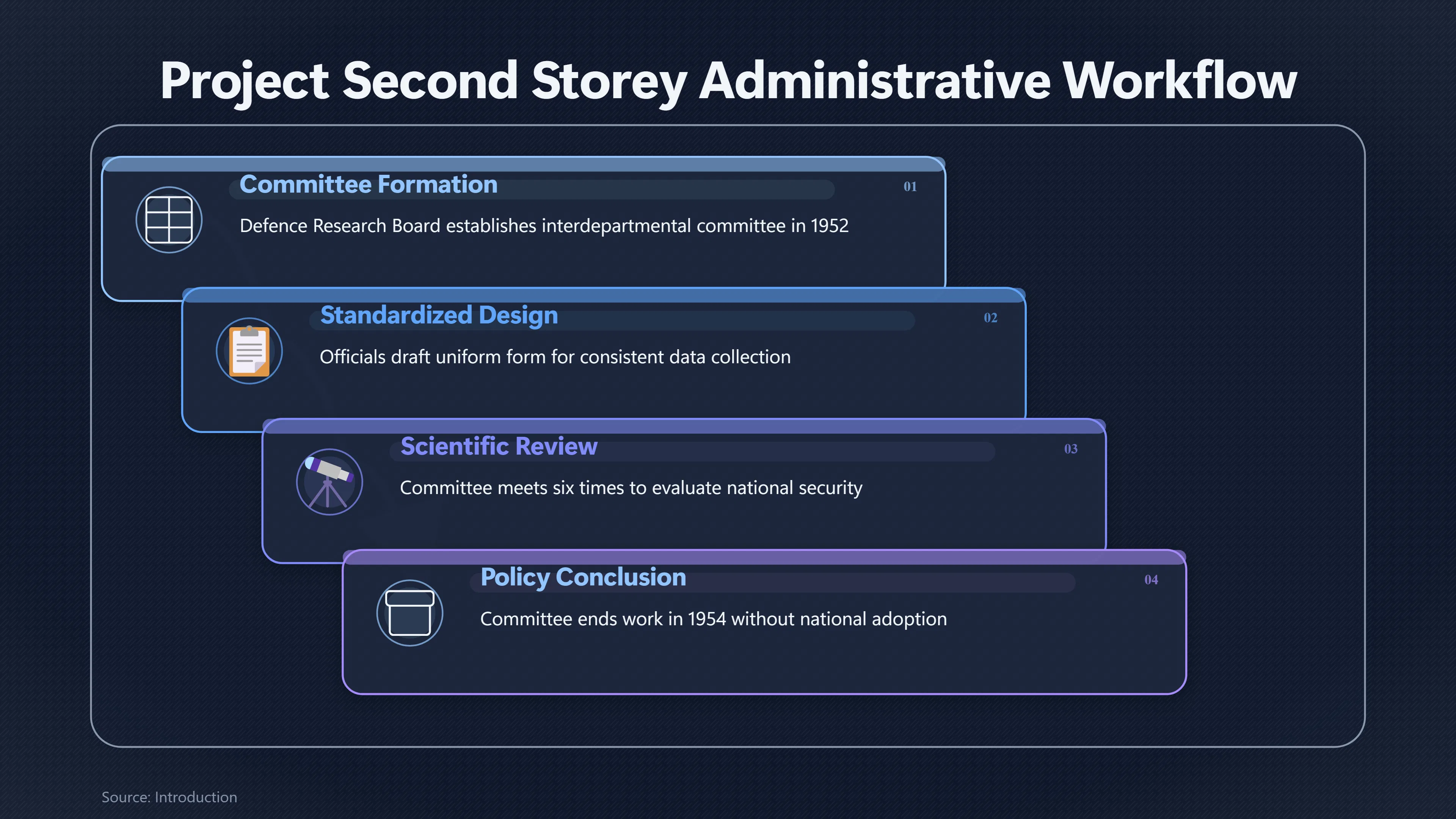
Project Second Storey was established in 1952 by the Defence Research Board, Canada’s military scientific organisation within the Department of National Defence. Rather than operating as an independent investigative unit, it functioned as an interdepartmental committee bringing together expertise from science, defence and intelligence.
The committee was chaired by astronomer Dr Peter Millman of the National Research Council (then associated with the Dominion Observatory) and included representatives from:
- the Defence Research Board;
- the Royal Canadian Air Force and military intelligence;
- the Department of National Defence;
- the Department of Transport; and
- other federal organisations with responsibility for aviation or security matters.
The committee met only six times between 1952 and 1954. Its members generally approached UFO reports from a scientific and national-security perspective rather than assuming extraordinary explanations. Their objective was to determine whether sightings represented aircraft, atmospheric phenomena, defence threats or other identifiable events requiring government attention.[ISED Canada]ised-isde.canada.caISED CanadaManagement of Public Reporting of Unidentified Aerial Phenomena in CanadaJune 1, 2025…
What the standard reporting form was meant to fix
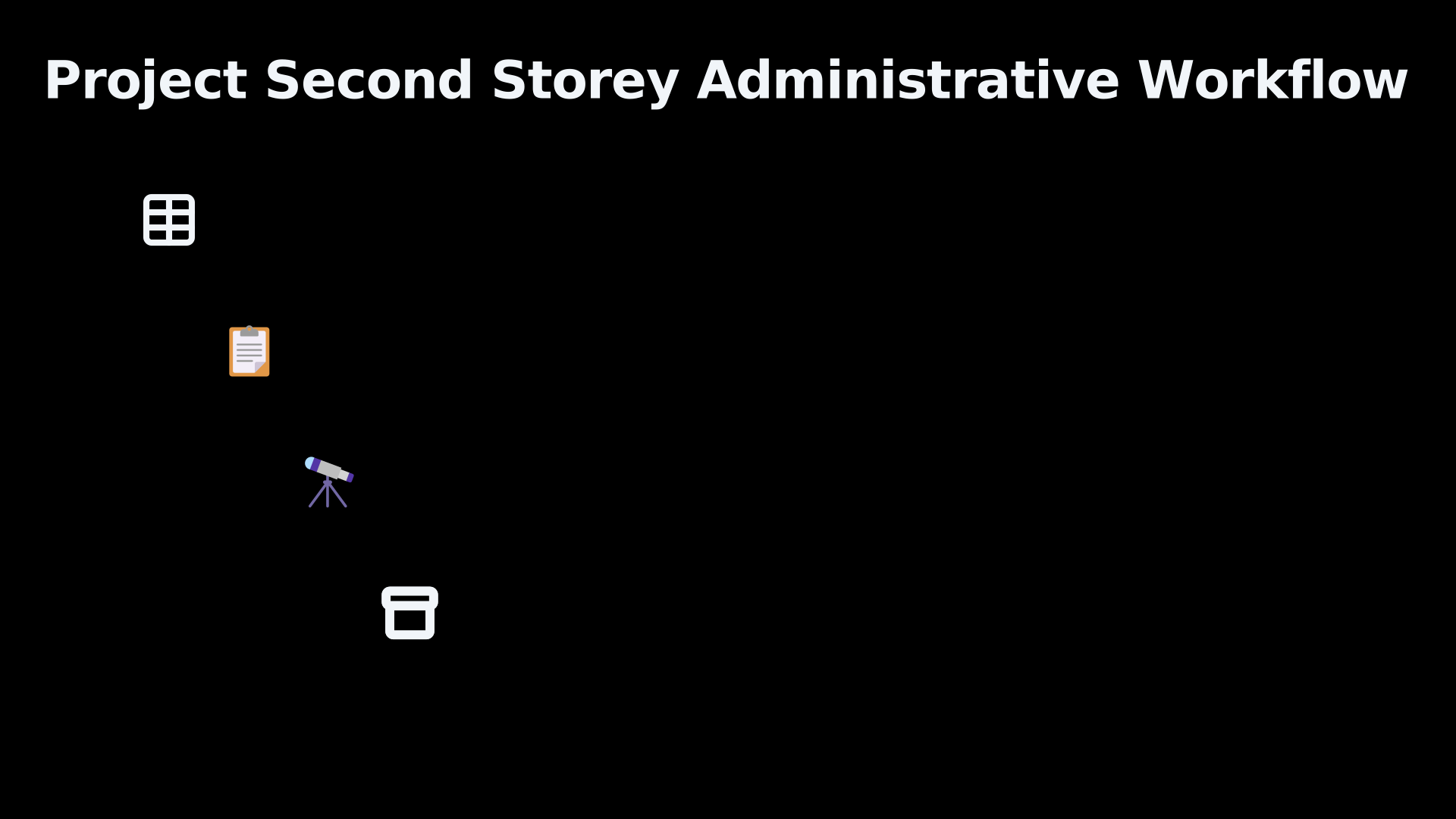
When Project Second Storey began its work, Canada had no consistent process for recording UFO reports. Witnesses might contact local police, the Royal Canadian Mounted Police, the Department of Transport, military authorities or another government office. Each organisation tended to collect different information, using its own paperwork and priorities.
The committee believed this inconsistency made meaningful analysis almost impossible. Reports often lacked basic observational details or omitted information that would help investigators compare one sighting with another.
The proposed standard reporting form attempted to solve this by requiring consistent factual observations, including matters such as:
- date and precise time;
- location;
- direction of travel;
- weather and visibility;
- duration of the observation;
- appearance, brightness and movement of the object;
- number and experience of witnesses; and
- any corroborating aviation or radar information where available.
The emphasis was on measurable observations rather than speculation. Instead of encouraging lengthy narratives about what witnesses believed they had seen, the form sought objective information that could be compared across multiple reports and examined by scientists or aviation specialists.[Canada UFO History]canadaufohistory.comCanada UFO HistoryCanada UFO History - Project Second Storey…
This approach reflected the committee’s broader philosophy: before asking whether an incident was unusual, investigators needed reliable, comparable data.
Why the reporting system never became national policy
Although the reporting form represented a practical administrative improvement, it never evolved into a mandatory government-wide reporting system.
Several factors contributed to its limited adoption.
First, Project Second Storey itself was short-lived. After six meetings, committee members concluded that reported UFOs neither presented a significant national-security threat nor justified a major scientific research programme. As a result, enthusiasm for building a permanent reporting infrastructure diminished.[ISED Canada]ised-isde.canada.caISED CanadaManagement of Public Reporting of Unidentified Aerial Phenomena in CanadaJune 1, 2025…
Second, no single department was given lasting responsibility for collecting every Canadian report. Different organisations continued receiving sightings according to their existing responsibilities. Police handled public complaints, aviation authorities dealt with flight safety, military organisations considered defence implications, and later the National Research Council accepted many public reports. None became the definitive national clearing house.[ISED Canada]ised-isde.canada.caISED CanadaManagement of Public Reporting of Unidentified Aerial Phenomena in CanadaJune 1, 2025…
Third, because the reporting form was never consistently required across departments, many officials continued using local procedures or informal correspondence instead of the standardised format. As a consequence, reports varied considerably in quality and completeness.
The result was not the absence of records but the absence of uniform records.
How limited adoption weakened Canada’s UFO archive
The consequences of this administrative failure became clearer over subsequent decades.
Instead of a single searchable national collection created from identical reporting forms, Canada’s historical UFO records accumulated through multiple institutional channels. Files eventually originated from organisations including:
- the Royal Canadian Mounted Police;
- the Department of National Defence;
- the Department of Transport; and
- the National Research Council.
Because each agency recorded information differently, researchers frequently encounter duplicate files, incomplete investigations, inconsistent terminology and varying levels of detail. Modern historians often have to reconstruct individual incidents by comparing documents from several archives rather than consulting one complete case file.[Canada]canada.cas UFOs: The search for the unknownCanada's UFOs: The search for the unknown - Canada.ca…
The Office of the Chief Science Advisor’s Sky Canada Project, published in 2025, identified this fragmented historical reporting system as one of the recurring weaknesses in Canada’s handling of unidentified aerial phenomena. Looking back, it noted that Project Second Storey’s reporting form was created specifically to improve consistency but was “never broadly adopted or used,” leaving responsibility to drift between departments over subsequent decades.[ISED Canada]ised-isde.canada.caISED CanadaManagement of Public Reporting of Unidentified Aerial Phenomena in CanadaJune 1, 2025…
Why this mattered for Manitoba
For Manitoba, the consequences were practical rather than theoretical.
Many provincial reports entered whichever federal organisation happened to receive them first. A report might begin with local police, be forwarded to the RCMP, copied to military authorities because aircraft were mentioned, or later reach the National Research Council if scientific identification was sought. Different agencies often retained different parts of the documentary trail.
This fragmented system helps explain why well-known Manitoba cases survive today in several archival collections rather than in one complete investigation file. Researchers examining incidents such as Falcon Lake often need to compare records held by different departments to understand how officials responded and what evidence each organisation considered.
Project Second Storey’s unrealised reporting system therefore influenced not only obscure sightings but also some of Canada’s most studied cases.
The lasting significance
Project Second Storey’s reporting form was an early attempt to solve a genuine administrative problem rather than to prove or disprove extraordinary claims. Its designers recognised that meaningful investigation depends on consistent evidence collection. In that respect, the proposal anticipated modern principles of incident reporting used in aviation and other technical fields.
Its failure was not that the form itself was technically flawed, but that no lasting government structure required its consistent use. Canada continued collecting UFO reports for decades, yet without the unified reporting system that Project Second Storey had envisioned. The surviving archival record consequently became extensive but uneven, preserving thousands of documents while making comprehensive national analysis more difficult than it might otherwise have been. This fragmented legacy remains central to understanding both Manitoba’s place in Canada’s UFO history and the broader evolution of Canadian government investigations into unidentified aerial phenomena.[canada.ca]ised-isde.canada.caISED CanadaManagement of Public Reporting of Unidentified Aerial Phenomena in CanadaJune 1, 2025…
Amazon book picks
Further Reading
Books and field guides related to Why Canada's UFO Reporting Form Never Took Hold. Use these as the next step if you want deeper reading beyond the article.
The UFO Experience: A Scientific Inquiry
Cited by the New York Review of Books as "the best brief for visitation," this classic study presents an analysis of UFO reports and conc...
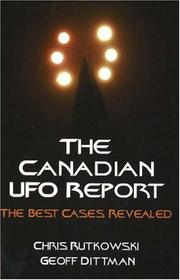
The Canadian UFO Report: The Best Cases Revealed
First published 2006. Subjects: Unidentified flying objects, Sightings and encounters.
UFOs and Government: A Historical Inquiry
Governments around the world have had to deal with the UFO phenomenon for a good part of a century. How and why they did so is the subjec...
The Report on Unidentified Flying Objects
Book Excerpt: ing can never be positively identified. It might have been a hallucination or it might have been some vehicle from outer sp...
eBay marketplace picks
Marketplace Samples
Live-tested eBay searches with available results related to this page.
Selected fromUFO poster oneBay.co.uk.


Current eBay listing
I Want To Believe UFO Poster Giclée Fine Art Heavyweight Print

Current eBay listing
VINTAGE UFO FLYING SAUCERS COMIC ADVERTISING A2 POSTER PRINT

Endnotes
1.
Source: ised-isde.canada.ca
Link:https://ised-isde.canada.ca/site/science/en/office-chief-science-advisor/sky-canada-project/management-public-reporting-unidentified-aerial-phenomena-canada
Source snippet
ISED CanadaManagement of Public Reporting of Unidentified Aerial Phenomena in CanadaJune 1, 2025...
Published: June 1, 2025
2.
Source: canada.ca
Title: ‘s UFOs: The search for the unknown
Link:https://www.canada.ca/en/library-archives/collection/research-help/science-technology/ufos.html
Source snippet
Canada's UFOs: The search for the unknown - Canada.ca...
3.
Source: canada.ca
Title: Accessing records: Request a record
Link:https://www.canada.ca/en/library-archives/services/public/access-information-privacy/make-atip-request.html
Source snippet
Where to start * 2. Browse previously requested records * 3. Send us your questions * 4. Before you make a request * 5. Request a record...
4.
Source: ised-isde.canada.ca
Title: ca Sky Canada Project
Link:https://ised-isde.canada.ca/site/science/en/office-chief-science-advisor/sky-canada-project
Source snippet
Canada ProjectDecember 3, 2025 — SKY CANADA PROJECT DISCLAIMER It should be noted that the Sky Canada Project is not intended to access a...
Published: December 3, 2025
5.
Source: ised-isde.canada.ca
Link:https://ised-isde.canada.ca/site/science/fr/bureau-conseillere-scientifique-chef/projet-ciel-canada/gestion-signalements-publics-phenomenes-aeriens-non-identifies-canada
Source snippet
des signalements publics de phénomènes aériens non identifiés au CanadaJune 1, 2025 — GESTION DES SIGNALEMENTS PUBLICS DE PHÉNOMÈNES AÉRI...
Published: June 1, 2025
6.
Source: library-archives.canada.ca
Title: ca Submit a report
Link:https://library-archives.canada.ca/eng/services/government-canada/public-opinion-research/Pages/submit-report.aspx
7.
Source: ised-isde.canada.ca
Link:https://ised-isde.canada.ca/site/science/en/office-chief-science-advisor/sky-canada-project/preview-sky-canada-report-ocsa
8.
Source: ised-isde.canada.ca
Title: ca Questions and Answers about the Sky Canada Project
Link:https://ised-isde.canada.ca/site/science/en/office-chief-science-advisor/sky-canada-project/questions-and-answers-about-sky-canada-project
9.
Source: library-archives.canada.ca
Title: ca Submit a report
Link:https://library-archives.canada.ca/eng/services/government-canada/public-opinion-research/submit-report
10.
Source: library-archives.canada.ca
Title: ca Submit a report
Link:https://library-archives.canada.ca/eng/services/government-canada/public-opinion-research/submit-report/Pages/submit-report.aspx
11.
Source: canadaufohistory.com
Link:https://www.canadaufohistory.com/1947-1954/project-second-storey
Source snippet
Canada UFO HistoryCanada UFO History - Project Second Storey...
12.
Source: declassified.ca
Title: Project Second Storey
Link:https://declassified.ca/project-second-storey/
Additional References
13.
Source: halifax.citynews.ca
Title: “When people are repeatedly exposed to false narratives,
Link:https://halifax.citynews.ca/2025/07/18/robust-federal-collection-analysis-of-ufo-data-could-dispel-misinformation-report/
Source snippet
federal collection, analysis of UFO data could dispel misinformation: reportJuly 18, 2025 — Unexplained sightings generate interest and c...
Published: July 18, 2025
14.
Source: youtube.com
Link:https://www.youtube.com/watch?v=4eG7Z5de1D0
Source snippet
Project Second Storey UFO Canada Project Second Storey (1952–1954): Canada’s Official UFO Investigation Explained Untold Archive...
15.
Source: youtube.com
Title: Increase in unexplained aerial sightings across Manitoba
Link:https://www.youtube.com/watch?v=fsyMddjvIs0
Source snippet
The Summer of UFOs: Canada's 1975 Wave (with Chris Rutkowski)...
16.
Source: publications.gc.ca
Link:https://www.publications.gc.ca/site/eng/9.954480/publication.html
Source snippet
Management of public reporting of unidentified aerial phenomena in Canada: report of the Sky Canada Project.: Iu37-59/2025E-PDF - Govern...
17.
Source: publications.gc.ca
Link:https://publications.gc.ca/pub?id=9.954480&sl=0
Source snippet
Management of public reporting of unidentified aerial phenomena in Canada: report of the Sky Canada Project.: Iu37-59/2025E-PDF - Govern...
18.
Source: canadianuforeport.ca
Link:https://canadianuforeport.ca/contact-us
19.
Source: youtube.com
Link:https://www.youtube.com/watch?v=J8C55yvSwGo
Source snippet
1952: Project Second Story UFOs...
20.
Source: mhs.mb.ca
Title: Historic Sites of Manitoba: Fallout Reporting Post KE4 (Northern Manitoba)
Link:https://www.mhs.mb.ca/docs/sites/falloutpostke4.shtml
21.
Source: youtube.com
Title: The renewed interest in UFOs
Link:https://www.youtube.com/watch?v=-MuTXU_Xnys
Source snippet
Increase in unexplained aerial sightings across Manitoba...
22.
Source: dokumen.pub
Link:https://dokumen.pub/search-for-the-unknown-canadas-ufo-files-and-the-rise-of-conspiracy-theory-9780228012290.html