Within Pilot Sightings
Could Night Illusions Explain the Yellowknife Lights?
Dark water, sparse ground references and a moving cockpit can make distant lights appear to circle, drift or change speed.
On this page
- Why dark terrain weakens distance and motion cues
- How autokinesis can alter apparent movement
- Which parts of the crew's account fit or resist this explanation
Page outline Jump by section
Introduction
Night-time approaches into Yellowknife often take aircraft across the dark expanse of Great Slave Lake and sparsely lit terrain. In these conditions, even experienced flight crews can find it difficult to judge the distance, height and movement of isolated lights. That matters when assessing reports of unusual lights near Yellowknife because some observations may reflect well-understood visual illusions rather than the behaviour of an unknown object. At the same time, not every unexplained sighting can be dismissed on that basis. The key question is whether the reported behaviour matches the kinds of perceptual errors that aviation researchers have documented, or whether parts of the account remain difficult to explain through human vision alone.[Transport Canada]tc.canada.caTransport Canada Hazards Associated with Flying at NightTransport CanadaHazards Associated with Flying at Night - PowerPoint PresentationJanuary 17, 2012…
Why dark terrain weakens distance and motion cues
Great Slave Lake creates conditions that aviation specialists have long recognised as challenging at night. Large stretches of dark water provide almost no texture or reference points. Once an aircraft leaves the brighter lights of Yellowknife, there may be little visible horizon, few illuminated buildings and only isolated light sources.
This environment removes many of the visual cues that pilots normally use without consciously thinking about them. During daylight, or over populated areas, differences in terrain, roads and buildings help the brain judge whether another aircraft is nearby or many kilometres away. Over a dark lake, a single light can appear suspended against an almost featureless background, making it much harder to estimate its position or movement.[gc.ca]bst.gc.caTransportation Safety Board of CanadaAviation Investigation Report A08Q0231 - Transportation Safety Board of Canada…
Transport Canada and the Transportation Safety Board of Canada (TSB) repeatedly describe these conditions as favourable to the “black-hole” effect. Although the term is usually discussed in relation to landing approaches, the underlying problem is broader: a lack of external visual references degrades depth perception and situational awareness. Numerous Canadian accident investigations have found that approaches over dark water or featureless terrain increase the likelihood of visual misjudgements even when weather and aircraft systems are functioning normally.[gc.ca]bst.gc.caTransportation Safety Board of CanadaAviation Investigation Report A08Q0231 - Transportation Safety Board of Canada…
How autokinesis can alter apparent movement
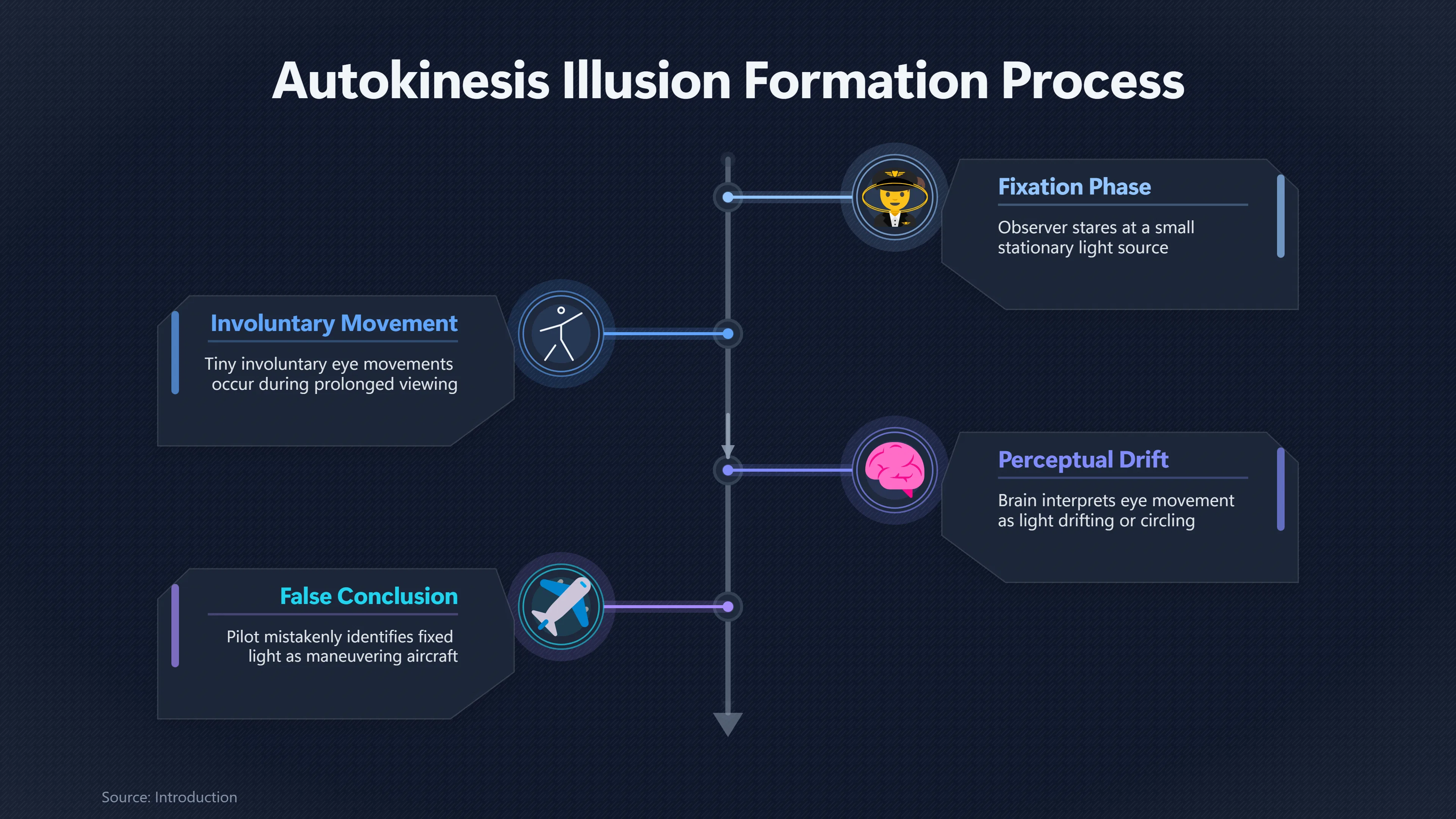
A separate mechanism, known as autokinesis, affects the perceived motion of individual lights.
When a person stares at a small stationary light against a dark background for several seconds, tiny involuntary eye movements can make the light appear to drift, wobble or trace small circles. The light itself has not moved, but the observer experiences convincing apparent motion. Transport Canada identifies autokinesis as a recognised aviation hazard because it has contributed to pilots mistakenly believing that a star, distant ground light or other fixed source was another aircraft manoeuvring nearby.[Transport Canada]tc.canada.caTransport Canada Handbook for Civil Aviation Medical ExaminersTransport CanadaHandbook for Civil Aviation Medical Examiners - TP 13312…
Several factors can strengthen this illusion:
- prolonged fixation on a single bright light;
- a dark sky with few surrounding reference points;
- the observer’s own aircraft changing heading or descending;
- atmospheric clarity that makes distant lights appear unusually bright.
Importantly, autokinesis rarely produces large, rapid movements across the sky. Instead, observers typically describe gentle drifting, circling, oscillation or hovering behaviour. Those descriptions overlap with some pilot reports of unidentified lights, which is why investigators routinely consider the illusion before proposing more unusual explanations.[Transport Canada]tc.canada.caTransport Canada Handbook for Civil Aviation Medical ExaminersTransport CanadaHandbook for Civil Aviation Medical Examiners - TP 13312…
Could this explain the Yellowknife lights?
The reported lights near Yellowknife have features that both support and challenge an illusion-based interpretation.
Several aspects fit recognised night-flying mechanisms:
- the observations occurred during a night descent over dark terrain and water;
- the lights were viewed against a largely featureless background;
- the crew’s estimates of the lights’ position changed during the approach;
- the reported movement included circling or “dancing”, behaviour consistent with how autokinetic motion is often described.[Transport Canada]tc.canada.caTransport Canada Handbook for Civil Aviation Medical ExaminersTransport CanadaHandbook for Civil Aviation Medical Examiners - TP 13312…
Changing estimates of altitude or distance do not necessarily imply that an object itself changed position. Because both the aircraft and the observers were moving, and because the lights lacked obvious background references, perceived location could shift significantly without any corresponding movement by the source. This is a well-documented limitation of night-time visual observation.[Transportation Safety Board of Canada]bst.gc.caTransportation Safety Board of CanadaAviation Investigation Report A08Q0231 - Transportation Safety Board of Canada…

Which parts of the crew’s account resist this explanation?
Visual illusions do not explain every element equally well.
One reason the Yellowknife report attracted attention is that it came from a professional flight crew who immediately queried air traffic control rather than assuming they had identified ordinary traffic. The observation also appears to have continued for much of the approach instead of lasting only a few seconds.
Autokinesis usually affects the apparent motion of one light that is being observed continuously. It does not automatically explain why observers would perceive two separate lights maintaining a relationship to one another, nor does it determine what the original light sources actually were. The illusion changes perceived motion, not the existence of the lights themselves.[Transport Canada]tc.canada.caTransport Canada Handbook for Civil Aviation Medical ExaminersTransport CanadaHandbook for Civil Aviation Medical Examiners - TP 13312…
Likewise, the absence of corresponding traffic information does not prove that the lights were extraordinary. Depending on their true distance and origin, they might have been celestial objects, distant ground lights, atmospheric effects or other light sources outside the crew’s initial expectations. Publicly available information has not established a definitive identification. The report therefore remains an unidentified observation rather than either a confirmed anomaly or a confirmed illusion.
What this mechanism contributes to the wider Yellowknife picture
For the broader subject of airports, pilots and unexplained lights near Yellowknife, night-flying illusions provide an important analytical tool rather than a complete explanation.
Great Slave Lake offers exactly the combination of dark water, sparse lighting and limited horizon cues that Canadian aviation safety authorities repeatedly identify as increasing the risk of visual misperception. That makes perceptual effects a plausible contributor whenever pilots report unusual light movement during night approaches.[canada.ca]tc.canada.caTransport Canada Hazards Associated with Flying at NightTransport CanadaHazards Associated with Flying at Night - PowerPoint PresentationJanuary 17, 2012…
At the same time, responsible investigation requires separating two questions:
- Did the lights genuinely appear to move? Human visual perception can readily produce that impression under northern night conditions.
- What produced the lights in the first place? The available public evidence does not conclusively answer that question for every Yellowknife report.
Viewed in that way, night-flying illusions neither dismiss nor confirm reports of unexplained lights. Instead, they explain why experienced crews operating over Great Slave Lake may honestly describe lights as circling, drifting or changing speed, even when those apparent movements originate in the interaction between human vision, a moving cockpit and one of Canada’s most visually featureless night-flying environments.

Amazon book picks
Further Reading
Books and field guides related to Could Night Illusions Explain the Yellowknife Lights?. Use these as the next step if you want deeper reading beyond the article.
UFOs: Generals, Pilots, and Government Officials Go on the Re...
NEW YORK TIMES BESTSELLER • Impeccably researched, this riveting journalistic investigation separates fact from fiction, and documents th...
The Invisible Gorilla
NEW YORK TIMES BESTSELLER • Our minds don’t work the way we think they do. Two renowned psychologists explain how and why our intuitions...
The Limits of Expertise: Rethinking Pilot Error and the Cause...
First published 2007. Subjects: Aircraft accidents, Case studies, Human factors, Investigation, Aéronautique.
Human Factors in Flight
First published 1987. Subjects: Human engineering, Airplanes, Design and construction, Flight, Flight, physiological aspects.
eBay marketplace picks
Marketplace Samples
Live-tested eBay searches with available results related to this page.
Selected fromYellowknife map print oneBay.co.uk.

Endnotes
1.
Source: tc.canada.ca
Title: Transport Canada Hazards Associated with Flying at Night
Link:https://tc.canada.ca/en/aviation/publications/system-safety-summer-briefing-kit-tp-14112/hazards-associated-flying-night-powerpoint-presentation
Source snippet
Transport CanadaHazards Associated with Flying at Night - PowerPoint PresentationJanuary 17, 2012...
Published: January 17, 2012
2.
Source: tc.canada.ca
Title: Transport Canada Handbook for Civil Aviation Medical Examiners
Link:https://tc.canada.ca/en/aviation/publications/handbook-civil-aviation-medical-examiners-tp-13312
Source snippet
Transport CanadaHandbook for Civil Aviation Medical Examiners - TP 13312...
3.
Source: tc.canada.ca
Title: Transport Canada Advisory Circular (AC) No. 603-001
Link:https://tc.canada.ca/en/aviation/reference-centre/advisory-circulars/advisory-circular-ac-no
Source snippet
603-001March 31, 2020 — ADVISORY CIRCULAR (AC) NO. 603-001 * ## Subject: Special Authorization for Night Vision Imaging Systems Operation...
Published: March 31, 2020
4.
Source: tsb.gc.ca
Link:https://tsb.gc.ca/eng/rapports-reports/aviation/2000/a00a0051/a00a0051.html
Source snippet
Aviation Investigation Report A00A0051 - Transportation Safety Board of Canada...
5.
Source: tsb.gc.ca
Link:https://www.tsb.gc.ca/eng/rapports-reports/aviation/2015/a15p0217/a15p0217.html
Source snippet
Aviation Investigation Report A15P0217 - Transportation Safety Board of Canada...
6.
Source: tc.canada.ca
Title: ca Black holes and little grey cells
Link:https://tc.canada.ca/en/aviation/general-operating-flight-rules/general-aviation-safety-video-gallery/black-holes-little-grey-cells-spatial-disorientation-during-nvfr
7.
Source: tsb.gc.ca
Link:https://tsb.gc.ca/eng/rapports-reports/aviation/2011/a11w0180/a11w0180.html
8.
Source: bst.gc.ca
Link:https://www.bst.gc.ca/eng/rapports-reports/aviation/2008/a08q0231/a08q0231.html
Source snippet
Transportation Safety Board of CanadaAviation Investigation Report A08Q0231 - Transportation Safety Board of Canada...
9.
Source: tsb-bst.gc.ca
Link:https://www.tsb-bst.gc.ca/eng/rapports-reports/aviation/2008/a08q0231/a08q0231.html
Additional References
10.
Source: sciencedirect.com
Title: The black hole illusion: A neglected source of aviation accidents
Link:https://www.sciencedirect.com/science/article/pii/S0169814121001530
Source snippet
January 1, 2022 — FUTURE DIRECTIONS FOR RESEARCH In conclusion, within the larger framework of situation awareness the black...
Published: January 1, 2022
11.
Source: medium.com
Title: Your Senses in the Shadows
Link:https://medium.com/faa/your-senses-in-the-shadows-5ed018e015b5
Source snippet
Nighttime Visual Illusions and Spatial… | by FAA Safety Briefing Magazine | Cleared for Takeoff | MediumJanuary 17, 2025 — Cleared for Ta...
Published: January 17, 2025
12.
Source: faa.gov
Link:https://www.faa.gov/Air_traffic/publications/atpubs/aim_html/chap8_section_1.html
13.
Source: faa.gov
Link:https://www.faa.gov/air_traffic/publications/atpubs/aip_html/chap8_section_1.html
14.
Source: faa.gov
Title: Federal Aviation Administration Chapter 8. Medical Facts for Pilots
Link:https://www.faa.gov/air_traffic/publications/atpubs/aim/aim0801.html
15.
Source: studocu.com
Title: airplane flying handbook faa h 8083 3c chapter 11 night operations
Link:https://www.studocu.com/en-us/document/embry-riddle-aeronautical-university/aerospace/airplane-flying-handbook-faa-h-8083-3c-chapter-11-night-operations/119520215
16.
Source: flight-study.com
Link:https://www.flight-study.com/2019/09/night-illusions.html
17.
Source: faasafety.gov
Title: Learning Center Library Contents
Link:https://www.faasafety.gov/gslac/ALC/libview_printerfriendly.aspx?id=6580
18.
Source: studylib.net
Title: pilot’s handbook of aeronautical knowledge
Link:https://studylib.net/doc/28388383/pilot%E2%80%99s-handbook-of-aeronautical-knowledge
19.
Source: kriso.ee
Title: Pilots Handbook of Aeronautical Knowledge
Link:https://www.kriso.ee/pilots-handbook-aeronautical-knowledge-db-97816287325596e.html