Within Angikuni Myth
How the Angikuni Mystery First Reached Newspapers
The earliest newspaper account was a distant, weakly documented report that introduced the core disappearance claim without naming the missing people.
On this page
- What the 1930 article actually claimed
- What the report failed to document
- How later writers changed the original account
Page outline Jump by section
Introduction
The Angikuni Lake disappearance story entered public view not through an official investigation or a report from northern Canada, but through a newspaper feature published far from the alleged scene. That matters because the first printed version established the basic outline of the legend while providing remarkably little evidence that the event had actually occurred. Before later writers added abandoned meals, mysterious lights, disturbed graves and other dramatic details, readers encountered a much simpler claim: a trapper had supposedly found an empty Inuit camp whose occupants had vanished. Understanding exactly what that first article said—and what it did not say—is essential to understanding why the Angikuni story remains a cautionary example of how an unverified newspaper report evolved into one of Canada’s best-known northern mysteries.[Wikipedia]WikipediaAngikuni LakeAngikuni Lake

How the Angikuni Mystery First Reached Newspapers
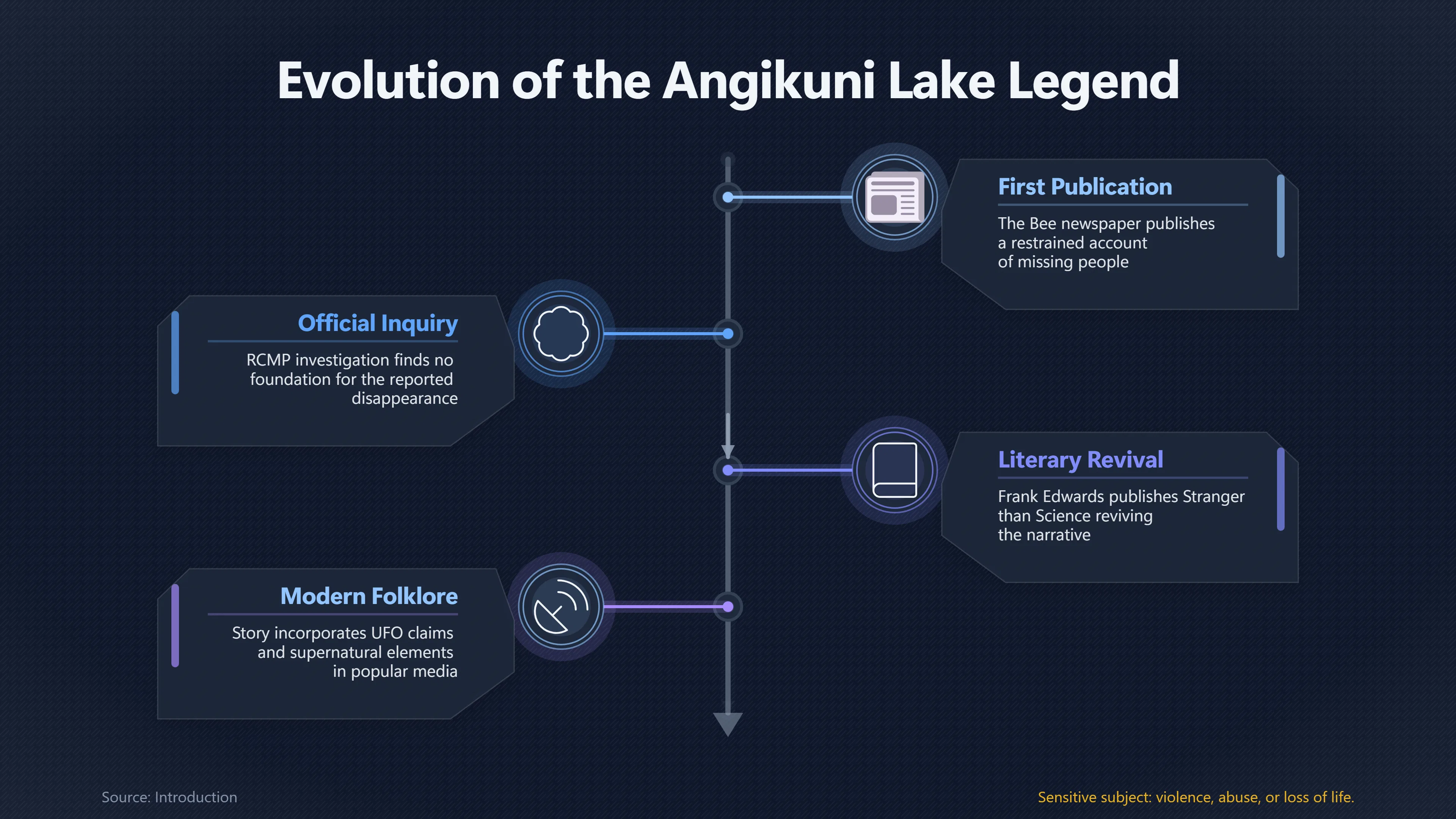
The earliest known published account appeared on 27 November 1930 in The Bee of Danville, Virginia, under the headline “Vanished Eskimo Tribe Gives North Mystery Stranger Than Fiction.” The story was credited to journalist Emmett E. Kelleher and centred on a trapper named Joe Labelle, who supposedly discovered an abandoned Inuit camp near Angikuni Lake after seeking shelter there.[Wikipedia]WikipediaAngikuni LakeAngikuni Lake
What is striking is where the story originated. Rather than appearing first in a newspaper serving northern Canada or the Northwest Territories (the region now forming part of Nunavut), it reached readers through a newspaper in the eastern United States. The article was then reproduced by other newspapers, allowing the account to circulate widely before any official response became publicly known. This pattern of republication helped transform a single, weakly sourced feature into a widely accepted anecdote.[Wikipedia]WikipediaAngikuni LakeAngikuni Lake
For readers interested in Nunavut’s place in Canadian UFO and mystery folklore, this publication history is significant. The story’s reputation rests less on documented events in the North than on how a dramatic newspaper narrative spread through the press.
What the 1930 Article Actually Claimed
The original article was noticeably more restrained than many later retellings. It described:
- a camp consisting of six tents;
- approximately 25 missing men, women and children;
- Labelle’s surprise at finding the camp deserted;
- an apparent absence of any explanation for where the occupants had gone.[Wikipedia]WikipediaAngikuni LakeAngikuni Lake
Just as important are the details that were not emphasised in this earliest version. The story did not describe thousands of missing people. Nor did it present elaborate UFO-related claims, alien abduction theories or many of the supernatural elements now commonly associated with the legend. Those features accumulated gradually over subsequent decades rather than appearing fully formed in 1930.[Wikipedia]WikipediaAngikuni LakeAngikuni Lake

What the Report Failed to Document
Measured against normal standards of reporting—even for 1930—the article left major questions unanswered.
No names were provided for the supposedly missing Inuit families. The settlement itself was not identified with enough precision to allow independent verification. The article included no list of witnesses beyond Labelle, no quotations from local residents, missionaries, traders or police, and no indication that any official search had confirmed the disappearance.[Wikipedia]WikipediaAngikuni LakeAngikuni Lake
The absence of documentary evidence is particularly important because a disappearance involving several families would normally be expected to generate multiple independent records, including:
- police correspondence;
- trading-post reports;
- missionary observations;
- accounts from neighbouring Inuit groups;
- or later confirmation that identified individuals had genuinely disappeared.
None accompanied the newspaper feature. Instead, readers received a dramatic narrative built around a single reported witness whose account could not be independently checked from the information supplied.[Wikipedia]WikipediaAngikuni LakeAngikuni Lake
This weakness in documentation explains why historians generally treat the newspaper article as the beginning of the legend rather than as evidence that the disappearance itself occurred.
How Later Writers Changed the Original Account
The 1930 newspaper story supplied the basic framework, but later authors greatly expanded it.
Frank Edwards’s 1959 book Stranger than Science helped revive the largely forgotten article nearly three decades later. In the process, the story became more dramatic. The number of missing people shifted, additional details appeared, and later retellings increasingly included abandoned meals, starving sled dogs, disturbed graves and mysterious lights in the sky. Still later versions inflated the missing population from a few dozen people to hundreds or even thousands.[wikipedia.org]WikipediaAngikuni LakeAngikuni Lake
This gradual embellishment is important because many details now regarded as defining features of the Angikuni mystery cannot be traced to the earliest newspaper account. Instead, they accumulated through repeated retelling, with each generation of writers adding memorable elements that made the story more suitable for books on unexplained mysteries and, eventually, UFO literature.[Wikipedia]WikipediaAngikuni LakeAngikuni Lake

Why the First Publication Still Matters
The history of the 1930 article illustrates how legends can develop from a small amount of poorly documented reporting. The newspaper feature did not prove that an Inuit community disappeared, but it did establish a narrative powerful enough to survive long after investigators challenged its credibility.
When inquiries reached the Royal Canadian Mounted Police, an internal investigation reportedly concluded in early 1931 that there was “no foundation” for the story, questioning both its factual basis and aspects of Labelle’s reported background. Those findings never achieved the same popular circulation as the original newspaper feature or the later paranormal retellings.[Wikipedia]WikipediaAngikuni LakeAngikuni Lake
Within the broader examination of the Angikuni Lake disappearance myth, the first newspaper article is therefore best understood not as confirmation of an extraordinary event, but as the point at which an unverified northern anecdote entered mass circulation. Its historical importance lies in demonstrating how a lightly sourced report, once reproduced and embellished, became one of the enduring legends associated with the Canadian Arctic and, much later, with Nunavut’s place in UFO folklore.[Wikipedia]WikipediaAngikuni LakeAngikuni Lake
Amazon book picks
Further Reading
Books and field guides related to How the Angikuni Mystery First Reached Newspapers. Use these as the next step if you want deeper reading beyond the article.
Extraordinary Popular Delusions and the Madness of Crowds
Rating: 4.0/5 from 5 Google Books ratings
First published in 1841, Extraordinary Popular Delusions and the Madness of Crowds is often cited as the best book ever written about mar...
Arctic Dreams
To write this book, the author travelled widely in the Arctic, with Eskimos, biologists, archaeologists and landscape painters, among oth...

The Vanishing Hitchhiker
First published 1981. Subjects: History and criticism, Legends, Urban folklore, Légendes, Folklore urbain.
eBay marketplace picks
Marketplace Samples
Live-tested eBay searches with available results related to this page.
Selected fromUFO poster oneBay.co.uk.

Current eBay listing
I Want To Believe UFO Poster Giclée Fine Art Heavyweight Print

Current eBay listing
VINTAGE UFO FLYING SAUCERS COMIC ADVERTISING A2 POSTER PRINT


Endnotes
1.
Source: Wikipedia
Title: Angikuni Lake
Link:https://en.wikipedia.org/wiki/Angikuni_Lake
2.
Source: unsolvedreport.com
Title: Lake Anjikuni: The Vanished Village That Never Existed | Unsolved Report
Link:https://unsolvedreport.com/en/lake-anjikuni-vanished-village/
Source snippet
June 22, 2022 — Strange History LAKE ANJIKUNI: THE VANISHED VILLAGE THAT NEVER EXISTED By Elliot Marsh · Published 2022-06-22 2,000 peopl...
Published: June 22, 2022
3.
Source: lva.virginia.gov
Link:https://www.lva.virginia.gov/public/vnd/results.php?cities=Danville
4.
Source: old.lva.virginia.gov
Link:https://old.lva.virginia.gov/public/vnd/results.php?cities=Danville
5.
Source: books.google.com
Link:https://books.google.com/books?id=_z_XAAAAMAAJ
Additional References
6.
Source: touristmaker.com
Link:https://www.touristmaker.com/dark-hidden/the-village-that-wasnt-there-anjikuni-lake-and-the-legend-that-refused-to-die/
Source snippet
The Village That Wasn't There: Anjikuni Lake and the Legend That Refused to DieJune 18, 2026 — THE VILLAGE THAT WASN’T THERE: ANJIKUNI LA...
Published: June 18, 2026
7.
Source: thedarkatlas.com
Title: KELLEHER The version of the story the world received was not Labelle’s
Link:https://thedarkatlas.com/posts/anjikuni-lake-disappearance-legend-canada
Source snippet
Angikuni Lake: The Vanished Inuit Village MysteryApril 30, 2026 — HOW THE STORY REACHED THE WORLD: FROM LABELLE'S TELEGRAM TO THE HALIFAX...
Published: April 30, 2026
8.
Source: handwiki.org
Title: The village had always welcomed the fur trappers who passed throu
Link:https://handwiki.org/wiki/Unsolved%3AAngikuni_Lake
Source snippet
Unsolved:Angikuni Lake - HandWikiMay 25, 2026 — LEGEND OF THE VANISHING VILLAGE In 1930, a newsman in The Pas, Manitoba reported on a sma...
Published: May 25, 2026
9.
Source: nature.com
Link:https://www.nature.com/articles/120115a0
10.
Source: timesofindia.indiatimes.com
Link:https://timesofindia.indiatimes.com/etimes/trending/dogs-starved-food-left-uneaten-this-entire-village-disappeared-overnight-without-any-clue/articleshow/124335029.cms
Source snippet
starved, food left uneaten: This entire village disappeared overnight without any clue | - The Times of IndiaOctober 6, 2025 — This story...
Published: October 6, 2025
11.
Source: timesofindia.indiatimes.com
Title: The origin
Link:https://timesofindia.indiatimes.com/etimes/trending/dogs-starved-food-left-uneaten-this-entire-village-disappeared-overnight-without-any-clue/amp_articleshow/124335029.cms
Source snippet
starved, food left uneaten: This entire village disappeared overnight without any clue | - The Times of IndiaOctober 6, 2025 — The myster...
Published: October 6, 2025
12.
Source: vocal.media
Link:https://vocal.media/fyi/the-angikuni-lake-vanishing
13.
Source: vocal.media
Link:https://vocal.media/horror/the-lost-people-of-angikuni-lake
14.
Source: paranormalpeopleonline.com
Link:https://paranormalpeopleonline.com/the-angikuni-mystery-the-case-of-the-missing-village/
15.
Source: lanavedemisterio.blogspot.com
Title: La Nave del Misterio: La extraña desaparición del pueblo de Anjikuni
Link:https://lanavedemisterio.blogspot.com/2015/03/la-extrana-desaparicion-del-pueblo-de.html