Within Sky Explanations
How Tagish Lake Stopped Being a UFO
Photographs, shock-wave recordings, satellite data and recovered fragments turned a spectacular Yukon sighting into a securely identified meteorite fall.
On this page
- What Yukon witnesses saw on 18 January 2000
- How photographs and instruments reconstructed the flight
- Why the recovered fragments settled the identification
Page outline Jump by section
Introduction
The Tagish Lake fireball of 18 January 2000 is one of the strongest examples in Yukon’s UFO history of an extraordinary aerial event that was rapidly and conclusively identified through multiple independent lines of evidence. Witnesses across southern Yukon, northern British Columbia and Alaska reported an exceptionally bright object, vivid colours, a persistent trail and delayed sonic booms—features that can easily lead observers to wonder whether they have seen something unusual or even unidentified. In this case, however, photographs, seismic and infrasound recordings, satellite observations, eyewitness reports and, ultimately, recovered meteorite fragments all pointed to the same conclusion: the object was a natural meteoroid that broke apart in Earth’s atmosphere.[nih.gov]pubmed.ncbi.nlm.nih.govThe fall, recovery, orbit, and composition of the Tagish Lake meteorite: a new type of carbonaceous chondrite - PubMedOctober 13, 2000…
Within the wider history of Yukon UFO reports, the Tagish Lake event is valuable precisely because it demonstrates how a spectacular sight can move from apparent mystery to high-confidence identification when several independent forms of evidence converge.
What Yukon witnesses saw on 18 January 2000
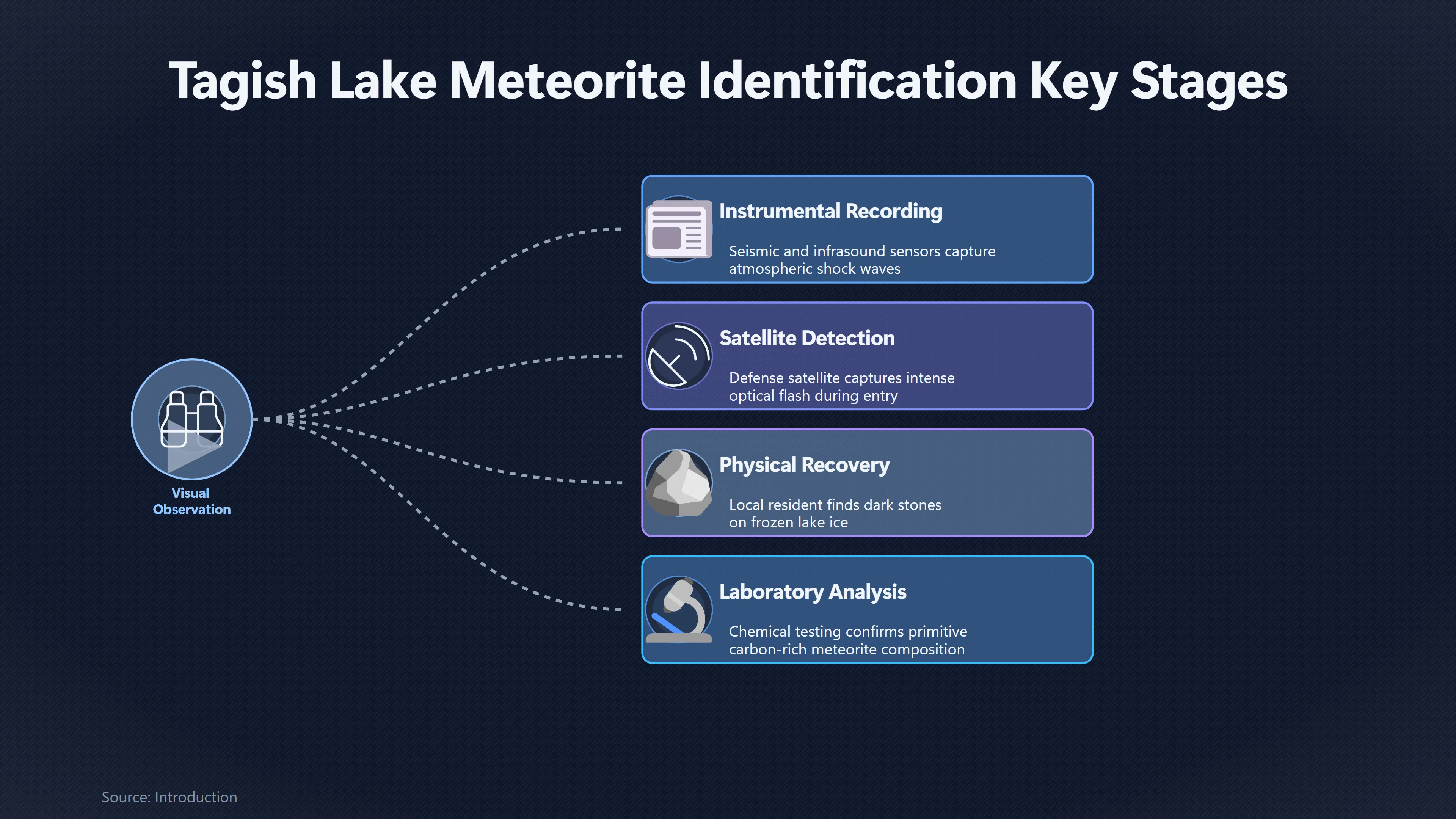
At approximately 8:43 a.m. local time, people across southern Yukon saw a brilliant fireball race across the winter sky. The object was visible in daylight, making it especially dramatic. Witnesses described an intensely bright white core surrounded by changing colours, a glowing trail that lingered after the object itself had disappeared, and loud explosions several minutes later as atmospheric shock waves reached the ground.[Wiley Online Library]onlinelibrary.wiley.comOnline Library The fall and recovery of the Tagish Lake meteoriteWiley Online LibraryThe fall and recovery of the Tagish Lake meteorite - Hildebrand - 2006 - Meteoritics & Planetary Science - Wiley Onli…
For anyone watching without additional information, these observations could easily have resembled the kind of event often reported as a UFO:
- an object apparently brighter than the Sun;
- rapidly changing colours;
- visible fragmentation into multiple glowing pieces;
- a persistent cloud-like trail;
- delayed booms arriving well after the light had vanished.
These characteristics are not unusual for very large meteor entries, but they are also features that have historically encouraged UFO speculation when only eyewitness testimony is available.
The importance of Yukon observations was geographical as well as historical. Reports from Whitehorse and surrounding communities helped define the object’s direction of travel and allowed investigators to compare observations from many different locations instead of relying on a single account.[Wiley Online Library]onlinelibrary.wiley.comOnline Library The fall and recovery of the Tagish Lake meteoriteWiley Online LibraryThe fall and recovery of the Tagish Lake meteorite - Hildebrand - 2006 - Meteoritics & Planetary Science - Wiley Onli…
How photographs and instruments reconstructed the flight
The identification did not depend on one dramatic photograph or one expert opinion. Instead, investigators combined several independent sources of information, each checking the others.
Photographs of the persistent trail
Several photographs captured the unusual cloud-like trail left after the brightest phase of the fireball. Because the trail drifted in the upper atmosphere, researchers could compare its changing shape with wind conditions and determine the object’s flight path far more accurately than eyewitness memory alone would allow. The photographs also provided precise reference points against the surrounding landscape, improving trajectory calculations.[Wiley Online Library]onlinelibrary.wiley.comOnline Library The fall and recovery of the Tagish Lake meteoriteWiley Online LibraryThe fall and recovery of the Tagish Lake meteorite - Hildebrand - 2006 - Meteoritics & Planetary Science - Wiley Onli…
Seismic and infrasound recordings
Although the meteoroid disintegrated high above the ground, its shock wave travelled through the atmosphere and into the Earth’s surface.
Scientists analysed:
- seismic stations that recorded the passage of the air wave;
- infrasound sensors that detected extremely low-frequency sound over long distances;
- the timing differences between multiple instruments.
These measurements allowed researchers to estimate the fireball’s energy release, fragmentation height and direction of travel independently of what witnesses reported. The reconstructed energy was consistent with a large natural meteoroid rather than an aircraft accident or spacecraft re-entry.[HERO]hero.epa.govOpen source on epa.gov.
Satellite observations
A United States defence satellite also detected the intense optical flash produced during the final stages of atmospheric entry.
Satellite measurements supplied an independent estimate of the fireball’s brightness and energy output. When combined with ground observations and atmospheric modelling, they showed that all datasets described the same event and produced a coherent reconstruction of the object’s trajectory through the atmosphere.[HERO]hero.epa.govOpen source on epa.gov.
This convergence was especially significant. Even if one source of evidence had been questioned—for example, eyewitness estimates of brightness or direction—the remaining measurements still supported the same explanation.
Why the recovered fragments settled the identification
The decisive step came only days later.
On the frozen surface of Tagish Lake in northern British Columbia, close to the Yukon border, local resident Jim Brook found dark stones resting on clean lake ice. Because many fragments were collected while still frozen and before prolonged contact with soil or liquid water, scientists obtained unusually uncontaminated samples. A later recovery expedition documented a strewn field roughly 16 kilometres long and several kilometres wide, matching the predicted fall area derived from trajectory calculations.[Wiley Online Library]onlinelibrary.wiley.comOnline Library The fall and recovery of the Tagish Lake meteoriteWiley Online LibraryThe fall and recovery of the Tagish Lake meteorite - Hildebrand - 2006 - Meteoritics & Planetary Science - Wiley Onli…
The recovered material answered the remaining question that no photograph or instrument alone could resolve: what had actually entered the atmosphere?
Laboratory examination showed that the fragments were an exceptionally primitive carbon-rich meteorite unlike most known meteorite types. Their mineralogy, chemistry and isotopic composition confirmed that the object was a natural Solar System body rather than debris from a spacecraft or any other artificial source. Researchers also reconstructed its pre-atmospheric orbit, indicating that it originated from an asteroid-like orbit consistent with known near-Earth objects.[PubMed]pubmed.ncbi.nlm.nih.govThe fall, recovery, orbit, and composition of the Tagish Lake meteorite: a new type of carbonaceous chondrite - PubMedOctober 13, 2000…
Because the debris field appeared exactly where the reconstructed flight predicted, the recovered stones provided physical confirmation of every earlier stage of the investigation.
Why this case matters in Yukon UFO history
Many UFO reports remain difficult to resolve because investigators have only witness recollections, sometimes recorded long after the event. The Tagish Lake fireball is fundamentally different.
Its identification rests on several independent forms of evidence that reinforce one another:
- numerous eyewitness reports from different locations;
- photographs showing the persistent atmospheric trail;
- seismic recordings of the air wave;
- infrasound measurements of the explosion;
- satellite detection of the fireball;[aquarid.physics.uwo.ca]aquarid.physics.uwo.caca Meteor PhysicsPhysicsDecember 14, 2011 — FIREBALL EVENTS THE TAGISH LAKE FIREBALL AND METEORITE [18-JAN-2000] FIRST EXPEDITION PHOTOS * Tagish Lake Met…
- trajectory reconstruction;
- recovery of meteorite fragments in the predicted fall zone;[pnnl.gov]pnnl.govfall and recovery tagish lake meteoriteThe Fall and Recovery of the Tagish Lake Meteorite | Journal Article | PNNLMarch 1, 2006 — March 1, 2006 Journal Article THE FALL AND REC…
- laboratory confirmation of the meteorite’s composition and origin.[wiley.com]onlinelibrary.wiley.comOnline Library The fall and recovery of the Tagish Lake meteoriteWiley Online LibraryThe fall and recovery of the Tagish Lake meteorite - Hildebrand - 2006 - Meteoritics & Planetary Science - Wiley Onli…
For readers exploring Yukon’s history of unusual aerial phenomena, the Tagish Lake event illustrates an important principle. Extraordinary appearances do not necessarily indicate an unidentified object. In this case, the spectacular visual display was entirely real, but every major line of evidence pointed to the same explanation. Rather than becoming a lasting UFO mystery, the fireball became one of northern Canada’s best-documented meteorite falls and a benchmark example of how multiple scientific observations can transform an astonishing sight into a securely identified natural event.
Amazon book picks
Further Reading
Books and field guides related to How Tagish Lake Stopped Being a UFO. Use these as the next step if you want deeper reading beyond the article.
Meteorite: The Stones from Alien Worlds
Meteorite tells the fascinating story of the stones from outer space scattered across our planet. From the impact that finished off the d...
Rocks from Space: Meteorites and Meteorite Hunters
Appendices A-C: Meteorite verification laboratories, Commercial meteorite dealers, Selected list of suspected impact craters worldwide.
The Cambridge Encyclopedia of Meteorites
Beautifully illustrated with over 140 full colour images, The Cambridge Encyclopedia of Meteorites provides a thorough guide to these fas...
Meteorites: The Story of Our Solar System
Meteorite tells the fascinating story of the stones from outer space scattered across our planet. From the impact that finished off the d...
eBay marketplace picks
Marketplace Samples
Live-tested eBay searches with available results related to this page.
Selected frommeteorite display oneBay.co.uk.

Endnotes
1.
Source: onlinelibrary.wiley.com
Title: Online Library The fall and recovery of the Tagish Lake meteorite
Link:https://onlinelibrary.wiley.com/doi/10.1111/j.1945-5100.2006.tb00471.x
Source snippet
Wiley Online LibraryThe fall and recovery of the Tagish Lake meteorite - Hildebrand - 2006 - Meteoritics & Planetary Science - Wiley Onli...
2.
Source: hero.epa.gov
Link:https://hero.epa.gov/reference/7684988/
3.
Source: onlinelibrary.wiley.com
Title: j.1945 5100.2006.tb00471.x
Link:https://onlinelibrary.wiley.com/doi/abs/10.1111/j.1945-5100.2006.tb00471.x
Source snippet
Hildebrand, Corresponding Author Alan R. Hildebrand Department of Geology and Geophysics, University of Calgary, Calgary, Alberta T2N 1N...
4.
Source: onlinelibrary.wiley.com
Title: j.1945 5100.2002.tb00846.x
Link:https://onlinelibrary.wiley.com/doi/10.1111/j.1945-5100.2002.tb00846.x
5.
Source: youtube.com
Title: Tagish Lake meteorite
Link:https://www.youtube.com/watch?v=WjA3MsA5gIU
Source snippet
Iconic: Tagish Lake Meteorite...
6.
Source: youtube.com
Title: CARBONACEOUS CHONDRITES (METEORITES) ☄️
Link:https://www.youtube.com/watch?v=VaSNnMRQaKA
Source snippet
Tagish Lake meteorite - Public's first look (2000) Vintage Broadcasting System · 1.8K views Iconic: Tagish Lake Meteorite Royal Ontario M...
7.
Source: pubmed.ncbi.nlm.nih.gov
Link:https://pubmed.ncbi.nlm.nih.gov/11030647/
Source snippet
The fall, recovery, orbit, and composition of the Tagish Lake meteorite: a new type of carbonaceous chondrite - PubMedOctober 13, 2000...
Published: October 13, 2000
8.
Source: researchgate.net
Title: 228626039 The fall and recovery of the Tagish Lake meteorite
Link:https://www.researchgate.net/publication/228626039_The_fall_and_recovery_of_the_Tagish_Lake_meteorite
Source snippet
The fall and recovery of the Tagish Lake meteorite | Request PDFMarch 1, 2006 — Article THE FALL AND RECOVERY OF THE TAGISH LAKE METEORIT...
Published: March 1, 2006
9.
Source: pnnl.gov
Title: fall and recovery tagish lake meteorite
Link:https://www.pnnl.gov/publications/fall-and-recovery-tagish-lake-meteorite
Source snippet
The Fall and Recovery of the Tagish Lake Meteorite | Journal Article | PNNLMarch 1, 2006 — March 1, 2006 Journal Article THE FALL AND REC...
Published: March 1, 2006
Additional References
10.
Source: pnnl.gov
Link:https://www.pnnl.gov/publications/fall-recovery-orbit-and-composition-tagish-lake-meteorite-new-type-carbonaceous
11.
Source: aquarid.physics.uwo.ca
Title: ca Meteor Physics
Link:https://aquarid.physics.uwo.ca/research/fireball/events/tagish/firstexpedition_photos.html
Source snippet
PhysicsDecember 14, 2011 — FIREBALL EVENTS THE TAGISH LAKE FIREBALL AND METEORITE [18-JAN-2000] FIRST EXPEDITION PHOTOS * Tagish Lake Met...
Published: December 14, 2011
12.
Source: youtube.com
Title: Canadian Meteorite Could Hold Clue To The Origins Of Life
Link:https://www.youtube.com/watch?v=5ANBqYqyez4
Source snippet
Hunting The Nighttime Fireball Of The Buzzard Coulee Meteorite...
13.
Source: researchgate.net
Link:https://www.researchgate.net/publication/235240616_The_Fall_Recovery_Orbit_and_Composition_of_the_Tagish_Lake_Meteorite_A_New_Type_of_Carbonaceous_Chondrite
14.
Source: aquarid.physics.uwo.ca
Link:https://aquarid.physics.uwo.ca/research/fireball/events/tagish/recovery_article.html
15.
Source: cir.nii.ac.jp
Link:https://cir.nii.ac.jp/crid/1362262944463029120
16.
Source: aquarid.physics.uwo.ca
Link:https://aquarid.physics.uwo.ca/~pbrown/tagish/index.html
17.
Source: heraldnet.com
Link:https://www.heraldnet.com/2000/10/12/meteorite-fragments-provide-scientists-clues-to-lifes-origin-on-earth/
18.
Source: cir.nii.ac.jp
Title: nii.ac.jp The fall and recovery of the Tagish Lake meteorite | Ci Nii Research
Link:https://cir.nii.ac.jp/crid/1362544421236939648
19.
Source: youtube.com
Title: Iconic: Tagish Lake Meteorite
Link:https://www.youtube.com/watch?v=OlZx-H0qmPk
Source snippet
Canadian Meteorite Could Hold Clue To The Origins Of Life...