Within Aircrew Cases
Did Radar Really Confirm the Labrador UFO?
The interceptor detected the BOAC airliner, but surviving accounts do not show a confirmed radar return from the reported objects.
On this page
- What the F 94 crew actually reported
- Limits of Goose Bay radar coverage
- How later retellings strengthened the claim
Page outline Jump by section
Introduction
The short answer is no. Although the 29 June 1954 BOAC aircrew encounter over Labrador is frequently described as a “radar-confirmed” UFO case, the surviving evidence does not support that claim. Contemporary accounts show that a United States Air Force F-94 interceptor used its airborne radar to acquire the British airliner, not the reported formation. Later official reviews, including the University of Colorado’s Condon Report, explicitly noted that no radar contact with the reported objects was obtained. This distinction matters because later retellings often transformed a visual aviation case into a combined visual-and-radar incident, making it appear stronger than the surviving documentation justifies.[files.ncas.org]files.ncas.orgCondon Report, Sec III, Chapter 5: Optical & Radar AnalysisCondon Report, Sec III, Chapter 5: Optical & Radar Analysis
What the F-94 crew actually reported
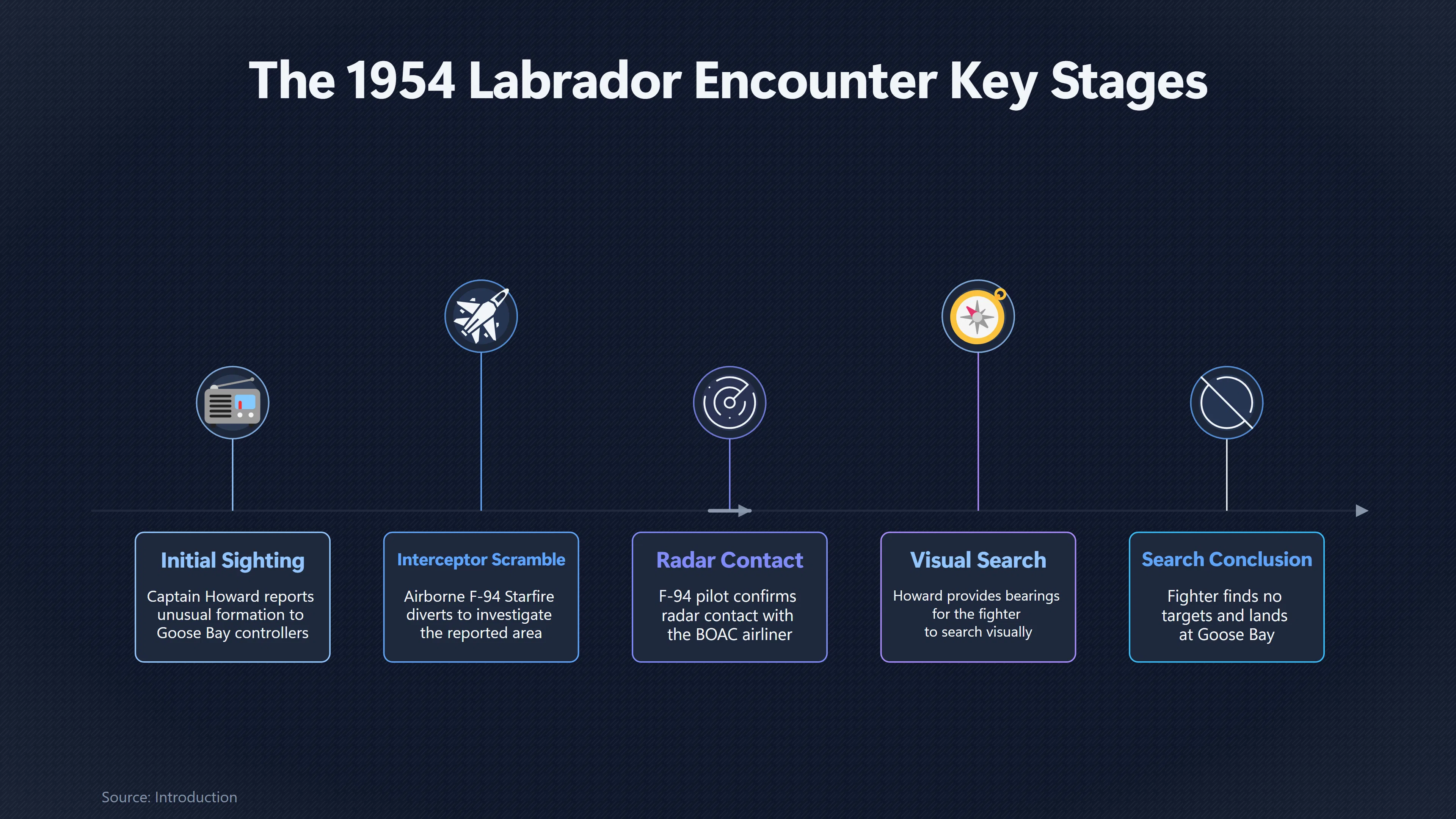
When Captain James Howard reported the unusual formation to Goose Bay, controllers arranged for a United States Air Force F-94 Starfire interceptor that was already airborne to investigate. Howard later recalled changing radio frequency to speak directly with the fighter crew.
The crucial detail is the wording of that exchange. According to Howard’s own account, the interceptor pilot said he had the BOAC Stratocruiser on radar while closing head-on at roughly 20 miles. Howard then passed the bearing of the mysterious formation relative to his own aircraft so that the fighter could search visually in the correct direction. He did not report that the interceptor had acquired the unidentified objects on radar.[ncas.org]files.ncas.orgCondon Report, Sec III, Chapter 5: Optical & Radar AnalysisCondon Report, Sec III, Chapter 5: Optical & Radar Analysis
This distinction is important because airborne interception radar in the early 1950s was designed to locate aircraft. Saying that the F-94 had radar contact with the airliner is entirely expected during an interception and should not be interpreted as evidence that it tracked the reported formation.
Later research drawing on pilot interviews likewise indicates that the interceptor crew found neither a visual target nor a radar target matching the reported objects before abandoning the search and landing at Goose Bay.[Martin Shough]martinshough.comBOAC aircrew sightingMartin ShoughBOAC aircrew sighting, Labrador, Newfoundland, June 29, 1954November 13, 2009…
Limits of Goose Bay radar coverage
Another source of confusion comes from assumptions about Goose Bay’s military facilities. Goose Bay was an important Cold War base, but that does not mean its radar systems automatically recorded everything reported in nearby airspace.
Available evidence suggests:
- Goose Bay controllers could coordinate an interception and track conventional aircraft.
- No surviving primary radar record has been produced showing the reported formation.
- The Condon investigation specifically stated that no radar contact was made in this incident despite the military response.[files.ncas.org]files.ncas.orgCondon Report, Sec III, Chapter 5: Optical & Radar AnalysisCondon Report, Sec III, Chapter 5: Optical & Radar Analysis
Some later writers have referred to radar at Cartwright or other installations in Labrador, but these claims are not supported by accessible contemporary radar logs. Researchers who examined the surviving documentation have found no verified radar record demonstrating that military operators tracked the reported objects.[Martin Shough]martinshough.comBOAC aircrew sightingMartin ShoughBOAC aircrew sighting, Labrador, Newfoundland, June 29, 1954November 13, 2009…
How later retellings strengthened the claim
As the Labrador encounter became one of the better-known aviation UFO cases, the radar element gradually became more dramatic in secondary accounts.
Several recurring embellishments appear in later literature:
- Ground radar supposedly tracked the formation. Contemporary documentation does not confirm this.
- The interceptor obtained a radar lock on the objects. Howard’s own account refers only to radar contact with the BOAC aircraft.
- The scramble proves radar detection. Available evidence indicates the F-94 was already airborne and diverted to investigate rather than launched because radar had detected an unknown target.[Martin Shough]martinshough.comBOAC aircrew sightingMartin ShoughBOAC aircrew sighting, Labrador, Newfoundland, June 29, 1954November 13, 2009…
Some modern summaries continue to repeat claims of radar confirmation without identifying a surviving radar log or official report. In contrast, the Condon Report and later technical analyses remain noticeably more cautious, separating what witnesses actually observed from what radar systems demonstrably recorded.[files.ncas.org]files.ncas.orgCondon Report, Sec III, Chapter 5: Optical & Radar AnalysisCondon Report, Sec III, Chapter 5: Optical & Radar Analysis
Why the missing radar evidence matters
The absence of confirmed radar returns does not mean the witnesses fabricated their experience. Captain Howard, his flight crew and numerous passengers consistently reported observing an unusual formation for many minutes, making this one of the more substantial visual aviation cases associated with Newfoundland and Labrador.
However, the lack of corroborating radar evidence changes how historians and investigators assess the case. Without independent instrument confirmation:
- the formation’s true distance cannot be established;
- its apparent size and speed remain uncertain because they depended on visual estimation;
- atmospheric optical effects remain a plausible explanation for at least some reported features, particularly the changing outline of the larger object.[files.ncas.org]files.ncas.orgCondon Report, Sec III, Chapter 5: Optical & Radar AnalysisCondon Report, Sec III, Chapter 5: Optical & Radar Analysis
For this reason, the Labrador encounter occupies an intermediate position in Canadian UFO history. It is stronger than many single-witness reports because of the experienced aviation observers and the prolonged observation, but weaker than a genuine radar-visual case because the instrumental evidence never materialised.
The most accurate assessment
The best-supported conclusion is straightforward: military authorities responded to the BOAC crew’s report, and an F-94 interceptor established radar contact with the airliner during the interception. What has not been demonstrated is that either the interceptor’s radar or ground-based military radar tracked the reported formation itself.
That distinction is often lost in popular retellings, but it remains one of the key points separating the documented record from later legend. The surviving evidence therefore supports describing the 1954 Labrador incident as a well-documented visual aircrew encounter with military involvement, rather than a confirmed military radar tracking case.[ncas.org]files.ncas.orgCondon Report, Sec III, Chapter 5: Optical & Radar AnalysisCondon Report, Sec III, Chapter 5: Optical & Radar Analysis
Amazon book picks
Further Reading
Books and field guides related to Did Radar Really Confirm the Labrador UFO?. Use these as the next step if you want deeper reading beyond the article.
The UFO Experience: A Scientific Inquiry
Cited by the New York Review of Books as "the best brief for visitation," this classic study presents an analysis of UFO reports and conc...
UFOs: Generals, Pilots, and Government Officials Go on the Re...
NEW YORK TIMES BESTSELLER • Impeccably researched, this riveting journalistic investigation separates fact from fiction, and documents th...
The Report on Unidentified Flying Objects
Book Excerpt: ing can never be positively identified. It might have been a hallucination or it might have been some vehicle from outer sp...
Introduction to Radar Systems
Since the publication of the second edition of "Introduction to Radar Systems," there has been continual development of new radar capabil...
eBay marketplace picks
Marketplace Samples
Live-tested eBay searches with available results related to this page.
Selected fromaviation poster oneBay.co.uk.

Endnotes
1.
Source: files.ncas.org
Title: Condon Report, Sec III, Chapter 5: Optical & Radar Analysis
Link:https://files.ncas.org/condon/text/s3chap05.htm
2.
Source: nicap.org
Title: BOA C Case: UFOS Follow British Airliner Over Labrador
Link:https://www.nicap.org/reports/boac.htm
3.
Source: nicap.org
Link:https://www.nicap.org/ufoe/section_10.htm
4.
Source: files.ncas.org
Link:https://files.ncas.org/condon/text/contents.htm
5.
Source: files.ncas.org
Link:https://files.ncas.org/condon/text/s6chap05.htm
6.
Source: files.ncas.org
Link:https://files.ncas.org/condon/text/s3chap01.htm
7.
Source: martinshough.com
Title: BOAC aircrew sighting
Link:https://www.martinshough.com/aerialphenomena/BOAC%20aircrew%20sighting.pdf
Source snippet
Martin ShoughBOAC aircrew sighting, Labrador, Newfoundland, June 29, 1954November 13, 2009...
Published: June 29, 1954
8.
Source: caelestia.be
Link:https://www.caelestia.be/BOAC.html
9.
Source: nrc-publications.canada.ca
Link:https://nrc-publications.canada.ca/eng/view/object/?id=cf0ba88e-70fd-4d08-9bc7-f251945a97ff
Additional References
10.
Source: uapdiscovery.discourse.group
Title: june 29 1954 seven islands quebec the boac stratocruiser case flying jellyfish
Link:https://uapdiscovery.discourse.group/t/june-29-1954-seven-islands-quebec-the-boac-stratocruiser-case-flying-jellyfish/214
Source snippet
June 29, 1954 — Seven Islands, Quebec — The BOAC Stratocruiser Case / Flying Jellyfish - Blue Book Unknowns - UAP Discovery ForumJune 29...
Published: June 29, 1954
11.
Source: cambridge.org
Title: J. Wylie Show author details * * * F. J. Wylie Affiliation: (Radio Advisory
Link:https://www.cambridge.org/core/journals/journal-of-navigation/article/survey-of-five-years-progress-in-marine-radar/4361279206C3B5F7D8E74166C64D5A0E
Source snippet
A Survey of Five Years' Progress in Marine Radar | The Journal of Navigation | Cambridge CoreJanuary 18, 2010 — A SURVEY OF FIVE YEARS' P...
Published: January 18, 2010
12.
Source: kevinrandle.blogspot.com
Title: A Different Perspective: Coast to Coast AM
Link:https://kevinrandle.blogspot.com/2023/03/coast-to-coast-am-labrador-sighting.html
Source snippet
FRIDAY, MARCH 31, 2023 COAST TO COAST AM - THE LABRADOR SIGHTING FROM 1954 There are some cases in the Blue Boo...
Published: March 31, 2023
13.
Source: youtube.com
Link:https://www.youtube.com/watch?v=tmH39EfqFls
Source snippet
Bethune/Gander UFO Incident, Newfoundland Canada 1951 eeasynow · 5.1K views...
14.
Source: youtube.com
Link:https://www.youtube.com/watch?v=6Oq_iWc0HTM
Source snippet
Bethune/Gander UFO Incident, Newfoundland Canada 1951...
15.
Source: media.nationalarchives.gov.uk
Title: cold war ufos
Link:https://media.nationalarchives.gov.uk/index.php/cold-war-ufos/
Source snippet
Cold War and UFOs | The National ArchivesMay 23, 2019 — The unidentified reports from the 1950s to 60s indicate the majority of the repor...
Published: May 23, 2019
16.
Source: youtube.com
Link:https://www.youtube.com/watch?v=MQrK1RYSjS8
Source snippet
The Condon UFO Report (Scientific Study & Evidence of UFOs) in 1969 - FindingUFO...
17.
Source: youtube.com
Link:https://www.youtube.com/watch?v=wFCCuRDo92s
Source snippet
Captain James Howard reflects on his sighting of 1954 (BOAC)...
18.
Source: scribd.com
Link:https://www.scribd.com/document/192717159/Final-Report-of-the-Scientific-Study-of-Unidentified-Flying-Objects
19.
Source: youtube.com
Link:https://www.youtube.com/watch?v=1ATddbIQM98
Source snippet
1951 Gander, Newfoundland U.F.O. Incident...